

What’s another way to say even though? Common alternatives include although, though, despite the fact that, in spite of the fact that, while, whereas, and notwithstanding the fact that. These expressions show contrast between two ideas. The best choice depends on your sentence structure, writing style, and whether you need a formal or casual tone.
Key Takeaways
- “Even though” introduces a contrast or an unexpected result.
- “Although” is one of the closest and most versatile alternatives.
- “Though” sounds more natural in casual conversations.
- “Despite” and “in spite of” require different sentence structures.
- Choosing the right contrast phrase makes writing clearer and more engaging.
Finding another way to say “even though” can help you write clearer sentences and avoid repeating the same expression. Whether you’re preparing a professional email, writing an essay, or having a casual conversation, the right phrase makes your message flow naturally.
Some alternatives work almost exactly like “even though,” while others require changes to your sentence. This guide explains 12 useful options, with examples and tips to help you choose the right one.
What Does “Even Though” Mean?

“Even though” is a conjunction used to introduce a fact that contrasts with another statement. It often highlights something surprising or unexpected.
For example:
“Even though it was raining, we went hiking.”
This means the rain did not stop the planned activity.
People commonly use “even though” in conversations, academic writing, emails, and storytelling. It helps connect contrasting ideas while keeping the relationship between them clear.
Why Use Other Ways to Say “Even Though”?
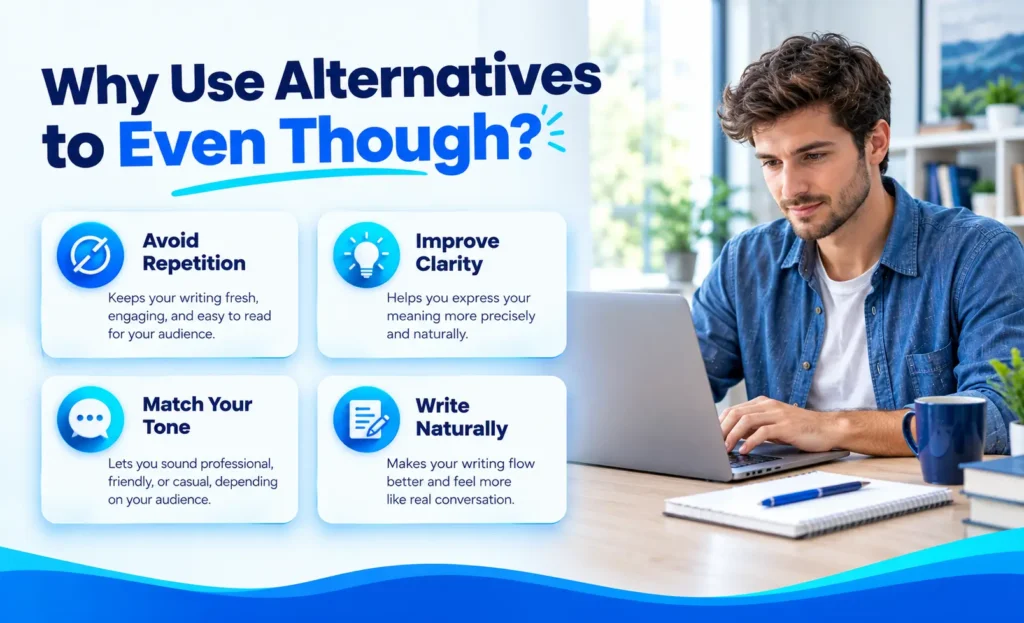

Using different expressions for contrast makes your writing more flexible and interesting. Some phrases sound professional, while others fit everyday conversations.
Here are the main benefits:
- Avoid repetition: Keep sentences from sounding too similar.
- Improve clarity: Show the relationship between contrasting ideas.
- Match your tone: Choose formal or casual wording.
- Strengthen writing: Create smoother transitions between thoughts.
- Improve communication: Express unexpected situations more precisely.
The key is choosing an alternative that fits both the meaning and grammar of your sentence.
12 Best Other Ways to Say “Even Though”

Here are 12 alternatives to “even though,” including close synonyms and related contrast expressions.
1. Although
Meaning: “Although” introduces a contrasting fact without strongly emphasizing the surprise. It is one of the closest substitutes for “even though.”
Best For: Professional, Formal, Polite
Example 1: Although the deadline was tight, our team finished the project.
Example 2: Although she felt nervous, she delivered an excellent presentation.
Quick Tip: Use “although” when you want a smooth, professional contrast.
2. Though
Meaning: “Though” expresses contrast in a simple, conversational way. It often sounds less formal than “although.”
Best For: Casual, Friendly
Example 1: Though I was tired, I stayed up to finish the movie.
Example 2: Though the restaurant was crowded, we found a table quickly.
Quick Tip: “Though” can also appear at the end of a sentence, unlike “even though.”
3. Despite the Fact That
Meaning: This expression introduces a fact that did not prevent another event. It creates a more formal contrast.
Best For: Formal, Professional
Example 1: Despite the fact that sales declined, the company remained profitable.
Example 2: Despite the fact that he lacked experience, he performed well.
Quick Tip: Use this phrase sparingly because “although” is often more concise.
4. In Spite of the Fact That
Meaning: This phrase emphasizes that something happened despite an obstacle. It is grammatically similar to “despite the fact that.”
Best For: Formal, Professional
Example 1: In spite of the fact that traffic was heavy, we arrived on time.
Example 2: In spite of the fact that funding was limited, the program continued.
Quick Tip: Shorten it to “in spite of” when a noun or an -ing phrase follows.
5. While
Meaning: “While” can introduce a contrast between two facts or opinions. It often presents differences in a balanced way.
Best For: Professional, Formal, Polite
Example 1: While the proposal has benefits, it also presents risks.
Example 2: While I appreciate your suggestion, I prefer the original plan.
Quick Tip: Make sure the context shows contrast rather than simultaneous actions.
6. Whereas
Meaning: “Whereas” highlights differences between two situations, people, or ideas. It is especially useful for direct comparisons.
Best For: Formal, Professional
Example 1: Whereas my brother enjoys city life, I prefer the countryside.
Example 2: Whereas the first design was simple, the second included more features.
Quick Tip: Choose “whereas” for comparisons, not every unexpected outcome.
7. Even If
Meaning: “Even if” introduces a possible or hypothetical condition. Unlike “even though,” it does not necessarily describe a known fact.
Best For: Casual, Friendly, Professional
Example 1: Even if it rains tomorrow, we’ll still attend the festival.
Example 2: Even if the interview feels difficult, stay confident.
Quick Tip: Use “even if” for possibilities and “even though” for established facts.
8. Despite
Meaning: “Despite” shows that an obstacle did not prevent something from happening. It must be followed by a noun, pronoun, or -ing phrase rather than a normal finite clause.
Best For: Professional, Formal
Example 1: Despite the cold weather, the children played outside.
Example 2: Despite feeling exhausted, Maria completed her assignment.
Quick Tip: Write “despite the rain,” not “despite it was raining.”
9. In Spite Of
Meaning: “In spite of” expresses contrast between a challenge and an outcome. It is close in meaning to “despite.”
Best For: Formal, Polite, Professional
Example 1: In spite of several setbacks, the business continued growing.
Example 2: In spite of his busy schedule, Daniel volunteered every weekend.
Quick Tip: Always include “of” after “in spite.”
10. Notwithstanding the Fact That
Meaning: This formal expression acknowledges a fact without allowing it to change the main statement. It appears most naturally in legal or highly formal writing.
Best For: Formal, Professional
Example 1: Notwithstanding the fact that objections were raised, the agreement remained valid.
Example 2: Notwithstanding the fact that expenses increased, the organization met its goals.
Quick Tip: Avoid this lengthy phrase in everyday emails.
11. Nevertheless
Meaning: “Nevertheless” connects contrasting statements and emphasizes that something remains true. It works as a transition rather than a direct grammatical replacement.
Best For: Formal, Professional
Example 1: The task was challenging. Nevertheless, the team completed it successfully.
Example 2: The hotel was expensive. Nevertheless, we enjoyed our stay.
Quick Tip: Use a period or semicolon before “nevertheless” when connecting independent clauses.
12. Nonetheless
Meaning: “Nonetheless” means that something remains true despite a contrasting situation. It is similar to “nevertheless” and suits thoughtful, polished writing.
Best For: Professional, Formal
Example 1: The instructions were confusing. Nonetheless, everyone completed the exercise.
Example 2: The journey took longer than expected. Nonetheless, the trip was worthwhile.
Quick Tip: Use “nonetheless” to connect complete thoughts, not as a conjunction before a dependent clause.
Comparison Table

| Alternative | Best Used In | Tone |
|---|---|---|
| Although | Essays, emails | Neutral, professional |
| Though | Conversations, messages | Casual, friendly |
| Despite the fact that | Reports, formal writing | Formal |
| In spite of the fact that | Detailed explanations | Formal |
| While | Balanced arguments | Polite, professional |
| Whereas | Direct comparisons | Formal |
| Even if | Hypothetical situations | Casual, neutral |
| Despite | Concise written statements | Professional |
| In spite of | Challenges and outcomes | Neutral, formal |
| Notwithstanding the fact that | Legal documents | Highly formal |
| Nevertheless | Essays, business reports | Formal |
| Nonetheless | Reports, academic writing | Professional |
Common Mistakes When Replacing “Even Though”

1. Confusing “Even Though” With “Even If”
“Even though” introduces a fact, while “even if” introduces a possible condition. Using them interchangeably can change your meaning.
2. Using “Despite” With an Incorrect Clause
Avoid writing “despite she was tired.” Instead, write “despite being tired” or “although she was tired.”
3. Choosing Overly Formal Expressions
Phrases such as “notwithstanding the fact that” can make simple conversations sound unnatural. Choose straightforward wording when possible.
4. Treating Transitions as Conjunctions
“Nevertheless” and “nonetheless” cannot directly replace “even though” in the same sentence structure. They normally connect independent statements.
5. Adding Unnecessary Contrast Words
Avoid combinations such as “although it was raining, but we continued.” Use either “although” or “but,” not both in that construction.
Frequently Asked Questions
1. What’s another way to say even though in a sentence?
“Although” and “though” are the most direct alternatives. For example, “Even though she was tired, she continued working” becomes “Although she was tired, she continued working.” Both sentences express the same contrast, although “even though” places slightly more emphasis on the unexpected outcome.
2. What is a formal synonym for even though?
“Although” is usually the best formal synonym for “even though.” You can also use “despite the fact that” or “notwithstanding the fact that” in certain contexts. However, shorter expressions often sound clearer and more professional, especially in business emails, academic assignments, and reports.
3. Can I use although instead of even though?
Yes, “although” can replace “even though” in most sentences without changing the basic meaning. Both introduce contrasting facts. However, “even though” usually adds stronger emphasis to the contrast. Choose “although” for a neutral statement and “even though” when the result seems especially surprising.
4. What is the difference between even though and though?
Both expressions introduce contrast, but “even though” typically emphasizes a surprising situation more strongly. “Though” sounds more conversational and can also appear at the end of a sentence. For example, “The food was expensive. It tasted great, though” is natural in casual American English.
5. Is despite another way to say even though?
Yes, “despite” communicates a similar contrast, but it requires different grammar. You can write “Even though it was cold, we went outside” or “Despite the cold, we went outside.” You cannot simply replace “even though” with “despite” without adjusting the words that follow.
6. Can you start a sentence with even though?
Yes, starting a sentence with “even though” is grammatically correct. For example, “Even though the store was closing, the cashier helped us.” When the dependent clause comes first, place a comma after it. This structure is common in professional writing, essays, and everyday communication.
7. What can I use instead of even though in an essay?
“Although,” “while,” and “whereas” are useful choices for essays, depending on the intended meaning. “Although” introduces a concession, while “whereas” makes a comparison. “Nevertheless” and “nonetheless” can also connect contrasting ideas, but they require different sentence structures and punctuation.
8. Are nevertheless and even though interchangeable?
Not directly. “Even though” introduces a dependent clause, while “nevertheless” usually connects independent statements. For example, “Even though the test was difficult, I passed” can become “The test was difficult. Nevertheless, I passed.” Both express contrast, but their grammar and punctuation are different.
Conclusion
Finding another way to say “even though” helps you express contrasting ideas with greater clarity and variety. The best alternative depends on your audience, sentence structure, and the strength of the contrast you want to communicate.
For everyday conversations, “though” sounds friendly and natural. In professional emails and academic writing, “although” is usually the safest choice. If you want to describe an obstacle, “despite” and “in spite of” are useful alternatives.
For direct comparisons, consider “whereas” or “while.” Meanwhile, “nevertheless” and “nonetheless” work well when connecting separate statements.
Remember that not every contrast expression follows the same grammar rules. Always check your sentence after replacing the original phrase.
The best takeaway: Choose an alternative that preserves your intended meaning while making your sentence sound clear, natural, and appropriate for the situation.

The Majestic Studio Editorial Team creates practical resources about synonyms, alternative phrases, vocabulary, and English usage. Our content is designed to help readers choose clearer, more natural words and communicate effectively in everyday, professional, and academic contexts.
Each article is researched, edited, and reviewed for clarity, context, usefulness, and language accuracy. We regularly update our content to keep examples and recommendations relevant.