

Saying goodbye is a natural part of everyday life, but the right words can make a farewell more meaningful. Whether you’re leaving a workplace, ending a conversation, writing a professional email, or saying goodbye to a loved one, there are many alternatives to “farewell.” The best choice depends on your relationship, the situation, and the tone you want to express.
Key Takeaways
- “Take care” is a warm, natural choice for everyday goodbyes.
- “Goodbye for now” works well when you expect to see someone again.
- “Until we meet again” adds a sentimental or formal touch.
- “Best wishes” suits professional messages and meaningful transitions.
- Choose a farewell that matches your relationship, setting, and intended message.
What Does “Another Way to Say Farewell” Mean?
Another way to say farewell is an alternative expression used when parting from someone. These expressions can communicate politeness, affection, respect, gratitude, or the hope of meeting again.
People use different farewell phrases in everyday conversations, workplace emails, retirement speeches, travel messages, and special occasions. Some sound casual and friendly, while others feel formal or emotional.
Why Use Other Ways to Say Farewell?

Choosing an alternative to “farewell” helps you communicate more naturally and express the right emotion. Although the word is correct, it can sometimes sound formal, old-fashioned, or more serious than the situation requires.
Here are a few reasons to choose a different expression:
- Avoid repetition: Make conversations and written messages sound more natural.
- Match the occasion: Choose words that fit a casual goodbye or a formal departure.
- Express warmth: Show care and appreciation when someone leaves.
- Improve professional communication: End emails and workplace conversations politely.
- Communicate your feelings: Make a goodbye feel sincere, hopeful, or memorable.
12 Best Other Ways to Say Farewell

1. Goodbye
Meaning
“Goodbye” is a common and direct way to end a conversation or part from someone. It works in almost any setting, making it one of the most useful alternatives to “farewell.”
Best For: Professional, Formal, Casual, Polite
Example 1: “Thank you for your time today. Goodbye, and have a wonderful afternoon.”
Example 2: “It was lovely catching up with everyone before I left. Goodbye!”
Quick Tip: Use “goodbye” when you want a clear, familiar expression that works across different situations.
2. Take Care
Meaning
“Take care” expresses concern for someone’s well-being as you part ways. It sounds friendly and thoughtful without being overly emotional, making it suitable for both personal conversations and informal professional exchanges.
Best For: Casual, Friendly, Warm, Polite
Example 1: “I enjoyed working with you on this project. Take care, and good luck with everything!”
Example 2: “The roads might be icy tonight, so take care on your drive home.”
Quick Tip: Choose this phrase when you want your goodbye to communicate genuine care.
3. See You Later
Meaning
“See you later” is an informal expression that suggests you expect to see the other person again. It is common among friends, coworkers, classmates, and family members.
Best For: Casual, Friendly
Example 1: “I’m heading out to grab lunch. See you later at the office!”
Example 2: “Thanks for stopping by to help with the decorations. See you later!”
Quick Tip: Use this expression when you expect another meeting or conversation, rather than when saying a final goodbye.
4. Until We Meet Again

Meaning
“Until we meet again” is a sentimental expression that emphasizes the possibility of reconnecting in the future. It often carries more emotional weight than everyday goodbyes and works well for meaningful departures.
Best For: Formal, Warm, Friendly
Example 1: “Your friendship has meant so much to our family. Until we meet again, may life bring you happiness.”
Example 2: “As our exchange program comes to an end, I wish every student success until we meet again.”
Quick Tip: Save this phrase for important occasions, farewells, or heartfelt messages where a memorable tone feels appropriate.
5. Best Wishes
Meaning
“Best wishes” communicates goodwill and hope for someone’s future. It is especially useful when a colleague changes jobs, a friend moves away, or someone begins an exciting new chapter.
Best For: Professional, Formal, Warm, Polite
Example 1: “Congratulations on your new position at the company. Best wishes for continued success.”
Example 2: “We’re going to miss having you in our neighborhood. Best wishes for your new home in Seattle!”
Quick Tip: Pair “best wishes” with a specific reference to the person’s next step to make the message more personal.
6. Have a Good Day
Meaning
“Have a good day” is a polite, upbeat way to end a brief interaction. It is especially common in customer service, business conversations, shops, and everyday exchanges.
Best For: Professional, Casual, Friendly, Polite
Example 1: “I’ve emailed the updated invoice for your records. Have a good day!”
Example 2: “Thanks for helping me find the right size. Have a good day!”
Quick Tip: This phrase works best for routine interactions rather than emotional or permanent farewells.
7. Catch You Later
Meaning
“Catch you later” is a relaxed, conversational way to say goodbye. It sounds casual and familiar, so it is best suited to people who already have a comfortable relationship.
Best For: Casual, Friendly
Example 1: “I’m going to finish these errands before dinner. Catch you later!”
Example 2: “The game starts in an hour, so I need to get going. Catch you later at the stadium.”
Quick Tip: Avoid this expression in formal business emails or when speaking to someone you do not know well.
8. Farewell for Now
Meaning
“Farewell for now” combines the traditional tone of “farewell” with the idea that the separation may not be permanent. It is useful when someone leaves for a period of time or when a group expects to reconnect.
Best For: Formal, Warm, Polite
Example 1: “My six-month assignment in Boston is complete. Farewell for now, and thank you for making me feel welcome.”
Example 2: “This is the final meeting of our volunteer group this year. Farewell for now, everyone!”
Quick Tip: Use this expression when you want a thoughtful goodbye that leaves room for future contact.
9. All the Best
Meaning
“All the best” is a friendly, concise way to express good wishes as someone moves on. It works in spoken conversations, farewell cards, and professional messages without sounding overly formal.
Best For: Professional, Friendly, Warm, Polite
Example 1: “Thank you for sharing your expertise with our team. All the best in your next role!”
Example 2: “I heard you’re opening your own bakery. All the best with your exciting new business.”
Quick Tip: Add a short personal sentence before this phrase when you want your goodbye to feel more sincere.
10. See You Soon
Meaning
“See you soon” expresses the expectation or hope of meeting someone again in the near future. It is warmer than a simple goodbye and works well when another visit or meeting is likely.
Best For: Casual, Friendly, Warm
Example 1: “I’m flying back home tomorrow, but I’ll visit again during the holidays. See you soon!”
Example 2: “Thanks for joining our book club tonight. See you soon at next month’s meeting.”
Quick Tip: Use this phrase when another meeting is reasonably likely, or when you genuinely hope to reconnect soon.
11. Until Next Time
Meaning
“Until next time” is a versatile farewell that acknowledges the current interaction while looking forward to another one. It is particularly useful for recurring events, regular meetings, and ongoing professional relationships.
Best For: Professional, Casual, Friendly, Polite
Example 1: “That wraps up today’s training session. Thank you for participating, and until next time!”
Example 2: “We had a great weekend exploring the coast together. Until next time, friends!”
Quick Tip: Use this phrase to close an event, presentation, or conversation when future contact is expected.
12. It Was a Pleasure
Meaning
“It was a pleasure” expresses appreciation for the time spent with another person. It is a polished way to end a meeting or professional interaction while leaving a positive impression.
Best For: Professional, Formal, Polite, Warm
Example 1: “Thank you for discussing the proposal with me. It was a pleasure meeting you.”
Example 2: “Working with your department on the annual fundraiser was a rewarding experience. It was a pleasure collaborating with you.”
Quick Tip: Mention the meeting, collaboration, or experience that you appreciated to make this expression feel genuine.
Comparison Table

| Alternative | Best Used In | Tone |
|---|---|---|
| Goodbye | Everyday conversations | Neutral |
| Take Care | Personal goodbyes | Warm |
| See You Later | Informal conversations | Casual |
| Until We Meet Again | Meaningful departures | Sentimental |
| Best Wishes | Career changes and life events | Supportive |
| Have a Good Day | Customer service and routine exchanges | Polite |
| Catch You Later | Friends and familiar coworkers | Relaxed |
| Farewell for Now | Temporary departures | Thoughtful |
| All the Best | Professional and personal messages | Encouraging |
| See You Soon | Expected future meetings | Friendly |
| Until Next Time | Recurring events and meetings | Upbeat |
| It Was a Pleasure | Business meetings and introductions | Professional |
Common Mistakes When Saying Farewell
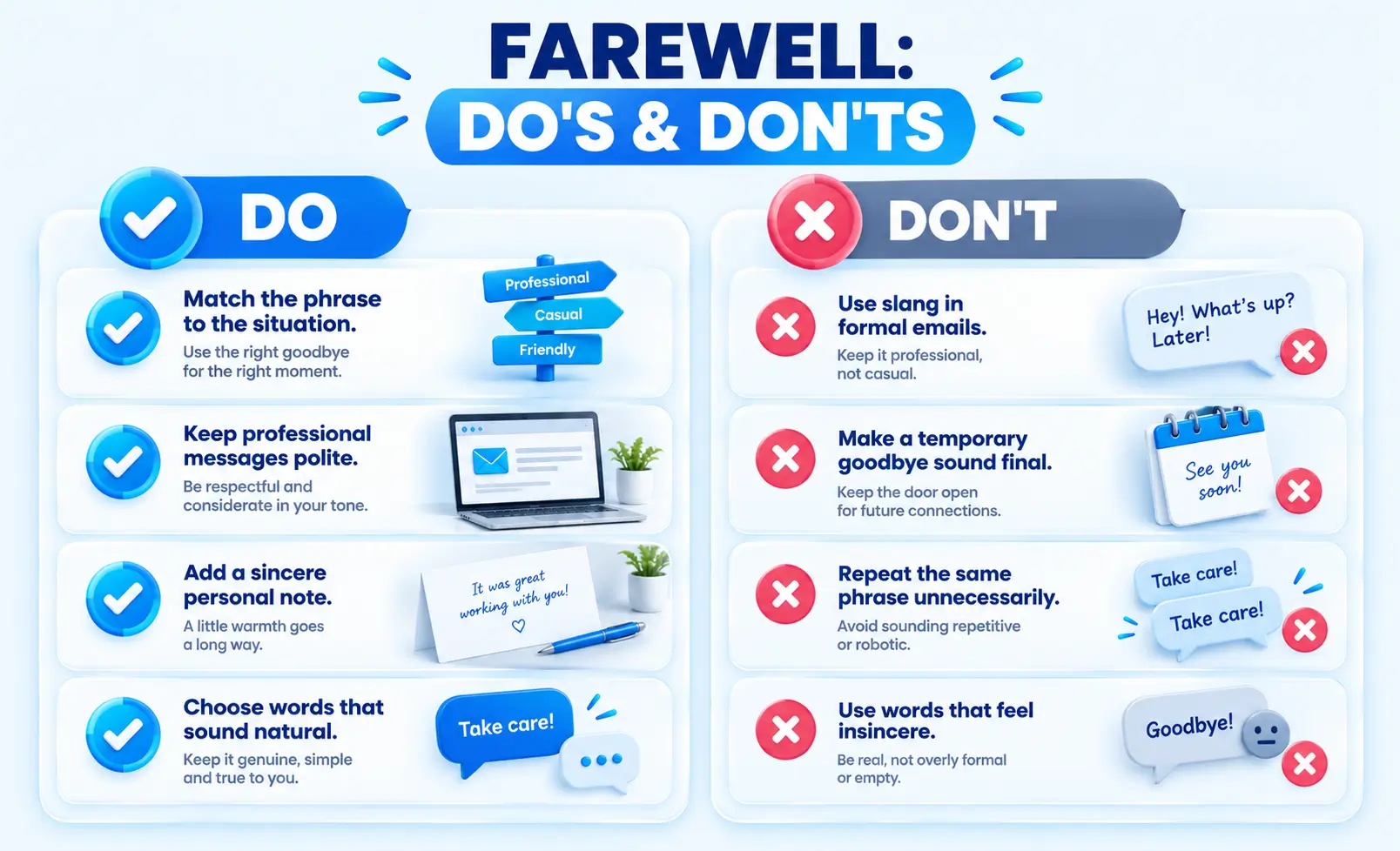
Choosing the right expression is about more than finding a synonym. The setting and your relationship with the other person matter, too.
- Using casual phrases in professional emails. Expressions such as “catch you later” may sound too relaxed when writing to a new client or senior manager. Choose “best wishes” or a polite closing instead.
- Choosing overly formal language. Saying “farewell” during a quick conversation with a close friend can feel unnecessarily serious. A simple “see you later” may sound more natural.
- Repeating the same phrase. Ending every email or conversation with identical wording can feel mechanical. Vary your language when the situation allows, but prioritize clarity over variety.
- Ignoring the context. “See you soon” suggests another meeting, while a permanent departure may call for different wording. Select a phrase that reflects the actual circumstances.
- Sounding insincere. A generic expression may feel impersonal when someone is leaving after years of working together. Include a specific thank-you or positive memory to show that you mean what you say.
Frequently Asked Questions
1. What is another way to say farewell?
Popular alternatives include “goodbye,” “take care,” “best wishes,” “all the best,” and “until we meet again.” The best option depends on your situation. For everyday conversations, “take care” sounds natural, while “best wishes” is useful for professional departures and important life changes.
2. What is a professional way to say farewell?
Professional alternatives include “best wishes,” “all the best,” “it was a pleasure working with you,” and “wishing you continued success.” These expressions help you end workplace conversations or emails on a positive note. Choose wording that reflects your relationship with the recipient and the purpose of your message.
3. What is a formal synonym for farewell?
“Goodbye,” “until we meet again,” and “best wishes” can work in formal situations, depending on the context. “Farewell” itself is also appropriate for official speeches and ceremonial occasions. For business correspondence, a phrase such as “It was a pleasure working with you” often sounds more natural and specific.
4. How do you say farewell to a coworker?
You can say, “It’s been great working with you,” “Wishing you success in your next role,” or “All the best in your new position.” If you have worked closely together, add a personal note about what you appreciated. A specific message usually feels more meaningful than a generic goodbye.
5. What is a warm and heartfelt way to say farewell?
“Until we meet again,” “take care of yourself,” and “I’ll miss you” can express affection and sadness. The best choice depends on how close you are to the person and whether the separation is temporary. Adding a sincere memory, thank-you, or expression of hope can make your farewell more personal.
6. How do you say goodbye without using the word goodbye?
Try “take care,” “see you later,” “until next time,” or “have a wonderful day.” These expressions communicate that the conversation is ending without using the word “goodbye.” For a professional message, “all the best” is another useful choice that sounds polished without being stiff.
7. Is “farewell” more formal than “goodbye”?
Generally, yes. “Farewell” often sounds more formal, ceremonial, or emotional than “goodbye,” especially in speeches, retirement celebrations, and major life transitions. However, context matters. “Goodbye” can also carry deep emotion, while “farewell” may sound natural in a written tribute or formal announcement.
8. What is a good farewell message for someone leaving?
A good farewell message combines appreciation, encouragement, and a positive closing. For example, you might thank the person for their support and wish them success in their next chapter. For a coworker, mention a contribution you valued. For a friend, share a meaningful memory or express your hope to meet again.
Conclusion
Finding another way to say farewell helps you communicate with greater warmth, clarity, and confidence. Although “farewell” works well for formal occasions and meaningful departures, other expressions can sound more natural in everyday conversations and professional settings.
Choose “take care” when you want to express concern, “see you later” when another meeting is likely, and “best wishes” when someone is beginning a new chapter. For workplace conversations, “all the best” and “it was a pleasure working with you” can leave a positive impression. Meanwhile, “until we meet again” is a thoughtful choice for a more emotional goodbye.
Most importantly, consider your relationship with the other person and the reason for the separation. A simple phrase can be powerful when it fits the moment. Add a sincere thank-you or personal message when appropriate, and your farewell will feel more genuine and memorable.

The Majestic Studio Editorial Team creates practical resources about synonyms, alternative phrases, vocabulary, and English usage. Our content is designed to help readers choose clearer, more natural words and communicate effectively in everyday, professional, and academic contexts.
Each article is researched, edited, and reviewed for clarity, context, usefulness, and language accuracy. We regularly update our content to keep examples and recommendations relevant.