

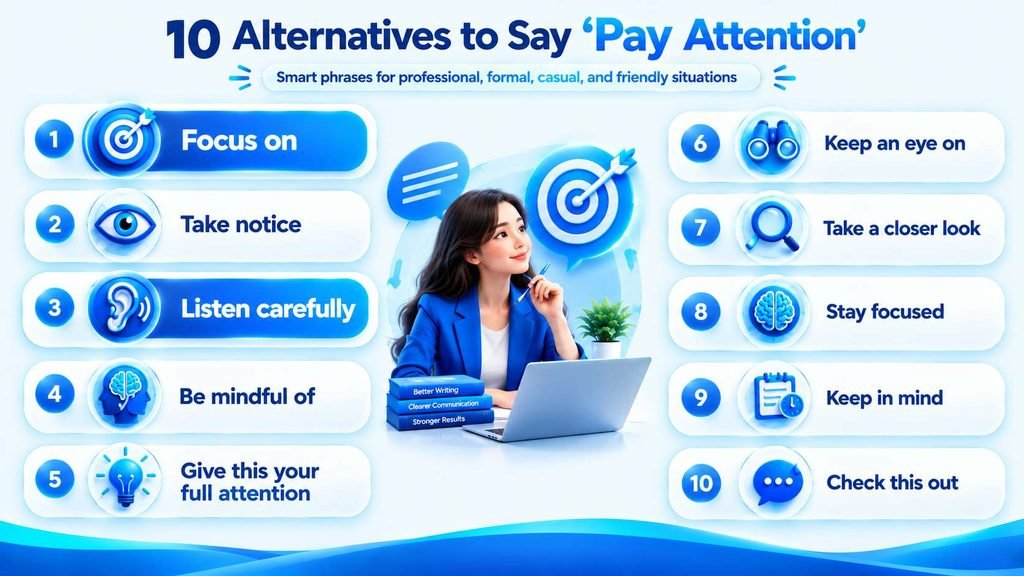
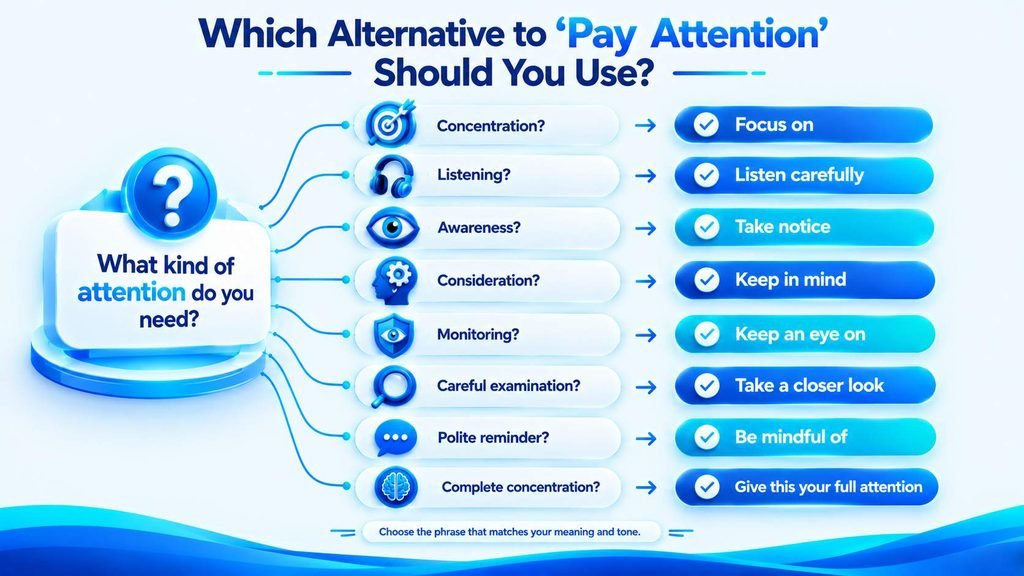
Another way to say “pay attention” depends on the situation and tone. Common alternatives include “take notice,” “listen carefully,” “focus on,” “keep an eye on,” and “be mindful of.” Use formal phrases such as “give this your full attention” in professional settings and casual options such as “check this out” with friends.
Key Takeaways
- “Pay attention” can be replaced with phrases that sound more polite, formal, friendly, or direct.
- “Focus on” works well when someone needs to concentrate on a specific task.
- “Listen carefully” is best when the speaker wants someone to hear and understand information.
- “Be mindful of” offers a softer and more polite way to request attention.
- The best alternative depends on your audience, purpose, and level of formality.
What Does “Another Way to Say Pay Attention” Mean?
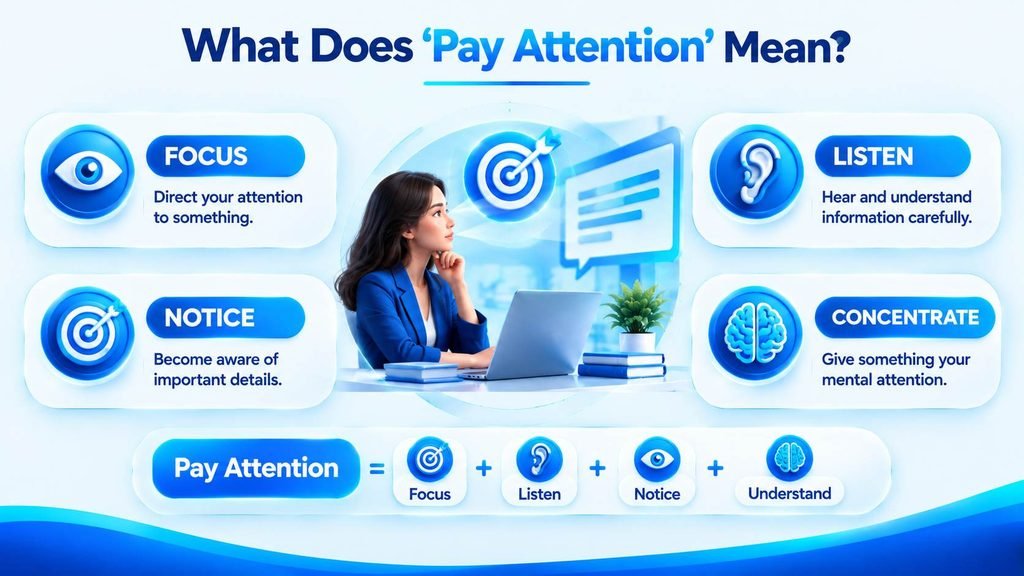
The phrase “pay attention” means to focus on something carefully so you can notice, understand, or remember it. People commonly use it when asking someone to concentrate on a conversation, instruction, warning, task, or important detail.
For example, a teacher might say, “Please pay attention to these instructions,” while a manager may use the phrase during an important meeting.
Looking for another way to say “pay attention” usually means you want a phrase that sounds more natural, polite, professional, or specific to the situation.
Why Use Other Ways to Say “Pay Attention”?
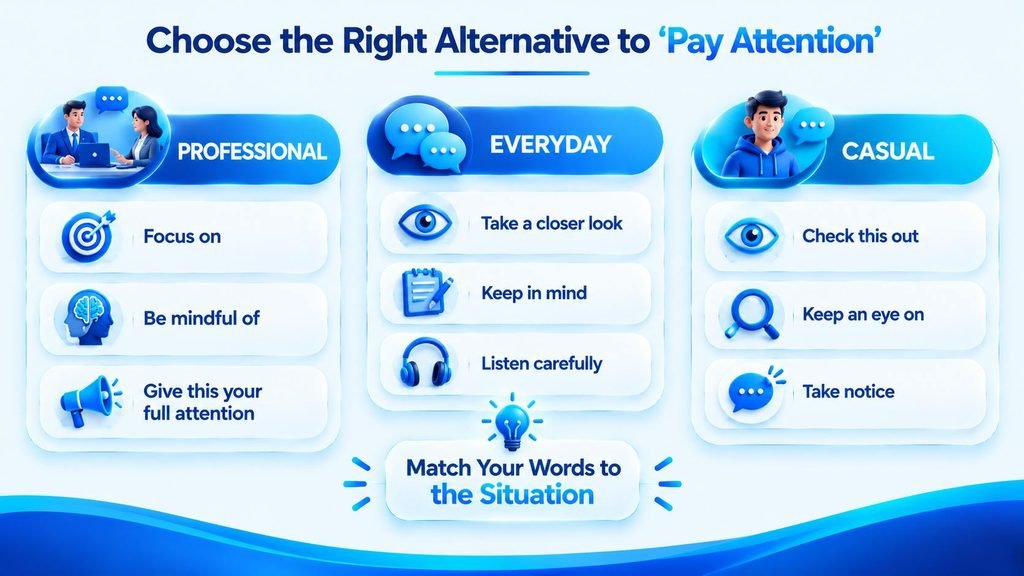
Although “pay attention” is clear and correct, repeating it can make your communication sound predictable or too direct.
Using alternatives can help you:
- Avoid repeating the same phrase.
- Sound more natural in everyday conversations.
- Make requests more polite.
- Match professional or formal situations.
- Communicate urgency without sounding rude.
- Choose words that better fit the context.
The key is not simply finding a synonym. It is choosing an expression that communicates the right level of attention and tone.
10 Best Other Ways to Say “Pay Attention”
1. Focus on
Meaning
“Focus on” means to direct your attention toward one particular person, task, subject, or detail. It is one of the most natural alternatives because it clearly tells someone where their attention should go.
Best For
- Professional
- Formal
- Casual
- Polite
Example 1
Please focus on the main points before reviewing the smaller details.
Example 2
If you want to improve your presentation, focus on speaking clearly and confidently.
Quick Tip
Use “focus on” when you want to identify what someone should concentrate on.
2. Take Notice
Meaning
“Take notice” means to become aware of or deliberately observe something. It works especially well when you want someone to recognize an important change, detail, or situation.
Best For
- Formal
- Professional
- Polite
Example 1
Please take notice of the updated deadline before submitting your application.
Example 2
Customers began to take notice when the company introduced its new service.
Quick Tip
Use “take notice” when awareness matters more than deep concentration.
3. Listen Carefully
Meaning
“Listen carefully” asks someone to give close attention to what another person is saying. It is particularly useful during instructions, conversations, lessons, presentations, and important announcements.
Best For
- Professional
- Formal
- Polite
- Friendly
Example 1
Listen carefully because the next step is slightly different from the previous one.
Example 2
I explained the process twice, so please listen carefully to the final instructions.
Quick Tip
Choose this phrase when the attention you need involves hearing and understanding spoken information.
4. Be Mindful Of
Meaning
“Be mindful of” is a softer way to ask someone to remain aware of something. It often communicates consideration rather than giving a strong command.
Best For
- Professional
- Formal
- Warm
- Polite
Example 1
Please be mindful of the time when preparing your presentation.
Example 2
Be mindful of other guests when using the shared workspace.
Quick Tip
Use this expression when you want your request to sound respectful and considerate.
5. Give This Your Full Attention
Meaning
“Give this your full attention” means to stop focusing on other things and concentrate completely on the matter at hand. It is stronger than simply saying “pay attention.”
Best For
- Professional
- Formal
- Polite
Example 1
This safety briefing is important, so please give it your full attention.
Example 2
Before we begin the discussion, I need everyone to give this their full attention.
Quick Tip
Use this phrase when the information is important and requires complete concentration.
6. Keep an Eye On
Meaning
“Keep an eye on” means to watch or monitor something carefully. Unlike “pay attention,” it often suggests continuing to watch something over a period of time.
Best For
- Casual
- Friendly
- Professional
- Polite
Example 1
Could you keep an eye on the oven while I answer the phone?
Example 2
Our team will keep an eye on the website for any unusual activity.
Quick Tip
Use this phrase when someone needs to monitor something rather than simply concentrate on it once.
7. Take a Closer Look
Meaning
“Take a closer look” encourages someone to examine something more carefully. It is useful when an important detail might not be obvious at first glance.
Best For
- Professional
- Casual
- Friendly
- Polite
Example 1
Take a closer look at the contract before you sign it.
Example 2
If the numbers seem unusual, take a closer look at the monthly report.
Quick Tip
This is a strong choice when you want someone to examine visual information, documents, data, or details.
8. Stay Focused
Meaning
“Stay focused” means to continue concentrating without becoming distracted. It is commonly used for work, studying, sports, projects, and other tasks that require sustained attention.
Best For
- Professional
- Casual
- Friendly
- Motivational
Example 1
We are almost finished, so stay focused and check the final section carefully.
Example 2
Stay focused during the exam and manage your time wisely.
Quick Tip
Use “stay focused” when someone is already concentrating but needs encouragement to continue.
9. Keep in Mind
Meaning
“Keep in mind” means to remember or consider something while making a decision or doing a task. It is less direct than “pay attention” and often sounds more conversational.
Best For
- Professional
- Formal
- Casual
- Polite
Example 1
Keep in mind that delivery times may change during the holiday season.
Example 2
When choosing a laptop, keep in mind how often you will travel with it.
Quick Tip
Use this phrase when you want someone to remember an important factor, rather than simply observe it.
10. Check This Out
Meaning
“Check this out” is a casual way to ask someone to look at or consider something interesting. It sounds friendly and enthusiastic, making it a poor fit for highly formal communication but a great choice with friends and coworkers in relaxed settings.
Best For
- Casual
- Friendly
- Warm
Example 1
Check this out—I found a much easier way to organize the files.
Example 2
You have to check this out; the new design looks incredible.
Quick Tip
Save this expression for relaxed conversations, social media, texts, or informal workplace communication.
Comparison Table
| Alternative | Best Used In | Tone |
| Focus on | Work, school, everyday communication | Direct and clear |
| Take notice | Formal writing, announcements | Formal and attentive |
| Listen carefully | Conversations, instructions, lessons | Direct and polite |
| Be mindful of | Workplace, public settings | Respectful and considerate |
| Give this your full attention | Meetings, warnings, important discussions | Serious and professional |
| Keep an eye on | Monitoring tasks, everyday situations | Casual and practical |
| Take a closer look | Documents, designs, reports | Helpful and specific |
| Stay focused | Work, studying, projects | Motivational |
| Keep in mind | Advice, decisions, instructions | Conversational and polite |
| Check this out | Friends, casual conversations | Friendly and enthusiastic |
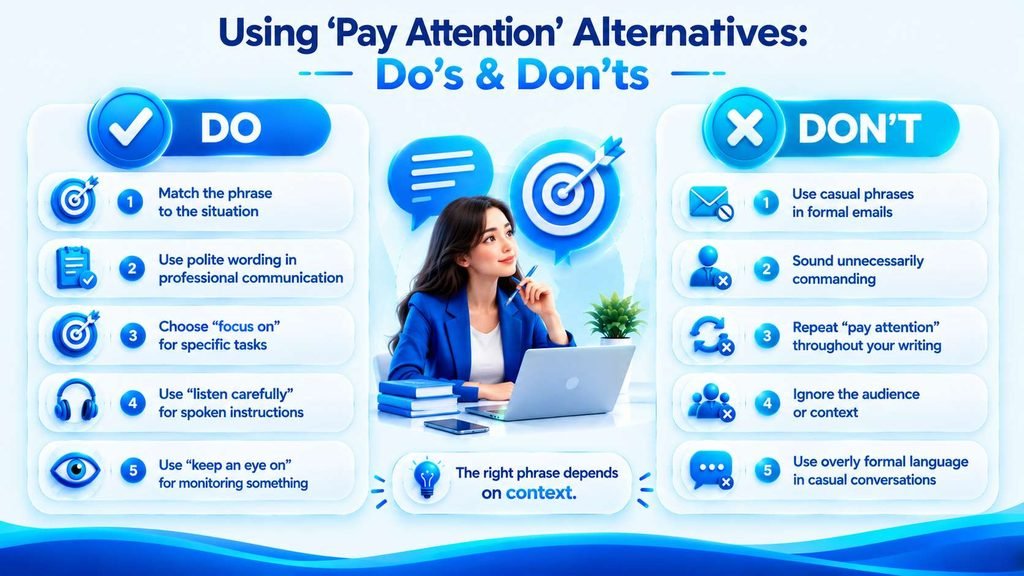
Common Mistakes
1. Using Casual Phrases in Professional Emails
Expressions such as “check this out” may sound too informal in a business email. Choose “take a closer look” or “please review” when communicating professionally.
2. Choosing Overly Formal Language
Not every situation requires formal wording. Saying “give this your full attention” to a close friend may sound unnecessarily serious when “check this out” would feel more natural.
3. Repeating the Same Phrase
Using “pay attention” several times in the same message can make your writing feel repetitive. Select alternatives based on the specific type of attention you need.
4. Forgetting the Context
“Listen carefully” applies to spoken information, while “keep an eye on” usually means monitoring something. A phrase can be grammatically correct but still fail to express your intended meaning.
5. Sounding Insincere or Too Commanding
Some alternatives can sound forceful if used without care. In professional situations, softer expressions such as “please be mindful of” can make a request feel more respectful.
Frequently Asked Questions
What is a professional way to say “pay attention”?
A professional way to say “pay attention” is “please focus on,” “please take note of,” or “please give this your full attention.” These phrases work well in emails, meetings, presentations, and workplace instructions. “Please focus on” is especially useful when you need someone to concentrate on a specific task or subject.
What is a polite way to say “pay attention”?
“Please be mindful of” is one of the politest alternatives to “pay attention.” It sounds respectful and avoids the commanding tone that “pay attention” can sometimes have. “Please take a closer look” is another good choice when you want someone to examine a particular detail or document.
What is a casual way to say “pay attention”?
In casual American English, you can say “check this out,” “look at this,” “listen up,” or “keep an eye on this.” The right option depends on what you want the person to do. “Check this out” sounds enthusiastic, while “listen up” is more direct.
Can I use “focus on” instead of “pay attention”?
Yes. “Focus on” is one of the closest and most versatile alternatives to “pay attention.” However, it usually identifies a specific subject or task. For example, “Focus on the instructions” tells someone exactly where to direct their attention.
What is another way to say “pay attention” in an email?
For a professional email, try “please take note of,” “please review,” “please be mindful of,” or “please give this your attention.” Your choice should match the purpose. “Please review” works well for documents, while “please take note of” is useful for important information or changes.
How do you say “pay attention” without sounding rude?
Use a polite request rather than a command. Phrases such as “please take a closer look,” “please keep in mind,” and “please be mindful of” can communicate the same idea more gently. Adding “please” can also soften a direct request in professional and everyday conversations.
What is another word for paying attention?
Depending on the context, words and phrases related to paying attention include concentrating, listening, noticing, observing, focusing, monitoring, and being aware. Each has a slightly different meaning. For example, “observing” suggests watching carefully, while “concentrating” emphasizes mental focus.
What is a stronger way to say “pay attention”?
If you need to emphasize urgency, say “give this your full attention,” “listen carefully,” or “focus closely on this.” These expressions communicate that the information deserves immediate or complete concentration. In serious situations, choose direct wording that clearly communicates why attention is necessary.
Conclusion
There are many effective alternatives to “pay attention,” but the best choice depends on your audience and situation. For professional communication, “focus on,” “be mindful of,” and “give this your full attention” are clear and polished options.
For everyday conversations, “keep an eye on,” “take a closer look,” and “check this out” can sound more natural. If someone needs to hear and understand spoken information, “listen carefully” is more precise than a general request to pay attention.
The goal is not simply to replace one phrase with another. Choose language that explains the kind of attention you need while matching the right tone. A well-chosen phrase can make your communication clearer, more natural, and more respectful.

Editorial contributors help develop practical English-language resources covering vocabulary, expressions, synonyms, and writing. Contributions focus on clear explanations, useful examples, and context so readers can understand not only what a phrase means, but when and how to use it naturally.