

Another way to say “work smarter, not harder” includes “work more efficiently,” “maximize productivity,” “focus on high-impact tasks,” and “work more strategically.” These phrases communicate the idea of getting better results through efficient planning, prioritization, automation, and focused effort rather than simply working longer or harder.
Key Takeaways
- “Work smarter, not harder” means improving results through efficiency and strategy.
- “Work more efficiently” is a simple choice for most professional situations.
- “Focus on high-impact tasks” works well when discussing priorities.
- More formal alternatives include “optimize your workflow” and “maximize productivity.”
- Choose your wording based on your audience, tone, and specific situation.
What Does “Another Way to Say Work Smarter Not Harder” Mean?
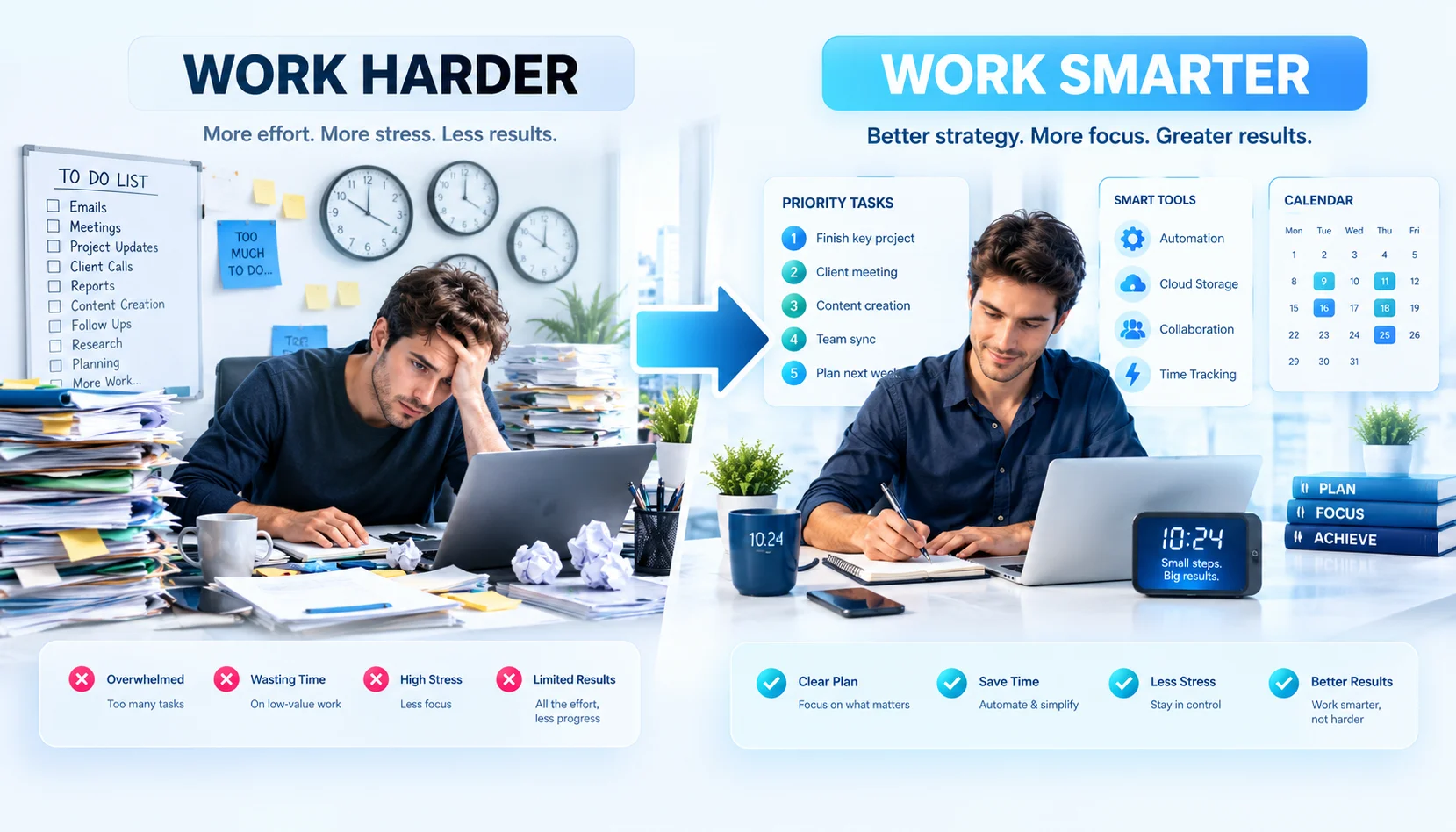
“Work smarter, not harder” means finding more effective ways to complete tasks instead of relying only on extra time or effort. The phrase encourages people to use planning, technology, delegation, prioritization, and better systems to improve results.
People commonly use it at work, in business, education, productivity discussions, and personal development. Because the phrase is familiar and somewhat casual, writers often look for alternatives that sound more professional, specific, or natural.
The best replacement depends on what you want to emphasize. You might focus on efficiency, strategy, productivity, priorities, or better use of resources.
Why Use Other Ways to Say “Work Smarter Not Harder”?

Using a different phrase can make your writing more precise and better suited to the situation.
You may want an alternative to:
- Avoid repeating a familiar expression.
- Sound more professional in workplace communication.
- Explain the idea in clearer, simpler language.
- Match a formal, friendly, or casual tone.
- Emphasize efficiency, strategy, or productivity.
- Make advice sound more specific and actionable.
12 Best Other Ways to Say “Work Smarter Not Harder”
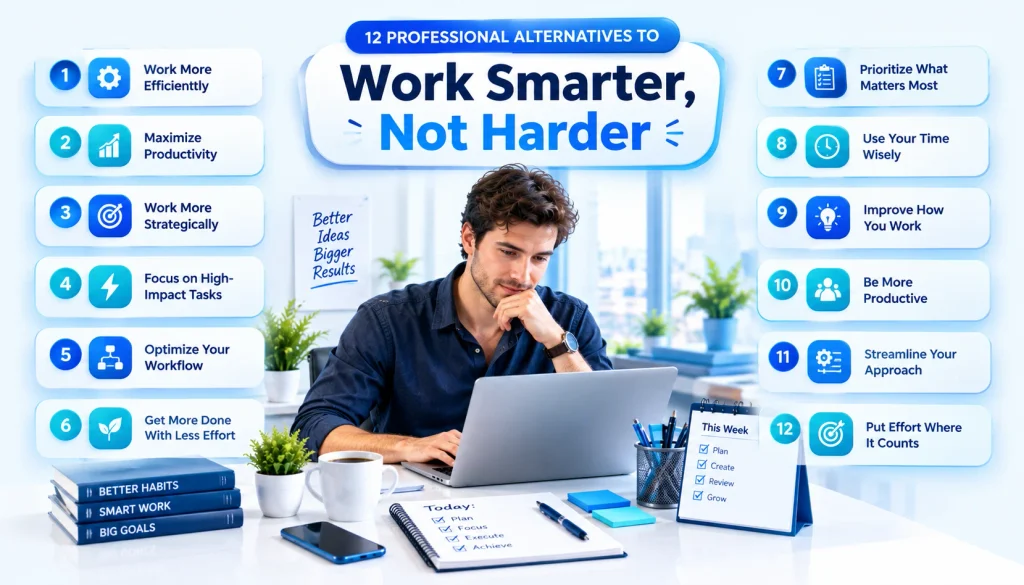
1. Work More Efficiently
Meaning
“Work more efficiently” focuses on completing work with less wasted time, effort, or resources. It is one of the closest and most natural alternatives to the original phrase.
Best For
Professional, Formal, Polite
Example 1
Our new scheduling system helps the team work more efficiently.
Example 2
She reorganized her daily routine so she could work more efficiently.
Quick Tip
Use this phrase when you want a clear, professional replacement without changing the original meaning too much.
2. Maximize Productivity
Meaning
“Maximize productivity” emphasizes getting the greatest useful output from available time and resources. It sounds more business-focused than “work smarter, not harder.”
Best For
Professional, Formal
Example 1
The department introduced new software to maximize productivity.
Example 2
Taking short breaks can help employees maximize productivity throughout the afternoon.
Quick Tip
This works especially well in business reports, workplace presentations, and productivity articles.
3. Work More Strategically
Meaning
“Work more strategically” suggests thinking carefully about goals, priorities, and methods before taking action. It highlights planning rather than simply increasing effort.
Best For
Professional, Formal
Example 1
Instead of responding to every request immediately, try to work more strategically.
Example 2
The manager encouraged the team to work more strategically during the busy season.
Quick Tip
Choose this option when your message is about planning, priorities, or long-term results.
4. Focus on High-Impact Tasks
Meaning
This phrase means spending more time on activities that produce meaningful results. It shifts attention away from busywork and toward important goals.
Best For
Professional, Formal
Example 1
Start each morning by focusing on high-impact tasks before checking routine messages.
Example 2
The team reduced meetings so employees could focus on high-impact tasks.
Quick Tip
Use this wording when you want to connect productivity with prioritization.
5. Optimize Your Workflow
Meaning
“Optimize your workflow” means improving the way tasks move from start to finish. It can involve removing unnecessary steps, using better tools, or changing inefficient processes.
Best For
Professional, Formal
Example 1
We need to optimize our workflow before taking on additional clients.
Example 2
Automating data entry helped the company optimize its workflow.
Quick Tip
This phrase is especially useful when discussing processes, systems, software, or operations.
6. Get More Done With Less Effort
Meaning
This alternative highlights the practical result of efficiency: accomplishing more without adding unnecessary effort. It is easy to understand and has a conversational tone.
Best For
Casual, Friendly
Example 1
The new shortcut lets me get more done with less effort.
Example 2
A clear weekly plan can help you get more done with less effort.
Quick Tip
Use this phrase when writing for a general audience rather than a highly formal business setting.
7. Prioritize What Matters Most
Meaning
“Prioritize what matters most” focuses on choosing important tasks instead of treating every task as equally urgent. It suggests that better decisions can improve results.
Best For
Professional, Friendly, Warm
Example 1
When deadlines pile up, prioritize what matters most.
Example 2
Her approach is simple: prioritize what matters most and let minor tasks wait.
Quick Tip
This is a strong choice for leadership advice, productivity tips, and personal development content.
8. Use Your Time Wisely
Meaning
“Use your time wisely” encourages people to make thoughtful decisions about how they spend their available hours. It is broader and more motivational than a direct efficiency statement.
Best For
Friendly, Warm, Polite
Example 1
Use your time wisely by handling complex work when your energy is highest.
Example 2
College students can use their time wisely by planning assignments before deadlines approach.
Quick Tip
Use this phrase when your message is encouraging rather than strictly business-focused.
9. Improve How You Work
Meaning
“Improve how you work” is a straightforward way to describe making work habits, systems, or methods better. It keeps the language simple and avoids corporate jargon.
Best For
Professional, Casual, Friendly
Example 1
Before adding more hours to your schedule, look for ways to improve how you work.
Example 2
The training program shows employees how to improve how they work with fewer distractions.
Quick Tip
This is a good choice when writing for readers who prefer plain, direct language.
10. Be More Productive
Meaning
“Be more productive” focuses on accomplishing useful work rather than simply spending more time working. It is short, familiar, and easy to fit into everyday conversations.
Best For
Casual, Professional, Friendly
Example 1
Turning off notifications can help you be more productive during focused work.
Example 2
He changed his morning routine to be more productive before lunch.
Quick Tip
Use this option when you need a concise phrase for headlines, advice, or casual conversation.
11. Streamline Your Approach
Meaning
“Streamline your approach” means simplifying a process so it becomes faster, clearer, or more efficient. It often implies removing unnecessary steps.
Best For
Professional, Formal
Example 1
The consultant helped us streamline our approach to customer support.
Example 2
We can streamline our approach by using one system for project updates.
Quick Tip
This phrase fits well when discussing business processes or organizational improvements.
12. Put Effort Where It Counts
Meaning
“Put effort where it counts” means directing your energy toward tasks that have the greatest value or impact. It preserves the motivational feel of the original expression.
Best For
Casual, Friendly, Warm
Example 1
You do not have to answer every email immediately; put effort where it counts.
Example 2
Great leaders put effort where it counts instead of trying to control every small detail.
Quick Tip
Choose this phrase when you want to sound encouraging and practical without using corporate language.
Comparison Table
| Alternative | Best Used In | Tone |
|---|---|---|
| Work more efficiently | Workplace communication | Professional |
| Maximize productivity | Business writing | Formal |
| Work more strategically | Planning and leadership | Professional |
| Focus on high-impact tasks | Productivity advice | Professional |
| Optimize your workflow | Processes and operations | Formal |
| Get more done with less effort | Everyday advice | Casual |
| Prioritize what matters most | Coaching and leadership | Warm |
| Use your time wisely | Personal advice | Friendly |
| Improve how you work | General communication | Casual |
| Be more productive | Everyday conversation | Friendly |
| Streamline your approach | Business and process writing | Formal |
| Put effort where it counts | Motivational advice | Warm |
Common Mistakes

- Using casual phrases in professional emails.
A phrase such as “get more done with less effort” may sound too informal for some business documents. “Work more efficiently” is usually a safer choice. - Choosing overly formal language.
Not every situation needs phrases such as “maximize productivity” or “optimize your workflow.” Simple language can sound more natural. - Repeating the same phrase.
Using “work smarter, not harder” several times can make an article or presentation feel repetitive. Choose alternatives that match the specific point. - Forgetting context.
Efficiency, prioritization, and productivity are related but not identical. Select a phrase that reflects the exact idea you want to communicate. - Sounding insincere.
Productivity language can feel empty when it lacks a practical point. Pair your chosen phrase with a specific action, such as automating a task or removing unnecessary steps.
Frequently Asked Questions
What is a professional way to say “work smarter, not harder”?
A professional alternative is “work more efficiently.” Other options include “work more strategically,” “optimize your workflow,” and “maximize productivity.” The best choice depends on your meaning. For example, “work more strategically” emphasizes planning, while “optimize your workflow” focuses on improving a process.
What is another way to say “work smarter, not harder” in an email?
“Work more efficiently” is a natural choice for most professional emails. You could also say “focus on high-impact tasks” when discussing priorities or “streamline our approach” when suggesting a process improvement. These alternatives sound clear without relying on a familiar motivational cliché.
What is a simple synonym for “work smarter, not harder”?
“Work more efficiently” is probably the simplest direct alternative. “Be more productive” also works, although it places more emphasis on output than on the method used to achieve that output.
What is a positive way to say “work smarter, not harder”?
“Put effort where it counts” is a positive and encouraging alternative. “Prioritize what matters most” also works well because it encourages people to focus their energy on meaningful tasks rather than simply doing more work.
How do you say “work smarter, not harder” in a formal way?
For formal writing, consider “optimize your workflow,” “maximize productivity,” or “work more strategically.” These phrases are suitable for business reports, presentations, workplace policies, and professional development materials. Choose the phrase that best matches whether you are discussing processes, results, or decision-making.
What is another way to say “work smarter, not harder” at work?
At work, “work more efficiently” is a versatile choice. If you are discussing priorities, “focus on high-impact tasks” is more specific. For process improvements, “streamline your approach” or “optimize your workflow” may communicate the idea more precisely.
Is “work more efficiently” the same as “work smarter, not harder”?
The two phrases have very similar meanings, but they are not identical in every context. “Work more efficiently” specifically emphasizes reducing wasted time or effort. “Work smarter, not harder” is broader and can also include better planning, delegation, prioritization, automation, or decision-making.
Which alternative sounds the most natural in everyday conversation?
“Be more productive,” “use your time wisely,” and “get more done with less effort” tend to sound natural in everyday conversation. The best option depends on the message. For friendly advice, “use your time wisely” sounds encouraging, while “be more productive” is shorter and more direct.
Conclusion

There are many useful ways to say “work smarter, not harder,” and the right choice depends on your audience and purpose. For professional communication, “work more efficiently” and “work more strategically” are clear, natural options. When discussing priorities, “focus on high-impact tasks” or “prioritize what matters most” gives your message more detail.
For business processes, “optimize your workflow” and “streamline your approach” can sound more precise. In casual or motivational writing, “get more done with less effort” and “put effort where it counts” feel more conversational.
The key is to choose a phrase that explains the specific kind of smarter work you mean. When possible, pair the phrase with a practical action so your advice feels useful rather than vague.