

Finding another way to say please can help you sound more natural, respectful, and confident in everyday conversations. Whether you are writing a professional email, asking a coworker for help, making a friendly request, or speaking with a customer, the right phrase can make your message feel more thoughtful. Below, you will find 15 useful alternatives, real-life examples, and practical tips for choosing the best expression for each situation.
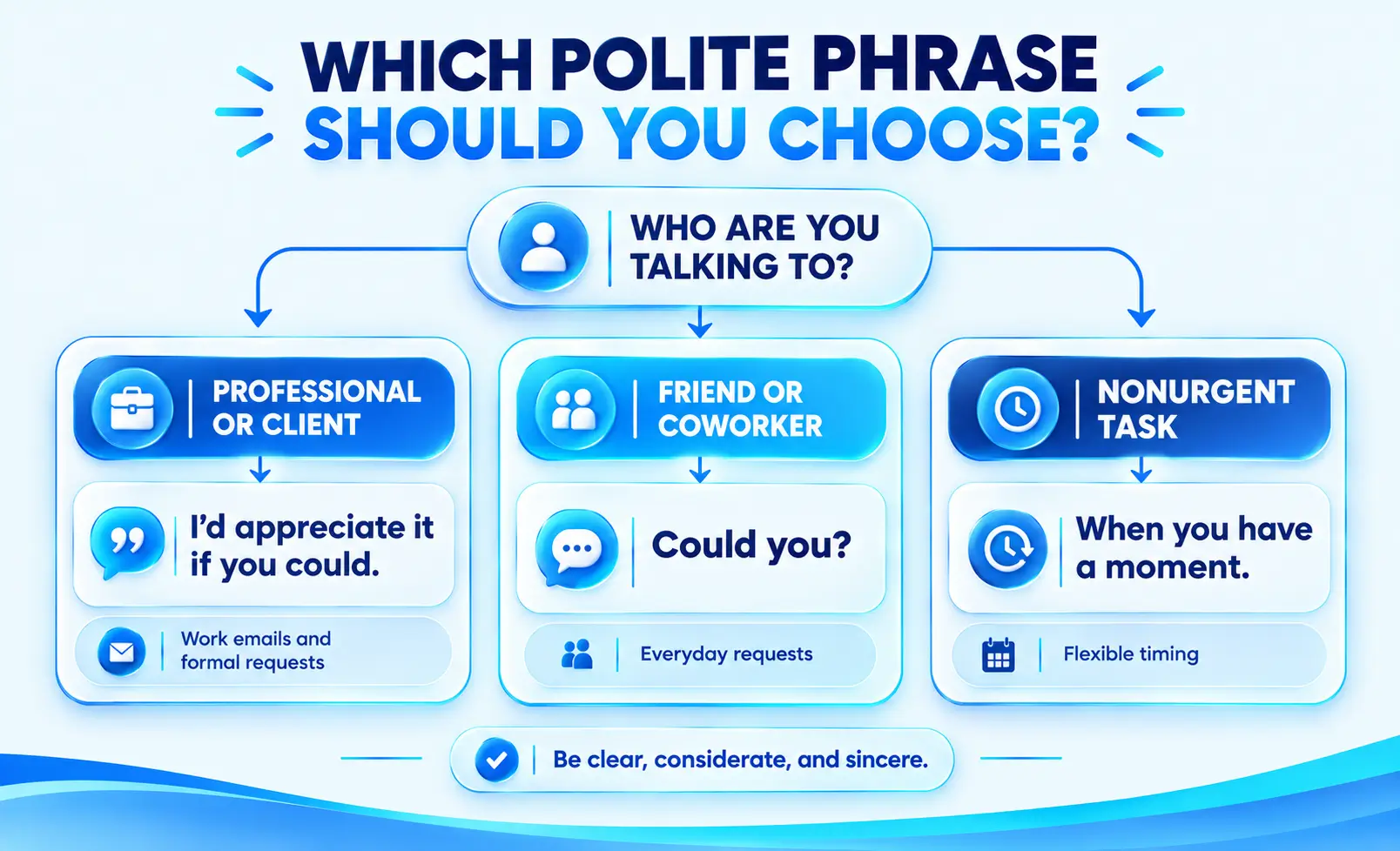
Another way to say please includes “could you,” “would you mind,” “when you have a moment,” “I’d appreciate it if,” and “if you don’t mind.” These alternatives help you make requests politely without repeating the same word. Choose a phrase that matches your relationship with the person, the urgency of your request, and the level of formality.
Key Takeaways
- Use “could you” or “would you mind” to make polite requests.
- Choose “I’d appreciate it if” for professional emails and workplace communication.
- Say “when you have a moment” when a task is not urgent.
- Use “if you don’t mind” for friendly, considerate requests.
- Match your wording to the situation, and keep your request clear and sincere.
The word please is simple, useful, and polite. However, using it in every request can make your conversations sound repetitive or less natural than you intend.
Learning alternative expressions gives you more flexibility. You can sound professional in an email, friendly with a coworker, or considerate when asking someone for a favor.
What Does “Another Way to Say Please” Mean?
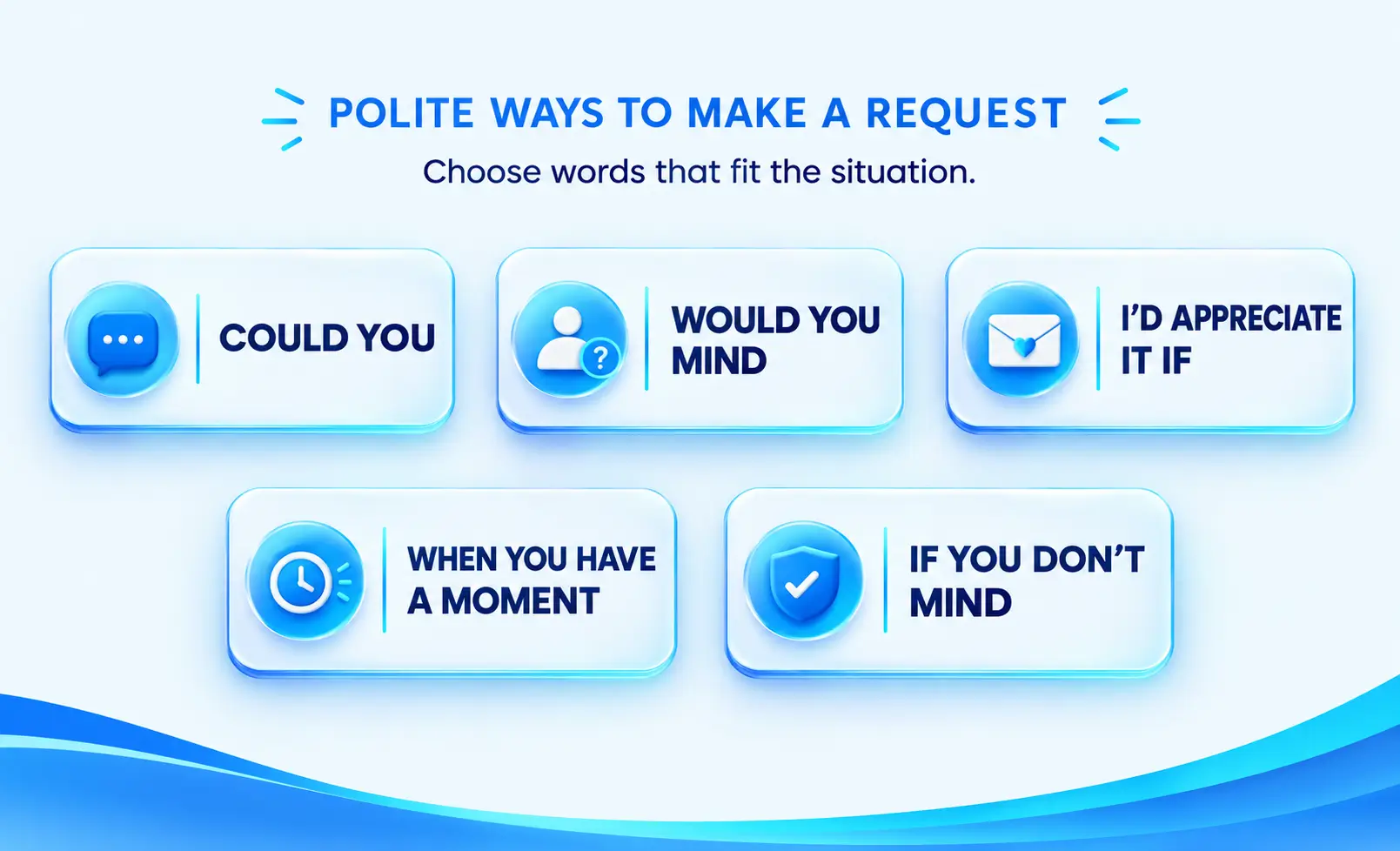
Another way to say please is an alternative expression that makes a request sound polite, respectful, or considerate. Instead of relying on the word please every time, you can use phrases such as “could you,” “would you mind,” or “I’d be grateful if you could.”
People use these expressions in emails, text messages, workplace conversations, customer service, and everyday interactions. The goal is to communicate what you need while respecting the other person’s time, preferences, and ability to respond.
For example, instead of writing, “Please send me the report,” you could say, “Could you send me the report when you have a moment?” Both requests are polite, but the second offers a slightly softer tone.
Why Use Other Ways to Say Please?
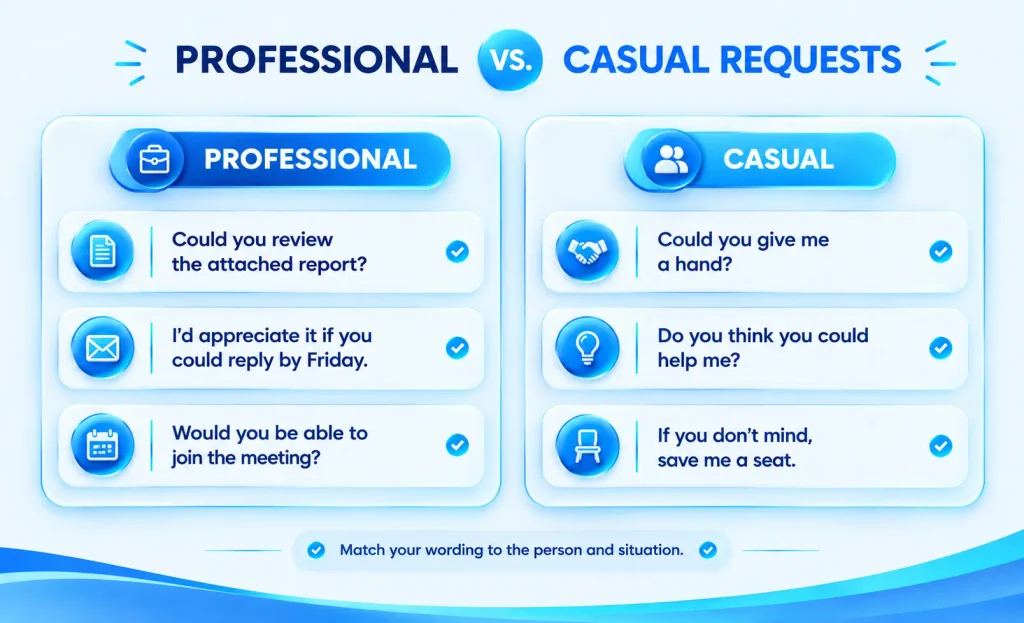
Using different polite expressions helps you communicate more naturally and choose words that fit each situation. The best alternative depends on who you are speaking to and what you need.
Here are the main benefits:
- Avoid repetition: Keep emails and conversations from sounding monotonous.
- Sound more natural: Use expressions that fit everyday American English.
- Adjust your tone: Make requests formal, friendly, gentle, or direct.
- Improve professional communication: Show consideration when contacting coworkers, clients, or managers.
- Express appreciation: Let people know that you value their time and effort.
- Clarify urgency: Distinguish between a routine request and something that needs immediate attention.
The key is to choose a phrase that sounds genuine rather than overly formal or unnecessarily complicated.
15 Best Other Ways to Say Please
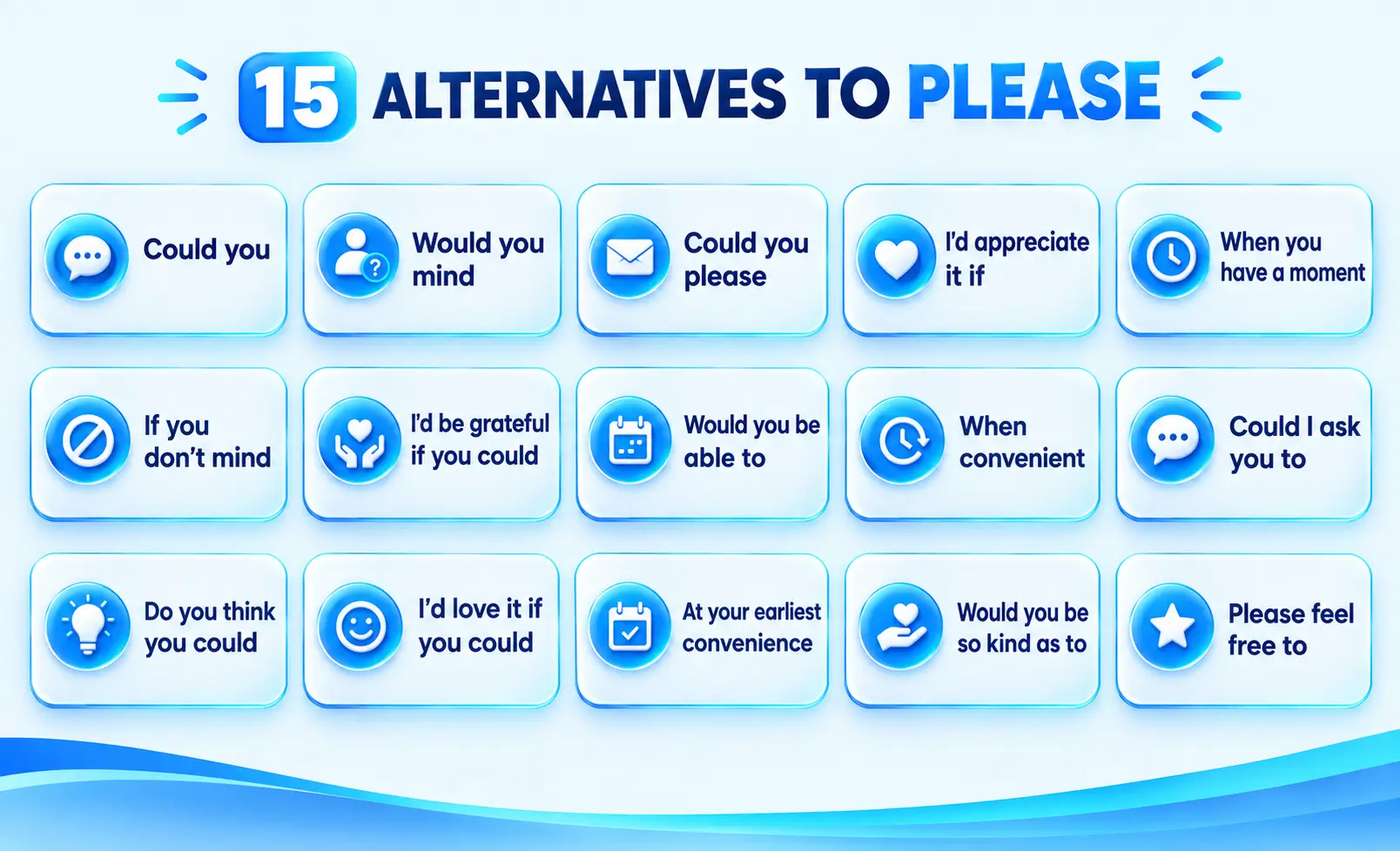
These 15 alternatives work in different settings, from formal business emails to casual conversations. Each phrase has its own tone, so consider the context before choosing one.
1. Could You
Meaning: “Could you” is a polite way to ask someone to do something. It sounds respectful without being too formal and works well in both professional and everyday situations.
Best For: Professional, Polite, Friendly
Example 1: Could you send me the updated schedule before our meeting?
Example 2: Could you pick up some milk on your way home?
Quick Tip: Add “when you have a moment” if the task is not urgent.
2. Would You Mind
Meaning: “Would you mind” makes a request sound considerate by asking whether someone is comfortable doing something. It is especially useful when you want to avoid sounding demanding.
Best For: Formal, Professional, Polite
Example 1: Would you mind reviewing this proposal before Friday?
Example 2: Would you mind closing the window? It’s getting chilly in here.
Quick Tip: Follow this phrase with a verb ending in -ing, as in “Would you mind checking?”
3. Could You Please
Meaning: “Could you please” combines a polite question with the familiar word please. It is useful when you want to make your request especially clear without sounding overly forceful.
Best For: Professional, Formal, Polite
Example 1: Could you please confirm that you received the invoice?
Example 2: Could you please leave the package at the front desk?
Quick Tip: Use it for clear requests in work emails, customer messages, and formal instructions.
4. I’d Appreciate It If
Meaning: This expression shows that you value the other person’s time and effort. It works particularly well when asking for assistance or requesting that someone complete a task.
Best For: Professional, Formal, Polite
Example 1: I’d appreciate it if you could share your feedback by Thursday.
Example 2: I’d appreciate it if you kept this information confidential.
Quick Tip: Follow the phrase with “you could” to keep your request courteous and grammatically natural.
5. When You Have a Moment
Meaning: This phrase tells someone that you would like their help but do not necessarily need it immediately. It makes routine requests feel less demanding.
Best For: Professional, Friendly, Polite
Example 1: When you have a moment, could you check the figures in this spreadsheet?
Example 2: Please call me when you have a moment so we can discuss the plans.
Quick Tip: Avoid this phrase when a task has a strict deadline or requires immediate attention.
6. If You Don’t Mind
Meaning: “If you don’t mind” acknowledges that your request may require some effort from another person. It adds a considerate, conversational touch to everyday interactions.
Best For: Casual, Friendly, Polite
Example 1: If you don’t mind, I’d like to sit near the window.
Example 2: Could you keep an eye on my bag, if you don’t mind?
Quick Tip: Use it for small favors, but avoid overusing it when you need to communicate a firm requirement.
7. I’d Be Grateful If You Could
Meaning: This expression conveys sincere appreciation before the other person responds. It is more formal than “could you” and works well when requesting someone’s time, knowledge, or assistance.
Best For: Formal, Professional, Polite
Example 1: I’d be grateful if you could provide the missing documents by Monday.
Example 2: I’d be grateful if you could recommend a reliable local contractor.
Quick Tip: Reserve it for meaningful requests or formal correspondence rather than simple, everyday tasks.
8. Would You Be Able to
Meaning: “Would you be able to” asks whether someone can complete a task. It gives the recipient room to explain their availability and can make a request feel less demanding.
Best For: Professional, Formal, Polite
Example 1: Would you be able to cover my shift next Wednesday?
Example 2: Would you be able to send a revised estimate this afternoon?
Quick Tip: Use this phrase when availability or workload may affect the person’s ability to help.
9. When Convenient
Meaning: “When convenient” indicates that a task can be completed when it fits the recipient’s schedule. It is concise and particularly suitable for professional communication.
Best For: Professional, Formal, Polite
Example 1: Please review the attached document when convenient.
Example 2: Could you schedule a quick call when convenient for you?
Quick Tip: If you need a response by a certain date, include the deadline rather than leaving the timing open.
10. Could I Ask You to
Meaning: This phrase introduces a request in a respectful, slightly formal way. It works when you want to ask someone to take responsibility for a specific action without sounding abrupt.
Best For: Professional, Formal, Polite
Example 1: Could I ask you to forward the invitation to the rest of the team?
Example 2: Could I ask you to double-check the room reservation?
Quick Tip: State the requested action immediately after the phrase so your message remains direct.
11. Do You Think You Could
Meaning: “Do you think you could” softens a request by inviting the other person to consider whether they can help. It often sounds natural in friendly conversations and informal workplace discussions.
Best For: Casual, Friendly, Polite
Example 1: Do you think you could help me move this table?
Example 2: Do you think you could explain that last step one more time?
Quick Tip: Use it when you want to sound approachable, but choose a more direct expression when instructions need to be precise.
12. I’d Love It If You Could
Meaning: This expression adds warmth and enthusiasm to a request. It is less formal than “I’d appreciate it if” and is best for situations where a friendly tone feels appropriate.
Best For: Friendly, Warm, Casual
Example 1: I’d love it if you could join us for dinner on Saturday.
Example 2: I’d love it if you could share your photos from the trip.
Quick Tip: Use it with friends, family, or familiar coworkers rather than in highly formal correspondence.
13. At Your Earliest Convenience
Meaning: This phrase asks someone to handle a task as soon as their schedule reasonably allows. It is common in business communication, although it can sound formal or imply urgency.
Best For: Professional, Formal
Example 1: Please forward the signed agreement at your earliest convenience.
Example 2: Could you provide the updated pricing at your earliest convenience?
Quick Tip: If the matter is urgent, state a specific deadline instead of relying on this phrase alone.
14. Would You Be So Kind as to
Meaning: This expression is a formal and courteous way to request an action. It can communicate respect, but in everyday American English it may sound old-fashioned or overly elaborate.
Best For: Formal, Polite
Example 1: Would you be so kind as to direct me to the admissions office?
Example 2: Would you be so kind as to provide a copy of the signed contract?
Quick Tip: Use it sparingly in formal situations; “Could you” usually sounds more natural in modern workplace conversations.
15. Please Feel Free to
Meaning: “Please feel free to” gives someone permission or encouragement to take an action. Unlike most alternatives on this list, it usually invites the other person to do something rather than asking them to complete a task for you.
Best For: Professional, Friendly, Warm
Example 1: Please feel free to contact me if you have any questions about the application.
Example 2: Please feel free to bring a guest to the celebration.
Quick Tip: Use it to welcome questions, suggestions, or participation—not as a replacement for every direct request.
Comparison Table: 15 Alternatives to Please
Use this table to find the right expression quickly.
| Alternative | Best Used In | Tone |
|---|---|---|
| Could you | Everyday requests, work | Polite, natural |
| Would you mind | Favors, considerate requests | Courteous |
| Could you please | Emails, instructions | Clear, polite |
| I’d appreciate it if | Workplace requests | Professional |
| When you have a moment | Nonurgent tasks | Relaxed, considerate |
| If you don’t mind | Small favors | Friendly |
| I’d be grateful if you could | Formal requests | Respectful |
| Would you be able to | Scheduling, assignments | Considerate |
| When convenient | Business correspondence | Professional |
| Could I ask you to | Work responsibilities | Formal, respectful |
| Do you think you could | Informal requests | Friendly |
| I’d love it if you could | Invitations, personal favors | Warm |
| At your earliest convenience | Business follow-ups | Formal, potentially urgent |
| Would you be so kind as to | Highly formal requests | Traditional, courteous |
| Please feel free to | Invitations, open communication | Welcoming |
Common Mistakes When Choosing Another Way to Say Please
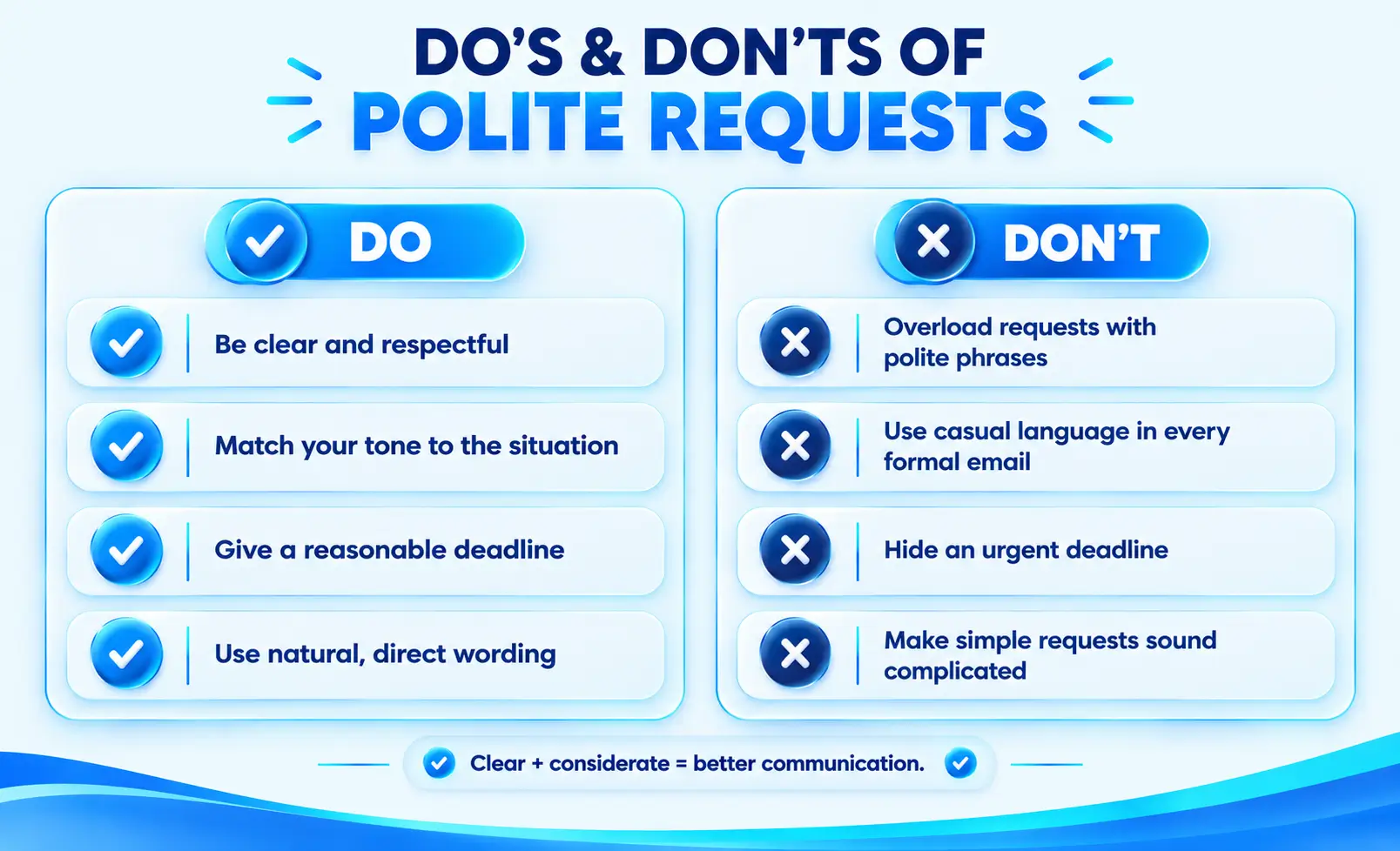
Even a polite expression can sound awkward if it does not fit the situation. Avoid these five common mistakes.
1. Using Casual Phrases in Professional Emails
Expressions such as “Do you think you could” work well with familiar coworkers, but they may be less suitable for formal client correspondence.
Better approach: Use “Could you” or “I’d appreciate it if you could” when writing to clients, managers, or unfamiliar contacts.
2. Making Simple Requests Sound Overly Formal
“Would you be so kind as to” may sound stiff when asking a teammate to share a file.
Better approach: Choose straightforward American English. A simple “Could you send me the file?” is often enough.
3. Repeating the Same Phrase Too Often
Starting every sentence with “Could you please” can make a long email sound repetitive.
Better approach: Vary your wording naturally. For example, combine “Could you review the draft?” with “I’d appreciate your feedback by Friday.”
4. Ignoring the Urgency of the Request
“When you have a moment” suggests flexibility. Using it for a task that must be completed immediately can create confusion.
Better approach: Communicate the deadline clearly. Say, “Could you send the final version by 3 p.m. today?”
5. Sounding Insincere or Indirect
Adding several polite expressions to one request can make your message feel unnatural. For example, “If you don’t mind, could you possibly help me, please?” may be unnecessarily wordy.
Better approach: Use one suitable expression, explain what you need, and thank the person when appropriate.
Frequently Asked Questions
1. What is another way to say please?
Some common alternatives are “could you,” “would you mind,” “I’d appreciate it if,” and “if you don’t mind.” The best choice depends on your situation. Use “could you” for everyday requests, “I’d appreciate it if” for professional communication, and “if you don’t mind” for friendly, informal favors.
2. How can I say please professionally in an email?
You can say “Could you please,” “I’d appreciate it if you could,” or “I’d be grateful if you could.” For example, write, “I’d appreciate it if you could review the attached proposal by Thursday.” These expressions keep your message respectful while making your expectations clear.
3. What is a polite way to ask someone to do something?
“Could you help me with this?” is a natural and widely useful option. You can also say “Would you mind helping me with this?” when you want to sound especially considerate. Choose the wording that suits your relationship with the person and the effort involved in your request.
4. How do you say please without sounding demanding?
Frame your request as a courteous question, explain what you need, and avoid unnecessary pressure. For example, “Could you share the notes when you have a moment?” sounds considerate when the task is not urgent. If you have a deadline, mention it clearly instead of expecting the person to guess.
5. What is a formal synonym for please?
Formal alternatives include “I’d be grateful if you could,” “I’d appreciate it if,” and “would you be so kind as to.” The first two usually sound natural in modern American business writing. The last is more traditional and may feel overly formal in ordinary emails.
6. How can I ask for a favor without saying please?
You could say, “Would you mind picking up the package?” or “I’d really appreciate your help with the presentation.” Both expressions communicate a request without relying on the word please. A sincere tone and a clear explanation can make a favor feel more considerate.
7. Is “could you” more polite than “can you”?
Both expressions are common in American English. “Could you” often sounds a little softer because it frames the request less directly, while “can you” is natural in everyday conversation. Neither is inherently rude. Your tone, relationship with the listener, and surrounding words also influence how the request comes across.
8. How can I politely ask for something urgently?
State the urgency and give a clear deadline. For example, “Could you send the revised document by noon? We need it for this afternoon’s meeting.” You can also acknowledge the short notice by saying, “I appreciate your help on short notice.” Clear timing is more effective than simply adding more polite words.
Conclusion
Learning another way to say please helps you communicate with greater confidence in professional emails, everyday conversations, and personal relationships. Expressions such as “could you,” “would you mind,” and “I’d appreciate it if” make requests sound courteous without relying on the same word repeatedly.
The best phrase depends on your audience and purpose. Choose “could you” for simple requests, “I’d be grateful if you could” for more formal situations, and “when you have a moment” when a task is not urgent. For friendly conversations, “if you don’t mind” or “I’d love it if you could” can sound more natural.
Remember that polite communication is not about using the longest or fanciest expression. It is about being clear, respectful, and sincere. Choose words that fit the situation, communicate your expectations honestly, and show appreciation when someone helps you.

The Majestic Studio Editorial Team creates practical resources about synonyms, alternative phrases, vocabulary, and English usage. Our content is designed to help readers choose clearer, more natural words and communicate effectively in everyday, professional, and academic contexts.
Each article is researched, edited, and reviewed for clarity, context, usefulness, and language accuracy. We regularly update our content to keep examples and recommendations relevant.