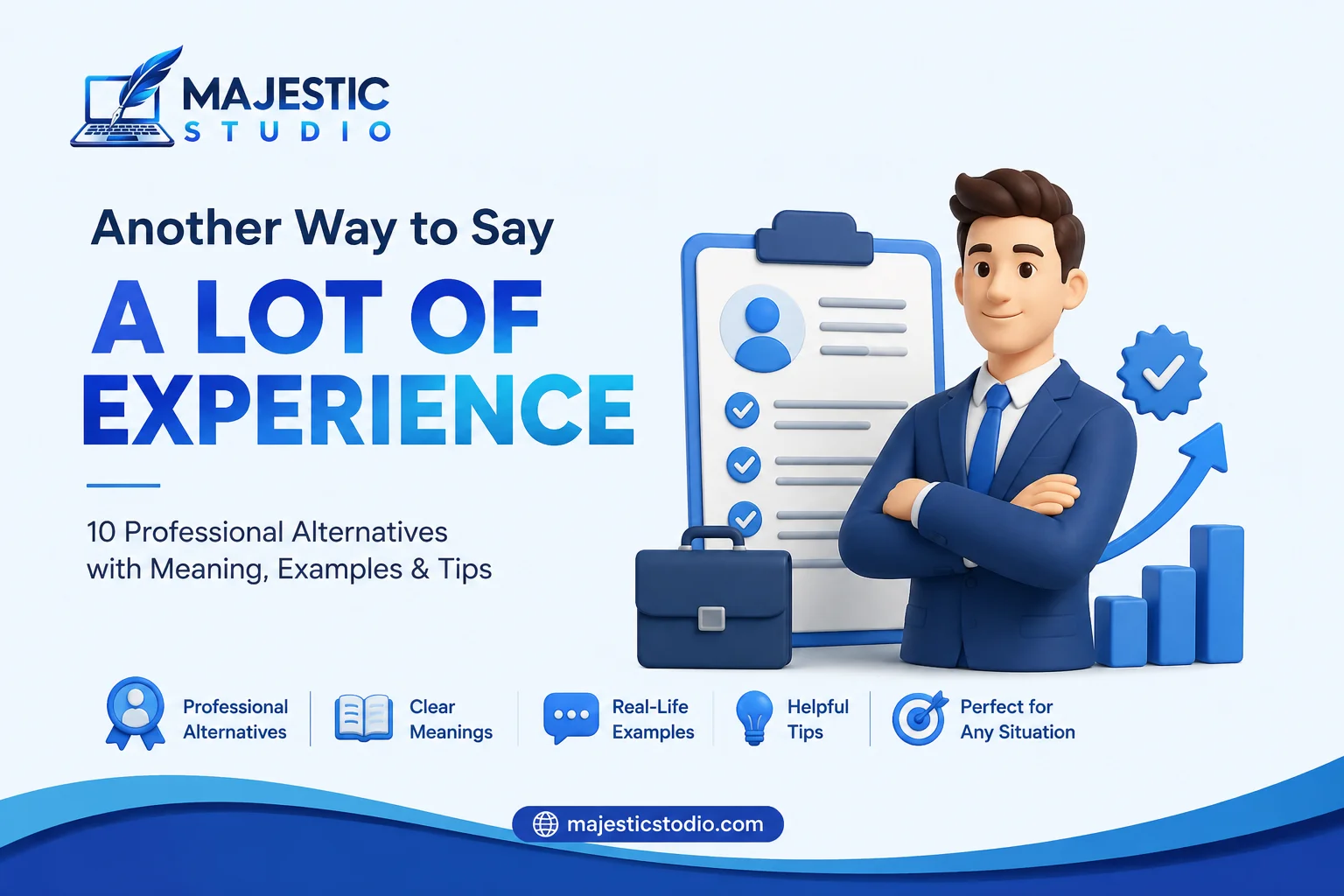
Another way to say “a lot of experience” includes extensive experience, a wealth of experience, years of experience, a strong background, and deep expertise. The best choice depends on context: use professional terms such as “extensive experience” on a resume, while “years of experience” works well when you want to highlight practical time spent in a field.
Key Takeaways
- “Extensive experience” is the safest professional alternative to “a lot of experience.”
- “A wealth of experience” sounds polished and emphasizes valuable knowledge.
- “Deep expertise” works best when someone has advanced knowledge in a specific area.
- “Years of experience” highlights practical time spent doing something.
- Choose your wording based on the audience, purpose, and level of formality.
Finding another way to say “a lot of experience” can make your writing sound more precise, professional, and natural. The right phrase can also show how someone gained experience, rather than simply saying they have plenty of it.
Whether you are writing a resume, cover letter, professional bio, email, recommendation, or interview answer, small wording changes can make your message stronger.
What Does “Another Way to Say a Lot of Experience” Mean?
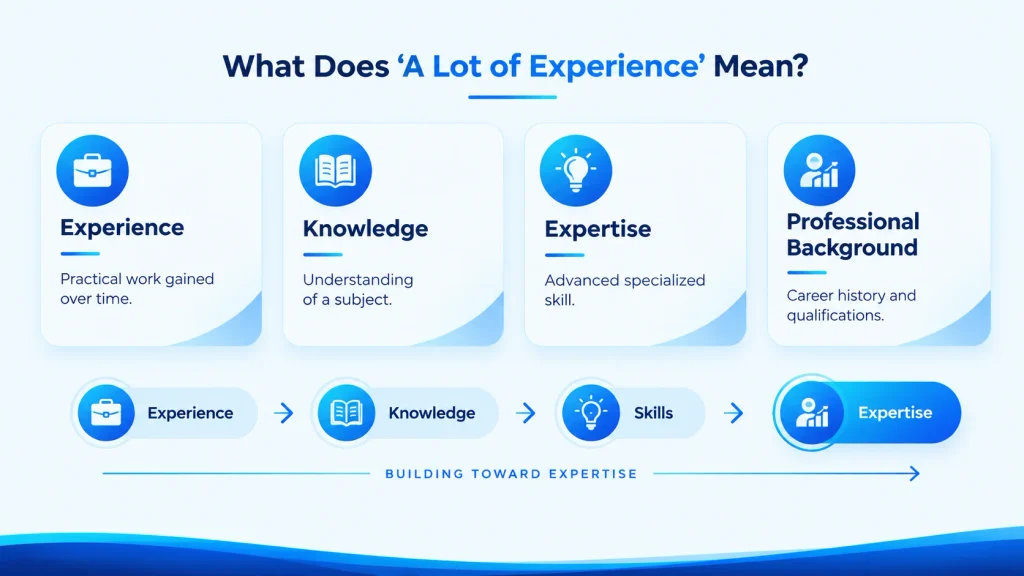
The phrase “another way to say a lot of experience” refers to alternative expressions that communicate extensive knowledge, skill, practice, or time spent in a particular field.
People commonly search for these alternatives when they want to avoid repetition or make their writing sound more polished. You might use them in resumes, job applications, business communications, academic writing, LinkedIn profiles, or everyday conversation.
For example, instead of saying, “She has a lot of experience in marketing,” you could say, “She has extensive experience in marketing.” The second version sounds more specific and professional.
Why Use Other Ways to Say “A Lot of Experience”?
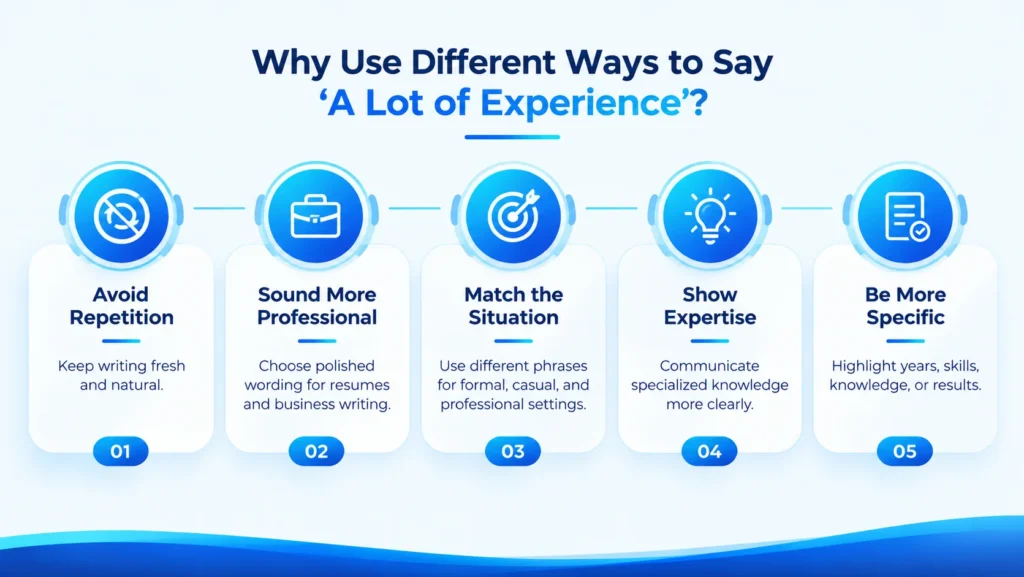
Using different expressions helps you communicate the same basic idea with greater precision.
- Avoid repetition: Keep your writing from sounding repetitive.
- Sound professional: Stronger wording can improve resumes and business documents.
- Match the situation: Some phrases suit formal writing, while others work better in conversation.
- Show expertise: Certain alternatives suggest specialized knowledge or advanced ability.
- Add meaning: You can emphasize time, skill, knowledge, or practical experience.
10 Best Other Ways to Say “A Lot of Experience”
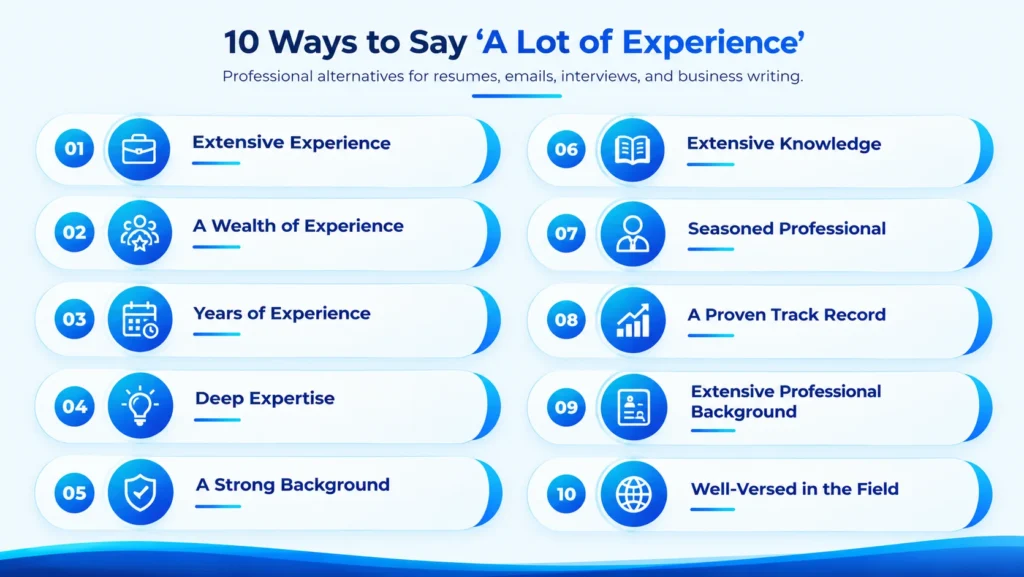
1. Extensive Experience
Meaning
“Extensive experience” means someone has gained a large amount of practical knowledge or experience over time. It is one of the most natural and widely accepted alternatives to “a lot of experience.”
Best For
- Professional
- Formal
- Polite
Example 1
Maria brings extensive experience in project management and team leadership.
Example 2
Our consultant has extensive experience working with small businesses.
Quick Tip
Use “extensive experience” on resumes, cover letters, professional websites, and business profiles when you want a reliable, polished phrase.
2. A Wealth of Experience
Meaning
“A wealth of experience” suggests that someone has accumulated a valuable amount of knowledge through past work or life experiences. It emphasizes the value of the experience, not just the quantity.
Best For
- Professional
- Formal
- Warm
Example 1
David brings a wealth of experience to our nonprofit organization.
Example 2
Her wealth of experience in education makes her an excellent mentor.
Quick Tip
This phrase works especially well when you want to praise someone’s background rather than simply describe it.
3. Years of Experience
Meaning
“Years of experience” directly highlights the amount of time someone has spent working in a particular area. It is clear, familiar, and easy to understand.
Best For
- Professional
- Casual
- Formal
Example 1
The mechanic has 15 years of experience repairing European vehicles.
Example 2
With years of experience in customer service, James knows how to handle difficult situations.
Quick Tip
Use this expression when the actual length of experience matters or when you can provide a specific number.
4. Deep Expertise
Meaning
“Deep expertise” describes advanced knowledge and strong skill in a specific subject. Unlike “years of experience,” it focuses more on the person’s level of understanding than the amount of time involved.
Best For
- Professional
- Formal
Example 1
The engineer has deep expertise in renewable energy systems.
Example 2
Her deep expertise in data analysis helped the company identify new opportunities.
Quick Tip
Choose this phrase when you want to emphasize specialized knowledge rather than simply having worked in a field for a long time.
5. A Strong Background
Meaning
“A strong background” refers to solid experience, training, education, or knowledge in a particular area. It is broader than some other alternatives and does not necessarily imply a specific number of years.
Best For
- Professional
- Formal
- Polite
Example 1
He has a strong background in software development and technical support.
Example 2
The candidate has a strong background in public relations and communications.
Quick Tip
This is a good choice when someone’s qualifications include both professional experience and relevant education or training.
6. Extensive Knowledge
Meaning
“Extensive knowledge” focuses on how much a person knows about a subject. It works well when the person’s understanding is more important than their job history.
Best For
- Professional
- Formal
Example 1
She has extensive knowledge of federal tax regulations.
Example 2
His extensive knowledge of local history made him a valuable resource for the project.
Quick Tip
Use “extensive knowledge” for subjects, systems, rules, or industries where expertise matters more than hands-on work.
7. Seasoned Professional
Meaning
A “seasoned professional” is someone who has developed substantial experience and judgment through years of work. The expression suggests maturity, reliability, and practical knowledge.
Best For
- Professional
- Formal
Example 1
As a seasoned professional, Linda knows how to manage complex negotiations.
Example 2
The company hired a seasoned professional to lead its expanding sales team.
Quick Tip
Use this phrase to describe a person, not a skill or field. It is particularly effective in biographies and professional introductions.
8. A Proven Track Record
Meaning
“A proven track record” means someone has demonstrated success through previous work or accomplishments. It emphasizes results rather than simply the amount of experience someone has.
Best For
- Professional
- Formal
- Polite
Example 1
The agency has a proven track record of delivering successful marketing campaigns.
Example 2
She has a proven track record of increasing customer retention.
Quick Tip
Choose this phrase when you can point to measurable achievements or successful outcomes.
9. Extensive Professional Background
Meaning
“Extensive professional background” describes a substantial history of work, responsibilities, and accomplishments in a career area. It sounds polished without claiming a specific number of years.
Best For
- Professional
- Formal
Example 1
He has an extensive professional background in financial services.
Example 2
Her extensive professional background prepared her for the demands of executive leadership.
Quick Tip
This expression is especially useful in resumes, executive biographies, cover letters, and formal introductions.
10. Well-Versed in the Field
Meaning
Being “well-versed in the field” means having strong knowledge and familiarity with a particular subject or profession. It sounds natural while avoiding a direct focus on how many years someone has worked.
Best For
- Professional
- Friendly
- Polite
Example 1
Our advisor is well-versed in the latest small-business accounting practices.
Example 2
Because she is well-versed in digital advertising, she quickly identified the campaign’s weaknesses.
Quick Tip
Use this phrase when you want to highlight knowledge and familiarity, especially in introductions or professional conversations.
Comparison Table
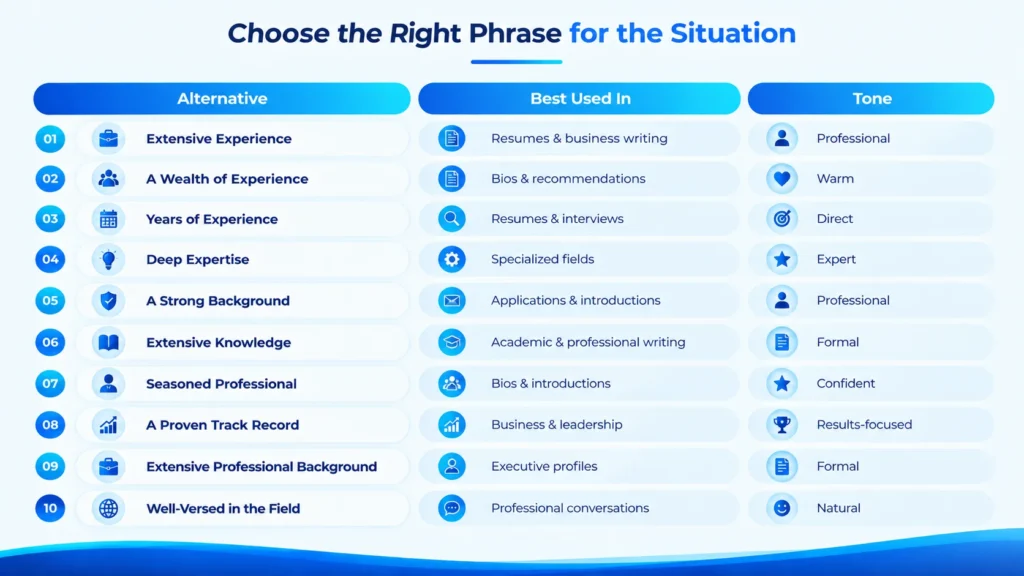
| Alternative | Best Used In | Tone |
| Extensive experience | Resumes, cover letters, business writing | Professional |
| A wealth of experience | Bios, recommendations, introductions | Polished, warm |
| Years of experience | Resumes, interviews, profiles | Direct |
| Deep expertise | Specialized professional writing | Expert |
| A strong background | Resumes, applications, introductions | Professional |
| Extensive knowledge | Academic and professional writing | Formal |
| Seasoned professional | Bios, introductions, recommendations | Confident |
| A proven track record | Business, sales, leadership | Results-focused |
| Extensive professional background | Resumes and executive profiles | Formal |
| Well-versed in the field | Emails, introductions, professional conversations | Natural, polished |
Common Mistakes
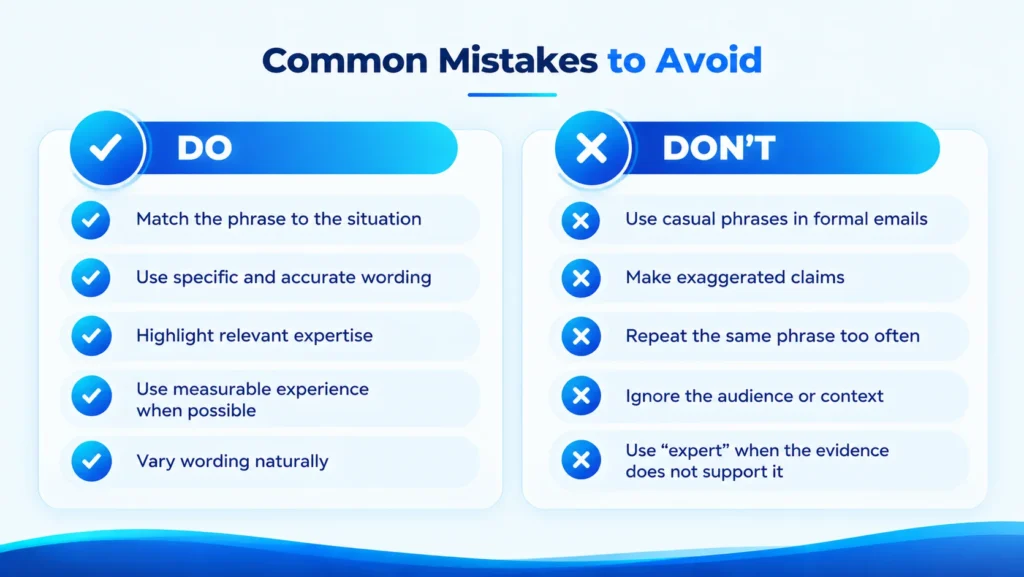
1. Using Casual Phrases in Professional Emails
Phrases such as “a ton of experience” or “loads of experience” can sound too informal in a business setting. Choose “extensive experience” or another professional alternative instead.
2. Choosing Overly Formal Language
Not every situation requires sophisticated wording. In a casual conversation, simply saying “she has years of experience” may sound more natural than “she possesses extensive professional expertise.”
3. Repeating the Same Phrase
Using “extensive experience” several times in the same document can make your writing feel repetitive. Vary your wording when the context allows it.
4. Forgetting Context
Experience and expertise are not always interchangeable. Someone can have many years in a field without being an expert in every part of it, so choose a phrase that accurately reflects the person’s qualifications.
5. Sounding Insincere
Avoid inflated claims such as “unparalleled expertise” unless you have clear evidence to support them. Specific, accurate language usually sounds more credible.
Frequently Asked Questions
What is a professional way to say “a lot of experience”?
“Extensive experience” is usually the best professional alternative. It sounds natural, confident, and appropriate for resumes, cover letters, LinkedIn profiles, and business writing. If you want to emphasize specialized knowledge instead, “deep expertise” may be a better choice.
What is another way to say “many years of experience”?
You can say “years of experience,” “extensive experience,” “a wealth of experience,” or “a long professional background.” If the exact number matters, stating it directly is often strongest, such as “more than 10 years of experience in sales.”
How do you say “a lot of experience” on a resume?
Use specific and professional wording. “Extensive experience,” “strong professional background,” and “proven track record” are useful options. When possible, combine the phrase with measurable accomplishments so employers can see what the experience actually produced.
Is “extensive experience” better than “a lot of experience”?
Yes, in most professional contexts. “Extensive experience” sounds more polished and precise, while “a lot of experience” is conversational. However, “extensive experience” should still be accurate and supported by the person’s actual background.
What is a better way to say someone has a lot of knowledge?
Consider “extensive knowledge,” “deep expertise,” or “well-versed in the field.” The best option depends on what you want to emphasize. “Extensive knowledge” highlights breadth, while “deep expertise” suggests advanced understanding of a specific subject.
How can I describe an experienced person without saying “experienced”?
Try “seasoned professional,” “industry veteran,” “subject-matter expert,” or “a proven professional,” depending on the context. These phrases can communicate experience while adding information about expertise, credibility, or professional standing.
What is a good phrase for a cover letter?
“Extensive experience” is a strong general choice for a cover letter. For example, you might say, “I bring extensive experience in client relations and account management.” Follow it with a specific achievement to make the statement more persuasive.
Is “a wealth of experience” formal?
Yes. “A wealth of experience” is generally professional and somewhat polished. It is especially useful when writing a recommendation, biography, professional introduction, or formal description of someone’s qualifications. It can also add a warmer tone than “extensive experience.”
Conclusion
There are many effective ways to say “a lot of experience,” and the best choice depends on what you want to emphasize. Extensive experience is the safest all-purpose option for professional writing, while years of experience works well when time is important. For specialized knowledge, consider deep expertise or extensive knowledge. If you want to highlight results, a proven track record is stronger.
For resumes and cover letters, choose precise language and support it with quantify your accomplishments on your resume whenever possible. In more personal or complimentary writing, a wealth of experience can sound warmer and more appreciative.
The key is to match the phrase to the situation rather than simply choosing the most impressive-sounding option. Use wording that is accurate, specific, and natural for your audience.

Sajid Ali is a web developer and digital publisher with experience in website development, WordPress, content publishing, and digital projects. He is interested in creating useful, well-structured online resources that make information easier to discover and understand.
At Majestic Studio, Sajid focuses on website development, content publishing, SEO-focused site structure, and maintaining a clear and user-friendly reading experience. He works with a practical, research-driven approach and continuously improves content and website usability based on reader needs and search behavior.