

Another way to say “comes from” depends on the context. Common alternatives include “originates from,” “stems from,” “is derived from,” “arises from,” “is sourced from,” “has its roots in,” “is attributable to,” “traces back to,” “is a result of,” and “is taken from.” Choose the phrase that best matches the source, cause, or origin you mean.
Key Takeaways
- “Originates from” works well when describing a source, place, or beginning.
- “Stems from” is useful when explaining the cause or origin of an idea, problem, or situation.
- “Is derived from” fits academic, technical, and professional writing.
- “Is sourced from” clearly identifies where a material, product, or resource was obtained.
- The best alternative depends on whether you mean origin, cause, source, influence, or extraction.
What Does “Another Way to Say Comes From” Mean?

The phrase “comes from” usually describes the origin, source, cause, or starting point of something. For example, “This tradition comes from Mexico” identifies its cultural origin, while “Her confidence comes from experience” identifies its source or cause.
People often search for another way to say “comes from” because the phrase can become repetitive. A more precise alternative can also make writing sound clearer, more professional, or better suited to a particular context.
You will commonly see these alternatives in essays, business writing, emails, reports, academic papers, conversations, and creative writing.
Why Use Other Ways to Say “Comes From”?
Replacing “comes from” does more than prevent repetition. The right phrase can tell readers whether you are discussing a physical source, historical origin, underlying cause, or direct influence.
Consider using an alternative when you want to:
- Make professional writing more precise.
- Avoid repeating the same phrase.
- Explain an origin or cause more clearly.
- Match the tone of an academic or business document.
- Make a sentence sound more natural.
- Add variety to an essay, report, or article.
10 Best Other Ways to Say “Comes From”

1. Originates From
Meaning
“Originates from” means that something began, developed, or was first produced in a particular place or source. It is especially useful when discussing history, culture, products, ideas, or traditions.
Best For
- Professional
- Formal
- Academic
Example 1
The recipe originates from a small coastal community in Maine.
Example 2
The term originates from an old French expression.
Quick Tip
Use “originates from” when you want to emphasize the beginning or original source of something.
2. Stems From
Meaning
“Stems from” usually identifies the underlying cause or source of something. It works particularly well when discussing problems, behaviors, beliefs, decisions, or situations.
Best For
- Professional
- Formal
- Casual
Example 1
Much of the confusion stems from unclear instructions.
Example 2
Her interest in architecture stems from childhood experiences.
Quick Tip
Choose “stems from” when “comes from” refers to a cause or underlying reason, rather than a physical location.
3. Is Derived From
Meaning
“Is derived from” means that something has been developed, obtained, or formed from another source. It is common in academic, scientific, technical, and professional writing.
Best For
- Formal
- Professional
- Academic
Example 1
The word is derived from an ancient Greek term.
Example 2
This natural ingredient is derived from citrus peel.
Quick Tip
Use this phrase when one thing is formed or developed from another, especially in technical or explanatory writing.
4. Arises From
Meaning
“Arises from” means that something develops or results from a particular condition, event, or circumstance. It often describes situations, questions, conflicts, opportunities, or concerns.
Best For
- Formal
- Professional
- Polite
Example 1
The disagreement arises from different interpretations of the contract.
Example 2
New opportunities often arise from strong professional relationships.
Quick Tip
Use “arises from” when something develops as a result of circumstances.
5. Is Sourced From
Meaning
“Is sourced from” focuses on where something is obtained or supplied. It is common when discussing food, materials, products, data, ingredients, and business supply chains.
Best For
- Professional
- Formal
Example 1
The coffee is sourced from family-owned farms in Colombia.
Example 2
All research data is sourced from publicly available government records.
Quick Tip
Use “is sourced from” when you want to identify the supplier, location, or origin of a resource.
6. Has Its Roots In
Meaning
“Has its roots in” describes a deep historical, cultural, personal, or intellectual origin. It has a slightly more expressive tone than “originates from.”
Best For
- Warm
- Friendly
- Formal
- Creative
Example 1
The festival has its roots in a centuries-old farming tradition.
Example 2
His approach to leadership has its roots in military training.
Quick Tip
This phrase works especially well when the connection to the original source is long-standing or deeply established.
7. Is Attributable To
Meaning
“Is attributable to” means that something can be credited to a particular cause, person, factor, or condition. It is more formal than everyday alternatives.
Best For
- Formal
- Professional
- Academic
Example 1
The increase in sales is attributable to the company’s new pricing strategy.
Example 2
The improvement is largely attributable to better staff training.
Quick Tip
Use this phrase when you are identifying a specific cause or contributing factor, especially in reports.
8. Traces Back To
Meaning
“Traces back to” means that the origin or history of something can be followed to an earlier time, place, person, or event. It often appears in historical and cultural discussions.
Best For
- Formal
- Casual
- Friendly
Example 1
The family’s tradition traces back to the early 1800s.
Example 2
The design traces back to a classic European style.
Quick Tip
Use “traces back to” when you want to emphasize a historical connection rather than simply name an immediate source.
9. Is a Result Of
Meaning
“Is a result of” explains that something happened because of a particular action, event, condition, or circumstance. It is straightforward and easy to understand.
Best For
- Professional
- Formal
- Casual
Example 1
The delay is a result of severe weather conditions.
Example 2
Her progress is a result of consistent practice.
Quick Tip
Choose this phrase when “comes from” means “is caused by” or “happens because of.”
10. Is Taken From
Meaning
“Is taken from” means that something has been copied, extracted, quoted, selected, or removed from another source. The meaning depends on the context.
Best For
- Professional
- Formal
- Casual
Example 1
The quotation is taken from the author’s second book.
Example 2
The sample is taken from a larger collection of survey responses.
Quick Tip
Use “is taken from” when something is directly extracted, copied, selected, or quoted from a source.

Comparison Table

| Alternative | Best Used In | Tone |
| Originates from | History, culture, places, ideas | Formal |
| Stems from | Causes, problems, behaviors | Professional |
| Is derived from | Academic and technical writing | Formal |
| Arises from | Situations, issues, circumstances | Professional |
| Is sourced from | Products, materials, data | Professional |
| Has its roots in | History, culture, personal background | Warm |
| Is attributable to | Causes, statistics, business reports | Formal |
| Traces back to | History, traditions, origins | Neutral |
| Is a result of | Causes and outcomes | Neutral |
| Is taken from | Quotes, excerpts, samples, sources | Neutral |
Common Mistakes
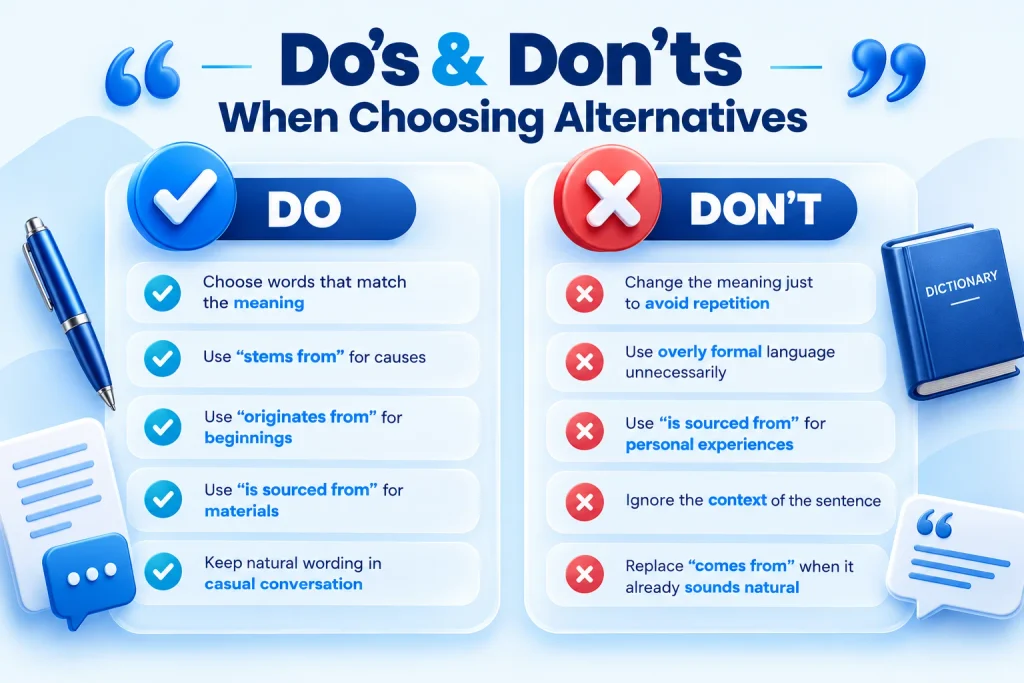
- Using casual phrases in professional writing
Phrases such as “comes out of” may sound conversational. In a formal report, “stems from” or “is attributable to” may communicate the idea more precisely. - Choosing an overly formal alternative
Not every sentence needs sophisticated wording. “Is a result of” may be clearer than “is attributable to” in ordinary communication. - Repeating the same alternative too often
Replacing every instance of “comes from” with “originates from” can create another form of repetition. Select alternatives based on meaning. - Forgetting the context
“Is sourced from” describes procurement, while “stems from” usually describes a cause. They are not interchangeable in every sentence. - Making the sentence sound unnatural
A synonym should improve the sentence, not simply replace a phrase. Read the entire sentence aloud to make sure the alternative fits naturally.
Frequently Asked Questions
What is the most professional way to say “comes from”?
There is no single best professional replacement because the meaning matters. “Originates from” works for an original source, “stems from” works for a cause, and “is derived from” works when something is developed from another source. Choose the phrase that accurately describes the relationship.
What is another way to say “comes from” in an essay?
For an essay, useful alternatives include “originates from,” “stems from,” “is derived from,” “traces back to,” and “has its roots in.” The best option depends on your sentence. Use “stems from” for causes and “originates from” for beginnings or sources.
Is “originates from” the same as “comes from”?
They can have similar meanings, but they are not always interchangeable. “Originates from” usually emphasizes where something began or first developed. “Comes from” is broader and can describe an origin, cause, source, or place of acquisition.
What is another word for “comes from” when describing a cause?
When “comes from” means “is caused by,” “stems from” is one of the most natural alternatives. Other choices include “arises from,” “results from,” and “is attributable to.” The appropriate choice depends on how formal the sentence needs to sound.
How can I say “comes from” in a formal sentence?
Formal alternatives include “originates from,” “is derived from,” “arises from,” and “is attributable to.” For example, instead of saying “The problem comes from poor communication,” you could write, “The problem stems from poor communication.”
What is a synonym for “comes from” in a business context?
Business writing often uses “is sourced from,” “stems from,” “results from,” or “is attributable to.” Use “is sourced from” for suppliers and materials, “stems from” for causes, and “is attributable to” when identifying a factor behind a measurable result.
What is a more natural way to say “comes from” in everyday English?
In casual conversation, “comes from” is already natural and correct. Depending on the meaning, you can use simple alternatives such as “is from,” “results from,” “starts with,” or “is based on.” Avoid replacing a familiar phrase with a formal expression when it does not improve clarity.
Can “comes from” refer to both a source and a cause?
Yes. “Comes from” has several meanings. You might say, “The package comes from Texas” to identify a source or location, while “Her confidence comes from experience” identifies a cause or foundation. That is why alternatives such as “originates from” and “stems from” are not always interchangeable.
Conclusion
The best another way to say “comes from” depends on what you mean. If you are describing an original source, “originates from” is clear and precise. For an underlying cause, “stems from” often sounds more natural. In technical or academic writing, “is derived from” can provide greater precision, while “is sourced from” works well for materials, products, and data.
Other choices, such as “has its roots in,” “traces back to,” and “is a result of,” add useful shades of meaning. Before choosing a synonym, identify whether your sentence discusses an origin, cause, historical connection, or direct source. The most effective replacement is not necessarily the most formal one—it is the phrase that communicates your intended meaning clearly and naturally.

Editorial contributors help develop practical English-language resources covering vocabulary, expressions, synonyms, and writing. Contributions focus on clear explanations, useful examples, and context so readers can understand not only what a phrase means, but when and how to use it naturally.