

If you need another way to say skin in the game, try phrases such as a personal stake, something to lose, a vested interest, or putting something on the line. The best choice depends on context: professional writing often favors “vested interest,” while casual conversation works well with “something to lose.”
Key Takeaways
- “Skin in the game” means having a personal stake or risk in an outcome.
- “A personal stake” is one of the most natural alternatives in everyday and professional English.
- “Vested interest” works especially well in business and formal writing.
- “Putting something on the line” emphasizes risk, effort, or sacrifice.
- Choose an alternative based on your audience, tone, and intended meaning.
What Does “another way to say skin in the game” Mean?
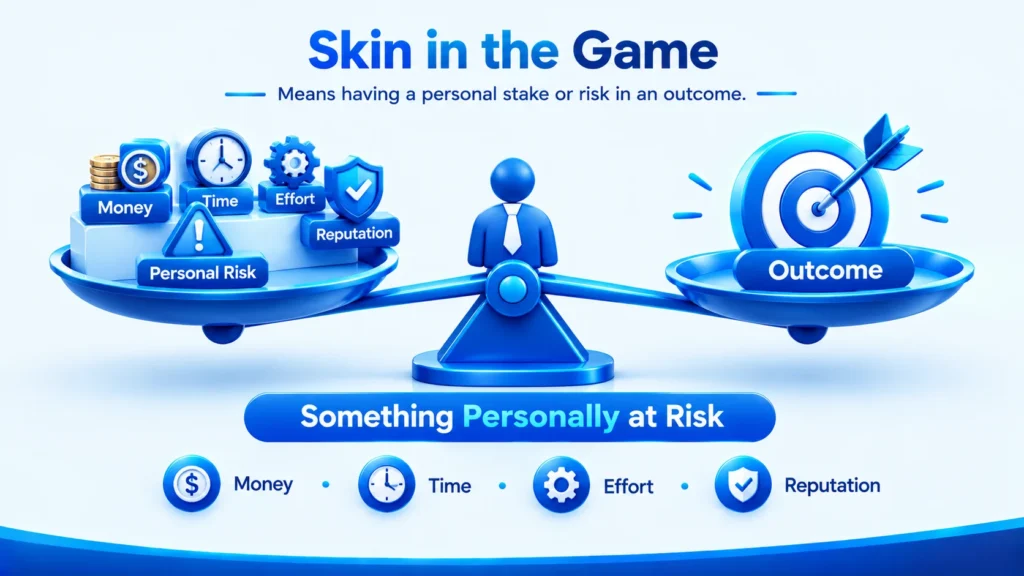
“Skin in the game” is an idiomatic expression meaning that someone has something personally at risk in a situation. If the outcome matters directly to you because you have invested money, time, effort, reputation, or another valuable resource, you have “skin in the game.”
The phrase is common in business, finance, leadership, sports, and everyday conversation. For example, a manager who invests personal money into a new company has a personal stake in its success.
People often use the expression to suggest that someone is more likely to take a situation seriously when they have something to lose.
Why Use Other Ways to Say “Skin in the Game”?

Although “skin in the game” is widely understood, another expression may fit your sentence better. Choosing the right alternative can help you:
- Avoid repeating the same idiom.
- Sound more natural in formal writing.
- Make your meaning clearer.
- Match the tone of a professional or casual conversation.
- Emphasize risk, responsibility, commitment, or personal interest.
The key is to choose a phrase that preserves the part of the meaning you want to highlight.
10 Best Other Ways to Say “Skin in the Game”
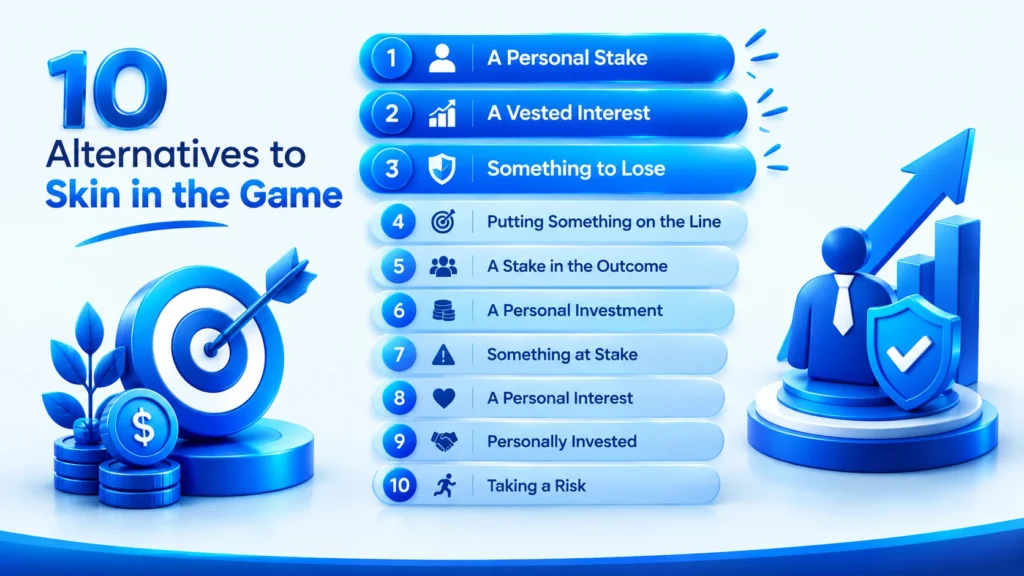
1. A Personal Stake
Meaning
“A personal stake” means having something personally connected to the outcome of a situation. It is one of the closest and most versatile alternatives to “skin in the game.”
Best For
- Professional
- Formal
- Casual
- Friendly
Example 1
The founder has a personal stake in making sure the new product succeeds.
Example 2
Because I have a personal stake in the project, I want to see every detail handled carefully.
Quick Tip
Use “a personal stake” when you want a clear replacement that works in almost any setting.
2. A Vested Interest
Meaning
“A vested interest” describes a strong personal reason to care about a particular result. It often suggests that someone could gain or benefit from a favorable outcome.
Best For
- Professional
- Formal
Example 1
The investors have a vested interest in keeping the company financially healthy.
Example 2
Local residents have a vested interest in the success of the neighborhood development plan.
Quick Tip
This phrase is especially useful in business, legal, political, and analytical writing.
3. Something to Lose
Meaning
“Something to lose” focuses on the risk involved rather than the investment itself. It implies that a person has a reason to act carefully because a poor outcome could cost them something valuable.
Best For
- Casual
- Friendly
- Professional
Example 1
She has something to lose, so she is taking the negotiations seriously.
Example 2
Once the team leader’s reputation was at stake, he realized he had something to lose.
Quick Tip
Choose this phrase when the main idea is potential loss rather than financial investment.
4. Putting Something on the Line
Meaning
“Putting something on the line” means risking something important in pursuit of a desired result. It can refer to money, reputation, a career, relationships, or personal effort.
Best For
- Casual
- Friendly
- Warm
Example 1
They are putting their reputation on the line by guaranteeing the product’s performance.
Example 2
I am putting a lot of time on the line to make this launch successful.
Quick Tip
This expression adds energy and emotion, making it useful when discussing a meaningful risk.
5. A Stake in the Outcome
Meaning
Having “a stake in the outcome” means that a person has a meaningful interest in what eventually happens. It is slightly more neutral and analytical than “skin in the game.”
Best For
- Professional
- Formal
Example 1
Employees have a stake in the outcome because the decision could affect their schedules.
Example 2
Every department has a stake in the outcome of the restructuring plan.
Quick Tip
Use this option when you want to emphasize involvement without sounding overly casual.
6. A Personal Investment
Meaning
“A personal investment” can refer to money, but it can also describe time, effort, emotion, or commitment. The phrase highlights what someone has contributed to a situation.
Best For
- Professional
- Formal
- Warm
Example 1
She has made a personal investment in helping the nonprofit grow.
Example 2
His personal investment in the community explains why he cares so deeply about the proposal.
Quick Tip
This is a strong choice when the person has contributed effort or emotion rather than just money.
7. Something at Stake
Meaning
“Something at stake” means that something valuable could be gained or lost depending on what happens. Unlike “skin in the game,” it does not always imply that the speaker is personally invested.
Best For
- Formal
- Professional
- Casual
Example 1
With the championship at stake, the players stayed focused until the final minute.
Example 2
There is a lot at stake for families affected by the policy change.
Quick Tip
Use this phrase when you want to stress the importance or consequences of a situation.
8. A Personal Interest
Meaning
“A personal interest” means that someone cares about an issue because it affects them directly. It is a straightforward alternative that avoids the informal tone of the original idiom.
Best For
- Professional
- Formal
- Polite
Example 1
The director has a personal interest in improving employee retention.
Example 2
I have a personal interest in seeing the program remain available to students.
Quick Tip
This phrase works well when clarity matters more than adding a strong sense of risk.
9. Personally Invested
Meaning
“Personally invested” describes someone who cares deeply about an outcome because they have contributed time, effort, resources, or emotion. It often sounds more natural than a formal noun phrase.
Best For
- Friendly
- Warm
- Professional
Example 1
Our teachers are personally invested in helping students succeed.
Example 2
I am personally invested in this project because I helped build it from the beginning.
Quick Tip
Use this phrase when you want to highlight commitment and involvement rather than potential loss.
10. Taking a Risk
Meaning
“Taking a risk” emphasizes the possibility of an unfavorable result. It is broader than “skin in the game” because a person can take a risk without already having a personal stake in the situation.
Best For
- Casual
- Friendly
- Professional
Example 1
The company is taking a risk by entering such a competitive market.
Example 2
He is taking a risk by leaving a secure position to launch his own business.
Quick Tip
Choose this phrase when the act of accepting uncertainty is more important than the person’s existing investment.
Comparison Table
| Alternative | Best Used In | Tone |
| A personal stake | Most situations | Neutral |
| A vested interest | Business and formal writing | Professional |
| Something to lose | Everyday conversation | Casual |
| Putting something on the line | Personal or high-risk situations | Conversational |
| A stake in the outcome | Business and analytical writing | Neutral |
| A personal investment | Work and personal contexts | Professional/Warm |
| Something at stake | Important outcomes | Neutral |
| A personal interest | Formal communication | Polite |
| Personally invested | Relationships and teamwork | Warm |
| Taking a risk | Situations involving uncertainty | Direct |
Common Mistakes
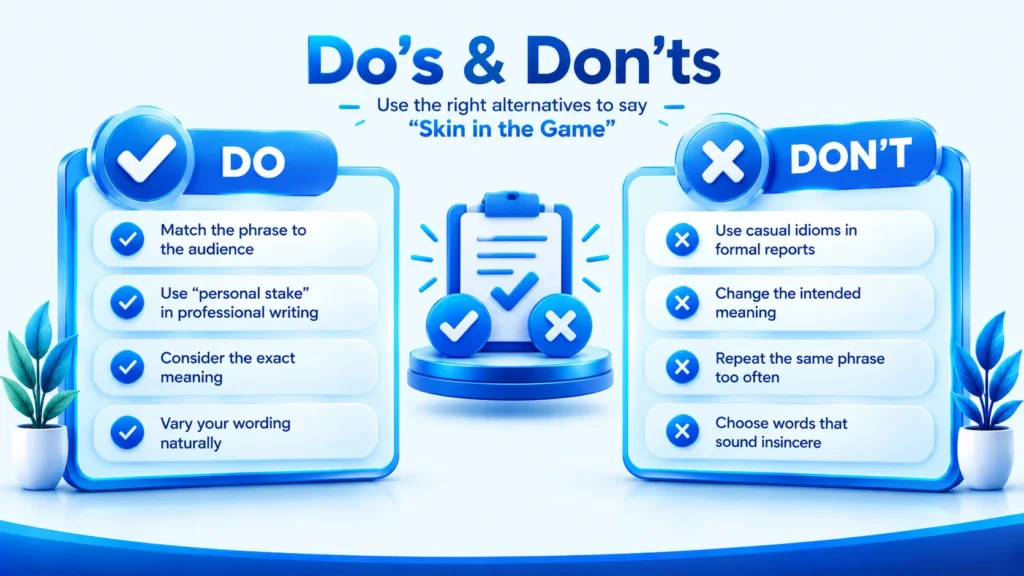
- Using casual phrases in professional emails
“Skin in the game” and “something to lose” can sound conversational. For formal communication, “a personal stake” or “a vested interest” may be more appropriate. - Choosing a phrase that changes the meaning
Not every alternative is an exact synonym. “Taking a risk,” for example, focuses on uncertainty, while “a personal stake” focuses on personal involvement. - Repeating the same expression too often
Even a useful phrase can become distracting when it appears several times in one paragraph. Vary your wording when the context allows it. - Forgetting the audience
An idiom may work perfectly in a team discussion but sound less polished in a report or business proposal. Match your wording to the reader. - Making the sentence sound insincere
Phrases such as “vested interest” can sometimes suggest self-interest. If you want to emphasize genuine commitment, “personally invested” may be a better choice.
Frequently Asked Questions
What is another way to say “skin in the game”?
Common alternatives include “a personal stake,” “a vested interest,” “something to lose,” “a stake in the outcome,” and “personally invested.” The best option depends on what you want to emphasize. “A personal stake” is usually the safest general-purpose replacement because it clearly communicates personal involvement in an outcome.
What is a professional way to say “skin in the game”?
“A personal stake” or “a vested interest” are strong professional alternatives. For example, instead of saying, “The executives have skin in the game,” you could write, “The executives have a personal stake in the company’s success.” This sounds clear and polished without relying on an informal idiom.
What is a synonym for “skin in the game”?
There is no single perfect synonym in every context. “Personal stake” is the closest general equivalent, while “vested interest” emphasizes personal benefit, “something at stake” emphasizes consequences, and “personally invested” highlights commitment.
Is “vested interest” the same as “skin in the game”?
They are similar but not identical. Both can describe personal involvement in an outcome, but “vested interest” often emphasizes a reason to benefit from a particular result. “Skin in the game” usually carries a stronger sense that the person has something personally invested or at risk.
What is a casual way to say “skin in the game”?
In casual conversation, you can say “something to lose,” “putting something on the line,” or “personally invested.” For example, “She has something to lose” sounds natural when explaining why someone is motivated to protect a particular outcome.
Can “personal stake” replace “skin in the game”?
Yes. “Personal stake” is one of the most direct replacements. It works in casual speech, workplace conversations, reports, and other forms of writing. It also makes the meaning clear to readers who may not be familiar with the idiom.
What does “having something at stake” mean?
“Having something at stake” means that an important benefit, possession, goal, reputation, or other valuable outcome could be gained or lost. The phrase does not necessarily mean the person has already invested something, so it can be broader than “skin in the game.”
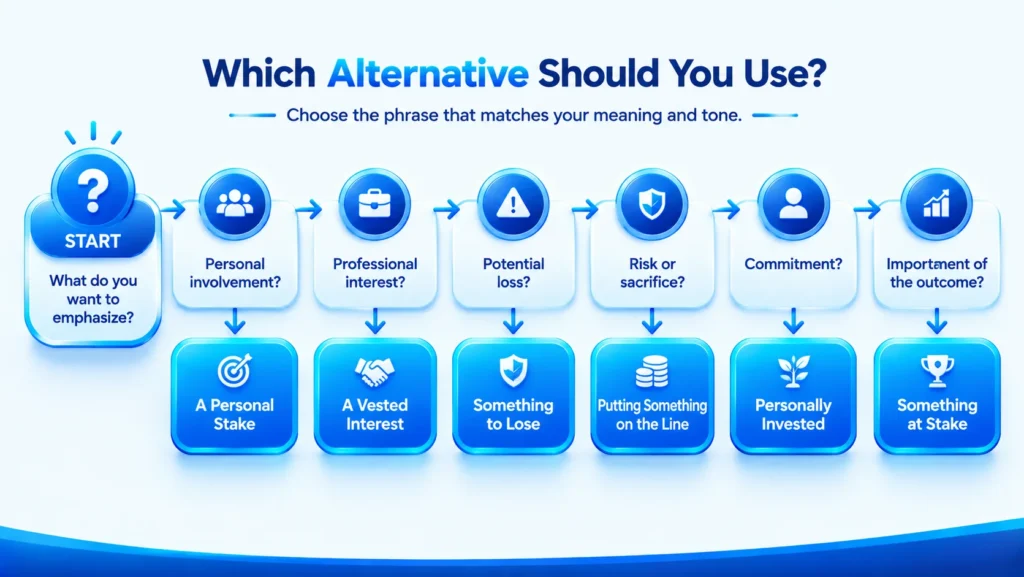
How do I choose the best alternative?
Start by identifying the idea you want to emphasize. Use “a personal stake” for general personal involvement, “vested interest” for professional contexts, “something to lose” for potential consequences, “personally invested” for commitment, and “putting something on the line” for a stronger sense of risk.
Conclusion
“Skin in the game” is a useful idiom, but it is not always the best choice for every sentence. If you need another way to say “skin in the game,” consider the exact idea you want to communicate: personal involvement, risk, commitment, or potential gain.
For most situations, “a personal stake” is the safest and clearest replacement. In professional writing, “a vested interest” can sound more formal, while “personally invested” works well when you want to stress dedication. For a more conversational tone, “something to lose” or “putting something on the line” can sound more natural.
The best wording is the one that fits both your meaning and your audience. When in doubt, choose clarity over cleverness.

The Majestic Studio Editorial Team creates practical resources about synonyms, alternative phrases, vocabulary, and English usage. Our content is designed to help readers choose clearer, more natural words and communicate effectively in everyday, professional, and academic contexts.
Each article is researched, edited, and reviewed for clarity, context, usefulness, and language accuracy. We regularly update our content to keep examples and recommendations relevant.