
Looking for another way to say “as discussed”? Try “as previously discussed,” “as we agreed,” “as mentioned earlier,” or “following our conversation.” These as discussed alternatives help you write clearer emails, confirm decisions, and follow up professionally. Choose a phrase that matches your meaning, audience, and level of formality.
Key Takeaways
- Use “as previously discussed” in formal business emails.
- Choose “as we agreed” when referring to a confirmed decision.
- Use “as mentioned earlier” to remind someone about information.
- Try “following our conversation” when introducing next steps.
- Match your wording to the situation instead of repeating the same phrase.
Another Way to Say “As Discussed”
The phrase “as discussed” is common in professional emails, meeting notes, and workplace conversations. It helps you refer to information, decisions, or plans covered earlier.
However, using the same phrase in every email can make your writing sound repetitive. The right alternative can make your message clearer, more natural, and better suited to your reader.
If you want to improve your professional writing, these 12 as discussed alternatives will help you communicate with confidence.
What Does “As Discussed” Mean?
“As discussed” means that a topic has already been talked about with another person or group. People often use it to introduce a reminder, confirm next steps, or refer to an earlier conversation.
For example, “As discussed, I have attached the revised report” tells the recipient that the attachment relates to a previous exchange.
You will often see this expression in business emails, project updates, meeting summaries, client messages, and follow-up notes. It is short and professional, but it may sound abrupt without enough context.
Why Use Other Ways to Say “As Discussed”?

Choosing different wording helps your emails sound natural while keeping your message clear. It also lets you show whether you are recalling information, confirming an agreement, or explaining your next action.
Here are a few reasons to use alternatives:
- Avoid repetition: Keep multiple emails from sounding alike.
- Improve clarity: Show whether you mean a discussion, reminder, or decision.
- Match your audience: Adjust your tone for managers, clients, and coworkers.
- Sound more natural: Use friendly wording when a formal phrase feels stiff.
- Communicate politely: Make reminders easier to understand without sounding demanding.
Remember that discussing a topic does not always mean everyone agreed. Choose your words carefully so you do not suggest a commitment that was never made.
12 Best As Discussed Alternatives for Professional Emails
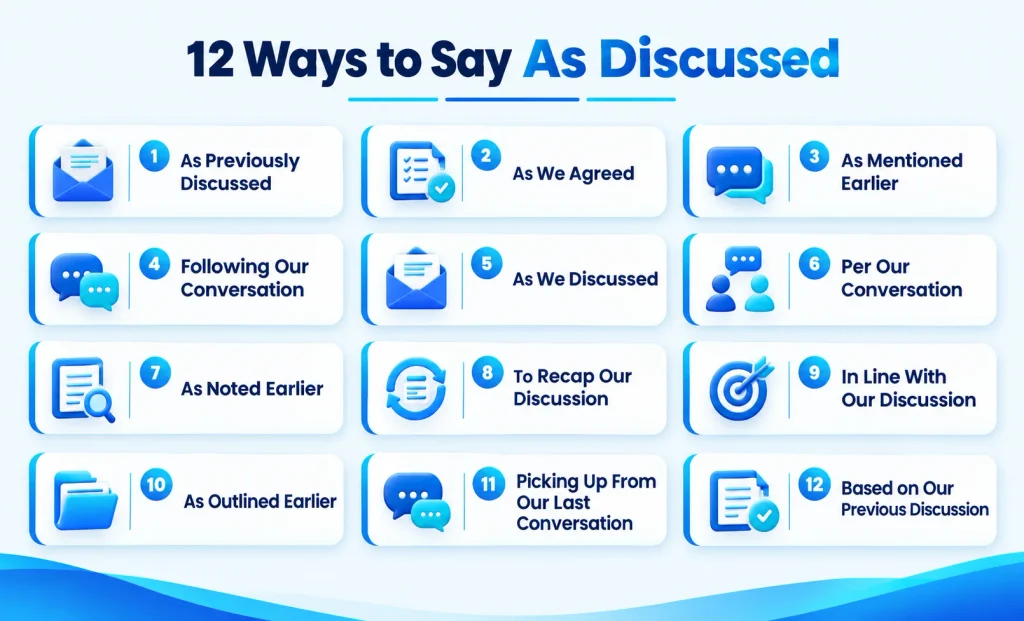
The following phrases offer practical options for different workplace situations. Each example shows how you can use them naturally in American English.
1. As Previously Discussed
Meaning
“As previously discussed” refers to a subject covered in an earlier conversation, meeting, or email. It is a reliable choice when you want to connect a previous discussion with a current task.
Best For
Professional, Formal, Polite
Example 1
“As previously discussed, we will launch the new website on November 15.”
Example 2
“As previously discussed, please submit the revised budget by Friday.”
Quick Tip
Use this expression in formal business emails when the earlier conversation provides important context.
2. As We Agreed
Meaning
“As we agreed” highlights a decision that both parties accepted. Unlike a general reference to a conversation, it suggests that everyone involved reached an understanding.
Best For
Professional, Formal, Polite
Example 1
“As we agreed, I’ll prepare the presentation while you finalize the slides.”
Example 2
“As we agreed during Monday’s meeting, the new pricing will begin next month.”
Quick Tip
Use this phrase only when the people involved clearly agreed on the decision.
3. As Mentioned Earlier
Meaning
“As mentioned earlier” refers to information shared before. It is useful when reminding someone about a detail without suggesting that they agreed to anything.
Best For
Professional, Casual, Polite
Example 1
“As mentioned earlier, our office will close at 3 p.m. on Thursday.”
Example 2
“As mentioned earlier, applicants must provide two professional references.”
Quick Tip
Choose this phrase when you are repeating information rather than confirming a decision.
4. Following Our Conversation
Meaning
“Following our conversation” connects an earlier discussion with a new action, update, or request. It sounds polished without being overly formal.
Best For
Professional, Formal, Friendly
Example 1
“Following our conversation, I’ve attached the updated project proposal.”
Example 2
“Following our conversation yesterday, I contacted the supplier about delivery dates.”
Quick Tip
This phrase works particularly well when explaining what you have done after speaking with someone.
5. As We Discussed
Meaning
“As we discussed” refers to a subject that you and the recipient covered together. It sounds conversational and professional, making it suitable for everyday workplace communication.
Best For
Professional, Casual, Friendly
Example 1
“As we discussed, I’ll send the final draft before the end of the day.”
Example 2
“As we discussed during our call, the team will test the new feature next week.”
Quick Tip
Use this expression with coworkers and clients when you want a direct but approachable tone.
6. Per Our Conversation
Meaning
“Per our conversation” means according to what you discussed earlier. It often appears in business correspondence that confirms instructions, shares documents, or records next steps.
Best For
Professional, Formal
Example 1
“Per our conversation, I have updated the invoice to reflect the revised amount.”
Example 2
“Per our conversation this morning, the contractor will begin work on Monday.”
Quick Tip
This phrase is useful in formal communication, but simpler wording may sound warmer in routine emails.
7. As Noted Earlier
Meaning
“As noted earlier” points to information that has already been written or recorded. It is especially useful when referring to reports, instructions, meeting notes, or details in an email thread.
Best For
Professional, Formal, Polite
Example 1
“As noted earlier, all expense reports must include supporting receipts.”
Example 2
“As noted earlier in the project brief, the design must meet accessibility standards.”
Quick Tip
Use this expression when you can point readers to a written record of the information.
8. To Recap Our Discussion
Meaning
“To recap our discussion” introduces a summary of the main points covered earlier. It helps readers review important details and understand what needs to happen next.
Best For
Professional, Friendly, Polite
Example 1
“To recap our discussion, the marketing team will finalize the campaign by Wednesday.”
Example 2
“To recap our discussion, we need approval from finance before placing the order.”
Quick Tip
Use this phrase before a summary of decisions, responsibilities, or action items.
9. In Line With Our Discussion
Meaning
“In line with our discussion” indicates that a plan or action follows the direction of an earlier conversation. It emphasizes consistency between what was discussed and what happens next.
Best For
Professional, Formal
Example 1
“In line with our discussion, we have adjusted the project timeline.”
Example 2
“In line with our discussion, the revised proposal includes the additional services.”
Quick Tip
This phrase works well in formal project updates. If you need to confirm a definite agreement, “as we agreed” may be more precise.
10. As Outlined Earlier
Meaning
“As outlined earlier” refers to information explained or organized in a previous section, document, or message. It is a good fit for plans, requirements, and step-by-step instructions.
Best For
Professional, Formal, Polite
Example 1
“As outlined earlier, each department must submit its quarterly report by the fifth.”
Example 2
“As outlined earlier in the proposal, the project includes three development phases.”
Quick Tip
Choose this expression when the earlier information follows a clear structure.
11. Picking Up From Our Last Conversation
Meaning
“Picking up from our last conversation” brings an earlier topic back into focus. It sounds friendly and suggests that you are continuing a discussion rather than starting from the beginning.
Best For
Casual, Friendly, Professional
Example 1
“Picking up from our last conversation, I found a vendor that fits our budget.”
Example 2
“Picking up from our last conversation, have you had a chance to review the samples?”
Quick Tip
Use this phrase for friendly follow-ups with coworkers, clients, or business contacts you know well.
12. Based on Our Previous Discussion
Meaning
“Based on our previous discussion” explains that an action, recommendation, or conclusion comes from an earlier exchange. It highlights how the conversation influenced the next step.
Best For
Professional, Formal, Polite
Example 1
“Based on our previous discussion, I recommend moving the training session to December.”
Example 2
“Based on our previous discussion, we have selected the shorter delivery schedule.”
Quick Tip
Use this phrase when explaining the reason behind a recommendation or decision.
Comparison Table: As Discussed Alternatives

| Alternative | Best Used In | Tone |
|---|---|---|
| As previously discussed | Formal business emails | Professional |
| As we agreed | Confirming decisions | Direct |
| As mentioned earlier | Reminders | Neutral |
| Following our conversation | Follow-up emails | Polished |
| As we discussed | Team communication | Natural |
| Per our conversation | Business correspondence | Formal |
| As noted earlier | Reports and records | Professional |
| To recap our discussion | Meeting summaries | Helpful |
| In line with our discussion | Project updates | Formal |
| As outlined earlier | Plans and proposals | Structured |
| Picking up from our last conversation | Friendly follow-ups | Conversational |
| Based on our previous discussion | Recommendations | Analytical |
Common Mistakes When Using As Discussed Alternatives
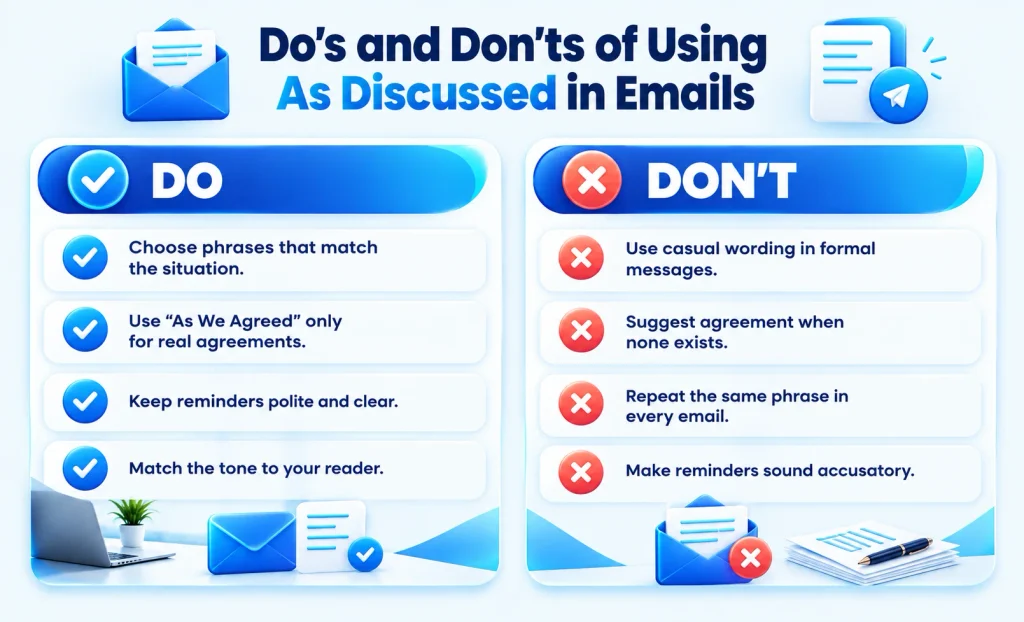
Avoid these five mistakes when choosing an alternative to “as discussed.”
1. Using casual language in formal emails. Phrases like “picking up where we left off” may feel too relaxed for legal correspondence or formal client updates. Choose wording that fits your audience.
2. Making the message sound overly formal. “Per our conversation” is appropriate in many business settings, but simpler wording often sounds warmer. Do not sacrifice clarity to sound professional.
3. Repeating the same phrase too often. Using “as previously discussed” in every message can make your writing feel mechanical. Vary your language when doing so improves readability.
4. Ignoring the context. “As we agreed” implies a shared decision, while “as mentioned earlier” simply refers to information. Choose the expression that accurately describes the situation.
5. Sounding accusatory or insincere. Repeated reminders can seem like criticism, especially when someone has missed a deadline. Keep your message factual, polite, and focused on the next step.
Frequently Asked Questions
1. What is the most professional way to say “as discussed”?
“As previously discussed” is one of the most professional alternatives. It works well in formal emails, project updates, and business documents. “Following our conversation” is another strong choice when introducing an action or update. The best option depends on whether you are referring to an earlier topic, an agreement, or a next step.
2. What can I say instead of “as discussed” in an email?
You can write “as mentioned earlier,” “following our conversation,” “per our conversation,” or “based on our previous discussion.” For example, “Following our conversation, I’ve attached the revised proposal” sounds natural and professional. Choose wording that explains why you are referring to the earlier exchange.
3. Is “as discussed” formal or informal?
“As discussed” is generally considered neutral to professional. It is common in workplace emails, meeting notes, and client communication. However, the phrase can sound abrupt if it appears without context. Adding a brief explanation, such as “As discussed during our call, here is the updated schedule,” makes the message clearer.
4. Is “per our conversation” better than “as discussed”?
Neither phrase is always better. “Per our conversation” sounds more formal and emphasizes that an action follows an earlier exchange. “As discussed” is shorter and more neutral. Use the first when documenting instructions or next steps, and use the second for routine workplace communication.
5. How do I say “as discussed” without sounding rude?
Use a polite, specific expression such as “Following our conversation, I wanted to share the updated details.” You can also write “As we discussed, the next step is to review the proposal.” Avoid using the phrase alone to highlight a missed commitment, as it may sound like a reprimand.
6. What is a friendly alternative to “as discussed”?
“As we talked about,” “as we discussed,” and “picking up from our last conversation” are friendly alternatives. They work well when communicating with coworkers, familiar clients, or teammates. For example, “Picking up from our last conversation, I found a solution that should work for everyone” sounds approachable and encourages further discussion.
7. Can I use “as agreed” instead of “as discussed”?
Yes, but only when the people involved reached an agreement. “As discussed” refers to a topic that was talked about, while “as agreed” confirms a decision or commitment. Using “as agreed” when no clear agreement exists can create confusion or make the recipient feel that a decision was made without their approval.
8. What is the best alternative to “as discussed” in meeting minutes?
“To recap our discussion,” “as noted earlier,” and “as outlined earlier” work well in meeting minutes. They help summarize decisions, document important details, and organize action items. For clarity, include the responsible person and deadline whenever possible, such as “To recap our discussion, Jordan will submit the revised budget by Friday.”
Conclusion
Choosing another way to say “as discussed” can make your emails, reports, and workplace conversations clearer and more natural. The best alternative depends on what you want to communicate and how formal your message needs to be.
For formal business communication, “as previously discussed” and “per our conversation” are reliable choices. When confirming a decision, “as we agreed” is more precise. For friendly follow-ups, “as we discussed” and “picking up from our last conversation” sound approachable. If you need to summarize key points, try “to recap our discussion.”
Remember that these phrases are not always interchangeable. Some refer to shared information, while others imply agreement or explain the reason behind a decision. Choose wording that accurately reflects the conversation, and keep your message focused on the information or action your reader needs.
A simple rule makes the choice easier: be clear about the context, match the tone to your audience, and prioritize natural communication over formal-sounding language.

The Majestic Studio Editorial Team creates practical resources about synonyms, alternative phrases, vocabulary, and English usage. Our content is designed to help readers choose clearer, more natural words and communicate effectively in everyday, professional, and academic contexts.
Each article is researched, edited, and reviewed for clarity, context, usefulness, and language accuracy. We regularly update our content to keep examples and recommendations relevant.