

Another way to say “can-do attitude” is positive attitude, proactive mindset, problem-solving approach, or willingness to take initiative. These phrases describe someone who focuses on solutions, welcomes challenges, and looks for ways to get things done. For professional settings, “proactive mindset” and “solution-oriented” are strong choices for resumes, cover letters, and workplace communication.
Key Takeaways
- “Proactive mindset” works well in professional settings and resumes.
- “Positive attitude” is a simple, friendly alternative for everyday conversations.
- “Solution-oriented” describes someone who focuses on finding answers rather than problems.
- “Willingness to take initiative” highlights independence and leadership.
- Choose an alternative that fits your audience, purpose, and level of formality.
A can-do attitude shows that someone is willing to take action, face challenges, and work toward solutions. It communicates confidence, determination, and a belief that progress is possible, even when a task seems difficult.
The phrase is common in job interviews, performance reviews, resumes, team discussions, and everyday conversations. However, using the same expression repeatedly can make your writing sound less specific. Choosing a more precise alternative helps you explain exactly what makes a person dependable, motivated, or effective.
What Does “Another Way to Say Can Do Attitude” Mean?

Looking for another way to say “can-do attitude” means finding a phrase that expresses a positive, practical, and action-focused approach to challenges.
People use this expression to describe employees who take responsibility, coworkers who help solve problems, and individuals who remain motivated when things do not go as planned. Employers often value this quality because it can support teamwork, adaptability, and productivity.
Depending on the situation, you might emphasize optimism, initiative, resourcefulness, determination, or a focus on solutions. The best alternative reflects the specific behavior you want to describe rather than simply replacing one phrase with another.
Why Use Other Ways to Say “Can Do Attitude”?

Using different expressions makes your communication clearer and more natural. It also helps you highlight specific strengths instead of relying on a broad phrase.
Consider using alternatives to:
- Avoid repetition: Keep resumes, cover letters, and professional profiles engaging.
- Sound more natural: Choose wording that fits everyday conversations or workplace discussions.
- Highlight specific strengths: Emphasize initiative, creativity, confidence, or persistence.
- Improve professional communication: Describe your approach to work with greater precision.
- Make a stronger impression: Support positive descriptions with meaningful language.
For example, “I have a proactive mindset” highlights initiative, while “I am solution-oriented” emphasizes problem-solving. Both communicate a can-do attitude, but each places the focus on a different strength.
15 Best Other Ways to Say “Can Do Attitude”

Here are 15 useful alternatives, including professional expressions, friendly phrases, and words that emphasize action, confidence, and resilience.
1. Positive Attitude
Meaning
A positive attitude means approaching situations with optimism and looking for opportunities instead of focusing only on difficulties. It suggests that someone remains encouraging and constructive, even when plans change.
Best For: Friendly, Warm, Professional
Example 1: Her positive attitude helped the team stay motivated during a busy week.
Example 2: I try to maintain a positive attitude when learning new skills.
Quick Tip: Use this phrase when you want to emphasize optimism and a pleasant approach to work or life.
2. Proactive Mindset
Meaning
A proactive mindset means taking action before someone needs to ask you. People with this approach anticipate potential problems, prepare for challenges, and look for opportunities to improve a situation.
Best For: Professional, Formal
Example 1: My proactive mindset helps me identify website issues before they affect visitors.
Example 2: We need a team member with a proactive mindset who can manage changing priorities.
Quick Tip: This is an excellent choice for resumes, LinkedIn profiles, interviews, and performance reviews when initiative matters.
3. Solution-Oriented Approach
Meaning
A solution-oriented approach focuses on finding practical answers rather than spending too much time discussing problems. It shows that someone can assess a challenge, consider options, and work toward a useful result.
Best For: Professional, Formal
Example 1: Her solution-oriented approach helped us resolve the scheduling conflict without delaying the project.
Example 2: I take a solution-oriented approach when troubleshooting WordPress errors.
Quick Tip: Use this expression when discussing problem-solving, customer service, project management, or technical work.
4. Willingness to Take Initiative
Meaning
This phrase describes someone who steps forward, accepts responsibility, and starts useful work without waiting for detailed instructions. It highlights independence and a readiness to contribute.
Best For: Professional, Formal, Polite
Example 1: The manager appreciated his willingness to take initiative during the product launch.
Example 2: My willingness to take initiative allows me to keep projects moving when priorities change.
Quick Tip: Choose this phrase when you want to demonstrate leadership potential or independent thinking.
5. Problem-Solving Mindset
Meaning
A problem-solving mindset means approaching difficulties with curiosity and a desire to find workable answers. Instead of giving up when something goes wrong, a person examines the issue and considers possible solutions.
Best For: Professional, Formal
Example 1: A problem-solving mindset is essential when a website feature does not work as expected.
Example 2: We value employees who bring a problem-solving mindset to complex customer requests.
Quick Tip: This phrase works especially well for technical roles, operations, customer support, and analytical work.
6. Growth Mindset
Meaning
A growth mindset is the belief that skills and abilities can improve through practice, learning, and effort. It suggests that mistakes and challenges can provide opportunities to develop rather than reasons to stop trying.
Best For: Professional, Friendly, Warm
Example 1: Her growth mindset encourages her to learn from feedback instead of taking it personally.
Example 2: I approach unfamiliar design tools with a growth mindset and a willingness to practice.
Quick Tip: Use this expression when discussing learning, personal development, training, or adaptability. It is not exactly the same as a can-do attitude, but the ideas often overlap.
7. Positive Work Ethic
Meaning
A positive work ethic reflects responsibility, reliability, and a commitment to doing work well. It emphasizes consistent effort and professional behavior rather than optimism alone.
Best For: Professional, Formal
Example 1: His positive work ethic makes him a dependable member of the department.
Example 2: I bring a positive work ethic and careful attention to detail to every client project.
Quick Tip: Choose this phrase when discussing reliability, discipline, and the quality of someone’s work.
8. Willingness to Embrace Challenges
Meaning
This expression describes someone who is prepared to face difficult tasks instead of avoiding them. It suggests courage, openness to learning, and a readiness to move beyond familiar routines.
Best For: Professional, Warm, Friendly
Example 1: Her willingness to embrace challenges helped her lead a project outside her usual area of expertise.
Example 2: We look for candidates who show a willingness to embrace challenges and learn from experience.
Quick Tip: Use it when describing adaptability, career growth, or a willingness to take on unfamiliar responsibilities.
9. Resourceful Attitude
Meaning
A resourceful attitude means finding creative and practical ways to work with the time, tools, and information available. It suggests that someone can adapt when the original plan does not work.
Best For: Professional, Friendly
Example 1: His resourceful attitude helped us complete the event despite a last-minute equipment issue.
Example 2: A resourceful attitude is useful when a client needs a website update on a tight budget.
Quick Tip: This is a strong alternative when you want to emphasize creativity, adaptability, and making the most of limited resources.
10. Action-Oriented Mindset
Meaning
An action-oriented mindset focuses on moving from ideas to practical steps. Rather than waiting for perfect conditions, someone with this approach makes a plan, starts working, and adjusts when needed.
Best For: Professional, Formal
Example 1: Her action-oriented mindset helped the team turn its planning notes into a finished campaign.
Example 2: We need an action-oriented mindset to meet the upcoming launch deadline.
Quick Tip: Use this phrase when speed, execution, and follow-through are important to the situation.
11. Self-Starter
Meaning
A self-starter is someone who begins tasks independently and stays motivated without constant supervision. The term describes a person who recognizes what needs to be done and takes steps to complete it.
Best For: Professional, Casual
Example 1: We are looking for a self-starter who can manage daily tasks with minimal supervision.
Example 2: As a self-starter, Maya organized the client files before the new project began.
Quick Tip: This concise term is particularly useful in job applications and recruitment. It describes a person rather than an attitude, so use it where that distinction makes sense.
12. Strong Sense of Initiative
Meaning
A strong sense of initiative describes someone who actively looks for ways to contribute and improve results. It highlights independent judgment and the confidence to act when an opportunity or need appears.
Best For: Professional, Formal
Example 1: Jordan’s strong sense of initiative helped the team streamline its weekly reporting process.
Example 2: The role requires a strong sense of initiative and the ability to prioritize tasks independently.
Quick Tip: This phrase works well in performance reviews, recommendation letters, and descriptions of leadership potential.
13. Determined Approach
Meaning
A determined approach means continuing to work toward a goal despite setbacks or obstacles. It emphasizes persistence and commitment rather than simply expecting things to go well.
Best For: Professional, Warm, Formal
Example 1: Her determined approach helped her finish the certification while working full-time.
Example 2: We took a determined approach to resolving the delivery issues before the holiday rush.
Quick Tip: Choose this expression when effort, persistence, and commitment are more important than optimism.
14. Ready to Tackle Challenges
Meaning
This phrase communicates that someone feels prepared to take on difficult or unfamiliar tasks. It sounds energetic and direct, making it useful for conversations about upcoming projects or new responsibilities.
Best For: Casual, Friendly, Professional
Example 1: Our team is ready to tackle challenges as we prepare for the website launch.
Example 2: I’m ready to tackle new responsibilities and help wherever the team needs support.
Quick Tip: Use this phrase in team meetings, interviews, and informal professional messages when you want an upbeat, confident tone.
15. A Willingness to Make Things Happen
Meaning
This expression describes someone who does more than talk about ideas. They take practical steps, coordinate with others, and follow through to turn plans into results.
Best For: Professional, Friendly, Warm
Example 1: Her willingness to make things happen helped turn a rough concept into a successful community event.
Example 2: We need someone with a willingness to make things happen and the patience to see the project through.
Quick Tip: Use this phrase when you want to emphasize ownership and follow-through in an approachable way. In formal writing, “results-driven” may be more concise.
Comparison Table: 15 Alternatives to “Can Do Attitude”
| Alternative | Best Used In | Tone |
|---|---|---|
| Positive attitude | Daily conversations, teamwork | Friendly, optimistic |
| Proactive mindset | Resumes, business communication | Professional |
| Solution-oriented approach | Problem-solving, client work | Professional, practical |
| Willingness to take initiative | Interviews, performance reviews | Formal, confident |
| Problem-solving mindset | Technical roles, operations | Analytical |
| Growth mindset | Training, development | Encouraging |
| Positive work ethic | Job applications, reviews | Professional |
| Willingness to embrace challenges | Career development, interviews | Motivational |
| Resourceful attitude | Troubleshooting, project work | Practical |
| Action-oriented mindset | Project management, leadership | Direct, energetic |
| Self-starter | Job descriptions, resumes | Concise, professional |
| Strong sense of initiative | Recommendations, leadership reviews | Formal |
| Determined approach | Goals, difficult projects | Persistent |
| Ready to tackle challenges | Team updates, interviews | Upbeat |
| A willingness to make things happen | Teamwork, project discussions | Approachable |
Common Mistakes When Using Alternatives to “Can Do Attitude”
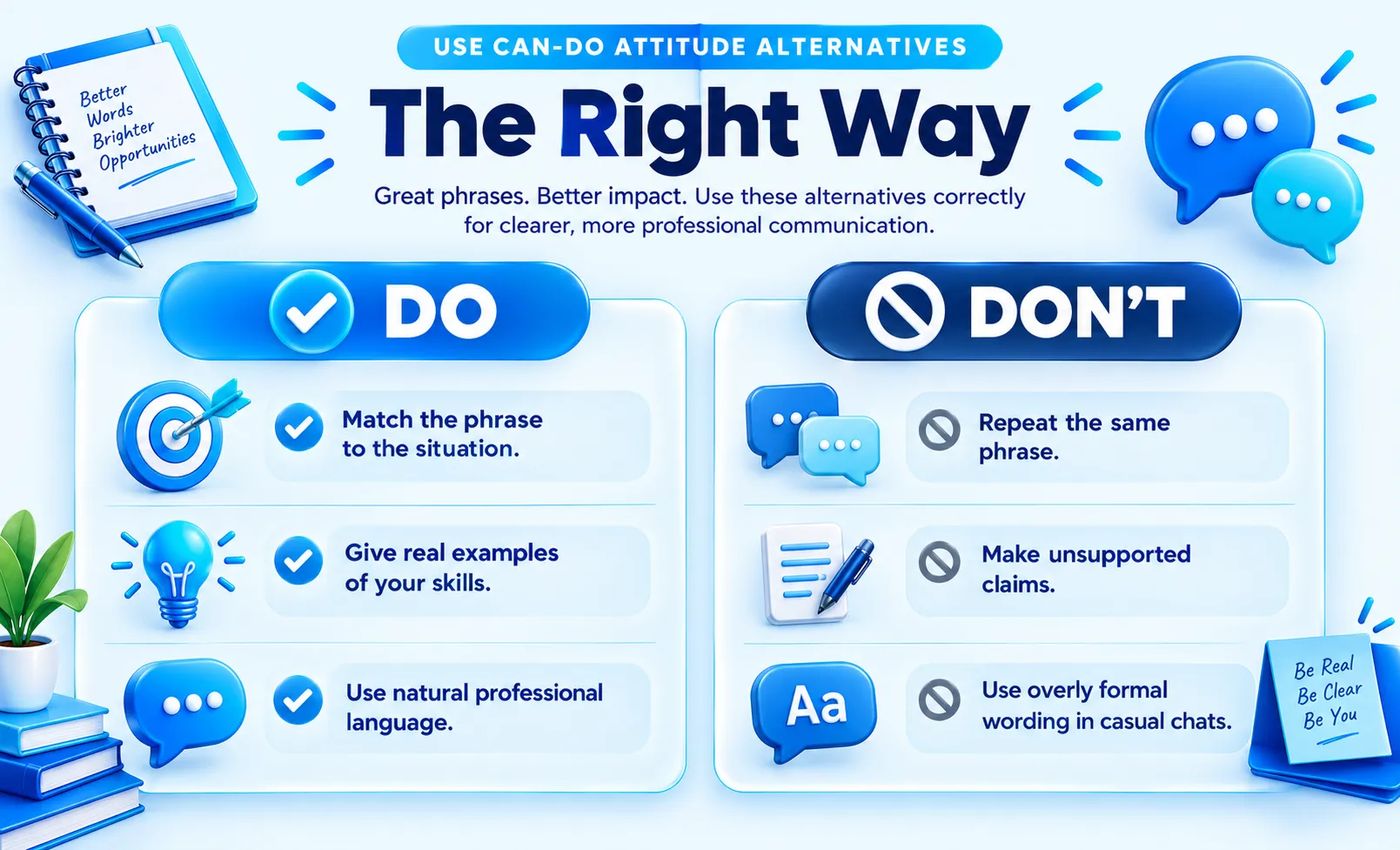
Choosing the right expression can make your writing more convincing. Avoid these five common mistakes to communicate your strengths clearly.
1. Using Casual Phrases in Professional Emails
Expressions such as “ready to tackle anything” can sound enthusiastic but may feel too informal in a formal application or business proposal. Choose “proactive mindset” or “solution-oriented approach” when writing to employers, clients, or senior colleagues.
2. Choosing Overly Formal Language
Not every conversation needs business terminology. Saying “I demonstrate a strong orientation toward proactive problem resolution” in a casual chat sounds unnatural. A simple phrase like “I like finding solutions” communicates the same general idea more clearly.
3. Repeating the Same Phrase Too Often
Using “can-do attitude” several times in a resume or cover letter can make your writing feel repetitive. Alternate it with relevant terms such as “initiative,” “resourcefulness,” and “determination,” but only when they accurately describe your strengths.
4. Forgetting the Context
A phrase that works in one setting may not suit another. “Self-starter” is useful when describing independent work, while “growth mindset” is better for emphasizing learning. Choose words based on the quality you want to communicate.
5. Sounding Insincere or Making Unsupported Claims
Calling yourself proactive or results-driven is more convincing when you provide evidence. Instead of claiming that you can solve every problem, describe a real example of how you identified an issue, took action, and achieved a useful result.
Frequently Asked Questions
1. What is another word for a can-do attitude?
A positive attitude, initiative, resourcefulness, and determination are related expressions. The best choice depends on the quality you want to emphasize. Use “initiative” for independent action, “resourcefulness” for creative problem-solving, and “determination” for persistence when facing obstacles.
2. What is a professional way to say “can-do attitude”?
“Proactive mindset,” “solution-oriented approach,” and “action-oriented mindset” are strong professional alternatives. They describe practical workplace behaviors rather than simply expressing optimism. For a resume or interview, choose the phrase that best matches your experience and support it with an example of how you approach work.
3. How do you describe a can-do attitude on a resume?
Describe the behavior behind the attitude instead of relying on a general statement. For example, write, “Took initiative to improve the website’s mobile layout and resolve usability issues.” This approach gives employers a clearer picture of your skills and shows how your attitude contributes to results.
4. What is a synonym for a can-do attitude at work?
“Proactive mindset,” “strong sense of initiative,” and “positive work ethic” are useful workplace alternatives. A proactive mindset emphasizes anticipating needs, initiative highlights independent action, and a positive work ethic focuses on responsibility and consistent effort. Select the term that best fits the specific job requirement.
5. How do you say someone has a can-do attitude?
You could say, “She takes initiative,” “He focuses on solutions,” or “They approach challenges with confidence.” These expressions describe observable behavior and sound more natural than repeating the original phrase. For a performance review, include a specific example that shows how the person contributed to a team or project.
6. Is “proactive” the same as having a can-do attitude?
Not exactly. A can-do attitude generally describes a willingness to face challenges with confidence and a positive outlook. Being proactive specifically means taking action before a problem arises or someone requests help. Both qualities often appear together, but “proactive” places greater emphasis on anticipating needs and acting independently.
7. What is a positive way to describe someone who solves problems?
You can describe the person as “solution-oriented,” “resourceful,” or someone with a “problem-solving mindset.” Use “solution-oriented” when the person focuses on practical answers, and “resourceful” when they find creative ways to overcome limitations. These terms communicate specific strengths without relying on vague praise.
8. What is a casual way to say “can-do attitude”?
In casual conversations, you might say someone is “always ready to help,” “up for a challenge,” or “good at finding a way forward.” These phrases sound friendly and natural among coworkers and friends. For professional writing, choose a more precise alternative when you need to highlight a particular skill or behavior.
Conclusion

A can-do attitude reflects a willingness to take action, face challenges, and work toward positive results. However, the best alternative depends on the message you want to convey and the audience you are addressing.
For professional settings, “proactive mindset,” “solution-oriented approach,” and “strong sense of initiative” are effective choices. If you want to highlight optimism, use “positive attitude.” For persistence, choose “determined approach,” while “resourceful attitude” works well when describing creative problem-solving.
When writing a resume, cover letter, LinkedIn profile, or performance review, choose language that reflects your actual strengths. Whenever possible, support your description with a specific example of how you handled a challenge, helped a team, or improved a result.
The key takeaway is simple: do more than describe yourself as someone who gets things done. Show readers how you take initiative, solve problems, and turn ideas into action.

The Majestic Studio Editorial Team creates practical resources about synonyms, alternative phrases, vocabulary, and English usage. Our content is designed to help readers choose clearer, more natural words and communicate effectively in everyday, professional, and academic contexts.
Each article is researched, edited, and reviewed for clarity, context, usefulness, and language accuracy. We regularly update our content to keep examples and recommendations relevant.