
Another way to say “check this out” depends on the situation. You can say “take a look at this,” “have a look at this,” “see what you think,” “I’d like to show you this,” or “take a moment to review this.” Casual options work well with friends, while polished alternatives fit professional emails and workplace conversations.
Key Takeaways
- “Check this out” is a casual way to ask someone to look at or consider something.
- “Take a look at this” is one of the most natural alternatives for everyday use.
- Professional settings often call for phrases such as “please review this” or “I’d like to show you this.”
- Your choice should depend on your audience, relationship, and communication channel.
- Avoid overly formal alternatives when a simple, friendly phrase sounds more natural.
What Does “Another Way to Say Check This Out” Mean?
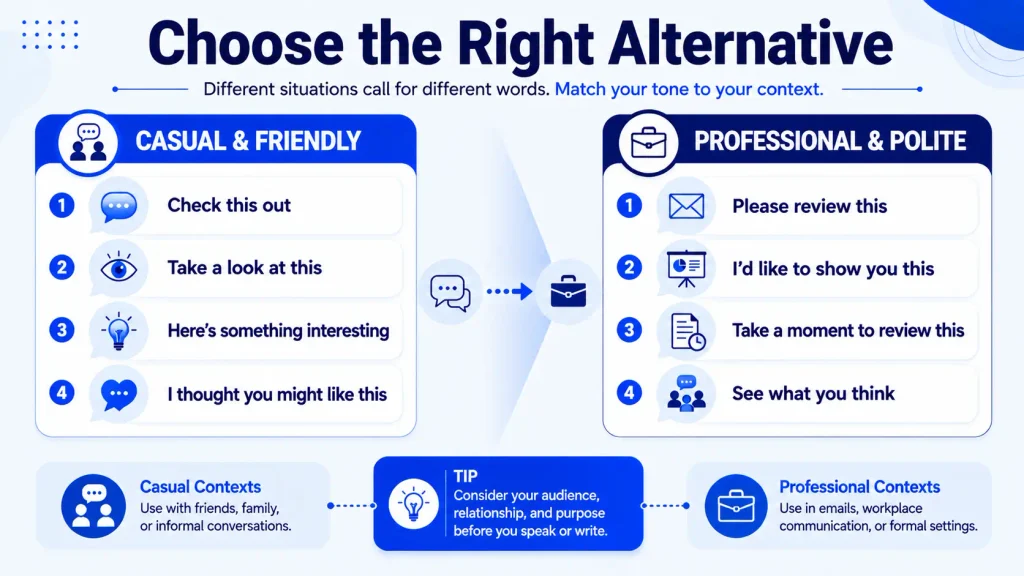
“Check this out” is an informal expression used to draw someone’s attention to something interesting, useful, surprising, or important. You might use it when sharing a photo, website, idea, product, document, video, or piece of information.
For example, a friend might say, “Check this out—I found a great new restaurant.” At work, however, a more polished phrase such as “Take a look at this” may sound more appropriate.
The best alternative depends on who you are talking to, what you are sharing, and how formal the situation is.
Why Use Other Ways to Say “Check This Out”?
Using different expressions helps your communication sound more natural and precise. While “check this out” is perfectly acceptable in casual conversation, it may feel too informal in certain professional situations.
Other phrases can help you:
- Avoid repeating the same expression.
- Match your tone to your audience.
- Sound more professional in workplace communication.
- Make a recommendation feel warmer or more personal.
- Invite someone to review something without sounding demanding.
- Show excitement when sharing something interesting.
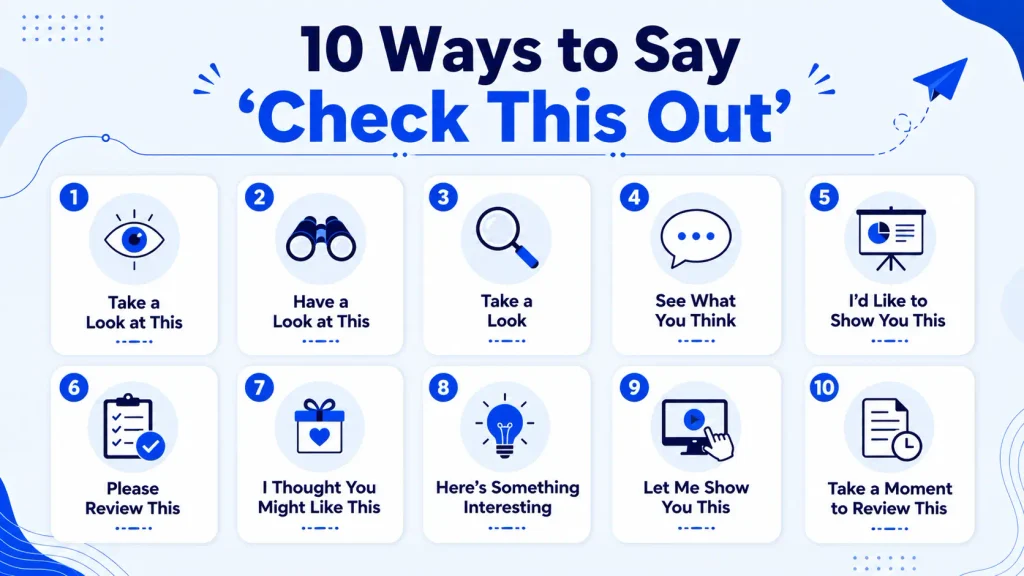
10 Best Other Ways to Say “Check This Out”
1. Take a Look at This
Meaning
“Take a look at this” is a natural and versatile alternative to “check this out.” It asks someone to look at something without sounding overly casual or formal.
Best For
- Professional
- Casual
- Friendly
- Polite
Example 1
“Take a look at this report before we discuss the results.”
Example 2
“Take a look at this photo from our trip—it turned out great.”
Quick Tip
Use this phrase when you want a safe, natural option that works in both personal and workplace conversations.
2. Have a Look at This
Meaning
“Have a look at this” invites someone to examine or view something. It sounds friendly and slightly softer than a direct command.
Best For
- Professional
- Casual
- Friendly
- Polite
Example 1
“Have a look at this draft and let me know what you think.”
Example 2
“Have a look at this jacket; I think it would suit you.”
Quick Tip
This phrase works especially well when you want to invite someone’s opinion rather than simply tell them to view something.
3. Take a Look
Meaning
“Take a look” is a shorter version of “take a look at this.” It is simple, flexible, and easy to use when the object is already clear from the conversation.
Best For
- Professional
- Casual
- Friendly
- Polite
Example 1
“I updated the homepage. Take a look when you have a chance.”
Example 2
“Take a look and tell me which design you prefer.”
Quick Tip
Use it when the person already knows what you are referring to, so you do not need to repeat the subject.
4. See What You Think
Meaning
“See what you think” focuses on getting someone’s reaction or opinion. It is useful when you want feedback instead of simply asking someone to look at something.
Best For
- Professional
- Casual
- Friendly
- Warm
Example 1
“I made a few changes to the proposal. See what you think.”
Example 2
“I found three hotels for our trip. See what you think of these options.”
Quick Tip
Choose this phrase when the other person’s judgment or feedback matters.
5. I’d Like to Show You This
Meaning
“I’d like to show you this” is a polite and professional way to introduce something. It creates a smoother transition than the highly casual “check this out.”
Best For
- Professional
- Formal
- Polite
- Warm
Example 1
“I’d like to show you this new layout before we finalize the website.”
Example 2
“I’d like to show you this feature because it could save the team time.”
Quick Tip
This is a strong choice for meetings, presentations, client conversations, and other professional settings.
6. Please Review This
Meaning
“Please review this” directly asks someone to examine something carefully. It is more formal and task-focused than “check this out.”
Best For
- Professional
- Formal
- Polite
Example 1
“Please review this document and send me your comments by Friday.”
Example 2
“Please review this proposal before the client meeting.”
Quick Tip
Use this phrase when you need careful consideration or feedback, especially for documents and work assignments.
7. I Thought You Might Like This
Meaning
“I thought you might like this” makes the recommendation feel personal and considerate. It works well when sharing something based on someone’s interests.
Best For
- Casual
- Friendly
- Warm
- Polite
Example 1
“I thought you might like this new coffee shop near the office.”
Example 2
“I thought you might like this article about beginner photography.”
Quick Tip
Use it when you want to explain why you are sharing something instead of simply directing attention to it.
8. Here’s Something Interesting
Meaning
“Here’s something interesting” introduces information that you believe will catch someone’s attention. It creates curiosity without sounding like an instruction.
Best For
- Casual
- Friendly
- Warm
Example 1
“Here’s something interesting: this building was designed more than a century ago.”
Example 2
“Here’s something interesting I learned about the company’s history.”
Quick Tip
This expression works well when sharing facts, stories, discoveries, or surprising information.
9. Let Me Show You This
Meaning
“Let me show you this” signals that you are about to present something directly. It sounds confident and conversational while remaining more polished than “check this out.”
Best For
- Professional
- Casual
- Friendly
- Warm
Example 1
“Let me show you this feature so you can see how it works.”
Example 2
“Let me show you this room before you decide where to sit.”
Quick Tip
Use it when you are physically presenting something or guiding someone through a screen, product, design, or idea.
10. Take a Moment to Review This
Meaning
“Take a moment to review this” politely asks someone to spend some time examining information. It sounds more deliberate and professional than casual alternatives.
Best For
- Professional
- Formal
- Polite
Example 1
“Please take a moment to review this updated project timeline.”
Example 2
“Take a moment to review this information before submitting your application.”
Quick Tip
Use this option when the material deserves more than a quick glance, such as instructions, proposals, or important documents.
Comparison Table
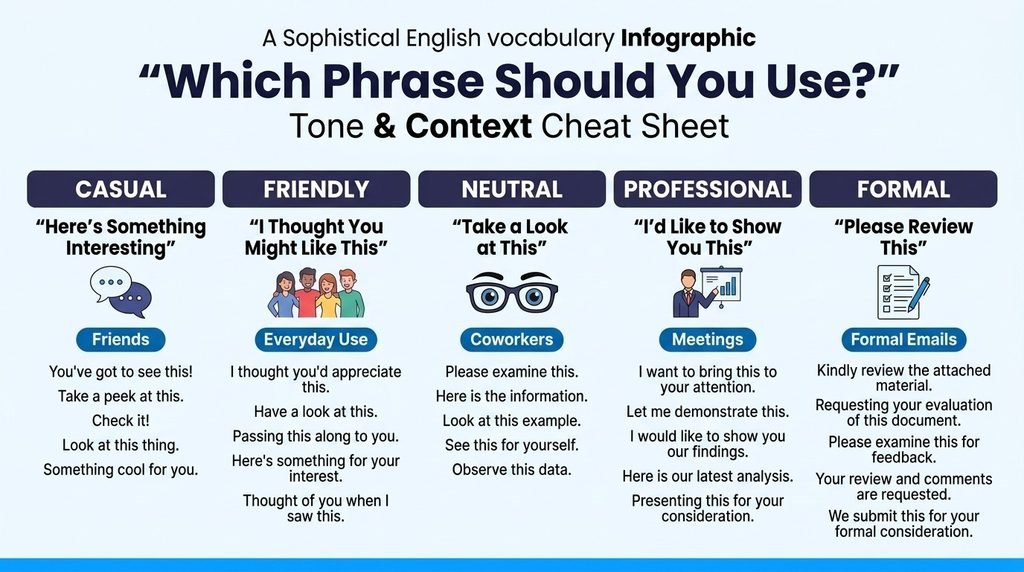
| Alternative | Best Used In | Tone |
| Take a Look at This | Work and everyday conversations | Neutral, friendly |
| Have a Look at This | Work and personal conversations | Polite, friendly |
| Take a Look | General situations | Neutral |
| See What You Think | Feedback and recommendations | Warm, collaborative |
| I’d Like to Show You This | Meetings and presentations | Professional, polite |
| Please Review This | Documents and work tasks | Formal, direct |
| I Thought You Might Like This | Personal recommendations | Warm, friendly |
| Here’s Something Interesting | Casual sharing | Friendly, engaging |
| Let Me Show You This | Demonstrations and presentations | Conversational, confident |
| Take a Moment to Review This | Important information | Professional, formal |
Common Mistakes
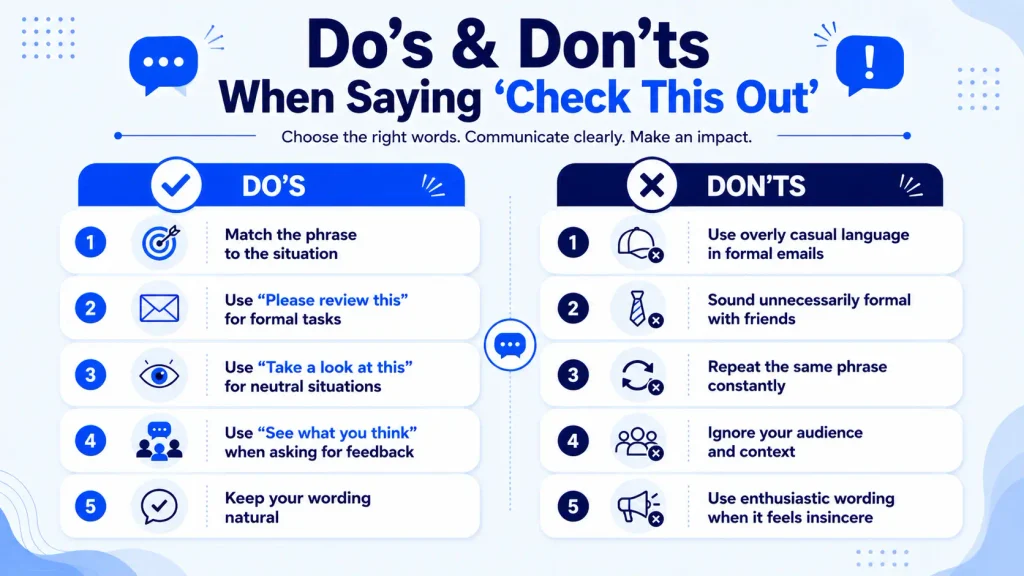
- Using casual phrases in professional emails
“Check this out” can sound too informal when writing to a client, manager, or business partner. Consider “Please review this” or “Take a look at this” instead. - Choosing overly formal language
Not every situation requires formal wording. Saying “Please review this material” to a close friend may sound stiff when “Take a look at this” would feel more natural. - Repeating the same phrase
Using “check this out” several times in one conversation or article can become repetitive. Switching between natural alternatives keeps your communication fresh. - Forgetting the context
“See what you think” asks for an opinion, while “Please review this” suggests a more careful examination. Choose a phrase that matches your actual purpose. - Sounding insincere or overly enthusiastic
Expressions such as “Here’s something interesting” should introduce something genuinely relevant or useful. Avoid using enthusiastic language simply to get attention.
Frequently Asked Questions
What is a professional way to say “check this out”?
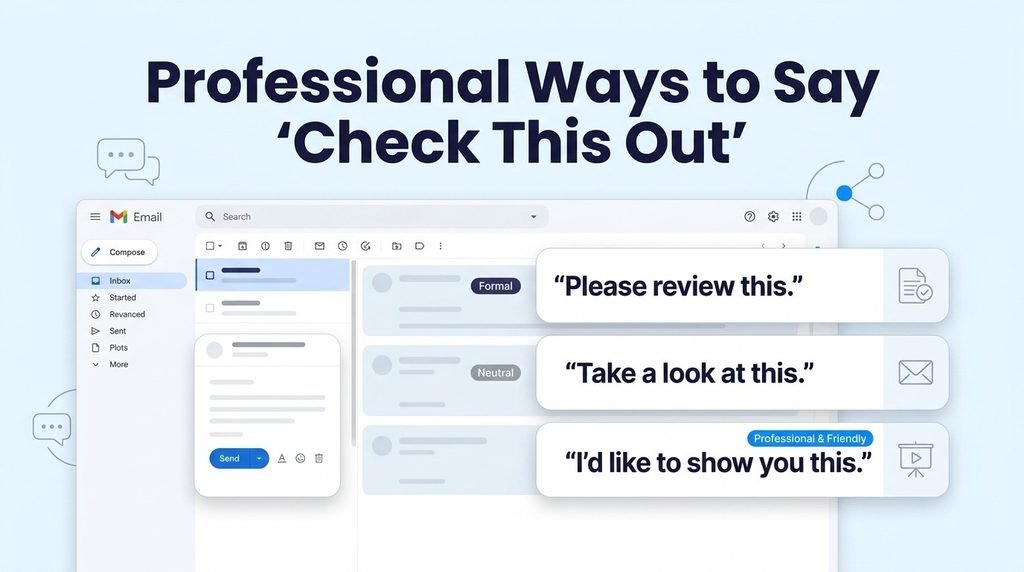
A professional alternative is “Please review this” when you need someone to examine information carefully. For a less formal workplace setting, “Take a look at this” or “I’d like to show you this” sounds natural. The best choice depends on whether you want the person to review, view, or respond to the material.
What is a casual way to say “check this out”?
“Take a look at this,” “Have a look at this,” and “Here’s something interesting” are natural casual alternatives. Among these, “Take a look at this” is especially flexible because you can use it with friends, family members, coworkers, or other people in relaxed conversations.
How do you say “check this out” in an email?
In an email, you can say “Please take a look at this,” “Please review this,” or “I’d like to share this with you.” Choose “Please review this” when you need detailed feedback and “Take a look at this” when you simply want the recipient to view something.
Is “take a look at this” better than “check this out”?
Neither phrase is always better. “Check this out” sounds more casual and energetic, while “take a look at this” is more neutral and versatile. If you are speaking with friends, either can work. In professional communication, “take a look at this” is usually the safer choice.
What is another way to say “check this out” at work?
At work, you can say “Take a look at this,” “Please review this,” “I’d like to show you this,” or “See what you think.” Use “Please review this” for documents that require careful attention and “See what you think” when you are specifically asking for someone’s opinion.
How can I politely ask someone to look at something?
Try “Could you take a look at this?” or “Would you mind taking a look at this?” These versions are more polite because they turn the request into a question. For formal workplace communication, “Could you please review this when you have a chance?” is also a good option.
Can “check this out” be used in professional communication?
Yes, but it depends on the workplace and audience. The phrase is informal, so it may be perfectly acceptable in a relaxed team chat. However, for clients, formal emails, reports, or important business communication, a phrase such as “Please review this” or “Take a look at this” is usually more appropriate.
What is the best alternative to “check this out”?
“Take a look at this” is the best all-purpose alternative because it sounds natural, clear, and polite in many situations. However, there is no single best phrase for every context. Use “Please review this” for formal tasks, “See what you think” for feedback, and “I thought you might like this” for personal recommendations.
Conclusion
There are many natural ways to say “check this out,” and the best choice depends on your audience and purpose. “Take a look at this” is a versatile option that works in both casual and professional conversations. If you want someone’s opinion, “See what you think” sounds collaborative and friendly. For workplace documents, “Please review this” provides a clearer and more professional request.
When sharing something based on someone’s interests, “I thought you might like this” adds a warmer personal touch. Meanwhile, “I’d like to show you this” works well during presentations or client conversations. The key is to choose language that matches the situation rather than relying on one phrase every time. A small change in wording can make your communication sound more natural, polite, and purposeful.
For workplace documents, “Please review this” provides a clearer and more professional request. For more guidance on choosing appropriate language in workplace contexts, see this resource on professional communication.

Editorial contributors help develop practical English-language resources covering vocabulary, expressions, synonyms, and writing. Contributions focus on clear explanations, useful examples, and context so readers can understand not only what a phrase means, but when and how to use it naturally.