
Featured Snippet:
Another way to say “clean up” depends on the situation. Common alternatives include tidy up, straighten up, clear away, organize, put in order, declutter, spruce up, sanitize, tidy, and put away. Use casual options like “tidy up” in everyday conversation and more specific choices such as “sanitize” when discussing cleanliness or hygiene.
Key Takeaways
- “Clean up” can mean removing dirt, organizing a space, or putting things away.
- Tidy up and straighten up are natural choices for everyday conversations.
- Organize and put in order work well when arranging items systematically.
- Sanitize is more appropriate when the goal is to remove germs or reduce contamination.
- The best alternative depends on what you are cleaning and the tone of the situation.
What Does “Another Way to Say Clean Up” Mean?
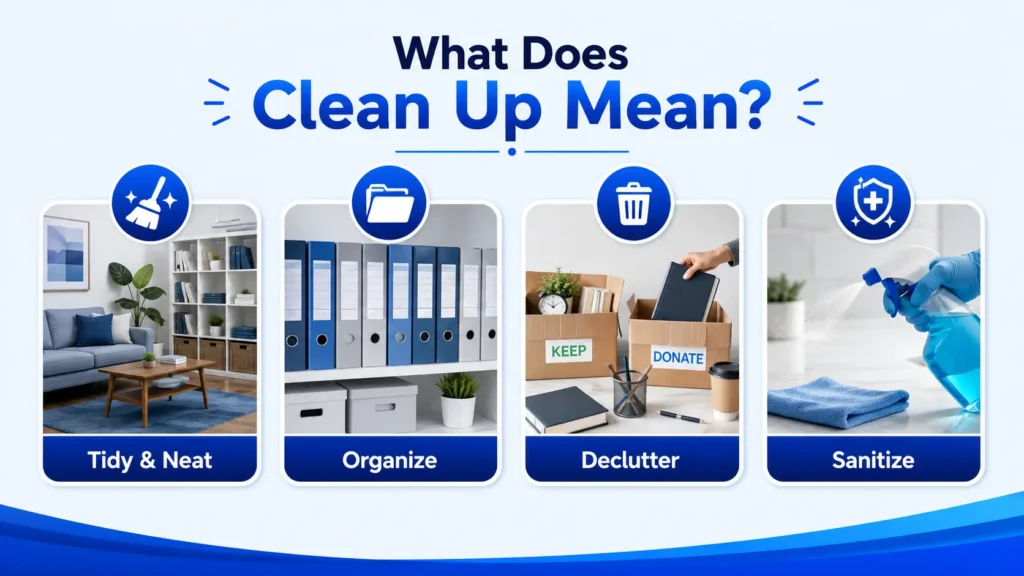
The phrase “another way to say clean up” refers to different words or expressions that communicate the same or a similar idea as clean up.
“Clean up” is a flexible phrasal verb. It can mean removing dirt, putting objects in their proper places, organizing a messy area, or making something look neat. For example, you might clean up your bedroom, clean up after dinner, or clean up a work area.
Because the phrase works in many situations, choosing a more specific alternative can make your writing or conversation clearer.
Why Use Other Ways to Say “Clean Up”?
Using a different expression can help you describe exactly what you mean instead of relying on the same phrase repeatedly.
Other alternatives can help you:
- Avoid repeating “clean up” in conversation or writing.
- Make your meaning more precise.
- Match the tone to a professional, casual, or formal situation.
- Describe organizing, removing clutter, or disinfecting more accurately.
- Make instructions sound more natural and specific.
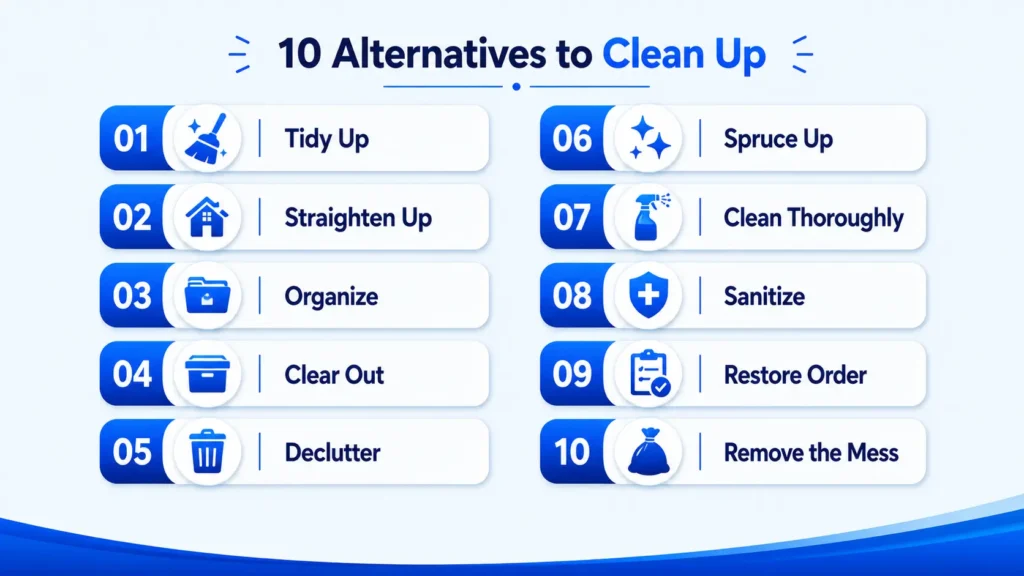
10 Best Other Ways to Say “Clean Up”
1. Tidy Up
Meaning
Tidy up means to make a space neat by putting things where they belong or removing visible mess. It usually focuses more on organization and appearance than on deep cleaning.
Best For
- Casual
- Friendly
- Polite
Example 1
Please tidy up the living room before our guests arrive.
Example 2
I spent Saturday morning tidying up my home office.
Quick Tip
Use “tidy up” when you want someone to make a messy space look neat without suggesting heavy cleaning.
2. Straighten Up
Meaning
Straighten up means to arrange things neatly or restore order to a room, desk, or other area. It is especially common in everyday American English.
Best For
- Casual
- Friendly
- Polite
Example 1
Could you straighten up the kitchen after breakfast?
Example 2
She straightened up her desk before starting the meeting.
Quick Tip
Choose “straighten up” when the main problem is disorder rather than dirt.
3. Organize
Meaning
Organize means to arrange items, information, or a space in a logical and orderly way. Unlike “clean up,” it often suggests creating a system rather than simply removing a mess.
Best For
- Professional
- Formal
- Polite
Example 1
I need to organize the files on my computer before the project begins.
Example 2
He organized the storage room by grouping similar supplies together.
Quick Tip
Use “organize” when you are creating order or arranging things systematically.
4. Declutter
Meaning
Declutter means to remove unnecessary, unwanted, or unused items from a space. It focuses on reducing excess rather than simply making things look neat.
Best For
- Casual
- Friendly
- Professional
Example 1
We decided to declutter the garage before winter.
Example 2
Decluttering my bedroom made it much easier to find what I needed.
Quick Tip
Use “declutter” when getting rid of unnecessary belongings is an important part of the task.
5. Put in Order
Meaning
Put in order means to arrange something neatly or restore it to an organized condition. It can describe physical spaces, documents, records, or even plans.
Best For
- Formal
- Professional
- Polite
Example 1
Please put the conference room in order after the presentation.
Example 2
She put the paperwork in order before submitting the application.
Quick Tip
This phrase works particularly well when you want a more polished alternative to “clean up.”
6. Clear Away
Meaning
Clear away means to remove unwanted objects, dishes, clutter, or other items from a particular area. It often describes removing things after an activity.
Best For
- Casual
- Friendly
- Polite
Example 1
Let’s clear away the dishes before we start dessert.
Example 2
The staff quickly cleared away the empty boxes from the hallway.
Quick Tip
Use “clear away” when the main action involves removing items from a surface or area.
7. Put Away
Meaning
Put away means to return something to its proper storage place after using it. It does not necessarily mean cleaning the item itself.
Best For
- Casual
- Friendly
- Polite
Example 1
Please put away your shoes before coming into the house.
Example 2
The children put away their toys after finishing their game.
Quick Tip
Use “put away” when the goal is specifically to return belongings to their designated places.
8. Spruce Up
Meaning
Spruce up means to improve the appearance of a place, object, or space by making small changes or giving it a cleaner, fresher look. It is informal and often suggests a quick improvement.
Best For
- Casual
- Friendly
- Warm
Example 1
We’re going to spruce up the backyard before the family barbecue.
Example 2
A fresh coat of paint helped spruce up the old guest room.
Quick Tip
“Spruce up” is a good choice when you want to emphasize making something look better rather than performing a thorough cleaning.
9. Sanitize
Meaning
Sanitize means to clean something in a way that reduces germs or harmful microorganisms to a safer level. It is more specific than “clean up” and is commonly used for hands, surfaces, kitchens, and shared equipment.
Best For
- Professional
- Formal
Example 1
Employees should sanitize shared equipment after each use.
Example 2
Please sanitize the kitchen counters before preparing the food.
Quick Tip
Use “sanitize” when hygiene and reducing germs are more important than simply making an area look neat.
10. Make Neat
Meaning
Make neat means to arrange or improve the appearance of something so it looks orderly and presentable. It is useful when the goal is mainly visual neatness.
Best For
- Casual
- Friendly
- Polite
Example 1
She made the guest room neat before her parents arrived.
Example 2
Let’s make the reception area neat before the clients come in.
Quick Tip
“Make neat” is useful when you want to emphasize the final appearance of a space rather than deep cleaning.
Comparison Table
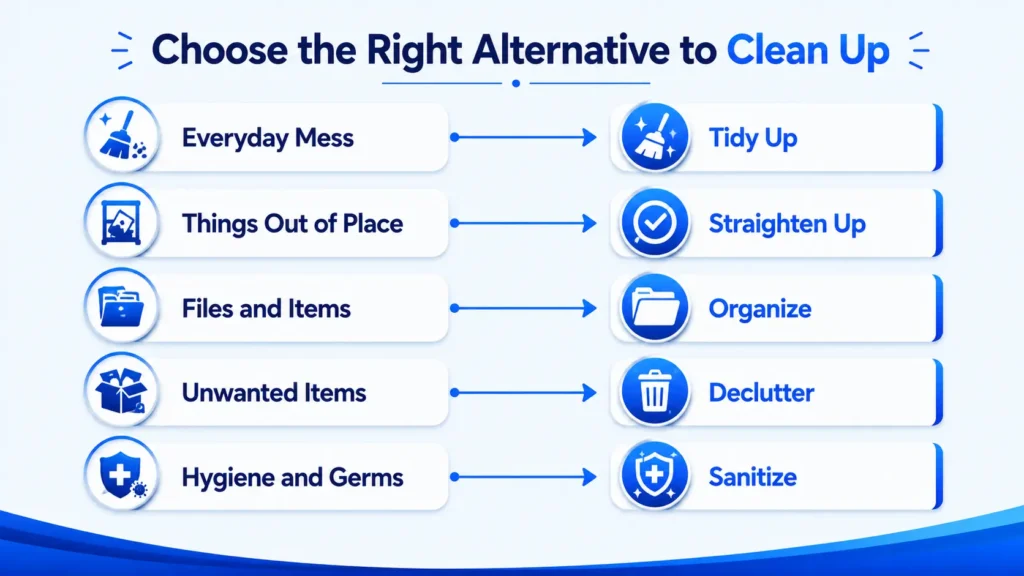
| Alternative | Best Used In | Tone |
| Tidy up | Everyday conversations | Casual, friendly |
| Straighten up | Rooms, desks, homes | Casual, polite |
| Organize | Files, spaces, belongings | Professional, formal |
| Declutter | Removing unnecessary items | Casual, practical |
| Put in order | Spaces, documents, records | Formal, professional |
| Clear away | Dishes, boxes, clutter | Casual, polite |
| Put away | Toys, clothes, belongings | Casual, friendly |
| Spruce up | Improving appearance | Casual, warm |
| Sanitize | Germs, surfaces, equipment | Professional, formal |
| Make neat | Improving appearance | Casual, polite |
Common Mistakes
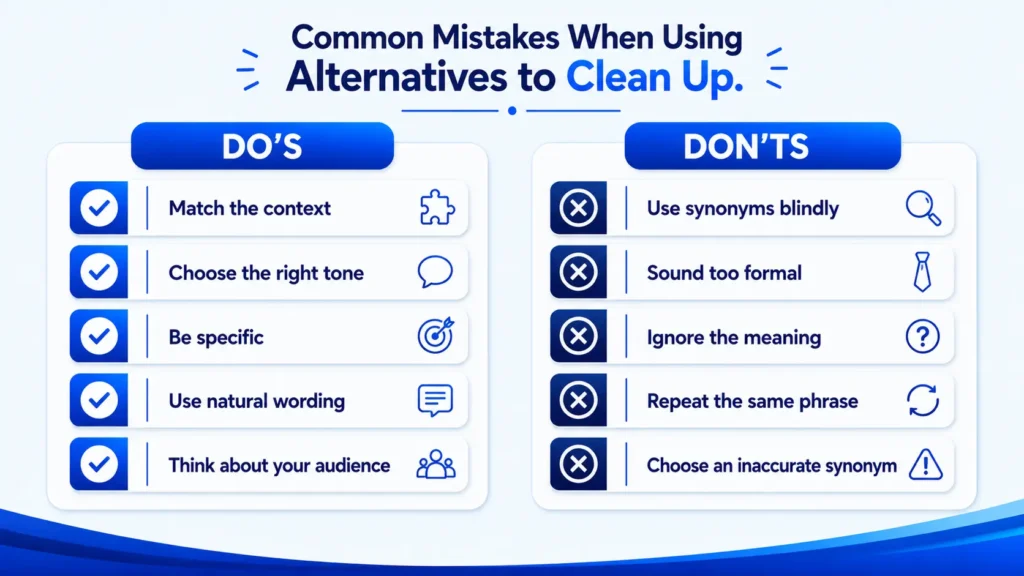
1. Using Casual Phrases in Professional Situations
Expressions such as “spruce up” may sound too informal in certain business contexts. In professional writing, “organize,” “sanitize,” or “put in order” may communicate the task more clearly.
2. Assuming Every Alternative Means Exactly the Same Thing
These phrases are related but not identical. “Put away” means returning items to storage, while “sanitize” specifically relates to reducing germs.
3. Using “Declutter” When You Only Mean Cleaning
Decluttering involves removing unnecessary belongings. If you simply want to remove dirt or stains, “clean” or “sanitize” may be more accurate.
4. Ignoring the Context
The right expression depends on what you are cleaning and why. “Straighten up the office” sounds natural, while “sanitize the office” communicates a very different task.
5. Repeating the Same Expression
Using “clean up” several times in the same paragraph can make your writing feel repetitive. Choose a precise alternative when it naturally fits the meaning.
Frequently Asked Questions
What is a better word for “clean up”?
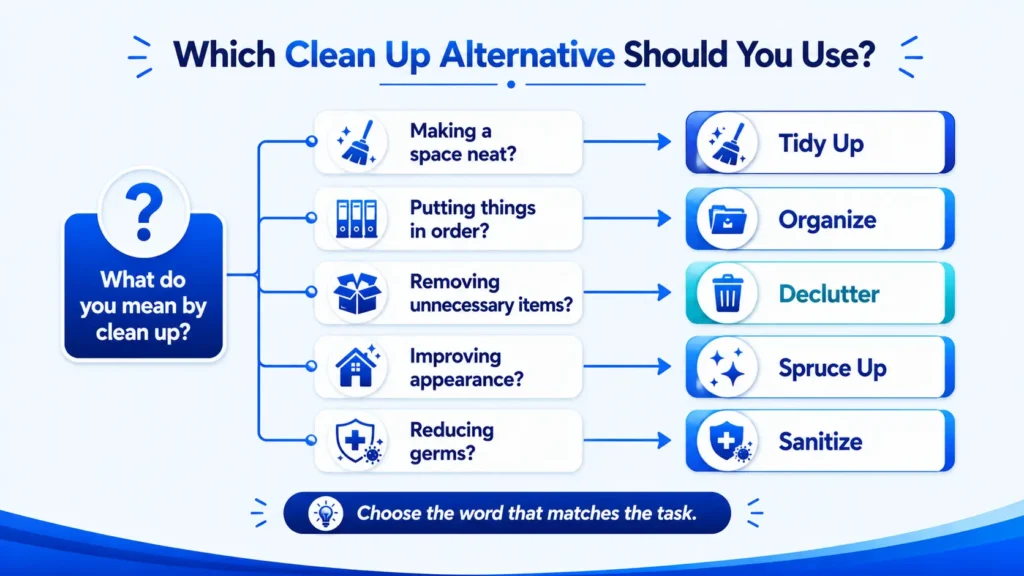
A better word depends on what you mean by “clean up.” Tidy up works well for making a space neat, organize fits arranging things systematically, declutter means removing unnecessary items, and sanitize refers to reducing germs. Choosing the most precise word makes your communication clearer.
What is another way to say “clean up” a room?
You can say tidy up the room, straighten up the room, organize the room, or put the room in order. “Tidy up” is probably the most natural everyday alternative when you mean putting belongings in their proper places and making the room look neat.
What is a professional way to say “clean up”?
In professional communication, alternatives such as organize, put in order, clear away, or sanitize can work depending on the task. For example, “Please organize the workspace” sounds more precise than “Please clean up the workspace” when you are specifically asking someone to arrange materials.
Is “tidy up” the same as “clean up”?
Not always. “Tidy up” usually means putting things in order and making an area look neat, while “clean up” can include removing dirt, washing surfaces, throwing away trash, or organizing objects. Therefore, “tidy up” is best when the main issue is clutter or disorder.
What is another way to say “clean up the mess”?
Natural alternatives include tidy up the mess, straighten things out, clear away the clutter, and put everything in order. The best choice depends on the situation. “Tidy up the mess” sounds casual, while “put everything in order” has a slightly more polished tone.
What is a polite way to ask someone to clean up?
You can make the request softer by saying, “Could you please tidy up the area?” or “Would you mind putting things away?” These expressions sound less demanding than a direct command. Adding “please” also helps make the request courteous in everyday and workplace situations.
What is another word for cleaning and organizing?
Organizing, tidying, and decluttering can describe different parts of cleaning and arranging a space. “Tidying” focuses on making things neat, “organizing” focuses on arranging them logically, and “decluttering” involves removing unnecessary items.
What is the difference between “clean up” and “sanitize”?
“Clean up” is a broad expression that can refer to removing dirt, clutter, trash, or disorder. “Sanitize” is more specific and refers to reducing germs or microorganisms on a surface or object. For hygiene-related instructions, “sanitize” is often the more accurate word.
Conclusion
There are many natural ways to say “clean up,” but the best alternative depends on the exact action you mean. For everyday situations, tidy up and straighten up are easy, natural choices. If you are arranging files or creating a system, organize is more precise. When you are removing unnecessary belongings, declutter communicates the idea better. Understanding the meaning and usage of “clean up” can also help you choose the most accurate alternative.
For specific cleaning tasks, clear away, put away, and sanitize can make your meaning much clearer. Meanwhile, spruce up works well when you want to improve the appearance of something.
The key is to choose a phrase that matches both the situation and your intended meaning. A precise alternative can make your conversation or writing sound more natural, clear, and professional.

Sajid Ali is a web developer and digital publisher with experience in website development, WordPress, content publishing, and digital projects. He is interested in creating useful, well-structured online resources that make information easier to discover and understand.
At Majestic Studio, Sajid focuses on website development, content publishing, SEO-focused site structure, and maintaining a clear and user-friendly reading experience. He works with a practical, research-driven approach and continuously improves content and website usability based on reader needs and search behavior.