

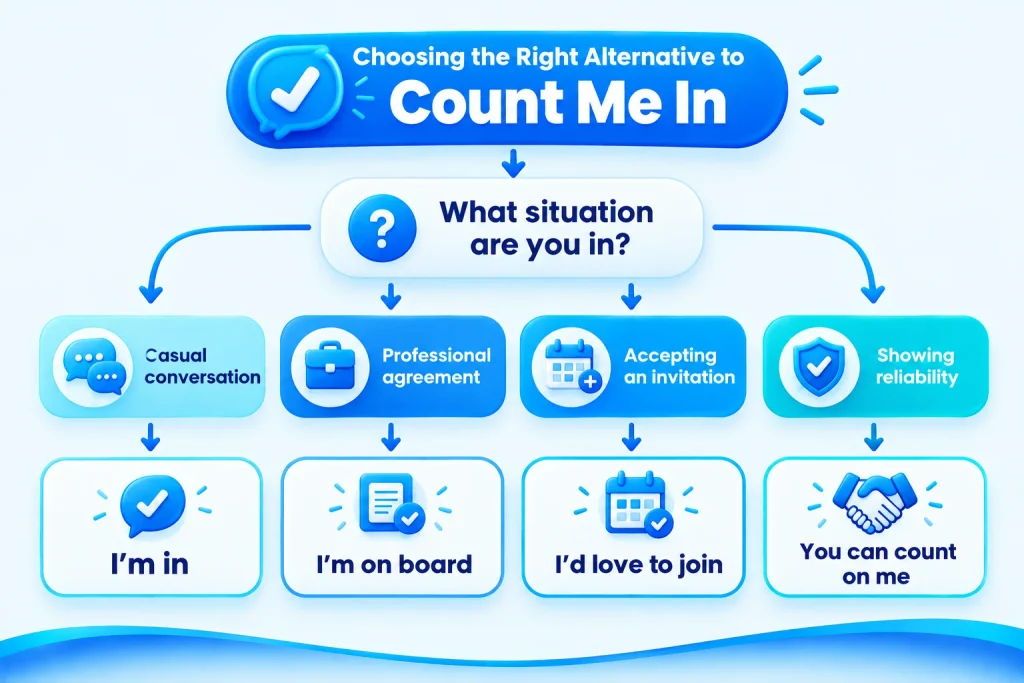
If you need another way to say “count me in,” you can use phrases such as “I’m in,” “I’m on board,” “I’d love to join,” “Sign me up,” or “I’m interested.” The best choice depends on the situation, relationship, and tone. Casual phrases work well with friends, while professional options fit workplace conversations and emails.
Key Takeaways
- “Count me in” means you are willing and ready to participate.
- “I’m in” is the simplest casual alternative.
- “I’m on board” works especially well in professional settings.
- “I’d love to join” adds warmth and enthusiasm.
- The best phrase depends on the audience, setting, and level of excitement.
What Does “Another Way to Say Count Me In” Mean?
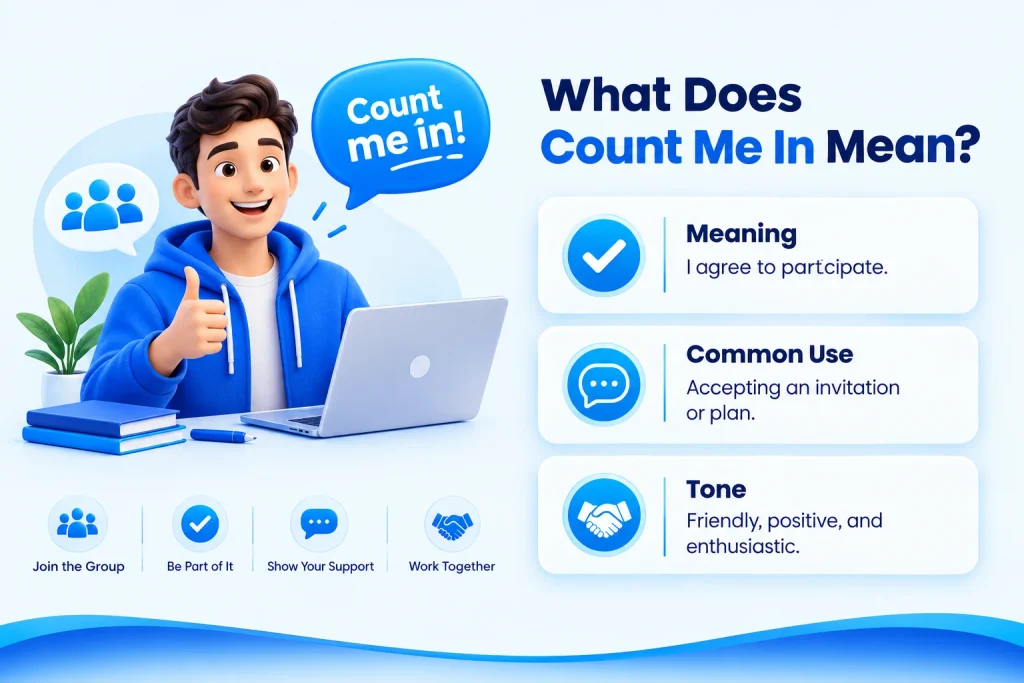
“Count me in” is an informal expression that means you want to participate in something or agree to be included. People commonly use it when accepting an invitation, joining a plan, supporting an idea, or volunteering for an activity.
For example, if a coworker asks, “Would you like to join us for lunch?” you might say, “Count me in.” A friend might use the same phrase when inviting you to a weekend trip or game night.
The expression sounds positive, friendly, and enthusiastic. However, you may want a different phrase when writing a professional email, responding formally, or trying to express a specific level of interest.
Why Use Other Ways to Say “Count Me In”?
Using different expressions can make your communication more natural and precise. Instead of relying on the same phrase every time, you can choose wording that matches the situation.
Other ways to say “count me in” can help you:
- Avoid repeating the same expression.
- Sound more natural in different conversations.
- Match casual, friendly, or professional situations.
- Show enthusiasm more clearly.
- Express agreement without sounding repetitive.
- Make workplace communication more polished.
The key is not simply finding a synonym. You should choose a phrase that communicates the right level of interest and commitment.
10 Best Other Ways to Say “Count Me In”
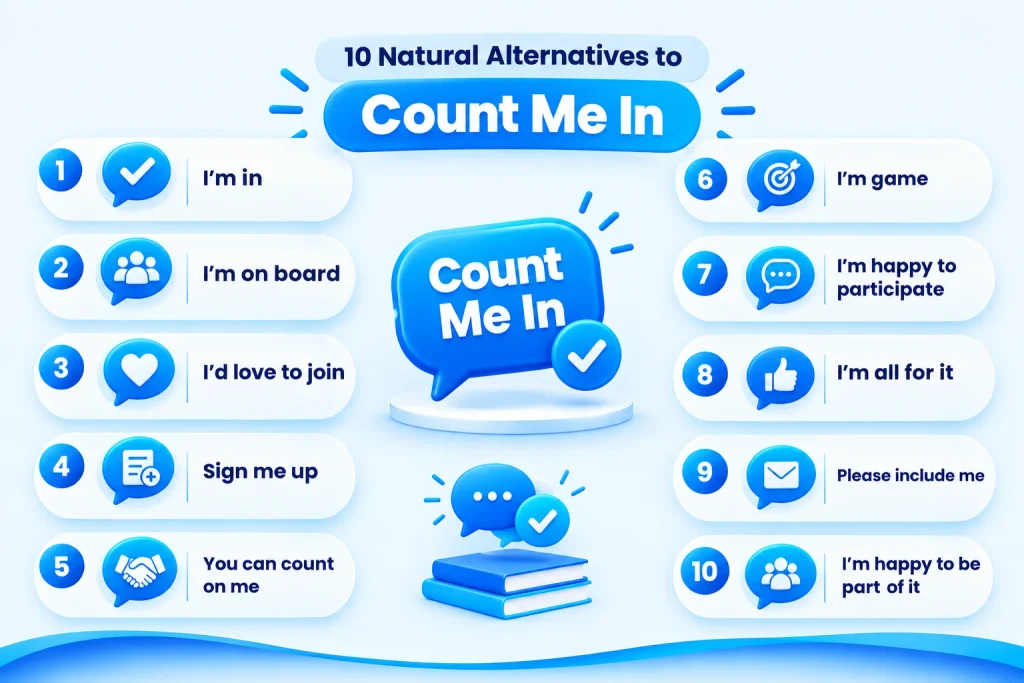
1. “I’m In”
Meaning
“I’m in” is one of the closest and most natural alternatives to “count me in.” It tells someone that you agree to participate or support the proposed plan.
The phrase is short, confident, and easy to use in everyday American English.
Best For
- Casual
- Friendly
- Warm
Example 1
“I’m in for the hiking trip this Saturday.”
Example 2
“You’re ordering pizza for everyone? I’m in.”
Quick Tip
Use “I’m in” when you want to sound enthusiastic without making your response overly formal.
2. “I’m On Board”
Meaning
“I’m on board” means that you agree with a plan, idea, or decision and are willing to support it. It is especially useful when participation involves cooperation or agreement.
Unlike some casual alternatives, this phrase fits comfortably into many workplace conversations.
Best For
- Professional
- Friendly
- Polite
Example 1
“I’m on board with the new marketing strategy.”
Example 2
“If the team wants to move the meeting to Friday, I’m on board.”
Quick Tip
Choose this expression when you want to communicate both agreement and support.
3. “Sign Me Up”
Meaning
“Sign me up” expresses strong interest in participating in an activity, event, opportunity, or experience. It often carries an upbeat and enthusiastic tone.
The phrase can sound playful, so it works best in informal or friendly communication.
Best For
- Casual
- Friendly
- Warm
Example 1
“A free cooking class downtown? Sign me up!”
Example 2
“If you’re putting together a weekend photography workshop, sign me up.”
Quick Tip
Use “sign me up” when you want your enthusiasm to be obvious.
4. “I’d Love to Join”
Meaning
“I’d love to join” is a warm and polite way to accept an invitation or indicate that you want to participate. It sounds more personal than simply saying “I’m in.”
This phrase works well when someone has specifically invited you to an activity or gathering.
Best For
- Friendly
- Warm
- Polite
Example 1
“I’d love to join you for dinner after the conference.”
Example 2
“Thanks for inviting me to the book club. I’d love to join.”
Quick Tip
Use this option when you want to combine acceptance with genuine warmth.
5. “I’m Interested”
Meaning
“I’m interested” communicates that something has caught your attention and that you may want to participate. It is slightly less committed than “count me in.”
That makes it useful when you want to show interest without promising that you will definitely participate.
Best For
- Professional
- Formal
- Polite
Example 1
“I’m interested in joining the training program next month.”
Example 2
“I’m interested in learning more about the volunteer opportunity.”
Quick Tip
Choose this phrase when you are interested but still need more information before making a final commitment.
6. “I’d Be Happy to Join”
Meaning
“I’d be happy to join” is a courteous way to accept an invitation or offer your participation. It sounds positive without being overly casual.
It is particularly useful when you want to maintain a friendly but professional tone.
Best For
- Professional
- Polite
- Warm
Example 1
“I’d be happy to join the planning committee.”
Example 2
“I’d be happy to join the client call if you need another team member.”
Quick Tip
Use this phrase when you want to sound cooperative and willing while keeping your language polished.
7. “I’m Up for It”
Meaning
“I’m up for it” means you are willing to do something and are open to the proposed activity. It usually sounds relaxed and conversational.
The phrase is common in everyday American English and works particularly well between friends, family members, and familiar coworkers.
Best For
- Casual
- Friendly
- Warm
Example 1
“I’m up for it if you want to try that new restaurant tonight.”
Example 2
“We could watch a movie after dinner. I’m up for it.”
Quick Tip
Use this phrase for informal plans when you want to sound relaxed rather than highly enthusiastic.
8. “I’ll Join You”
Meaning
“I’ll join you” clearly tells someone that you intend to participate with them. It is direct and works especially well when the activity is already planned.
The phrase focuses on your decision to participate rather than your general agreement with an idea.
Best For
- Casual
- Friendly
- Polite
Example 1
“If you’re heading to the coffee shop, I’ll join you.”
Example 2
“I’ll join you for the team lunch after the presentation.”
Quick Tip
Use this expression when you are accepting a specific invitation or joining someone who is already doing something.
9. “I’d Like to Participate”
Meaning
“I’d like to participate” is a more formal alternative to “count me in.” It clearly communicates your willingness to take part in an activity, program, meeting, or project.
Because of its professional tone, it is useful in workplace, academic, and organized group settings.
Best For
- Professional
- Formal
- Polite
Example 1
“I’d like to participate in the upcoming leadership workshop.”
Example 2
“I’d like to participate in the community outreach project.”
Quick Tip
Use this option when clarity and professionalism matter more than casual enthusiasm.
10. “You Can Include Me”
Meaning
“You can include me” tells someone that you want to be part of a planned activity, group, project, or event. It is straightforward and emphasizes that you are available to participate.
The phrase can work in both casual and professional contexts depending on the surrounding conversation.
Best For
- Professional
- Casual
- Polite
Example 1
“You can include me in the afternoon meeting.”
Example 2
“If you’re making a list of volunteers, you can include me.”
Quick Tip
Choose this phrase when you want to make your participation clear without sounding overly excited or informal.
Comparison Table
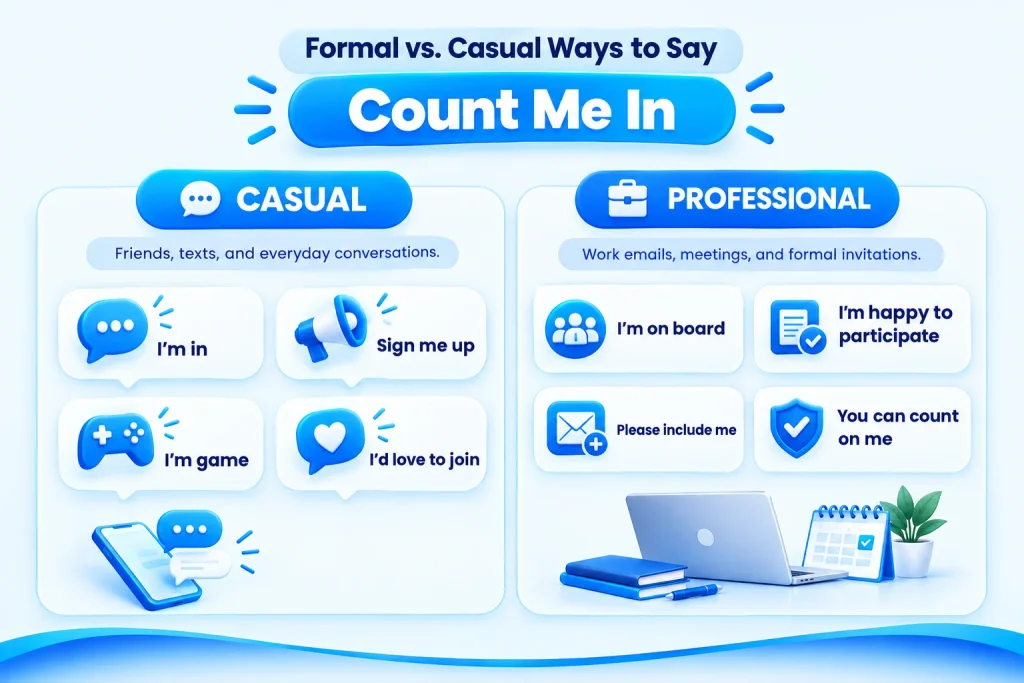
| Alternative | Best Used In | Tone |
| I’m In | Everyday conversations | Casual, enthusiastic |
| I’m On Board | Work and group decisions | Professional, supportive |
| Sign Me Up | Activities and events | Casual, enthusiastic |
| I’d Love to Join | Invitations and social plans | Warm, friendly |
| I’m Interested | Opportunities and professional settings | Polite, reserved |
| I’d Be Happy to Join | Work and invitations | Warm, professional |
| I’m Up for It | Informal plans | Casual, relaxed |
| I’ll Join You | Specific invitations | Friendly, direct |
| I’d Like to Participate | Work, school, and formal events | Formal, polite |
| You Can Include Me | Groups, meetings, and plans | Direct, neutral |
Common Mistakes
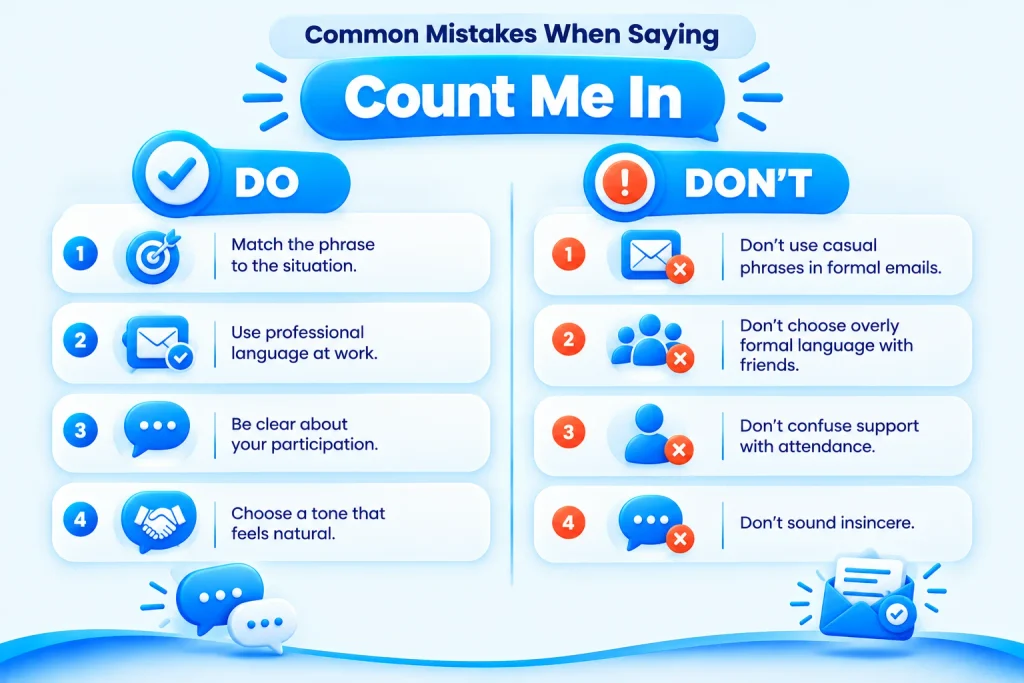
1. Using Casual Phrases in Professional Emails
Expressions such as “Sign me up!” can sound too informal in some workplace messages. Choose “I’d like to participate” or “I’d be happy to join” when communicating formally.
2. Choosing Overly Formal Language
Not every situation requires polished business language. Saying “I’d like to participate” to a close friend may sound stiff when a simple “I’m in!” would feel more natural.
3. Repeating “Count Me In” Too Often
Using the same expression repeatedly can make your communication feel predictable. Vary your wording based on the context instead of automatically using the same response.
4. Forgetting the Level of Commitment
“I’m interested” does not always mean the same thing as “I’m in.” The first can show curiosity, while the second usually communicates a stronger willingness to participate.
5. Sounding Insincere
Choose words that match your actual level of enthusiasm. If you are only considering an opportunity, “I’m interested” may be more honest than an enthusiastic “Sign me up!”
Frequently Asked Questions
What is another way to say “count me in”?
Some common alternatives include “I’m in,” “I’m on board,” “sign me up,” “I’d love to join,” and “I’d be happy to join.” The best choice depends on the situation. “I’m in” is natural for casual conversations, while “I’m on board” and “I’d like to participate” can work better in professional settings.
Is “I’m in” the same as “count me in”?
Yes, in most everyday situations, “I’m in” and “count me in” communicate the same basic idea: you want to participate. “I’m in” is slightly shorter and more direct. Both expressions sound natural in casual American English and can show that you agree with a proposed plan or invitation.
What is a professional way to say “count me in”?
“I’m on board,” “I’d be happy to join,” and “I’d like to participate” are strong professional alternatives. They communicate willingness without sounding too casual. For emails or workplace discussions, choose the phrase that best matches your relationship with the recipient and the level of formality required.
What is a casual way to say “count me in”?
“I’m in,” “sign me up,” and “I’m up for it” are natural casual alternatives. They work well with friends, family members, and familiar coworkers. “Sign me up” sounds particularly enthusiastic, while “I’m up for it” feels more relaxed and conversational.
Can I say “count me in” in a professional email?
Yes, but it depends on the workplace and the relationship. “Count me in” is friendly and understandable, but it can sound informal in a formal business email. If you want a more polished response, consider “I’d be happy to participate” or “I’d be glad to join.”
What is another way to say “count me in” for an invitation?
For an invitation, you can say “I’d love to join,” “I’ll join you,” “I’d be happy to join,” or simply “I’m in.” These choices make it clear that you accept the invitation. “I’d love to join” is especially useful when you want your response to sound warm and appreciative.
Does “I’m interested” mean the same thing as “count me in”?
Not exactly. “I’m interested” usually indicates curiosity or willingness to consider something, while “count me in” normally communicates a stronger commitment to participate. If you have not made a final decision, “I’m interested” is often the more accurate choice.
What is the most enthusiastic way to say “count me in”?
“Sign me up!” is one of the most enthusiastic casual alternatives. “I’d love to join” can also communicate strong interest while sounding warm and polite. For professional situations, “I’d be happy to participate” expresses enthusiasm in a more appropriate and measured way.
Conclusion
There are many natural ways to say “count me in,” and the best choice depends on your audience and situation. For everyday conversations, “I’m in” is simple, direct, and natural. If you want to show extra enthusiasm, “sign me up” works well.
For invitations, “I’d love to join” adds warmth, while “I’ll join you” gives a clear and direct response. In professional settings, phrases such as “I’m on board,” “I’d be happy to join,” and “I’d like to participate” sound more polished. If you are interested but not ready to commit, “I’m interested” is the safer choice.
The main takeaway is simple: don’t just look for a synonym—choose the phrase that matches your tone, relationship, and level of commitment.

Sajid Ali is a web developer and digital publisher with experience in website development, WordPress, content publishing, and digital projects. He is interested in creating useful, well-structured online resources that make information easier to discover and understand.
At Majestic Studio, Sajid focuses on website development, content publishing, SEO-focused site structure, and maintaining a clear and user-friendly reading experience. He works with a practical, research-driven approach and continuously improves content and website usability based on reader needs and search behavior.