

Another way to say “doesn’t make sense” is “isn’t logical,” “doesn’t add up,” “is confusing,” “seems unreasonable,” or “is hard to understand.” For professional conversations, use “I’m having trouble following the logic.” In casual conversations, “that doesn’t add up” works well when something seems inconsistent or incorrect.
Key Takeaways
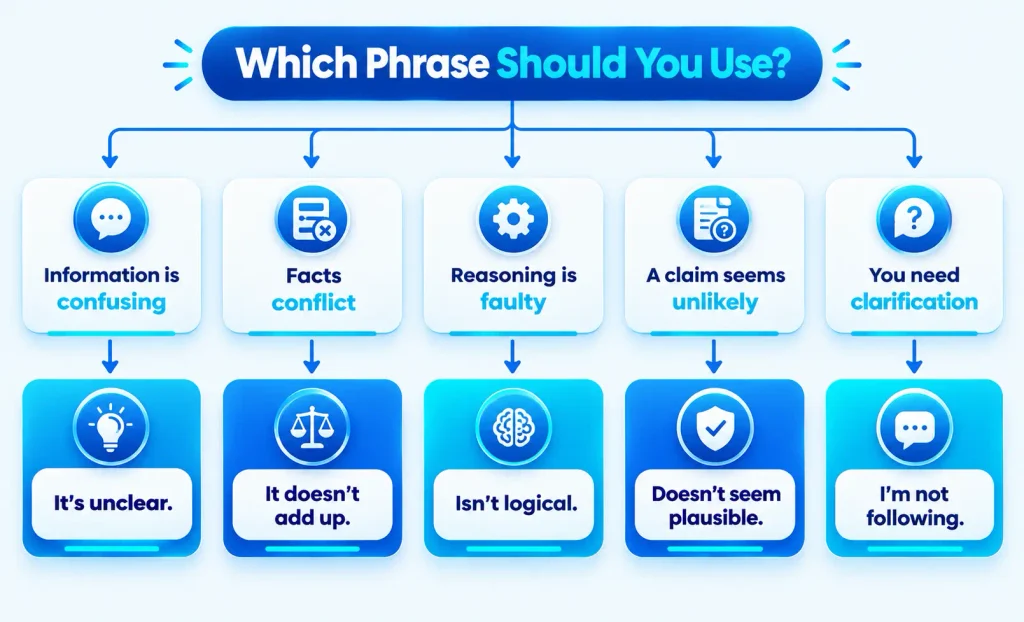
- Use “isn’t logical” when an idea lacks clear reasoning.
- Choose “doesn’t add up” when facts or details seem inconsistent.
- Say “is unclear” when you need more information or explanation.
- Use “I’m having trouble following the logic” to sound polite at work.
- Match your wording to the situation, audience, and tone you want to convey.
What Does “Doesn’t Make Sense” Mean?

The phrase “doesn’t make sense” means something is confusing, illogical, unclear, or difficult to understand. People use it when an idea, statement, action, or situation seems unreasonable or does not fit the available facts.
For example, you might say a set of instructions doesn’t make sense if the steps are unclear. You might also use the phrase when a friend’s explanation contradicts something they said earlier.
This expression is common in everyday conversations, workplace discussions, emails, classrooms, and online communication. However, depending on your tone, it can sound direct or critical. Choosing a more specific alternative can help you explain the problem without making the other person feel dismissed.
Why Use Other Ways to Say “Doesn’t Make Sense”?
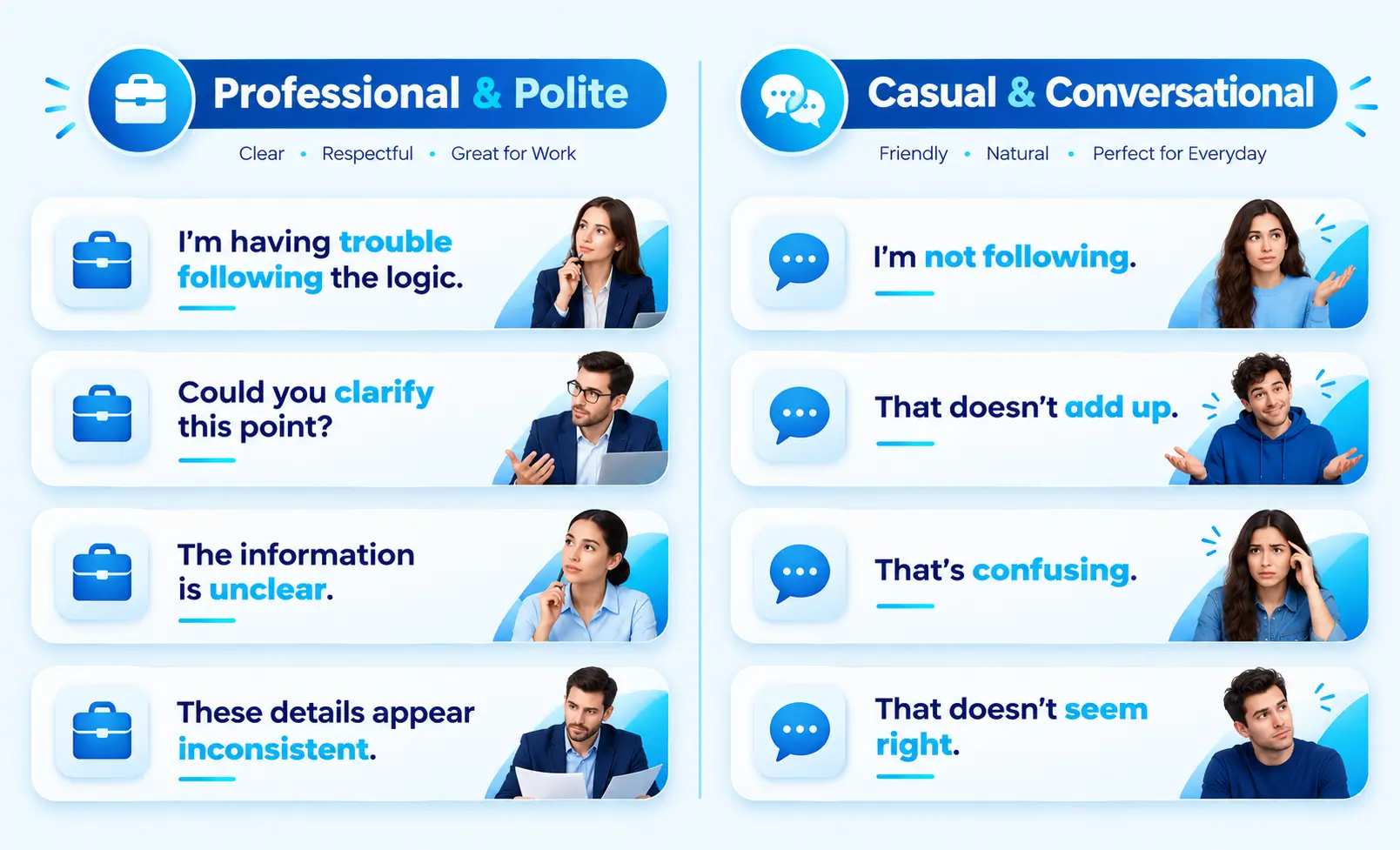
Using different expressions helps you communicate clearly while adjusting your tone to fit the situation.
- Avoid repetition: Keep conversations and written content natural.
- Sound more professional: Explain problems without sounding rude.
- Be more precise: Separate confusing information from faulty reasoning.
- Encourage discussion: Ask questions instead of immediately rejecting an idea.
- Express your point clearly: Explain exactly what seems inconsistent, unclear, or unreasonable.
For example, “I don’t understand this part” invites clarification, while “That conclusion isn’t logical” challenges the reasoning itself. Both communicate a concern, but they serve different purposes.
12 Best Other Ways to Say “Doesn’t Make Sense”
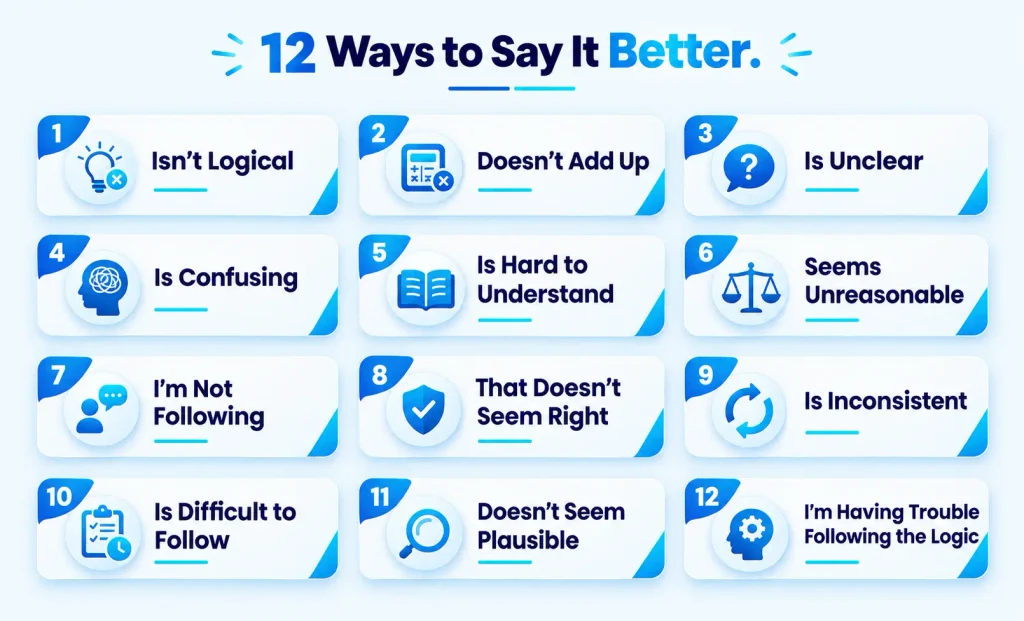
Here are 12 natural alternatives, with meanings, tones, and examples to help you choose the right expression.
1. Isn’t Logical
Meaning
“Isn’t logical” means an idea or conclusion does not follow clear reasoning. It is useful when you want to question someone’s argument rather than simply say you don’t understand it.
Best For: Professional, Formal
Example 1: The proposed solution isn’t logical because it increases costs without fixing the main problem.
Example 2: Her conclusion isn’t logical when you consider the evidence presented in the report.
Quick Tip: Focus on the reasoning behind an idea, not the person who shared it. This keeps your criticism constructive.
2. Doesn’t Add Up
Meaning
“Doesn’t add up” means the details of a situation seem inconsistent or the explanation does not match the facts. It often suggests that something may be missing or incorrect.
Best For: Casual, Professional, Friendly
Example 1: The numbers on this invoice don’t add up to the total listed at the bottom.
Example 2: His explanation of the missed deadline doesn’t add up with the timeline we received.
Quick Tip: Use this phrase when you notice conflicting details. It can suggest suspicion, so explain which facts seem inconsistent.
3. Is Unclear
Meaning
“Is unclear” means information, instructions, or an explanation does not communicate its meaning well. It is a neutral alternative that identifies a problem without blaming anyone.
Best For: Professional, Formal, Polite
Example 1: The final paragraph is unclear about who needs to approve the request.
Example 2: It is unclear whether the revised policy applies to existing customers.
Quick Tip: Identify the specific part that needs clarification so the other person knows what to explain.
4. Is Confusing
Meaning
“Is confusing” describes something that is difficult to follow or understand. It works well when information feels complicated, poorly organized, or presented in a way that makes comprehension difficult.
Best For: Casual, Friendly, Professional
Example 1: The new checkout process is confusing for customers who are placing their first order.
Example 2: These instructions are confusing because they list the final step before the first one.
Quick Tip: If you are giving feedback, explain what causes the confusion and suggest how to make the information easier to follow.
5. Is Hard to Understand
Meaning
“Is hard to understand” communicates that an idea or explanation requires more effort to follow. It is straightforward and works well when you want to express difficulty without sounding overly critical.
Best For: Casual, Friendly, Polite
Example 1: The speaker’s explanation was hard to understand because she used several unfamiliar terms.
Example 2: This paragraph is hard to understand without an example of how the formula works.
Quick Tip: Use this phrase when the main problem is comprehension, not necessarily incorrect reasoning.
6. Seems Unreasonable
Meaning
“Seems unreasonable” suggests that a request, decision, or expectation does not appear fair or sensible. The word “seems” softens the statement by showing that you are expressing your perspective rather than declaring an absolute fact.
Best For: Professional, Formal, Polite
Example 1: Requiring employees to respond to every message within two minutes seems unreasonable.
Example 2: The additional fee seems unreasonable given the limited services included.
Quick Tip: Use this expression when discussing expectations, rules, costs, or decisions. Explain why you believe the situation is unreasonable.
7. I’m Not Following
Meaning
“I’m not following” means you are having trouble understanding someone’s explanation or the connection between their ideas. It places the focus on your understanding rather than suggesting the other person is wrong.
Best For: Casual, Friendly, Professional
Example 1: I’m not following how we moved from the initial estimate to this much higher budget.
Example 2: I’m not following the last step in your explanation. Could you walk me through it again?
Quick Tip: Add a specific question after this phrase to encourage clarification and keep the conversation moving.
8. That Doesn’t Seem Right
Meaning
“That doesn’t seem right” expresses doubt about information, a decision, or an outcome. It is less forceful than saying something is wrong and leaves room for further discussion.
Best For: Casual, Friendly, Polite
Example 1: That doesn’t seem right; the website shows a different delivery date.
Example 2: The amount deducted from my paycheck doesn’t seem right based on my recorded hours.
Quick Tip: Use this phrase when you suspect an error but need to verify the details before making a firm claim.
9. Is Inconsistent
Meaning
“Is inconsistent” means that two or more statements, actions, results, or details do not agree with one another. It is especially useful in reports, workplace discussions, and situations where accuracy matters.
Best For: Professional, Formal
Example 1: The information in the client brief is inconsistent with the approved project requirements.
Example 2: Her latest statement is inconsistent with the explanation she gave during Monday’s meeting.
Quick Tip: Point out the specific details that conflict. This makes your observation more objective and easier to resolve.
10. Is Difficult to Follow
Meaning
“Is difficult to follow” describes an explanation, process, argument, or set of instructions that lacks clarity or a clear sequence. It is a tactful way to offer feedback without sounding dismissive.
Best For: Professional, Formal, Polite
Example 1: The presentation is difficult to follow because the speaker moves between topics without transitions.
Example 2: The approval process is difficult to follow when responsibilities are spread across three departments.
Quick Tip: Use this phrase when discussing communication or processes. Suggest a clearer structure if you can.
11. Doesn’t Seem Plausible
Meaning
“Doesn’t seem plausible” means something appears unlikely or difficult to believe based on the available information. It is useful when assessing a claim or explanation that may be possible but lacks convincing support.
Best For: Professional, Formal
Example 1: The claim that the entire project was completed in one hour doesn’t seem plausible.
Example 2: The forecast doesn’t seem plausible given the team’s current sales figures.
Quick Tip: Use this phrase when evaluating whether a claim is believable. Avoid treating a lack of evidence as proof that something is false.
12. I’m Having Trouble Following the Logic
Meaning
“I’m having trouble following the logic” politely communicates that you cannot see how someone’s reasoning leads to their conclusion. It works well when you want to challenge an argument while remaining open to explanation.
Best For: Professional, Formal, Polite
Example 1: I’m having trouble following the logic behind reducing the advertising budget while increasing our sales targets.
Example 2: I’m having trouble following the logic of this proposal. Could you explain how the final recommendation supports our original goal?
Quick Tip: Use this expression during meetings, discussions, and professional emails when you want clarification without directly accusing someone of being wrong.
Comparison Table
Use this table to compare all 12 alternatives by setting and tone.
| Alternative | Best Used In | Tone |
|---|---|---|
| Isn’t logical | Arguments and decisions | Direct, analytical |
| Doesn’t add up | Conflicting facts or numbers | Informal, skeptical |
| Is unclear | Instructions and documents | Neutral, professional |
| Is confusing | Complicated information | Conversational |
| Is hard to understand | Difficult explanations | Simple, neutral |
| Seems unreasonable | Requests and expectations | Diplomatic, critical |
| I’m not following | Live conversations | Friendly, open |
| That doesn’t seem right | Possible errors | Cautious, polite |
| Is inconsistent | Reports and conflicting statements | Formal, objective |
| Is difficult to follow | Processes and presentations | Tactful, constructive |
| Doesn’t seem plausible | Claims and predictions | Analytical, skeptical |
| I’m having trouble following the logic | Meetings and complex arguments | Professional, diplomatic |
Common Mistakes When Replacing “Doesn’t Make Sense”
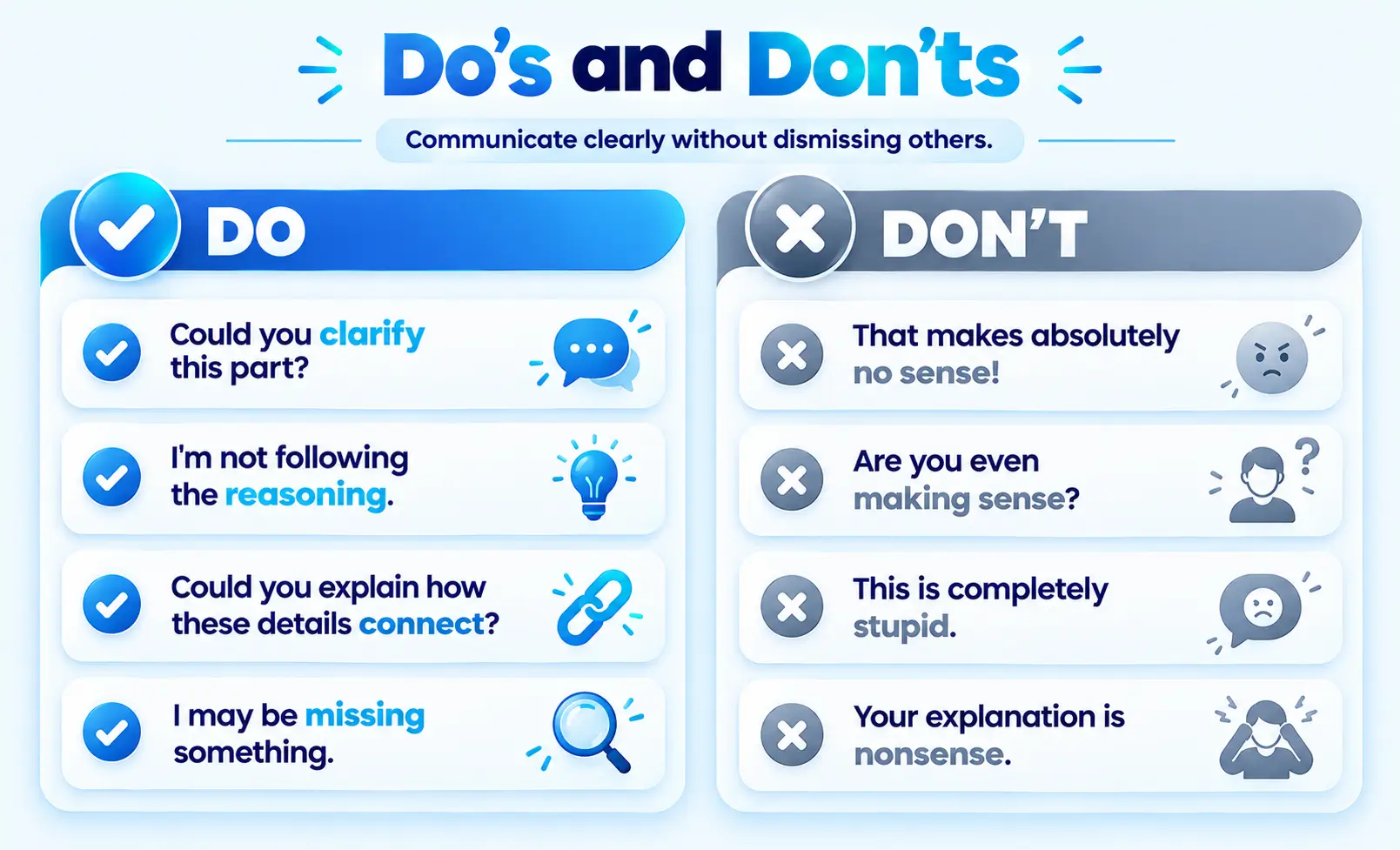
Choosing the right alternative depends on what you mean and how you want your message to sound. Avoid these five common mistakes.
1. Using Casual Phrases in Formal Emails
Expressions such as “doesn’t add up” can sound too conversational in some formal reports or client communications.
Better approach: Use “is inconsistent,” “is unclear,” or “does not appear reasonable” when the situation calls for a more professional tone.
2. Choosing Overly Formal Language
Using phrases such as “doesn’t seem plausible” in every everyday conversation can make you sound unnecessarily stiff.
Better approach: Choose simple expressions like “I’m not following” or “that doesn’t seem right” when speaking with friends or coworkers.
3. Repeating the Same Expression
Using “doesn’t make sense” several times in one email or discussion can make your communication sound repetitive.
Better approach: Vary your wording based on the issue. For example, describe unclear instructions as “confusing” and conflicting numbers as “inconsistent.”
4. Ignoring the Context
Not every confusing statement is illogical, and not every surprising decision is unreasonable. Choosing the wrong phrase may communicate a stronger criticism than you intend.
Better approach: Determine whether the problem involves missing information, faulty reasoning, conflicting details, or an expectation you consider unfair.
5. Sounding Insincere or Dismissive
Saying “That makes absolutely no sense” can make another person feel that you are rejecting their idea without considering it.
Better approach: Ask a clarifying question or explain your concern. For example, “Could you help me understand how you reached that conclusion?” keeps the conversation respectful.
Frequently Asked Questions
1. What is a professional way to say “doesn’t make sense”?
Professional alternatives include “is unclear,” “is inconsistent,” and “I’m having trouble following the logic.” The best choice depends on the issue. Use “is unclear” when you need more information, and “is inconsistent” when details contradict each other. These expressions communicate concerns without sounding unnecessarily harsh.
2. What is a polite way to say something doesn’t make sense?
You can say, “I’m not sure I understand,” “Could you clarify that point?” or “I’m having trouble following your explanation.” These phrases focus on your understanding rather than blaming the other person. They also invite a response, making them useful in meetings, personal conversations, and professional emails.
3. What is another way to say “that makes no sense”?
You could say “that doesn’t add up,” “that’s illogical,” “that seems unreasonable,” or “that doesn’t seem right.” Each expression has a slightly different meaning. Use “that doesn’t add up” for conflicting facts and “that’s illogical” when an argument does not follow sound reasoning.
4. How do you say “doesn’t make sense” in a work email?
In a work email, try “I’m having difficulty understanding this point” or “Could you clarify how these details align?” Both phrases sound professional and encourage discussion. If you have identified a specific problem, explain it directly so the recipient understands what needs clarification or correction.
5. Is “doesn’t add up” the same as “doesn’t make sense”?
The expressions overlap, but they are not always interchangeable. “Doesn’t add up” usually suggests that details, facts, or numbers do not agree. “Doesn’t make sense” has a broader meaning and can describe anything that seems confusing, illogical, or difficult to understand.
6. What is a formal synonym for “doesn’t make sense”?
Formal alternatives include “is illogical,” “is inconsistent,” “is unclear,” and “is not supported by the evidence.” Choose the phrase that best describes the problem. For example, “is inconsistent” suits conflicting statements, while “is not supported by the evidence” works when a conclusion lacks sufficient proof.
7. How can I say something doesn’t make sense without sounding rude?
Use language that describes your difficulty or asks for clarification. For example, “Could you help me understand this part?” sounds more inviting than “That makes no sense.” You can also explain what seems unclear and give the other person an opportunity to share additional information.
8. What is a casual way to say “doesn’t make sense”?
In casual American English, you can say “I’m not following,” “that doesn’t add up,” “that’s confusing,” or “that seems off.” These expressions sound natural with friends, family, and coworkers in relaxed conversations. Choose “I’m not following” when you need an explanation and “that seems off” when something feels wrong.
Conclusion
Choosing another way to say “doesn’t make sense” can help you communicate more clearly and adjust your tone to fit the situation. The best alternative depends on whether you are confused, questioning someone’s reasoning, identifying conflicting information, or expressing concern about a decision.
For professional communication, use “is unclear,” “is inconsistent,” or “I’m having trouble following the logic.” In everyday conversations, “I’m not following” and “that doesn’t seem right” sound natural and approachable. When details conflict, “doesn’t add up” is often a good fit.
Remember that the goal is not simply to replace one phrase with another. It is to explain your concern accurately while respecting your audience. Whenever possible, identify the specific detail that seems confusing and ask a useful question. Clear, thoughtful language makes misunderstandings easier to resolve and conversations more productive.

The Majestic Studio Editorial Team creates practical resources about synonyms, alternative phrases, vocabulary, and English usage. Our content is designed to help readers choose clearer, more natural words and communicate effectively in everyday, professional, and academic contexts.
Each article is researched, edited, and reviewed for clarity, context, usefulness, and language accuracy. We regularly update our content to keep examples and recommendations relevant.