

If you need another way to say “without a doubt,” you can use phrases such as undoubtedly, certainly, definitely, unquestionably, absolutely, or without question. The best choice depends on your tone and context. For professional writing, “certainly” and “undoubtedly” work well, while “absolutely” sounds more conversational and emphatic.
Key Takeaways
- “Without a doubt” means something is completely certain or beyond reasonable question.
- Certainly, undoubtedly, and definitely are strong choices for professional communication.
- Absolutely and no question sound more conversational and emphatic.
- Clearly works when the evidence makes something easy to understand, not simply because you feel certain.
- Choose an alternative based on the situation, audience, and level of certainty you want to express.
What Does “Another Way to Say Without a Doubt” Mean?
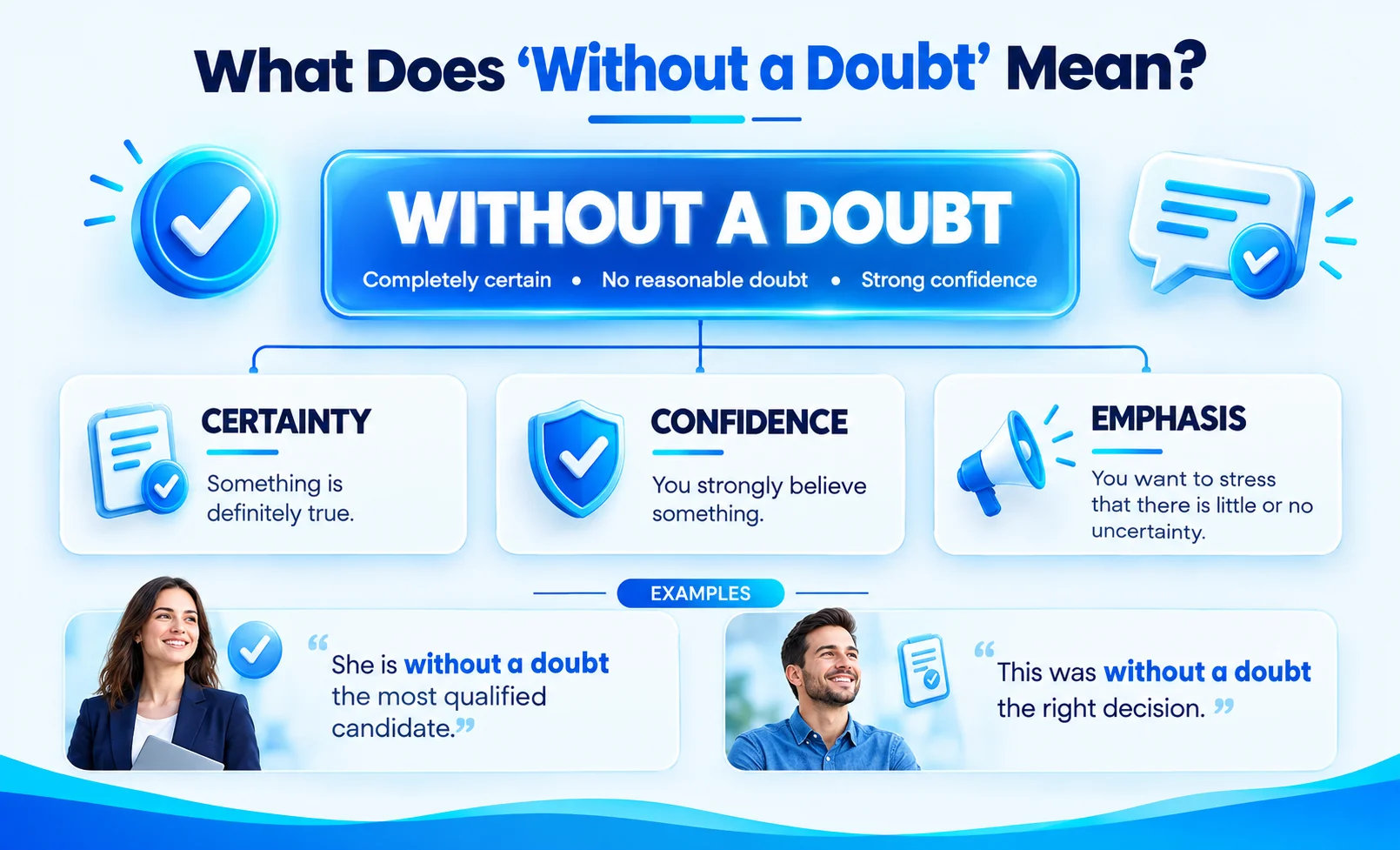
“Without a doubt” means that you are completely certain about something. It emphasizes confidence and leaves little or no room for uncertainty.
For example, you might say, “She is without a doubt the most qualified candidate.” This tells the reader that you strongly believe her qualifications are clear and convincing.
The phrase is common in everyday conversations, professional writing, reviews, essays, and persuasive statements. However, repeating it too often can make your writing sound predictable.
Why Use Other Ways to Say “Without a Doubt”?
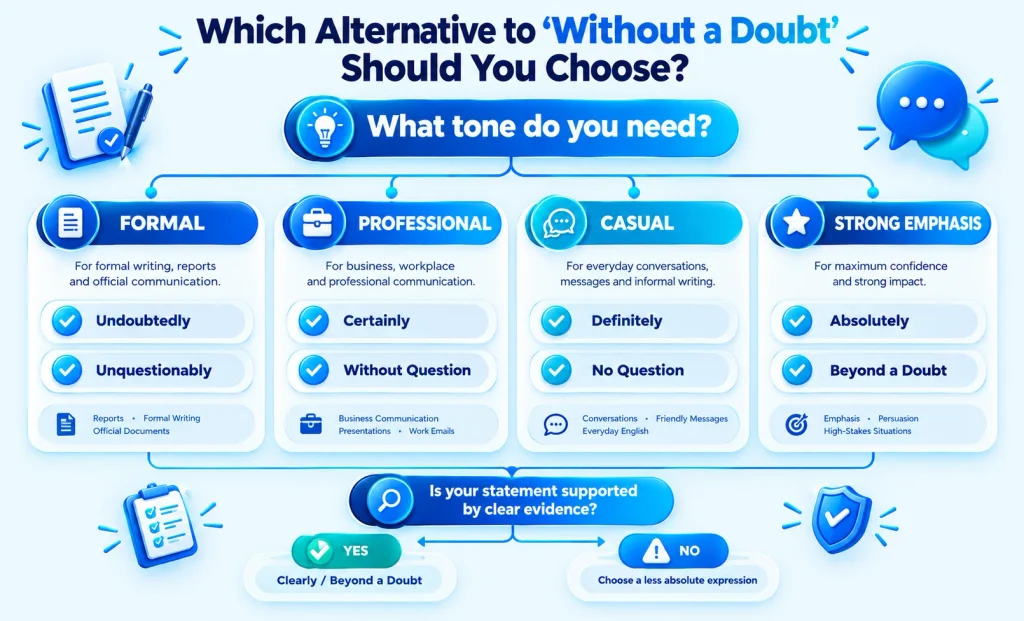
Using different expressions can make your writing more natural and precise. While “without a doubt” is perfectly correct, another phrase may better match the tone or strength of your statement.
Other alternatives can help you:
- Avoid repeating the same expression.
- Sound more natural in conversation.
- Make professional writing more polished.
- Show strong confidence without sounding repetitive.
- Match formal, casual, or persuasive situations.
- Express certainty in a more specific way.
The key is to choose a phrase that fits both your meaning and your audience.
12 Best Other Ways to Say “Without a Doubt”
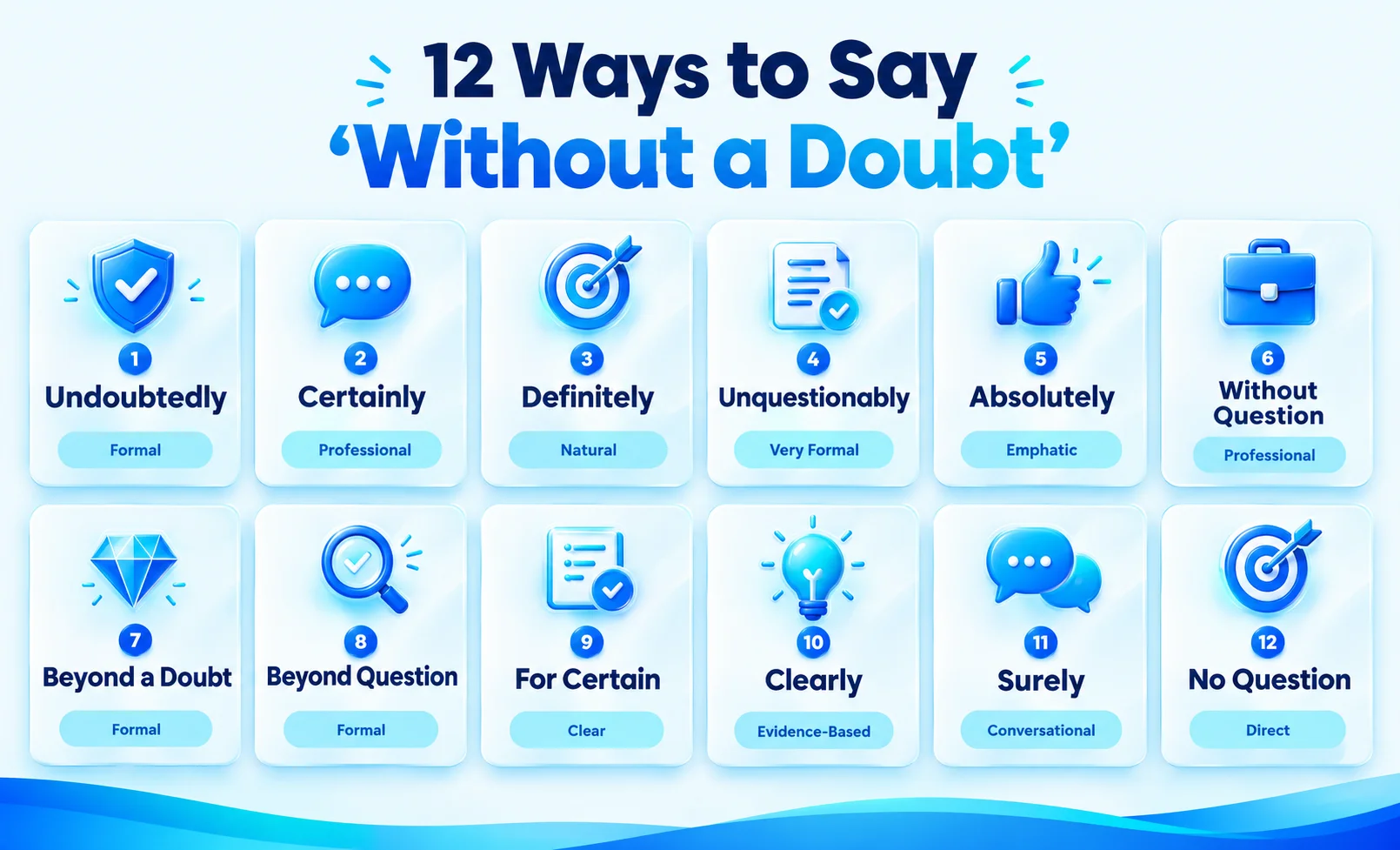
1. Undoubtedly
Meaning
“Undoubtedly” means that something is certain and cannot reasonably be questioned. It is a strong expression of confidence and often works well in formal or professional writing.
Best For
- Professional
- Formal
Example 1
Undoubtedly, her leadership skills played a major role in the team’s success.
Example 2
The project was undoubtedly one of the company’s most successful launches.
Quick Tip
Use “undoubtedly” when you want to make a confident statement without sounding overly conversational.
2. Certainly
Meaning
“Certainly” expresses strong confidence that something is true or will happen. It can also be used as a polite way to agree with someone or confirm something.
Best For
- Professional
- Formal
- Polite
- Friendly
Example 1
She certainly has the experience needed for the position.
Example 2
We can certainly discuss the proposal during tomorrow’s meeting.
Quick Tip
“Certainly” is one of the safest choices because it sounds natural in both professional and everyday communication.
3. Definitely
Meaning
“Definitely” shows strong certainty or confidence. It is common in American English and sounds more conversational than “undoubtedly.”
Best For
- Casual
- Friendly
- Professional
Example 1
I’ll definitely send you the revised document this afternoon.
Example 2
That restaurant is definitely worth trying if you’re visiting Chicago.
Quick Tip
Choose “definitely” when you want to sound confident but still natural and approachable.
4. Unquestionably
Meaning
“Unquestionably” means that something is so clear or certain that it should not be questioned. It has a strong and somewhat formal tone.
Best For
- Formal
- Professional
Example 1
Her contribution was unquestionably important to the team’s final result.
Example 2
The discovery was unquestionably a major achievement for the research team.
Quick Tip
Because it sounds strong, use “unquestionably” when the evidence or situation genuinely supports a high level of certainty.
5. Absolutely
Meaning
“Absolutely” expresses complete agreement, certainty, or confidence. It is especially common in spoken American English and can add emotional emphasis.
Best For
- Casual
- Friendly
- Warm
- Professional
Example 1
I absolutely agree that we should review the contract first.
Example 2
She is absolutely the right person to lead the presentation.
Quick Tip
“Absolutely” works best when you want your statement to sound confident and energetic rather than highly formal.
6. Without Question
Meaning
“Without question” means that there is no reasonable reason to doubt the statement. It closely matches the meaning of “without a doubt” but can sound slightly more polished.
Best For
- Professional
- Formal
- Persuasive
Example 1
Without question, customer service should remain one of our top priorities.
Example 2
He is, without question, one of the strongest candidates for the role.
Quick Tip
Use “without question” when making a firm claim in an essay, presentation, review, or professional discussion.
7. Beyond a Doubt
Meaning
“Beyond a doubt” emphasizes that something is certain and cannot reasonably be disputed. It is particularly useful when discussing evidence, conclusions, or established facts.
Best For
- Formal
- Professional
Example 1
The results prove beyond a doubt that the new process is more efficient.
Example 2
Her performance established beyond a doubt that she was ready for greater responsibility.
Quick Tip
This phrase is especially effective when your statement is supported by clear evidence.
8. Beyond Question
Meaning
“Beyond question” means that something is unquestionably true or accepted as certain. It has a formal and authoritative tone.
Best For
- Formal
- Professional
Example 1
His commitment to the organization is beyond question.
Example 2
The team’s dedication to quality is beyond question.
Quick Tip
Use this expression sparingly because its formal tone can sound too strong for casual conversation.
9. For Certain
Meaning
“For certain” means with complete confidence or certainty. It is often used when talking about something you know or strongly believe to be true.
Best For
- Casual
- Friendly
- Professional
Example 1
We know for certain that the meeting will begin at nine.
Example 2
I can’t say for certain when the repairs will be finished.
Quick Tip
“For certain” is particularly useful when distinguishing confirmed information from something that is only a possibility.
10. Clearly
Meaning
“Clearly” indicates that something appears obvious or is supported by information that is easy to understand. Unlike “without a doubt,” it often emphasizes visible evidence rather than personal certainty.
Best For
- Professional
- Formal
- Academic
Example 1
Clearly, the new strategy has improved customer engagement.
Example 2
The results clearly show that the revised process saves time.
Quick Tip
Use “clearly” when evidence makes your conclusion obvious. Avoid using it simply to state that you personally feel certain.
11. Surely
Meaning
“Surely” expresses strong belief or confidence, but it can also suggest that you expect others to agree with you. Depending on the context, it may sound persuasive or slightly rhetorical.
Best For
- Casual
- Friendly
- Warm
Example 1
Surely, there must be a better solution to this problem.
Example 2
She surely deserves recognition for everything she accomplished.
Quick Tip
“Surely” can imply expectation, so it is not always a direct replacement for “without a doubt.”
12. No Question
Meaning
“No question” is a concise way to say that something is completely certain or not open to serious debate. It is especially common in conversational American English.
Best For
- Casual
- Friendly
- Professional
Example 1
There is no question that the team worked hard to meet the deadline.
Example 2
No question, this was the best decision for the company.
Quick Tip
Use “no question” when you want a confident, direct expression that sounds natural rather than overly formal.
Comparison Table
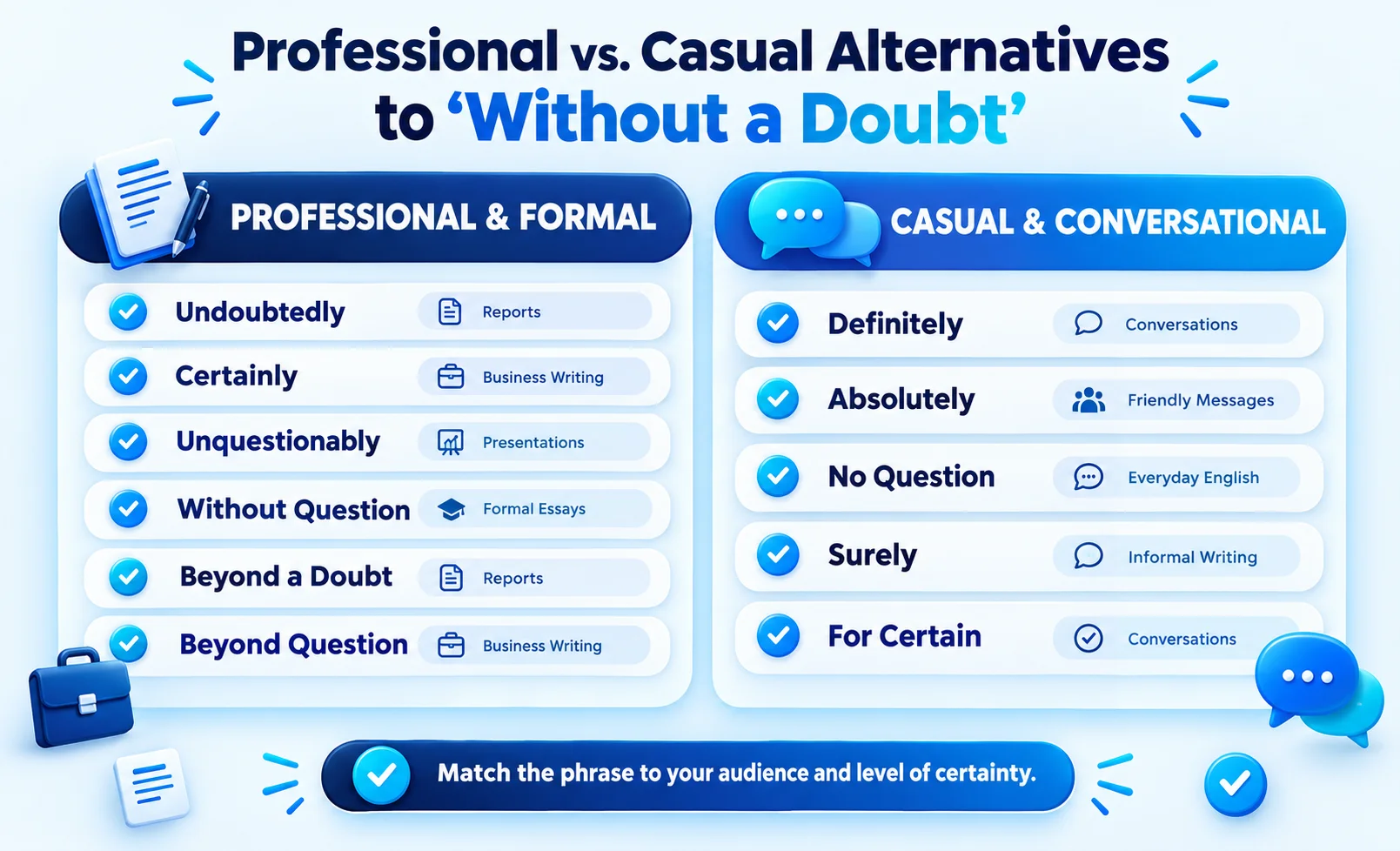
| Alternative | Best Used In | Tone |
|---|---|---|
| Undoubtedly | Professional, formal writing | Strong, authoritative |
| Certainly | Professional and everyday communication | Polite, confident |
| Definitely | Conversations and informal writing | Natural, confident |
| Unquestionably | Formal and persuasive writing | Very strong, authoritative |
| Absolutely | Conversations and emphasis | Strong, energetic |
| Without Question | Professional and persuasive writing | Firm, confident |
| Beyond a Doubt | Evidence-based or formal statements | Certain, formal |
| Beyond Question | Formal statements | Authoritative |
| For Certain | Confirmed information and everyday speech | Clear, confident |
| Clearly | Evidence-based statements | Direct, objective |
| Surely | Conversations and rhetorical statements | Confident, expectant |
| No Question | Conversational and direct statements | Firm, natural |
Common Mistakes
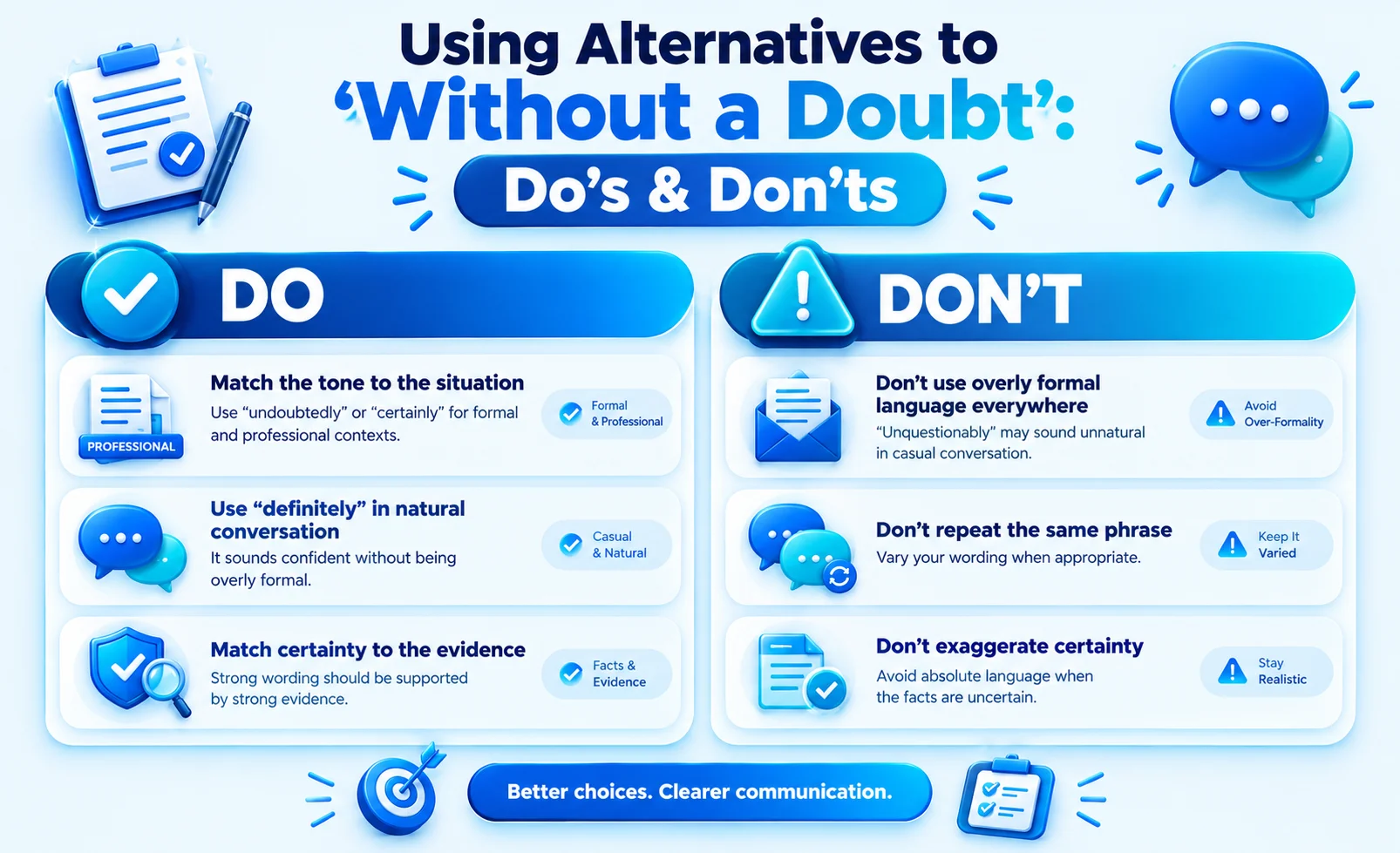
1. Using a casual phrase in a formal context
Expressions such as “absolutely” and “no question” can work professionally, but they may sound too conversational in highly formal academic or legal writing. Choose “undoubtedly” or “unquestionably” when a more formal tone is appropriate.
2. Choosing a phrase that is too strong
Not every situation calls for absolute certainty. If the evidence is limited, avoid expressions that suggest there is no possible doubt.
3. Repeating the same phrase
Using “without a doubt” several times in one article, email, or essay can make your writing feel repetitive. Rotate between suitable alternatives instead.
4. Ignoring the context
“Clearly” focuses on something that is evident, while “surely” can express expectation. They are related to certainty but do not always mean exactly the same thing.
5. Sounding overly confident
Strong certainty can make a statement sound persuasive, but it can also sound arrogant if you have not provided enough support. Match the strength of your language to the evidence.
Frequently Asked Questions
What is another way to say “without a doubt”?
Common alternatives include “undoubtedly,” “certainly,” “definitely,” “unquestionably,” “absolutely,” and “without question.” The best option depends on the situation. “Certainly” is versatile, “undoubtedly” sounds more formal, and “definitely” is especially natural in everyday American English.
What is a professional way to say “without a doubt”?
“Certainly,” “undoubtedly,” and “without question” are strong professional alternatives. “Undoubtedly” works especially well in formal reports and business writing, while “certainly” sounds more natural in emails and workplace conversations.
What is a formal synonym for “without a doubt”?
“Undoubtedly” and “unquestionably” are among the strongest formal alternatives. “Beyond question” and “beyond a doubt” can also work when you want to emphasize that something is supported by strong evidence or cannot reasonably be disputed.
Is “definitely” the same as “without a doubt”?
“Definitely” and “without a doubt” both express strong certainty, so they are often interchangeable. However, “definitely” sounds more conversational, while “without a doubt” can add stronger emphasis to a statement.
Can I use “certainly” instead of “without a doubt”?
Yes. “Certainly” is one of the most natural alternatives. It expresses confidence while remaining polite and professional. For example, “She is certainly qualified for the position” communicates strong confidence without sounding overly dramatic.
What is a casual way to say “without a doubt”?
“Definitely,” “absolutely,” and “no question” are natural casual alternatives. “Definitely” is particularly common in everyday American English, while “absolutely” can add enthusiasm or strong agreement.
Is “clearly” a synonym for “without a doubt”?
“Clearly” can sometimes replace “without a doubt,” but the meanings are not identical. “Clearly” suggests that evidence or circumstances make something obvious. “Without a doubt” focuses more directly on complete certainty.
What is the strongest way to say “without a doubt”?
“Unquestionably,” “beyond question,” and “beyond a doubt” can communicate very strong certainty. However, the strongest phrase is not always the best choice. Your wording should reflect the actual evidence and the tone of your writing.
Conclusion
There are many natural ways to say “without a doubt,” and the best choice depends on your audience and purpose. For professional or formal writing, undoubtedly, certainly, unquestionably, and without question are reliable options. In everyday American English, definitely, absolutely, and no question sound more conversational.
If you are referring to clear evidence, clearly may be more precise. When you are distinguishing confirmed information from uncertainty, for certain can work especially well.
The most important rule is to match the strength of your language to the situation. Choose a phrase that communicates confidence without exaggerating your claim. When used thoughtfully, these alternatives can make your writing clearer, more natural, and less repetitive.

The Majestic Studio Editorial Team creates practical resources about synonyms, alternative phrases, vocabulary, and English usage. Our content is designed to help readers choose clearer, more natural words and communicate effectively in everyday, professional, and academic contexts.
Each article is researched, edited, and reviewed for clarity, context, usefulness, and language accuracy. We regularly update our content to keep examples and recommendations relevant.