
Another way to say work experience includes professional experience, employment history, career experience, professional background, and relevant experience. The best choice depends on context. For a résumé, “professional experience” or “relevant experience” works well, while “employment history” is better when describing previous jobs and employers.
Key Takeaways
- “Professional experience” is a strong choice for résumés, LinkedIn profiles, and applications.
- “Employment history” focuses on previous jobs, employers, and dates.
- “Professional background” gives a broader view of someone’s career.
- “Relevant experience” highlights skills that directly match a role or project.
- Choose the phrase based on your audience, purpose, and level of formality.
What Does “Another Way to Say Work Experience” Mean?
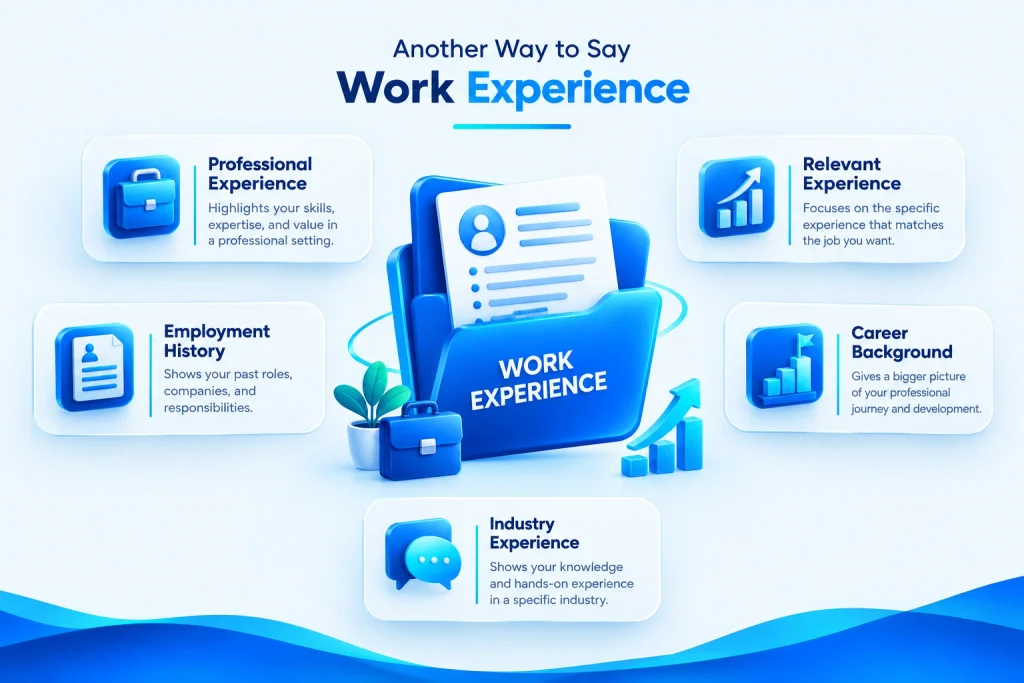
The phrase another way to say work experience refers to alternative words or phrases that describe the jobs, responsibilities, skills, and knowledge someone has gained through employment.
People commonly search for alternatives when writing a résumé, cover letter, LinkedIn profile, job application, email, or professional biography. Using the right expression can make your writing more precise and prevent repetitive wording.
For example, “professional experience” sounds polished on a résumé, while “employment history” is useful when listing previous positions. The meaning is similar, but each phrase emphasizes a slightly different part of a person’s career.
Why Use Other Ways to Say “Work Experience”?
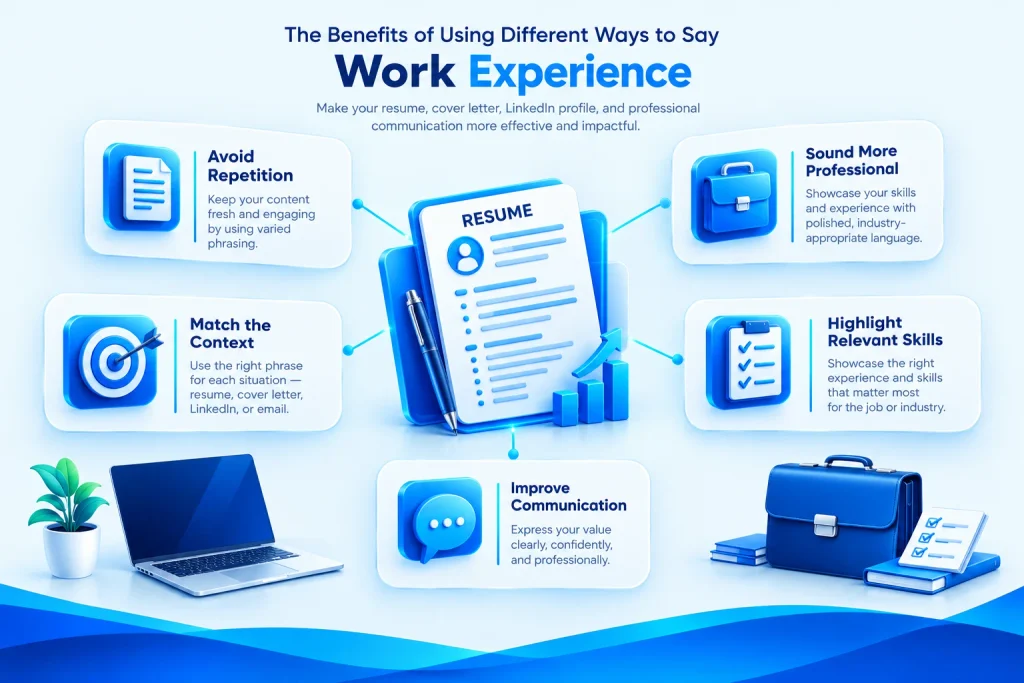
Using alternatives can make professional writing clearer and more natural. It also helps you choose language that fits the situation instead of repeating the same phrase.
Common reasons include:
- Avoiding repetitive wording in résumés and applications.
- Making professional writing sound more polished.
- Highlighting specific skills or career achievements.
- Matching the tone of a formal or casual situation.
- Describing experience more accurately.
- Making a résumé section or profile more engaging.
10 Best Other Ways to Say “Work Experience”
1. Professional Experience
Meaning
“Professional experience” describes experience gained through professional employment, especially in a career-related field. It is one of the most natural alternatives to “work experience” in formal career writing.
Best For
- Professional
- Formal
Example 1
My professional experience includes five years of project management in the technology sector.
Example 2
Please review my professional experience before our interview next week.
Quick Tip
Use “professional experience” when you want a polished phrase for a résumé, cover letter, or professional profile.
2. Relevant Experience
Meaning
“Relevant experience” refers specifically to experience that relates to a particular job, task, industry, or opportunity. It helps employers quickly see why your background fits a position.
Best For
- Professional
- Formal
Example 1
My relevant experience includes customer support, account management, and sales training.
Example 2
The hiring manager asked me to describe my relevant experience with financial software.
Quick Tip
Use this phrase when you want to emphasize experience that directly matches the requirements of a role.
3. Employment History
Meaning
“Employment history” focuses on a person’s previous jobs and employers. Unlike “professional experience,” it often emphasizes where and when someone worked rather than the skills they developed.
Best For
- Formal
- Professional
Example 1
The application asks for your complete employment history for the past ten years.
Example 2
Her employment history shows steady growth from assistant to department manager.
Quick Tip
Choose “employment history” when discussing job titles, companies, dates, and periods of employment.
4. Professional Background
Meaning
“Professional background” provides a broader description of someone’s career and expertise. It can include employment, education, industry knowledge, certifications, and other career-related qualifications.
Best For
- Professional
- Formal
- Friendly
Example 1
His professional background is in marketing, communications, and brand strategy.
Example 2
We were impressed by your professional background in nonprofit fundraising.
Quick Tip
Use this expression when you want to describe a career as a whole rather than simply listing previous jobs.
5. Career Experience
Meaning
“Career experience” refers to the knowledge and skills developed throughout someone’s career. It works especially well when discussing long-term professional growth or accomplishments.
Best For
- Professional
- Formal
Example 1
Her career experience has prepared her to lead large international teams.
Example 2
The position requires strong career experience in operations and strategic planning.
Quick Tip
Use “career experience” when the focus is on accumulated experience over several stages of a person’s career.
6. Industry Experience
Meaning
“Industry experience” highlights experience within a particular business sector. It is useful when specialized knowledge of an industry matters more than general employment experience.
Best For
- Professional
- Formal
Example 1
Candidates with healthcare industry experience will be familiar with the role’s regulatory requirements.
Example 2
I developed extensive industry experience while working with manufacturing companies.
Quick Tip
Use this phrase when the type of industry is important, such as healthcare, finance, construction, retail, or technology.
7. Professional Background and Experience
Meaning
“Professional background and experience” combines a person’s broader career history with the practical knowledge gained from working. It gives a fuller description than “work experience” alone.
Best For
- Professional
- Formal
Example 1
Her professional background and experience make her well suited to the consulting position.
Example 2
The biography highlights his professional background and experience in public relations.
Quick Tip
This longer phrase works best in biographies, introductions, proposals, and other formal documents where a broad description is helpful.
8. Career Background
Meaning
“Career background” describes the path someone has taken professionally, including previous roles, fields, and areas of expertise. It sounds natural when discussing someone’s overall career story.
Best For
- Professional
- Friendly
- Formal
Example 1
Tell us about your career background and how it led you to this position.
Example 2
Her career background spans education, publishing, and digital media.
Quick Tip
Choose “career background” when talking about a person’s professional journey rather than a simple list of past jobs.
9. Practical Experience
Meaning
“Practical experience” emphasizes knowledge gained by actually performing tasks rather than learning only through study or theory. It is especially useful for technical, vocational, and hands-on roles.
Best For
- Professional
- Casual
- Formal
Example 1
The internship gave me practical experience using industry-standard design software.
Example 2
Applicants should have practical experience repairing commercial HVAC systems.
Quick Tip
Use “practical experience” when you want to show that someone has applied knowledge in real situations.
10. Professional Track Record
Meaning
“Professional track record” refers to a person’s demonstrated history of performance, achievements, or results. It focuses more on what someone has accomplished than simply where they have worked.
Best For
- Professional
- Formal
Example 1
She has a strong professional track record of improving customer retention.
Example 2
The company is looking for a manager with a proven professional track record.
Quick Tip
Use this phrase when achievements and measurable results matter more than a simple employment history.
Comparison Table
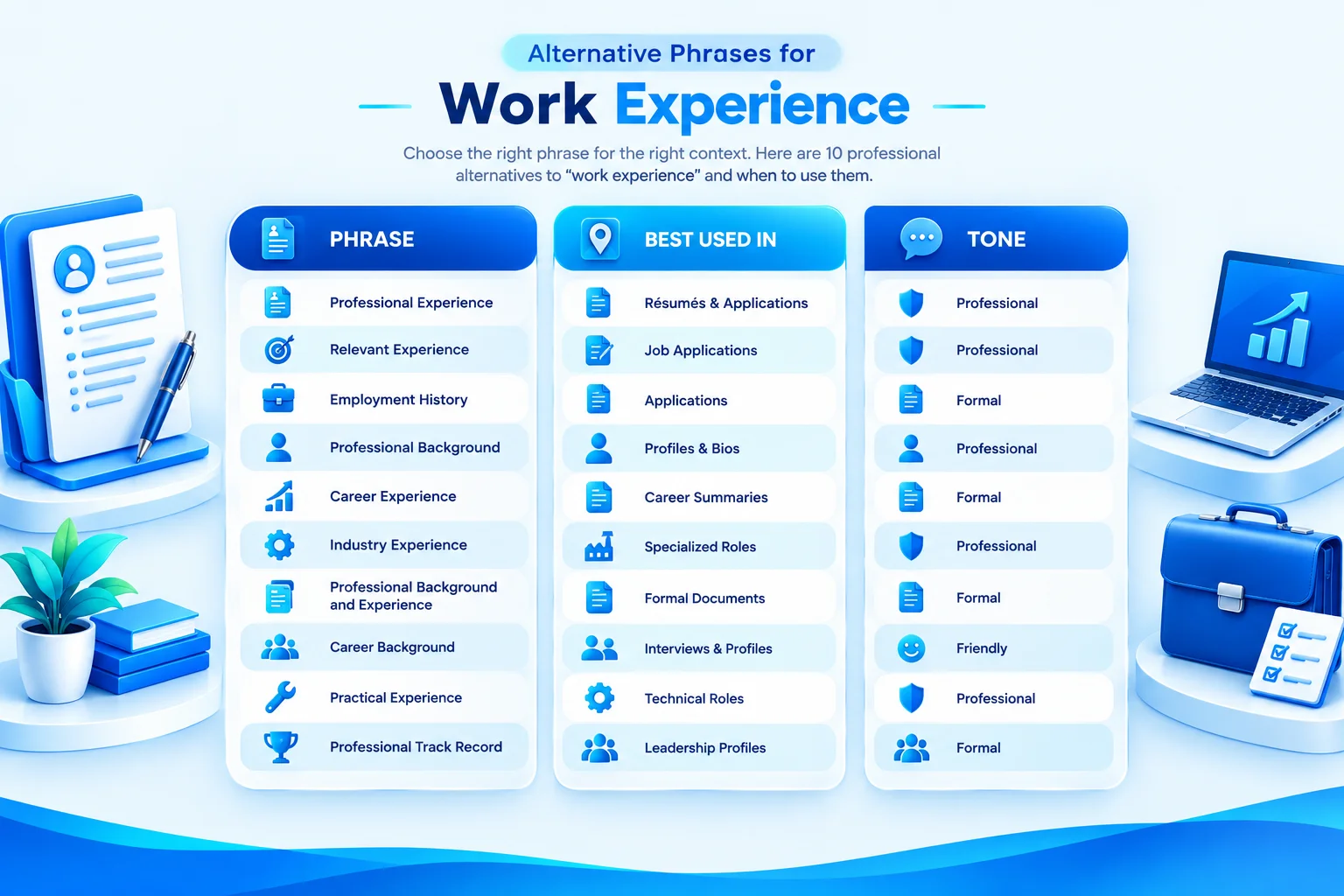
| Alternative | Best Used In | Tone |
| Professional Experience | Résumés, applications, profiles | Professional |
| Relevant Experience | Job applications, interviews | Professional |
| Employment History | Applications, background forms | Formal |
| Professional Background | Bios, résumés, introductions | Professional |
| Career Experience | Career summaries, profiles | Formal |
| Industry Experience | Job descriptions, applications | Professional |
| Professional Background and Experience | Proposals, biographies | Formal |
| Career Background | Interviews, profiles, introductions | Friendly |
| Practical Experience | Technical résumés, internships | Professional |
| Professional Track Record | Leadership profiles, business writing | Formal |
Common Mistakes
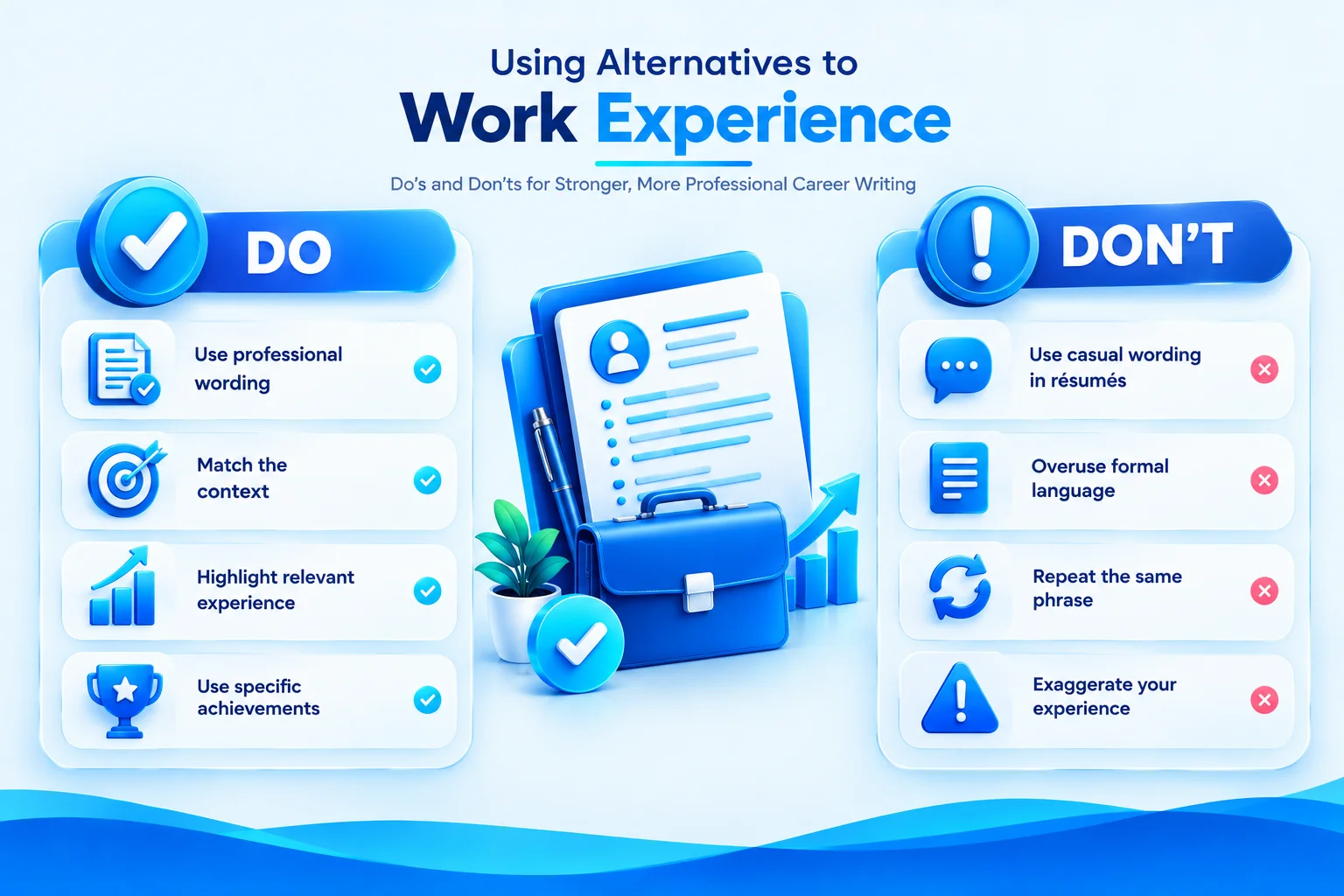
- Using casual phrases in professional writing.
Expressions such as “jobs I’ve had” may sound too informal for a résumé or cover letter. Choose “professional experience” or “employment history” instead. - Choosing overly formal language.
A complicated phrase does not automatically sound more professional. Simple wording is often clearer and more effective. - Repeating the same phrase throughout a document.
Repeating “work experience” several times can make a résumé or profile feel mechanical. Use a suitable alternative when the meaning remains accurate. - Forgetting context.
“Practical experience” and “industry experience” do not mean exactly the same thing. Pick a phrase that reflects what you actually want to emphasize. - Sounding insincere or exaggerated.
Avoid calling your background a “proven track record” unless you can support the statement with real accomplishments, results, or responsibilities.
Frequently Asked Questions
What is a professional way to say “work experience”?
“Professional experience” is one of the most natural and widely accepted alternatives. It works especially well on résumés, cover letters, LinkedIn profiles, and job applications. You can also use “professional background,” “relevant experience,” or “employment history,” depending on whether you want to emphasize career scope, job-related skills, or previous positions.
What can I write instead of “work experience” on a résumé?
Common résumé alternatives include “Professional Experience,” “Relevant Experience,” “Employment History,” and “Professional Background.” “Professional Experience” is a strong general-purpose heading, while “Relevant Experience” is useful when you want to focus on qualifications that directly match the position.
Is “professional experience” better than “work experience”?
Both phrases are correct, but “professional experience” often sounds more polished in career documents. The better choice depends on your audience and purpose. “Work experience” is broad and straightforward, while “professional experience” places more emphasis on career-related skills, responsibilities, and accomplishments.
What is another word for employment history?
“Career history,” “professional history,” and “work history” can all describe a person’s previous employment. However, “employment history” is especially clear when you are referring to employers, job titles, and dates. For a résumé, “Professional Experience” may be more useful when you also want to highlight accomplishments and skills.
How do you describe work experience in a cover letter?
Focus on experience that connects directly to the employer’s needs. Instead of simply stating that you have “five years of work experience,” explain what you accomplished, what skills you developed, and how those skills relate to the position. Specific results usually make the statement stronger.
What is a good alternative to “years of work experience”?
Depending on the context, you can say “years of professional experience,” “years of industry experience,” or “years of relevant experience.” Use “industry experience” when the sector matters and “relevant experience” when you want to connect your background directly to a particular job.
Can “practical experience” replace “work experience”?
Sometimes, but the terms are not identical. “Practical experience” emphasizes hands-on application of knowledge, while “work experience” covers employment more broadly. For example, an internship, apprenticeship, volunteer project, or training placement may provide practical experience even when it is not traditional full-time employment.
What is the best phrase for a job interview?
There is no single phrase that fits every interview. “Professional experience” works well when discussing your career, while “relevant experience” is useful when explaining why your background fits the role. When answering interview questions, specific examples of responsibilities and accomplishments are usually more informative than a general label.
Conclusion
There are many effective ways to say work experience, but the best phrase depends on what you want to emphasize. “Professional experience” is a versatile choice for résumés and applications, while “employment history” focuses on previous jobs and employers.
If you want to highlight experience that matches a particular position, choose “relevant experience.” For specialized knowledge, “industry experience” is more precise, while “practical experience” emphasizes hands-on skills. “Professional track record” works when accomplishments and results are the main focus.
The key is to choose language that accurately reflects your background and fits the situation. A simple, precise phrase will usually make your professional writing clearer and more credible.

Editorial contributors help develop practical English-language resources covering vocabulary, expressions, synonyms, and writing. Contributions focus on clear explanations, useful examples, and context so readers can understand not only what a phrase means, but when and how to use it naturally.