

Another way to say “per your request” includes “as requested,” “as you requested,” “in response to your request,” and “following your request.” These alternatives can make emails sound more natural, clear, or appropriately formal. The best choice depends on your audience, the action you completed, and the tone you want to create.
Key Takeaways
- “As requested” is a concise and versatile professional alternative.
- “As you requested” sounds more personal and conversational.
- “In accordance with your request” works well in highly formal communication.
- “In response to your request” clearly connects your reply to the recipient’s request.
- Always match the phrase to your audience, purpose, and level of formality.
What Does “Another Way to Say Per Your Request” Mean?

“Per your request” means that you are doing something because someone asked you to do it. It is commonly used in professional emails when sending documents, providing information, making changes, or confirming that a request has been completed.
For example, you might write, “Per your request, I have attached the revised proposal.” The phrase is grammatically correct and professional, although some writers may prefer shorter or more conversational wording depending on the workplace and audience.
You will often see “per your request” in business emails, customer service messages, workplace updates, reports, and formal correspondence.
Why Use Other Ways to Say “Per Your Request”?

Repeating the same phrase in every email can make your writing feel predictable or overly formal. Choosing a different expression lets you communicate the same idea while better matching the situation.
Other alternatives can help you:
- Avoid repetitive wording.
- Make emails sound more natural.
- Adjust your level of formality.
- Sound warmer and more conversational.
- Clearly connect your action to the recipient’s request.
- Write concise and reader-friendly business messages.
The goal is not to avoid “per your request” completely. Instead, choose wording that fits the relationship, context, and purpose of your message.
10 Best Other Ways to Say “Per Your Request”

1. As Requested
Meaning
“As requested” is one of the simplest and most useful alternatives to “per your request.” It tells the reader that you completed an action or provided something they previously asked for.
It works especially well because it is concise without sounding too casual.
Best For
- Professional
- Formal
- Polite
Example 1
As requested, I have attached the updated sales report.
Example 2
As requested, the revised schedule is included below.
Quick Tip
Use “as requested” when you want a short, polished phrase that works in most professional emails.
2. As You Requested
Meaning
“As you requested” directly refers to the person who made the request. This makes the phrase slightly more personal and conversational than “per your request.”
It is useful when you want to sound professional while still maintaining a friendly tone.
Best For
- Professional
- Friendly
- Polite
- Warm
Example 1
As you requested, I updated the presentation with the new figures.
Example 2
As you requested, I scheduled the meeting for next Tuesday.
Quick Tip
Choose this option when you want your email to sound attentive and personal rather than overly formal.
3. In Response to Your Request
Meaning
“In response to your request” clearly shows that your message is an answer to something the recipient previously asked. It works particularly well when providing information, documents, or a detailed explanation.
The phrase has a formal and organized feel.
Best For
- Professional
- Formal
- Polite
Example 1
In response to your request, I have included the project timeline below.
Example 2
In response to your request, our team reviewed the account details.
Quick Tip
Use this phrase when your email directly answers a question or request from an earlier message.
4. Following Your Request
Meaning
“Following your request” emphasizes that you took action after receiving someone’s request. It creates a natural connection between the original request and your current update.
It is appropriate for many workplace situations, especially when explaining what happened next.
Best For
- Professional
- Formal
- Polite
Example 1
Following your request, I contacted the supplier for an updated quote.
Example 2
Following your request, we reviewed the available appointment times.
Quick Tip
This phrase works best when you want to emphasize the action that occurred after the request was made.
5. In Accordance With Your Request
Meaning
“In accordance with your request” is a highly formal alternative. It communicates that an action was completed according to what the recipient asked for.
Because it sounds more official, it may be more suitable for formal documents, policies, legal correspondence, or traditional business communication.
Best For
- Formal
- Professional
- Polite
Example 1
In accordance with your request, the contract has been revised.
Example 2
In accordance with your request, the records have been forwarded to your office.
Quick Tip
Reserve this phrase for situations where a formal tone is appropriate. For a routine workplace email, “as requested” may sound more natural.
6. Based on Your Request
Meaning
“Based on your request” focuses on the decision or action that resulted from what the recipient asked for. It works well when explaining changes, recommendations, updates, or customized information.
The wording feels clear and practical rather than overly formal.
Best For
- Professional
- Polite
- Friendly
Example 1
Based on your request, I adjusted the proposal to include three pricing options.
Example 2
Based on your request, we prepared a shorter version of the presentation.
Quick Tip
Use this phrase when you want to explain how someone’s request influenced the work you completed.
7. At Your Request
Meaning
“At your request” indicates that something happened because the recipient specifically asked for it. It can sound polished and formal, but it is also short enough for many professional situations.
The phrase is especially useful when describing a change, service, appointment, or action performed for someone.
Best For
- Formal
- Professional
- Polite
Example 1
At your request, we extended the deadline by one week.
Example 2
At your request, the meeting has been moved to Friday morning.
Quick Tip
Use “at your request” when the recipient specifically asked you to make an adjustment or take an action.
8. In Line With Your Request
Meaning
“In line with your request” means that an action or decision follows what the recipient asked for. It has a professional tone without sounding as formal as some legal or administrative expressions.
It can be useful when discussing plans, changes, recommendations, or completed work.
Best For
- Professional
- Formal
- Polite
Example 1
In line with your request, we have updated the project specifications.
Example 2
In line with your request, the final draft uses a simpler layout.
Quick Tip
Choose this phrase when you want to emphasize that the result matches the recipient’s preferences or requirements.
9. You Asked For
Meaning
“You asked for” is a direct and conversational alternative. Instead of using a formal introductory phrase, it clearly identifies the item the reader requested.
For example, “Here is the information you asked for” often sounds more natural than a highly formal construction.
Best For
- Casual
- Friendly
- Professional
- Warm
Example 1
Here is the pricing information you asked for.
Example 2
I attached the photos you asked for during our call.
Quick Tip
Use this option when communicating with coworkers, clients you know well, or anyone who would appreciate a straightforward tone.
10. The Information You Requested
Meaning
“The information you requested” is a clear way to identify exactly what you are providing. Instead of focusing on the request itself, this phrase puts attention on the material being delivered.
It works especially well in emails containing documents, answers, reports, or other requested information.
Best For
- Professional
- Formal
- Polite
Example 1
The information you requested is included in the attached report.
Example 2
Below is the information you requested regarding the upcoming training session.
Quick Tip
Use this phrase when clarity matters more than variety, especially when you want to tell the reader exactly what your email contains.
Comparison Table

| Alternative | Best Used In | Tone |
|---|---|---|
| As requested | General professional emails | Professional, concise |
| As you requested | One-to-one workplace communication | Warm, polite |
| In response to your request | Formal replies and detailed responses | Formal, professional |
| Following your request | Workplace updates | Professional, polite |
| In accordance with your request | Official or highly formal communication | Very formal |
| Based on your request | Changes, decisions, and customized work | Clear, professional |
| At your request | Formal requests and specific actions | Polished, formal |
| In line with your request | Business updates and requirements | Professional, neutral |
| You asked for | Friendly workplace communication | Casual, direct |
| The information you requested | Emails providing specific information | Professional, clear |
Common Mistakes
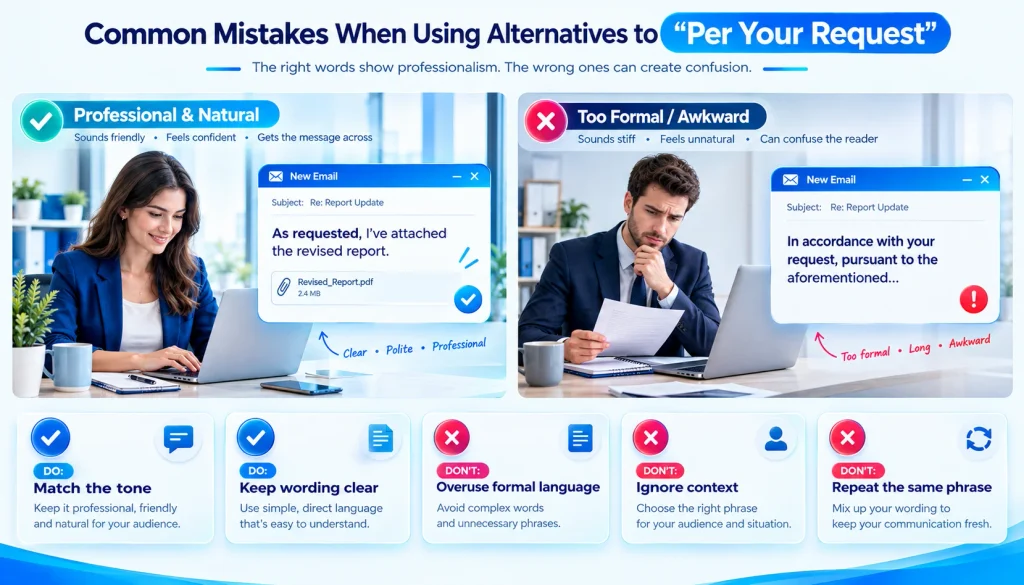
1. Using Casual Phrases in Formal Emails
A phrase such as “Here’s what you asked for” may sound perfectly natural with a coworker but less suitable for a legal notice or highly formal client communication.
2. Choosing Overly Formal Language
Expressions such as “in accordance with your request” can sound unnecessarily stiff in a simple workplace email. When a shorter option communicates the same idea, consider using “as requested.”
3. Repeating the Same Phrase
Using “per your request” in every email can make your writing sound mechanical. Vary your wording when another phrase fits the situation better.
4. Forgetting the Context
Not every request involves the same type of action. “In response to your request” works well for an answer, while “based on your request” can be better when explaining a decision or change.
5. Sounding Insincere
Formal language does not automatically make an email more professional. If the wording feels stiff or distant, a simple sentence may communicate your message more effectively.
Frequently Asked Questions
Is “per your request” professional?
Yes. “Per your request” is a professional expression commonly used to connect an action with something another person asked for. It can work well in business emails, client communication, and workplace updates. However, tone depends on context, so “as requested” or “as you requested” may sound more natural in some situations.
What is the most natural alternative to “per your request”?
“As requested” is one of the most concise and versatile alternatives. It works in many professional emails without sounding overly formal. For example, “As requested, I attached the revised proposal” is direct, clear, and easy for the reader to understand.
Is “as requested” better than “per your request”?
Neither phrase is universally better. “As requested” is shorter and often feels more natural in modern professional writing, while “per your request” has a slightly more formal business tone. Your choice should depend on your audience, workplace style, and the message you are sending.
Can I use “per your request” in a formal email?
Yes. “Per your request” is appropriate for formal emails, especially when you are sending documents, confirming an action, or responding to a specific request. If the email has a legal, administrative, or highly official purpose, an even more formal phrase such as “in accordance with your request” may fit the context.
What can I say instead of “per your request” in a casual email?
For a casual email, try “you asked for,” “here’s what you asked for,” or “as you requested.” These options sound more conversational and less formal. For example, “Here’s the file you asked for” feels natural when communicating with a coworker or someone you know well.
Is “in response to your request” formal?
Yes. “In response to your request” has a professional and somewhat formal tone. It is particularly useful when answering a question or providing information requested in an earlier email. It also makes the connection between the original request and your response very clear.
What is a good alternative when sending an attachment?
“As requested” is an excellent choice when sending an attachment. You can also be more direct by naming the document: “I’ve attached the report you requested.” This approach tells the reader exactly what you included and avoids unnecessary formal wording.
Does “per your request” sound rude?
No. The phrase itself is not rude. However, very formal wording can sometimes feel distant when used in an otherwise casual conversation. If you want your message to feel warmer, “as you requested” or “here’s what you asked for” may create a more conversational tone.
Conclusion
Choosing another way to say “per your request” can make your emails more natural, precise, and appropriate for the situation. “As requested” is a concise choice for everyday professional communication, while “as you requested” adds a warmer and more personal touch. For formal correspondence, “in accordance with your request” may be suitable, while “you asked for” works better in friendly conversations.
The key is to focus on context rather than replacing one phrase automatically. Consider who you are writing to, what they requested, and how formal your message needs to be. A clear sentence such as “I’ve attached the report you requested” can often communicate more effectively than a complicated formal expression. When in doubt, choose wording that is direct, polite, and easy to understand.

Editorial contributors help develop practical English-language resources covering vocabulary, expressions, synonyms, and writing. Contributions focus on clear explanations, useful examples, and context so readers can understand not only what a phrase means, but when and how to use it naturally.