
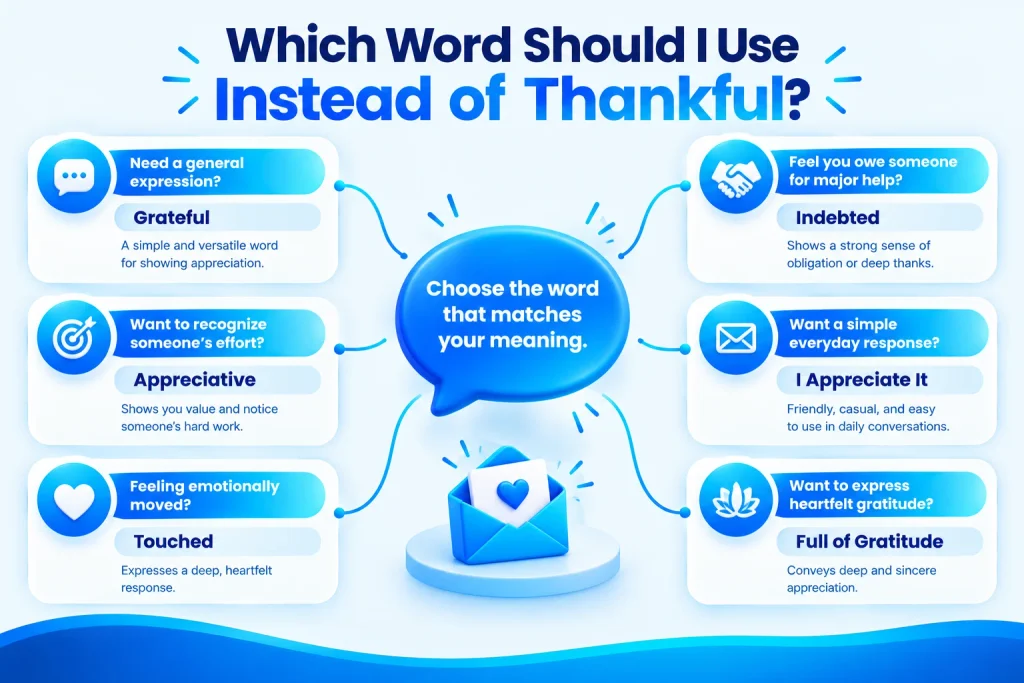
Another way to say thankful is grateful, appreciative, indebted, touched, or full of gratitude. The best choice depends on context: “grateful” works in most situations, while “appreciative” suits professional communication and “touched” expresses a more emotional response.
Key Takeaways
- Grateful is the most natural all-purpose alternative to “thankful.”
- Appreciative works especially well in professional and polite communication.
- Touched expresses a deeper emotional response to kindness or support.
- Indebted suggests that someone feels they owe another person for their help.
- Choose your wording based on the relationship, situation, tone, and level of emotion.
What Does “Another Way to Say Thankful” Mean?
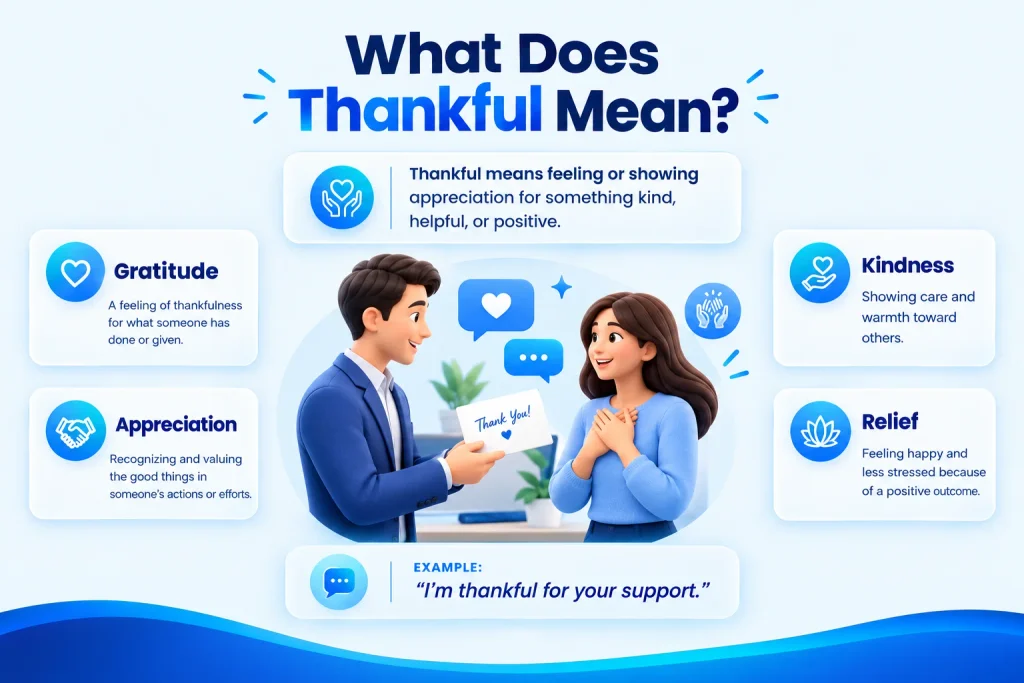
Looking for another way to say thankful usually means you want a different word or phrase to express gratitude, appreciation, or relief. Although “thankful” is natural and widely used, another expression can make your message more precise or better suited to the situation.
For example, you might say “I’m grateful for your support” in a professional message, while “I’m touched by your kindness” can sound more personal and emotional.
“Thankful” commonly appears in everyday conversations, thank-you messages, professional emails, cards, speeches, and personal reflections. The right alternative depends on what you want to emphasize: appreciation, emotion, relief, or a sense of obligation.
Why Use Other Ways to Say “Thankful”?
Using different expressions for “thankful” can make your communication sound more natural and specific. Instead of repeating the same word, you can choose language that matches the relationship and situation.
Other benefits include:
- Avoiding repetition in conversations and writing.
- Sounding more natural in everyday American English.
- Matching the situation, from casual chats to formal messages.
- Improving professional communication with polished wording.
- Expressing emotion more clearly when simple gratitude is not enough.
- Showing appreciation with greater precision.
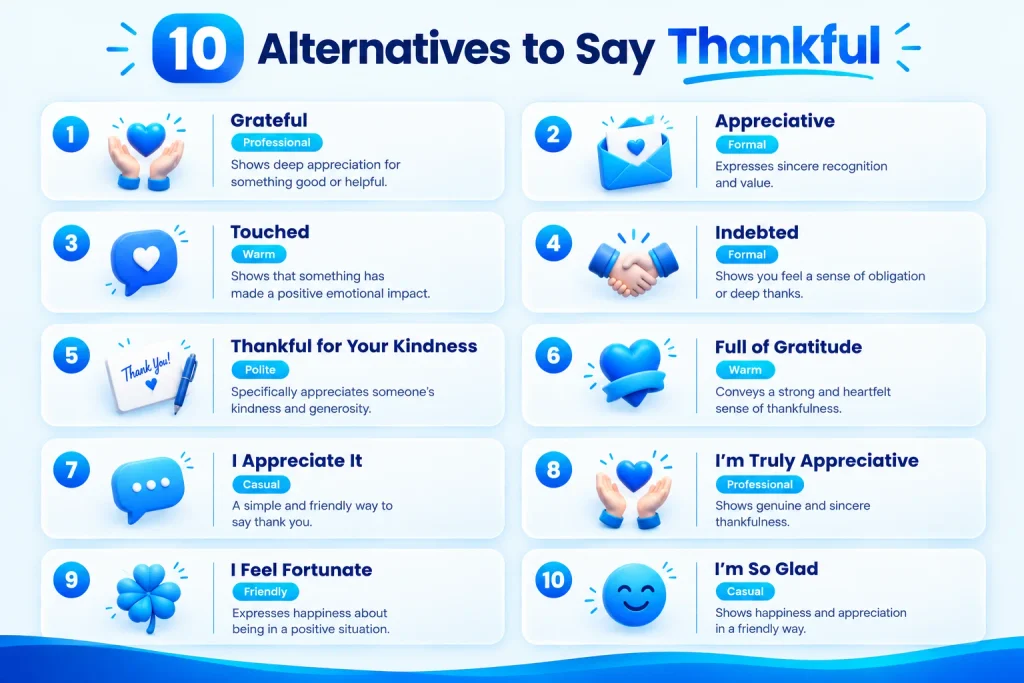
10 Best Other Ways to Say “Thankful”
1. Grateful
Meaning
Grateful is the closest and most widely useful alternative to “thankful.” It expresses a sincere feeling of appreciation for someone’s help, kindness, support, or something positive in your life.
Best For
- Professional
- Formal
- Friendly
- Warm
- Polite
Example 1
I’m grateful for everything you did to help me prepare for the presentation.
Example 2
We’re grateful to have such supportive neighbors.
Quick Tip
Use grateful when you want a natural replacement that works in almost any setting.
2. Appreciative
Meaning
Appreciative means recognizing and valuing someone’s effort, kindness, assistance, or contribution. It is particularly useful when you want to acknowledge something specific that another person has done.
Best For
- Professional
- Formal
- Polite
- Friendly
Example 1
I’m very appreciative of your quick response to my request.
Example 2
The team was appreciative of the extra time you gave us.
Quick Tip
Use appreciative when you want to focus on recognizing someone’s effort or contribution.
3. Touched
Meaning
Touched describes feeling emotionally moved by someone’s kindness, generosity, or thoughtful action. It often conveys more personal emotion than the straightforward word “thankful.”
Best For
- Warm
- Friendly
- Casual
- Polite
Example 1
I was truly touched by the thoughtful note you left for me.
Example 2
She felt touched when her coworkers surprised her with a celebration.
Quick Tip
Choose touched when the kindness affected you emotionally, rather than simply helping you.
4. Indebted
Meaning
Indebted means feeling that you owe someone because of the help or support they provided. It can sound more serious or formal than “thankful,” especially when the person’s assistance was significant.
Best For
- Formal
- Professional
- Warm
Example 1
I’m deeply indebted to my mentor for the guidance she provided throughout my career.
Example 2
The organization remains indebted to its volunteers for their years of service.
Quick Tip
Use indebted carefully because it can suggest a stronger sense of obligation than ordinary gratitude.
5. Thankful for Your Kindness
Meaning
Thankful for your kindness is a warm phrase that directly acknowledges someone’s considerate or generous behavior. It works well when you want your gratitude to feel personal without sounding overly formal.
Best For
- Friendly
- Warm
- Polite
- Casual
Example 1
I’m truly thankful for your kindness while I was going through a difficult week.
Example 2
We’re thankful for your kindness and generosity during our visit.
Quick Tip
Use this phrase when you want to connect your gratitude directly to someone’s kindness.
6. Full of Gratitude
Meaning
Full of gratitude expresses a strong or heartfelt feeling of thankfulness. It is more expressive than simply saying “thankful” and often appears in speeches, personal messages, and reflective writing.
Best For
- Formal
- Warm
- Friendly
Example 1
I’m leaving this experience full of gratitude for everyone who supported me.
Example 2
She was full of gratitude after receiving so much encouragement from her community.
Quick Tip
Choose this phrase when you want to emphasize deep or heartfelt appreciation.
7. I Appreciate It
Meaning
I appreciate it is a common American English expression used to thank someone for a specific action. It is concise, natural, and especially common in everyday conversations and workplace communication.
Best For
- Professional
- Casual
- Friendly
- Polite
Example 1
Thanks for sending those files so quickly. I really appreciate it.
Example 2
I appreciate it when you keep me updated about changes to the schedule.
Quick Tip
Use I appreciate it when you want a simple, natural response to someone’s help or consideration.
8. I’m Truly Appreciative
Meaning
I’m truly appreciative adds emphasis to the feeling of appreciation. It can sound sincere and polished when you want to communicate that someone’s support or effort genuinely matters to you.
Best For
- Professional
- Formal
- Warm
- Polite
Example 1
I’m truly appreciative of the time you spent reviewing my proposal.
Example 2
I’m truly appreciative of everyone who contributed to the project.
Quick Tip
Use truly to add warmth, but avoid adding too many intensifiers because they can make your message sound less natural.
9. I Feel Fortunate
Meaning
I feel fortunate expresses gratitude by focusing on the positive circumstances, opportunities, or people in your life. It is useful when you want to sound reflective rather than directly thanking someone.
Best For
- Formal
- Warm
- Friendly
- Polite
Example 1
I feel fortunate to have had the opportunity to work with such a talented team.
Example 2
We feel fortunate to have your continued support.
Quick Tip
Use I feel fortunate when your gratitude is connected to an opportunity, relationship, or positive circumstance.
10. I’m So Glad
Meaning
I’m so glad can communicate gratitude when you are relieved or happy about something positive that happened. It is more casual than “grateful” and works best in friendly, conversational situations.
Best For
- Casual
- Friendly
- Warm
Example 1
I’m so glad you were able to come and support me.
Example 2
I’m so glad you checked in when I needed someone to talk to.
Quick Tip
Use I’m so glad when gratitude and happiness naturally overlap, especially in personal conversations.
Comparison Table
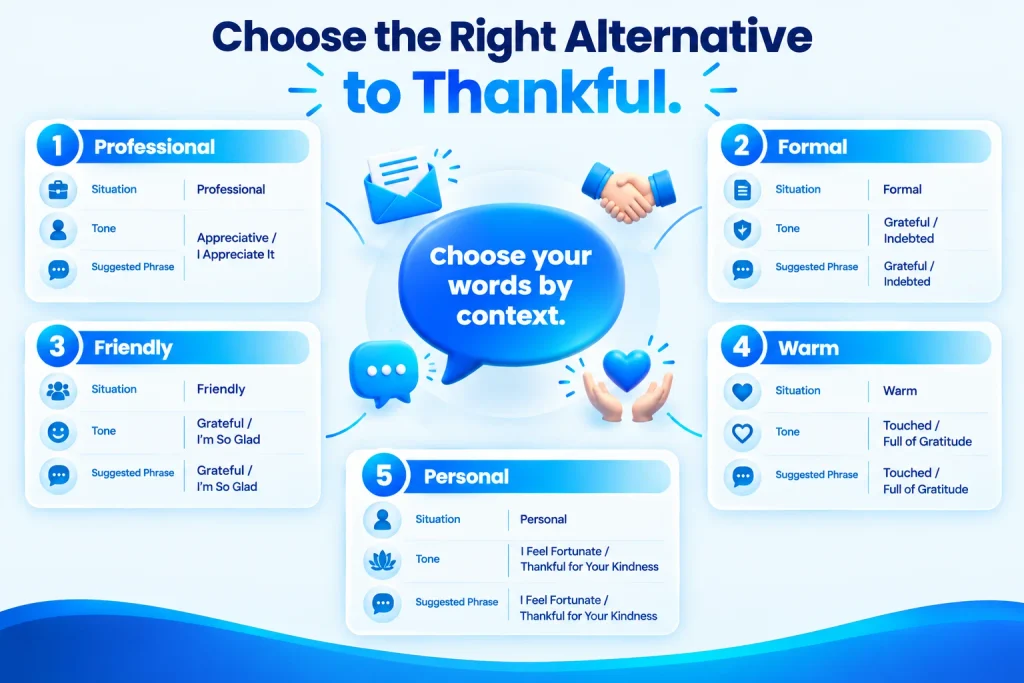
| Alternative | Best Used In | Tone |
| Grateful | Everyday, professional, personal | Warm, sincere |
| Appreciative | Workplace, emails, formal communication | Polite, professional |
| Touched | Personal messages, acts of kindness | Emotional, warm |
| Indebted | Significant help, formal contexts | Serious, respectful |
| Thankful for Your Kindness | Personal appreciation | Warm, sincere |
| Full of Gratitude | Speeches, reflections, heartfelt writing | Deep, expressive |
| I Appreciate It | Conversations, emails, quick responses | Natural, polite |
| I’m Truly Appreciative | Professional and personal messages | Sincere, polished |
| I Feel Fortunate | Opportunities, relationships, life events | Reflective, warm |
| I’m So Glad | Friendly and casual conversations | Casual, positive |
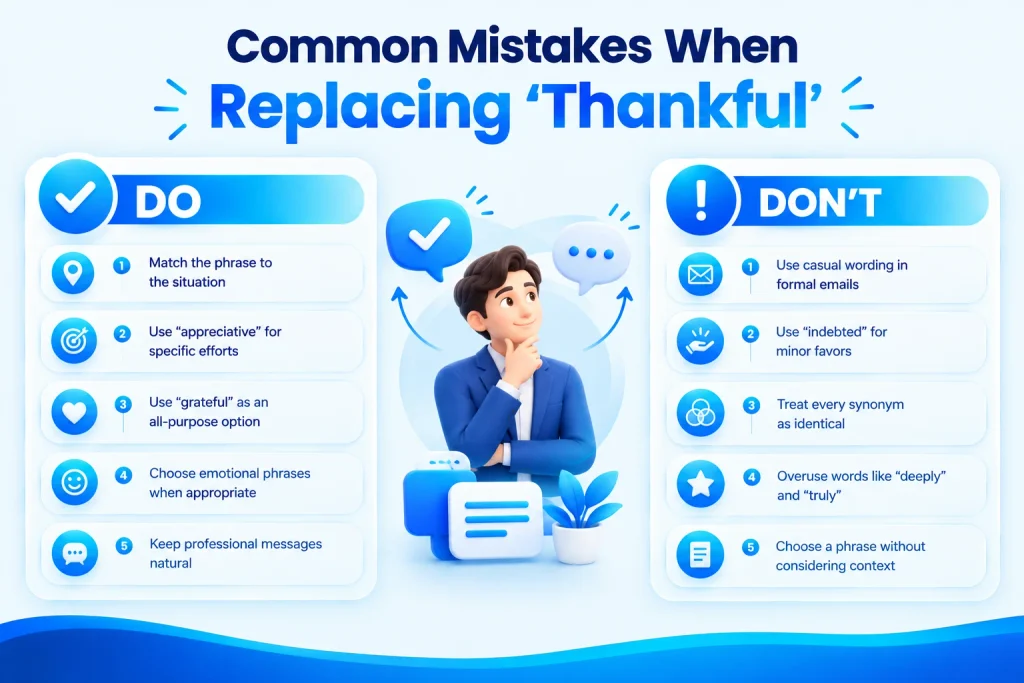
Common Mistakes When Replacing “Thankful”
1. Using Casual Phrases in Professional Emails
Expressions such as “I’m so glad” may sound too conversational in a formal workplace message. For business communication, “I’m grateful” or “I appreciate it” is often more appropriate.
2. Choosing Overly Formal Language
Words such as “indebted” can sound unusually serious when someone simply helped with a small task. Match the strength of your wording to the situation.
3. Repeating the Same Phrase
Using “thankful” repeatedly can make a message feel predictable. Vary your language with alternatives such as “grateful,” “appreciative,” or “touched” when they accurately express your meaning.
4. Forgetting the Context
Not every synonym has exactly the same meaning. “Touched” emphasizes emotion, while “indebted” suggests that you feel you owe someone, so replacing “thankful” without considering context can change your message.
5. Sounding Insincere
Adding strong words such as “deeply,” “truly,” or “incredibly” to every expression can make your writing feel exaggerated. Use emphasis when it reflects your genuine feelings.
Frequently Asked Questions
What is the best word for thankful?
The best general alternative to “thankful” is grateful. It works naturally in personal conversations, professional emails, formal writing, and everyday situations. “Appreciative” is another strong choice when you want to recognize someone’s specific effort or contribution.
Is grateful the same as thankful?
“Grateful” and “thankful” have very similar meanings, and they can often be used interchangeably. However, “grateful” can sound slightly more deliberate or heartfelt, while “thankful” is also commonly used to describe relief or appreciation for a positive outcome.
What is a professional way to say thankful?
Appreciative, grateful, and I appreciate it are useful professional alternatives. For example, “I’m grateful for your assistance” sounds polished, while “I appreciate your help” is concise and natural in workplace emails and conversations.
What is a formal way to say thankful?
For formal communication, you can use grateful, appreciative, or indebted, depending on the situation. “I’m deeply grateful for your support” communicates sincere appreciation, while “I’m indebted to you” suggests that the person’s assistance created a stronger sense of obligation.
What is another way to say “I am thankful for you”?
You could say “I’m grateful to have you in my life,” “I truly appreciate you,” or “I feel fortunate to have you.” The best option depends on your relationship and whether you want the message to sound warm, personal, romantic, or simply appreciative.
How do you say thankful in a professional email?
Try phrases such as “I appreciate your assistance,” “I’m grateful for your support,” or “I truly appreciate your time.” These expressions sound natural in American workplace communication and make your gratitude specific rather than generic.
What is a stronger word for thankful?
Words such as grateful, touched, and indebted can communicate stronger or more specific feelings than “thankful.” However, they are not interchangeable in every situation. “Touched” emphasizes emotion, while “indebted” emphasizes a sense of owing someone.
Can I use “appreciative” instead of “thankful”?
Yes. Appreciative is a natural alternative when you want to recognize someone’s effort, assistance, or kindness. For example, “I’m appreciative of your support” works well in professional communication, although “I appreciate your support” may sound more conversational.
Conclusion
There are many natural ways to say thankful, and the right choice depends on the situation and the feeling you want to communicate. Grateful is the most versatile option, while appreciative works particularly well when recognizing someone’s effort or support.
For a more emotional message, touched can show that someone’s kindness affected you personally. Indebted is more serious and suggests that you feel you owe someone for significant help. In casual conversations, I appreciate it and I’m so glad can sound relaxed and natural.
Before choosing an alternative, consider your audience, relationship, and purpose. The best expression is not necessarily the most formal one—it is the phrase that communicates genuine gratitude naturally and clearly.

The Majestic Studio Editorial Team creates practical resources about synonyms, alternative phrases, vocabulary, and English usage. Our content is designed to help readers choose clearer, more natural words and communicate effectively in everyday, professional, and academic contexts.
Each article is researched, edited, and reviewed for clarity, context, usefulness, and language accuracy. We regularly update our content to keep examples and recommendations relevant.