

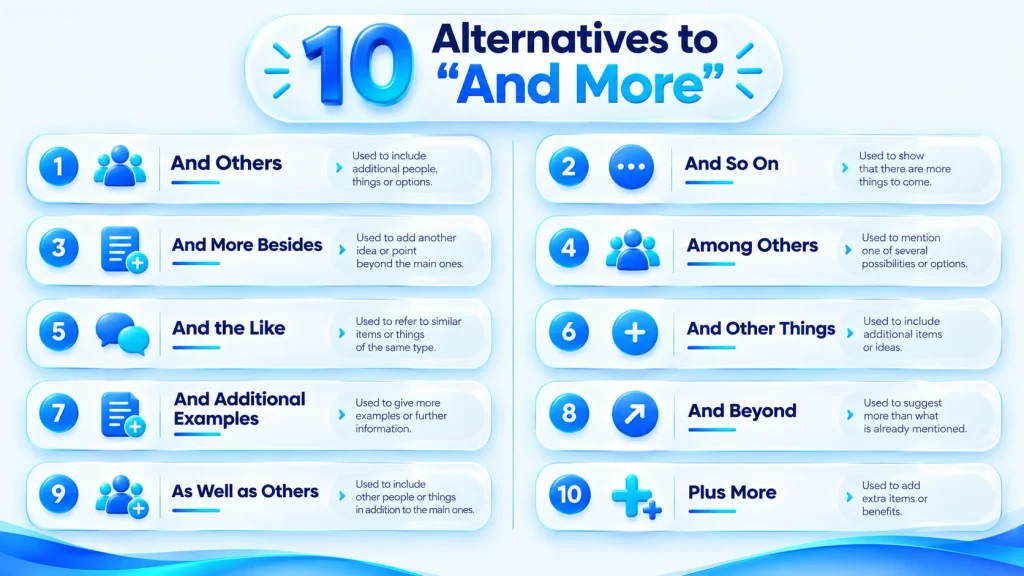
If you need another way to say “and more,” you can use phrases such as among others, to name a few, and so on, and so forth, and the like, plus more, additional items, and beyond, or etc. The best choice depends on your context, tone, and the type of list you are describing.
Key Takeaways
- Among others works well when referring to additional people, organizations, or things within a larger group.
- To name a few is useful when you are giving selected examples rather than a complete list.
- And so on and and so forth work naturally when a recognizable list or pattern continues.
- And the like is best when the additional items are similar to the examples already mentioned.
- In professional and academic writing, a specific description can often be clearer than simply saying “and more.”
What Does “And More” Mean?
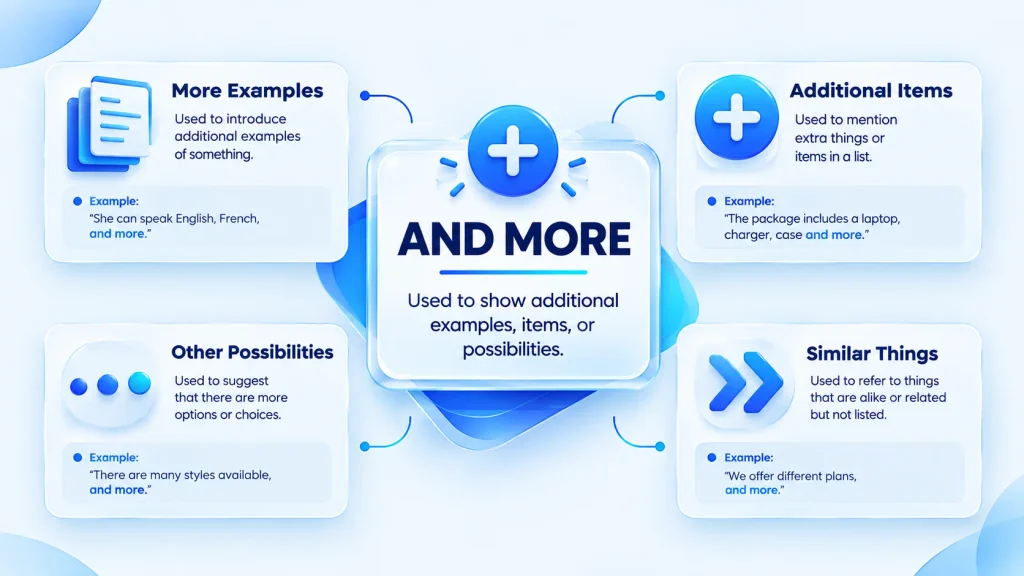
The phrase “and more” means that additional things exist beyond the items that have already been mentioned. It is commonly used at the end of a list when the writer does not want to name every item.
For example:
The conference includes workshops, networking sessions, panel discussions, and more.
This sentence tells the reader that workshops, networking sessions, and panel discussions are only some of the conference activities.
“And more” is common in everyday conversations, websites, advertisements, product descriptions, presentations, and informal writing. However, repeating it too often can make your writing sound vague or predictable.
The best alternative depends on exactly what you mean. Some expressions refer to additional items, while others emphasize similar things, selected examples, or a continuing pattern.
Why Use Alternatives to “And More”?
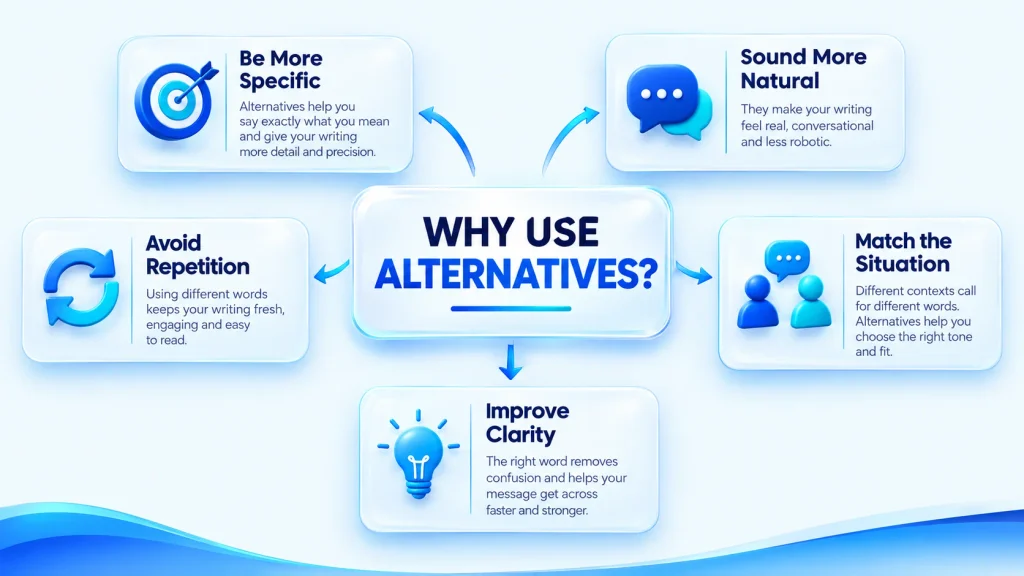
There are several reasons to replace “and more.”
First, using different expressions can make your writing sound more natural. Repeating the same phrase at the end of several lists can become monotonous.
Second, alternatives can communicate a more specific meaning. For example, “among others” indicates that the named people or things are part of a larger group, while “to name a few” emphasizes that you are providing only selected examples.
Third, some alternatives are better suited to particular situations. A casual conversation might naturally use “and so on,” while a professional report may benefit from “among others” or a more precise description.
Finally, sometimes you do not need a replacement at all. If the sentence already makes it clear that the list is incomplete, removing “and more” may make the writing cleaner.
10 Alternatives to “And More”
1. Among Others
“Among others” means that the people or things you have mentioned are part of a larger group.
It is especially useful when listing several people, organizations, industries, subjects, or categories without naming every member of the group.
Best for: Professional writing, reports, articles, and formal communication.
Formality: 4/5
Example 1:
The project involved designers, developers, and researchers, among others.
Example 2:
She has worked with companies in technology, healthcare, and finance, among others.
Quick Tip:
Use “among others” when the unlisted items belong to the same general group as the examples you have already named.
2. To Name a Few
“To name a few” tells the reader that you are providing only some examples from a larger collection.
It is natural in both spoken and written English and works well when you want to make it clear that your list is not complete.
Best for: Articles, presentations, professional communication, and everyday English.
Formality: 3/5
Example 1:
The course covers grammar, vocabulary, pronunciation, and public speaking, to name a few.
Example 2:
Our clients work in education, technology, healthcare, and finance, to name a few.
Quick Tip:
Choose “to name a few” when you intentionally want to highlight several examples without listing everything.
3. And So On
“And so on” indicates that a list continues in the same general way.
It is one of the most natural alternatives to “and more” in everyday conversations and informal writing.
Best for: Casual conversations, emails, notes, and familiar lists.
Formality: 2/5
Example 1:
We discussed deadlines, budgets, staffing, and so on.
Example 2:
Bring your notebook, laptop, charger, and so on.
Quick Tip:
Use “and so on” when readers can easily understand what other items would follow.
4. And So Forth
“And so forth” has a meaning similar to “and so on.” It shows that a list or pattern continues beyond the examples provided.
It can sound slightly more formal than “and so on,” although the two phrases are often interchangeable.
Best for: Professional conversations, explanatory writing, and formal-leaning communication.
Formality: 3/5
Example 1:
The workshop covers planning, budgeting, scheduling, and so forth.
Example 2:
Students learn how to research sources, organize notes, create citations, and so forth.
Quick Tip:
Use “and so forth” when you want a polished alternative to “and so on” without changing the basic meaning.
5. And the Like
“And the like” refers to other things that are similar to the examples already mentioned.
This expression is particularly useful when the similarity between the listed and unlisted items matters.
Best for: Formal and semi-formal writing.
Formality: 4/5
Example 1:
The store sells office supplies such as notebooks, planners, folders, and the like.
Example 2:
The discussion covered privacy, cybersecurity, data protection, and the like.
Quick Tip:
Do not use “and the like” when the additional items could be completely unrelated. The phrase suggests similarity.
6. Plus More
“Plus more” emphasizes that additional items, features, or benefits are available beyond the ones already listed.
It has a casual and promotional feel, so it is more common in advertisements, websites, product descriptions, and conversational writing.
Best for: Marketing copy, casual communication, and promotional content.
Formality: 2/5
Example 1:
The membership includes discounts, exclusive events, free resources, plus more.
Example 2:
The app offers budgeting tools, spending reports, reminders, plus more.
Quick Tip:
For formal writing, consider replacing “plus more” with a more precise phrase such as “additional features” or “among other benefits.”
7. To Name a Few Examples
“To name a few examples” clearly communicates that the items listed are only selected examples.
It is useful when you want to make the limited nature of your list especially clear.
Best for: Educational, professional, and explanatory writing.
Formality: 3/5
Example 1:
The training covers communication, leadership, conflict resolution, and time management, to name a few examples.
Example 2:
Common workplace challenges include unclear expectations, missed deadlines, and communication problems, to name a few examples.
Quick Tip:
This phrase can sound slightly repetitive because “to name a few” already communicates the same idea. Use it when extra clarity is helpful.
8. Additional Items
“Additional items” is a direct and professional way to refer to things that have not been specifically listed.
It works particularly well in documents, instructions, reports, forms, and business communication.
Best for: Professional and formal writing.
Formality: 4/5
Example 1:
The package includes installation support, maintenance, training, and additional items.
Example 2:
The application requires your name, address, phone number, and additional items for verification.
Quick Tip:
“Additional items” is precise, but it may sound less natural than “and more” in casual conversation.
9. A nd Beyond
“And beyond” suggests that something extends past the examples or limits that have just been mentioned.
Unlike “and more,” it can emphasize broader scope rather than simply adding more items to a list.
Best for: Presentations, professional writing, marketing, and broader descriptions.
Formality: 3/5
Example 1:
The program supports students through graduation and beyond.
Example 2:
Our services cover website design, development, maintenance, and beyond.
Quick Tip:
Use “and beyond” when you want to communicate that the scope extends further than the specific examples you mentioned.
10. Etc.
“Etc.” is short for the Latin phrase et cetera and is commonly used at the end of a list to indicate that other similar items have been left out.
Best for: Concise writing, notes, instructions, and situations where the missing items are obvious.
Formality: 4/5
Example 1:
Bring pens, pencils, notebooks, etc.
Example 2:
The report covers travel, lodging, meals, transportation, etc.
Quick Tip:
Do not use “etc.” when the missing information is important to the reader. Name important items directly instead.
“And More” Alternatives by Situation
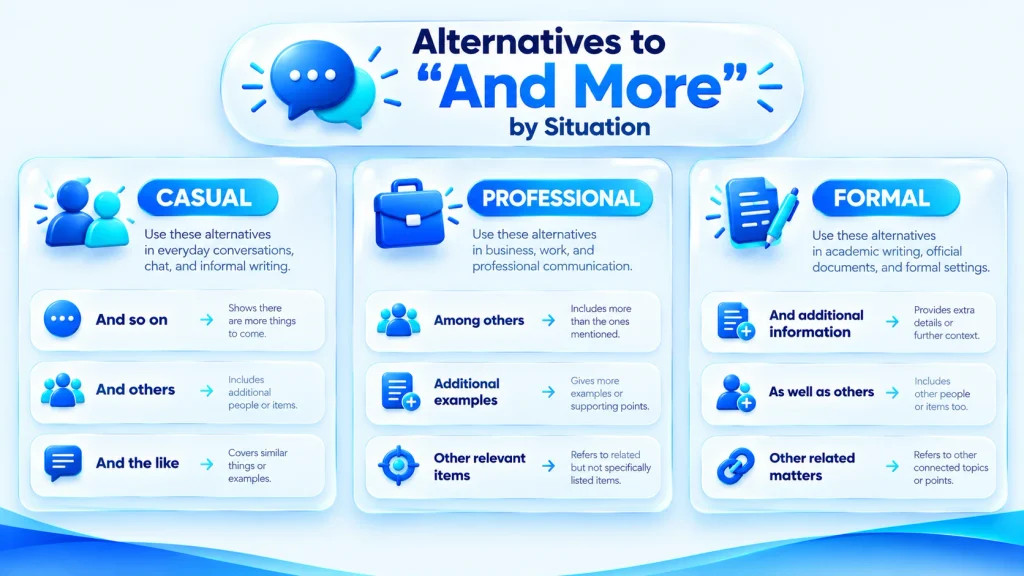
The best alternative depends on the situation.
When Listing People or Organizations
Use “among others.”
Example:
The meeting included teachers, administrators, and parents, among others.
When Giving Selected Examples
Use “to name a few.”
Example:
The website covers grammar, vocabulary, pronunciation, and writing, to name a few.
When Continuing an Obvious List
Use “and so on.”
Example:
We discussed schedules, deadlines, budgets, and so on.
When Referring to Similar Things
Use “and the like.”
Example:
The store sells notebooks, folders, planners, and the like.
When Writing a Formal Document
Consider “additional items” or provide a more specific description.
Example:
The application requires identification, proof of address, and additional documents.
When You Want to Emphasize Broader Scope
Use “and beyond.”
Example:
Our support continues after installation and beyond.
“And More” vs. “More and More”
These two expressions are easy to confuse, but they have different meanings.
“And more” refers to additional things.
The event includes workshops, presentations, networking opportunities, and more.
“More and more” means increasingly or to a growing degree.
More and more students are using online resources to study.
The first expression adds unspecified items to a list. The second describes an increase.
A simple way to remember the difference is:
And more = additional things
More and more = increasing amount or degree
When “And More” Is Better Than an Alternative
You do not always need to replace “and more.”
Sometimes it is the clearest and most natural choice.
For example:
The new phone offers better battery life, improved cameras, faster performance, and more.
This sounds natural in product or marketing copy.
Similarly:
We have books, games, movies, and more for the whole family.
The phrase works well because the writer wants to create a broad sense of variety without listing every item.
The goal should not be to avoid “and more” at all costs. Instead, choose the wording that communicates your meaning naturally.
When You Should Remove “And More”
Sometimes the best alternative is simply nothing.
Consider:
The course covers subjects such as grammar, vocabulary, pronunciation, and more.
The phrase “such as” already introduces examples, so “and more” may not add much information.
You could write:
The course covers subjects such as grammar, vocabulary, and pronunciation.
Or, if you want to provide more information:
The course covers grammar, vocabulary, pronunciation, writing, and speaking skills.
The second version gives the reader useful information instead of leaving the additional content unspecified.
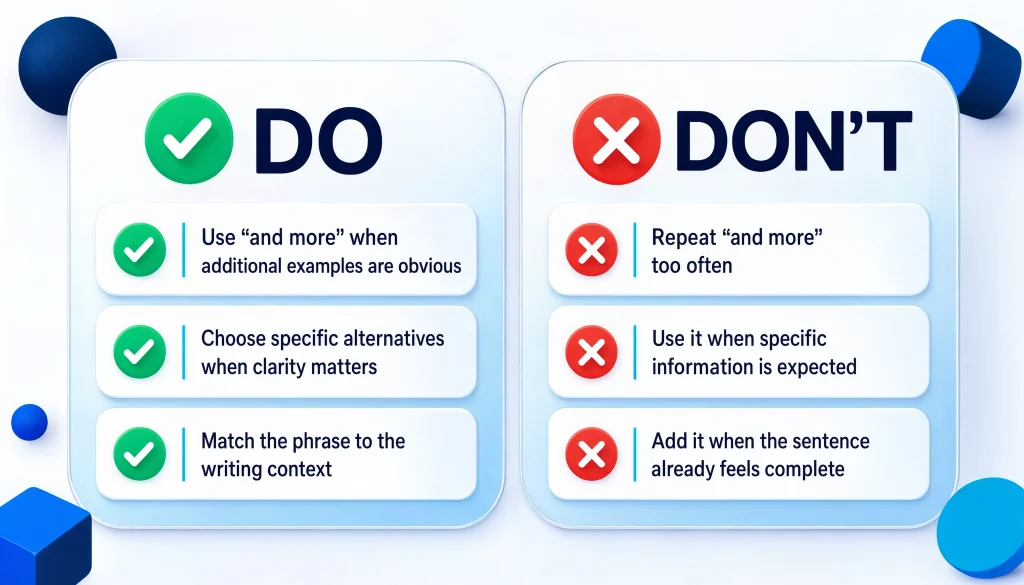
Common Mistakes When Using “And More”
1. Confusing “And More” With “More and More”
Mistake:
The company offers web design, hosting, and more and more.
Why it sounds wrong:
“More and more” describes something increasing, not additional items in a list.
Better approach:
The company offers web design, hosting, and more.
2. Using “And More” After Every List
Mistake:
Using “and more” repeatedly throughout an article or website.
Why it sounds weak:
Frequent repetition can make the writing feel vague and predictable.
Better approach:
Choose a context-specific alternative or provide more precise information.
3. Using “And the Like” for Unrelated Items
Mistake:
The conference covers marketing, accounting, hiking, and the like.
Why it sounds wrong:
“And the like” suggests that the omitted items are similar to the examples.
Better approach:
Use “and more” or “among other topics” when the additional subjects are not necessarily similar.
4. Adding “And More” When the Sentence Is Already Clear
Mistake:
The course includes subjects such as grammar, vocabulary, and pronunciation, and more.
Why it can be unnecessary:
“Such as” already indicates that the examples are not necessarily exhaustive.
Better approach:
The course includes subjects such as grammar, vocabulary, and pronunciation.
5. Using “Etc.” When Readers Need Specific Information
Mistake:
Please bring your identification, application form, etc.
Why it may be unhelpful:
The reader may not know which additional documents are required.
Better approach:
List every important document the reader needs to bring.
Tips for Using Alternatives Naturally
The strongest choice depends on what the reader needs to understand.
If the omitted items are members of a group, use “among others.”
If you are providing selected examples, use “to name a few.”
If a familiar list continues, use “and so on” or “and so forth.”
If the omitted items are similar to the listed examples, use “and the like.”
If you need a short, familiar ending, “etc.” may work.
If the subject has a broader scope, “and beyond” can communicate that idea.
And if the reader needs to know exactly what the additional items are, the best choice is usually to name them directly.
Frequently Asked Questions
What is another way to say “and more”?
Some common alternatives are among others, to name a few, and so on, and so forth, and the like, plus more, additional items, and beyond, and etc. The right choice depends on the context. For example, “among others” works well for groups, while “to name a few” is useful for selected examples.
What is a professional way to say “and more”?
Professional alternatives include “among others,” “additional items,” “to name a few,” and “and so forth.” However, a precise description is often better than a vague phrase. For example, instead of saying “reports, emails, and more,” you could write “reports, emails, presentations, and other business documents.”
What is a formal synonym for “and more”?
There is no single formal synonym that works in every sentence. “Among others,” “and the like,” “additional items,” and “and so forth” can all work in formal contexts. The best option depends on whether you are referring to additional members of a group, similar things, or a continuing list.
Can I use “and so on” instead of “and more”?
Yes, in many situations. Both phrases can indicate that a list continues beyond the examples provided. “And so on” often suggests that the reader can predict the next items or recognize the pattern. “And more” is broader and can simply indicate that additional items exist.
Is “and more” grammatically correct?
Yes. “And more” is grammatically acceptable when it is used to indicate additional items, information, features, or possibilities. However, it can sometimes be unnecessary. If another expression already shows that the list is incomplete, removing “and more” may make the sentence cleaner.
Is “and the like” the same as “and more”?
Not exactly. “And the like” specifically suggests that the additional items are similar to the examples already mentioned. “And more” has a broader meaning and does not necessarily imply that the additional items are similar.
Can I use “etc.” instead of “and more”?
In some situations, yes. “Etc.” works when the omitted items are similar to the listed items and the reader can reasonably understand what they might be. However, if the missing information is important, it is better to list the relevant items rather than using “etc.”
What is the difference between “and more” and “more and more”?
“And more” means additional things, while “more and more” means increasingly. For example, “The store sells clothes, shoes, and more” refers to additional products. “More and more people are shopping online” describes a growing number of people.
Final Thoughts
There are many ways to say “and more,” but the best alternative depends on what you want your sentence to communicate. “Among others” works well for groups, “to name a few” works for selected examples, and “and so on” is natural for continuing lists. “And the like” is better when the additional items are similar, while “etc.” provides a concise way to indicate that a list continues.
For professional and academic writing, think about whether your reader actually needs the missing information. If they do, give specific examples instead of hiding useful details behind “and more.”
The most natural writing is not always the writing with the most synonyms. Choose the expression that gives your reader the clearest meaning with the least unnecessary wording.

Editorial contributors help develop practical English-language resources covering vocabulary, expressions, synonyms, and writing. Contributions focus on clear explanations, useful examples, and context so readers can understand not only what a phrase means, but when and how to use it naturally.