

Another way to say “bridge the gap” is close the gap, narrow the divide, connect the dots, build a connection, or bring people together. The best alternative depends on your context. Use “close the gap” for solving differences, “build a connection” for relationships, and “align efforts” for professional teamwork.
Key Takeaways
- “Bridge the gap” means reducing differences, solving problems, or connecting two sides.
- “Close the gap” is a direct alternative for addressing differences or missing results.
- “Foster understanding” works well when people have different views or backgrounds.
- “Align efforts” suits business communication, teamwork, and shared goals.
- Choose an alternative that matches your audience, purpose, and tone.
What Does “Bridge the Gap” Mean?

The phrase “bridge the gap” means reducing a difference, solving a disconnect, or creating a link between two people, groups, ideas, or situations. It suggests bringing separate things closer together so they can work better or reach a shared goal.
People commonly use this expression in business, education, relationships, technology, and everyday conversation. For example, a manager might bridge the gap between departments, while a teacher might bridge the gap between theory and practice.
The phrase can describe many situations, but repeating it too often may make your writing sound predictable. Choosing a more precise alternative can help readers understand exactly what you mean.
Why Use Other Ways to Say “Bridge the Gap”?
Using different expressions helps you communicate your message with greater clarity and purpose. The right wording can also make your writing sound more natural.
Here are a few reasons to choose an alternative:
- Avoid repetition: Keep articles, reports, and emails interesting.
- Sound more natural: Match the language to your audience and situation.
- Improve professional communication: Describe goals, solutions, and teamwork more precisely.
- Express your meaning clearly: Show whether you want to solve a problem, improve a relationship, or reduce a difference.
- Adjust your tone: Choose wording that feels formal, friendly, persuasive, or practical.
15 Best Other Ways to Say “Bridge the Gap”
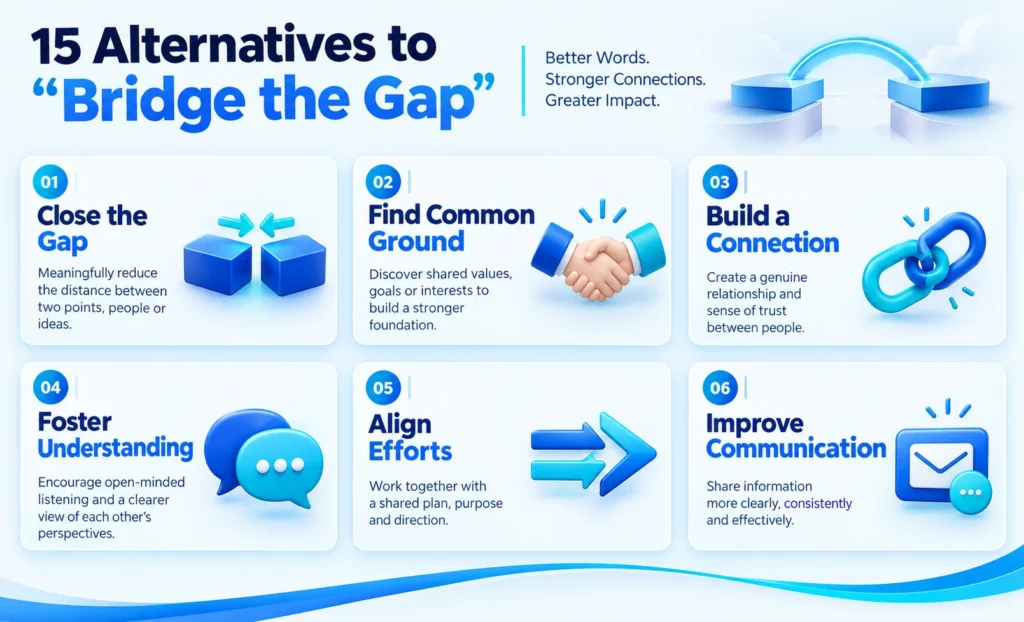
1. Close the Gap
Meaning
“Close the gap” means reducing or eliminating a difference between two things. It works especially well when discussing performance, skills, income, expectations, or measurable results.
Best For
- Professional
- Formal
Example 1
Our new training program will help close the gap between employee skills and job requirements.
Example 2
The company introduced flexible pricing to close the gap between customer expectations and its current offerings.
Quick Tip
Use this phrase when you want to emphasize a clear difference that needs to become smaller or disappear.
2. Narrow the Divide
Meaning
“Narrow the divide” means reducing separation between people, groups, or opposing viewpoints. It often suggests progress without claiming that every disagreement has been resolved.
Best For
- Formal
- Professional
Example 1
The community forum aims to narrow the divide between longtime residents and new homeowners.
Example 2
Open discussions may help narrow the divide between management and frontline employees.
Quick Tip
Choose this expression when describing social, political, or workplace differences that may take time to resolve.
3. Build a Connection
Meaning
“Build a connection” means creating a relationship or link between people, ideas, or organizations. Unlike phrases focused on fixing a problem, it emphasizes developing trust and cooperation.
Best For
- Friendly
- Warm
- Professional
Example 1
The mentorship program helps new graduates build a connection with experienced professionals.
Example 2
Our nonprofit works with local schools to build a connection between students and community leaders.
Quick Tip
Use this phrase when relationships, trust, or ongoing communication matter more than measurable outcomes.
4. Foster Understanding
Meaning
“Foster understanding” means helping people learn about different experiences, beliefs, or points of view. It focuses on empathy and awareness rather than forcing everyone to agree.
Best For
- Formal
- Professional
- Warm
Example 1
The workshop encourages employees to foster understanding across cultural differences.
Example 2
Listening to personal stories can foster understanding between generations.
Quick Tip
This is a strong choice when discussing diversity, conflict resolution, education, or communication.
5. Connect the Dots
Meaning
“Connect the dots” means identifying relationships between separate pieces of information or ideas. It is especially useful when people need to understand how individual details fit into a larger picture.
Best For
- Casual
- Professional
Example 1
The analyst helped the leadership team connect the dots between customer complaints and declining sales.
Example 2
Once we connect the dots between daily habits and long-term results, the benefits become clearer.
Quick Tip
Use this expression when the main goal is to reveal a pattern or explain how separate details relate.
6. Bring People Together
Meaning
“Bring people together” means encouraging cooperation, unity, or shared purpose among individuals or groups. It emphasizes common ground rather than differences.
Best For
- Friendly
- Warm
- Professional
Example 1
The annual neighborhood festival helps bring people together through food, music, and local traditions.
Example 2
The joint project will bring people together around a shared environmental goal.
Quick Tip
Choose this phrase for community projects, team-building activities, and efforts to improve relationships.
7. Align Efforts
Meaning
“Align efforts” means coordinating actions so that people work toward the same objectives. It suggests practical cooperation and a clear direction.
Best For
- Professional
- Formal
Example 1
The department heads will align efforts before launching the new customer service strategy.
Example 2
We need to align efforts across marketing and sales to meet the quarterly target.
Quick Tip
This phrase works best when people already share a goal but need better coordination.
8. Find Common Ground
Meaning
“Find common ground” means identifying shared interests, values, or goals despite differences. It is particularly useful during negotiations or disagreements.
Best For
- Professional
- Friendly
- Polite
Example 1
The two business partners found common ground on pricing and delivery schedules.
Example 2
Although the neighbors disagreed about parking, they found common ground on keeping the street safe.
Quick Tip
Use this expression when people have different opinions but need a point of agreement.
9. Reconcile Differences
Meaning
“Reconcile differences” means resolving disagreements or making conflicting views more compatible. It often implies thoughtful discussion, compromise, or a deliberate decision.
Best For
- Formal
- Professional
Example 1
The project leaders met to reconcile differences in their proposed budgets.
Example 2
The mediator helped the two parties reconcile differences before signing the agreement.
Quick Tip
Choose this phrase when the focus is on resolving a specific disagreement rather than simply improving communication.
10. Create a Link
Meaning
“Create a link” means establishing a connection between two people, concepts, systems, or activities. It can describe both physical connections and relationships between ideas.
Best For
- Professional
- Formal
Example 1
The research team hopes to create a link between early reading habits and later academic performance.
Example 2
Our new platform will create a link between independent retailers and regional suppliers.
Quick Tip
Use this alternative when you want to highlight a connection without suggesting that a conflict or major difference exists.
11. Improve Communication

Meaning
“Improve communication” means making information easier to share, understand, and act on. It is a practical alternative when misunderstandings or poor information flow cause a disconnect.
Best For
- Professional
- Polite
Example 1
Weekly check-ins should improve communication between the design team and developers.
Example 2
The school plans to improve communication with parents through regular progress updates.
Quick Tip
Choose this phrase when the problem involves unclear messages, delayed updates, or a lack of feedback.
12. Overcome Barriers
Meaning
“Overcome barriers” means dealing with obstacles that prevent progress or access. These barriers may involve cost, language, technology, limited resources, or personal challenges.
Best For
- Professional
- Formal
- Warm
Example 1
The scholarship program helps first-generation students overcome barriers to higher education.
Example 2
The engineering team worked together to overcome barriers that delayed product testing.
Quick Tip
Use this expression when a specific obstacle stands between people and their desired outcome.
13. Close the Divide
Meaning
“Close the divide” means reducing separation between groups or viewpoints. It often carries a social or emotional meaning and can suggest a move toward greater unity.
Best For
- Formal
- Warm
Example 1
The city launched a public dialogue initiative to close the divide between residents and local officials.
Example 2
Shared volunteer work can help close the divide between people from different backgrounds.
Quick Tip
This phrase suits discussions about social differences, community relationships, and opposing perspectives.
14. Establish Common Ground
Meaning
“Establish common ground” means deliberately identifying shared priorities or principles. It is slightly more structured than “find common ground” and works well when people need a starting point for cooperation.
Best For
- Formal
- Professional
- Polite
Example 1
Before discussing contract terms, both companies agreed to establish common ground on project goals.
Example 2
The committee began by establishing common ground on student safety and academic standards.
Quick Tip
Use this expression at the beginning of a negotiation, meeting, or discussion that requires agreement.
15. Facilitate Collaboration
Meaning
“Facilitate collaboration” means making it easier for people to work together. It emphasizes the steps, tools, or conditions that support effective teamwork.
Best For
- Professional
- Formal
Example 1
The shared project dashboard will facilitate collaboration between remote design teams.
Example 2
The coordinator introduced monthly planning sessions to facilitate collaboration among nonprofit partners.
Quick Tip
Choose this phrase when describing a process or action that helps people cooperate, rather than the final result of their cooperation.
Comparison Table
| Alternative | Best Used In | Tone |
|---|---|---|
| Close the gap | Performance, skills, measurable results | Direct |
| Narrow the divide | Social or workplace differences | Formal |
| Build a connection | Relationships and networking | Warm |
| Foster understanding | Diversity and conflict resolution | Thoughtful |
| Connect the dots | Analysis and problem-solving | Conversational |
| Bring people together | Community and team activities | Friendly |
| Align efforts | Business goals and teamwork | Professional |
| Find common ground | Negotiations and disagreements | Cooperative |
| Reconcile differences | Dispute resolution | Formal |
| Create a link | Research and connected systems | Neutral |
| Improve communication | Workplace and school updates | Practical |
| Overcome barriers | Access and problem-solving | Encouraging |
| Close the divide | Social unity and shared perspectives | Warm |
| Establish common ground | Meetings and negotiations | Diplomatic |
| Facilitate collaboration | Project management and teamwork | Professional |
Common Mistakes
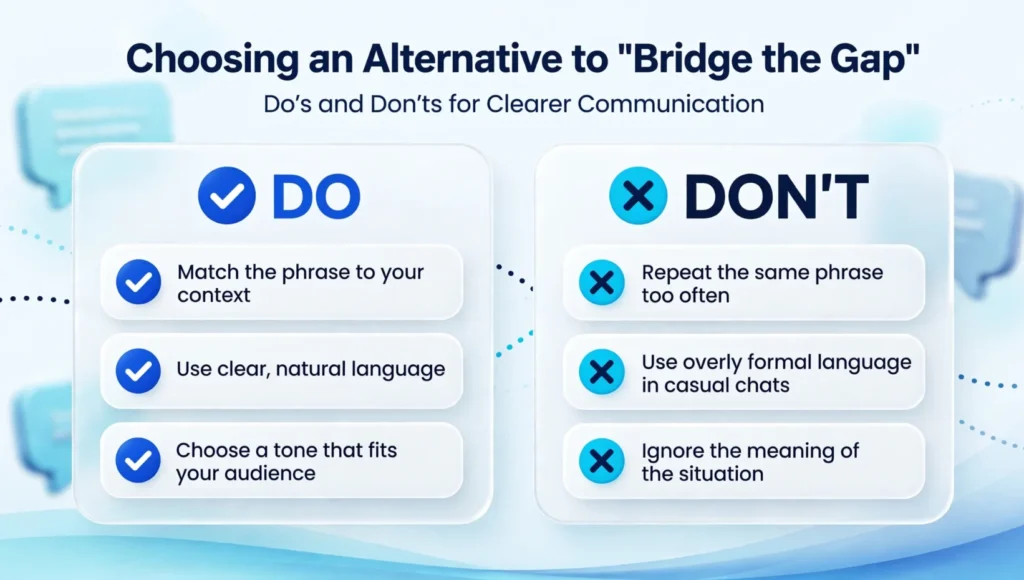
1. Using Casual Phrases in Formal Emails
Expressions such as “connect the dots” can sound too conversational in a legal report or executive proposal. Choose a more precise option, such as “establish a connection” or “align efforts,” when the setting requires a formal tone.
2. Choosing Overly Formal Language
Not every conversation needs phrases such as “reconcile differences.” In a friendly discussion, “find common ground” or “work together” may sound clearer and more natural.
3. Repeating the Same Alternative
Replacing “bridge the gap” with “close the gap” in every paragraph does little to improve variety. Select different expressions based on whether you mean resolving conflict, improving communication, or coordinating work.
4. Ignoring the Context
Some alternatives describe different goals. “Improve communication” addresses information sharing, while “overcome barriers” focuses on obstacles. Choose wording that accurately reflects the problem you want to solve.
5. Sounding Insincere
A polished phrase cannot replace genuine concern or action. For example, saying that a company wants to “foster understanding” means little if leaders refuse to listen to employee concerns. Support your words with specific steps.
Frequently Asked Questions

1. What is the best synonym for “bridge the gap”?
“Close the gap” is one of the closest synonyms because both expressions describe reducing a difference or disconnect. However, the best choice depends on your goal. Use “find common ground” for disagreements, “build a connection” for relationships, and “align efforts” when coordinating a team.
2. What is another professional way to say “bridge the gap”?
Professional alternatives include “align efforts,” “improve communication,” “facilitate collaboration,” and “reconcile differences.” Each serves a slightly different purpose. For example, use “align efforts” when departments need to coordinate their work, or “facilitate collaboration” when describing actions that help a team work together.
3. How do you say “bridge the gap” in a formal email?
In a formal email, you could write “address the disconnect,” “reduce the disparity,” or “establish common ground.” For example: “I would welcome a meeting to establish common ground on the project timeline.” This wording sounds professional while making your goal clear.
4. What is another way to say “bridge the gap between two people”?
You can say “build a connection,” “improve mutual understanding,” “find common ground,” or “strengthen the relationship.” The best expression depends on the situation. Use “improve mutual understanding” when people misunderstand each other and “find common ground” when they disagree but share some interests.
5. Is “close the gap” the same as “bridge the gap”?
The phrases are similar, but they do not always mean exactly the same thing. “Close the gap” often emphasizes reducing a measurable difference, such as a skills or income gap. “Bridge the gap” can also suggest connecting separate groups, ideas, or experiences without eliminating every difference.
6. What is another way to say “bridge the gap” in business?
In business, you can use “align priorities,” “coordinate efforts,” “improve cross-functional communication,” or “facilitate collaboration.” For example, a manager might say, “We need to align priorities across departments before the product launch.” Specific language helps employees understand the action required.
7. What is a simple way to say “bridge the gap”?
Simple alternatives include “bring closer,” “work together,” “connect,” and “close the gap.” These phrases are easy to understand and fit everyday conversation. For example, “The new program helps connect students with local employers” communicates the idea without using a more complex expression.
8. How can I avoid repeating “bridge the gap” in an essay?
First, identify what the phrase means in each sentence. If you mean reducing inequality, use “narrow the divide.” If you mean connecting ideas, use “establish a link.” If you mean resolving disagreements, try “reconcile differences.” Choose alternatives for accuracy rather than variety alone.
Conclusion
Choosing another way to say “bridge the gap” starts with understanding the message you want to convey. If you need to reduce a measurable difference, “close the gap” is a clear choice. For disagreements, “find common ground” or “reconcile differences” may work better. When you want to strengthen relationships, consider “build a connection” or “foster understanding.”
In professional settings, expressions such as “align efforts,” “improve communication,” and “facilitate collaboration” help explain practical goals. Meanwhile, “bring people together” offers a warmer tone for community projects and personal relationships.
Before choosing a phrase, consider your audience, purpose, and level of formality. Avoid selecting an alternative simply because it sounds impressive. The strongest wording is the one that communicates your meaning accurately and naturally.
Helpful takeaway: Match the phrase to the problem you want to solve, whether that means reducing differences, improving understanding, or helping people work toward a shared goal.

The Majestic Studio Editorial Team creates practical resources about synonyms, alternative phrases, vocabulary, and English usage. Our content is designed to help readers choose clearer, more natural words and communicate effectively in everyday, professional, and academic contexts.
Each article is researched, edited, and reviewed for clarity, context, usefulness, and language accuracy. We regularly update our content to keep examples and recommendations relevant.