

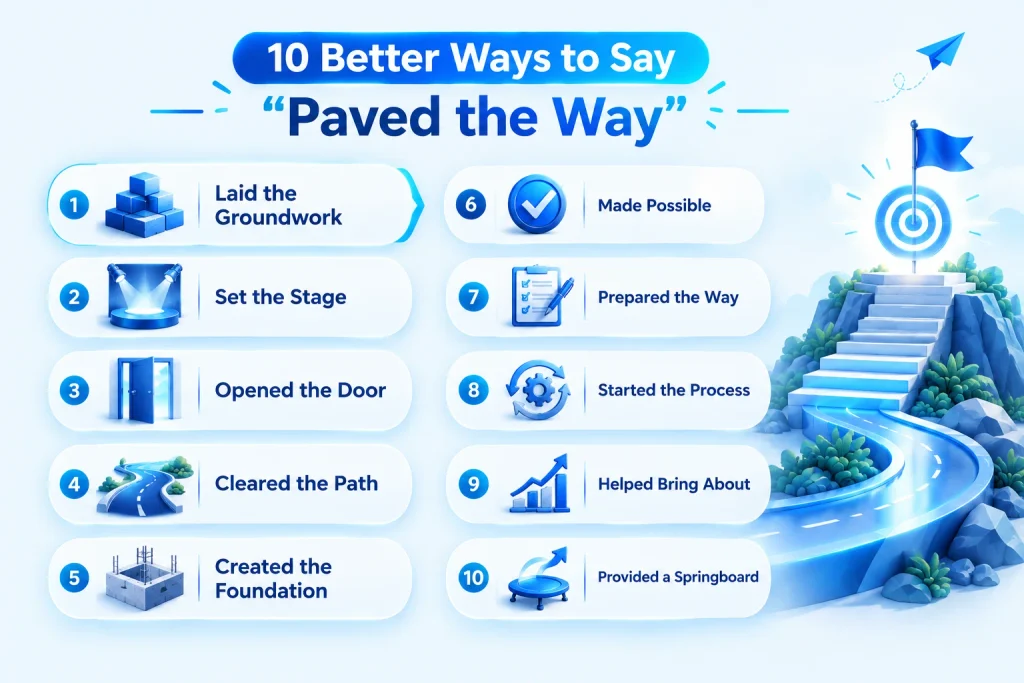
Another way to say “paved the way” includes “opened the door,” “laid the groundwork,” “set the stage,” “cleared the path,” and “created the foundation.” The best choice depends on context: “laid the groundwork” works well professionally, while “opened the door” sounds more conversational.
Key Takeaways
- “Paved the way” means making something easier or possible in the future.
- “Laid the groundwork” is a strong choice for professional and formal writing.
- “Set the stage” works well when describing events that led to an outcome.
- “Opened the door” sounds natural in conversational and business contexts.
- The best alternative depends on your tone, audience, and specific meaning.
What Does “Another Way to Say Paved the Way” Mean?

“Paved the way” means to create the conditions, opportunity, or foundation that makes something else possible or easier later. For example, “The new policy paved the way for major improvements” means the policy helped make those improvements possible.
People often use this expression when discussing progress, achievements, discoveries, decisions, or events that lead to later results. It is common in business writing, academic work, news articles, speeches, and everyday conversation.
Why Use Other Ways to Say “Paved the Way”?
Using alternatives can make your writing more precise and natural. While “paved the way” is widely understood, repeating it too often can make your writing feel predictable.
Other expressions can help you:
- Avoid repeating the same phrase.
- Match formal and casual situations.
- Explain cause and effect more clearly.
- Make professional writing sound more polished.
- Emphasize preparation, opportunity, progress, or influence.
10 Best Other Ways to Say “Paved the Way”
1. Laid the Groundwork
Meaning
“Laid the groundwork” means to establish the basic preparation or conditions needed for something to happen later. It often focuses on the work done before a major result.
Best For
- Professional
- Formal
- Academic
Example 1
The research team laid the groundwork for a more effective treatment.
Example 2
Early investments in public transportation laid the groundwork for the city’s economic growth.
Quick Tip
Use this phrase when the earlier action involved planning, preparation, research, or foundational work.
2. Set the Stage
Meaning
“Set the stage” means to create circumstances that make a later event or development more likely. It emphasizes the situation that existed before an important outcome.
Best For
- Professional
- Formal
- Casual
Example 1
The company’s successful pilot program set the stage for a national expansion.
Example 2
Her early performances set the stage for a long and successful career.
Quick Tip
Choose this expression when you want to highlight what happened immediately before a significant development.
3. Opened the Door
Meaning
“Opened the door” means to create a new opportunity or possibility. It has a more conversational feel than some formal alternatives.
Best For
- Casual
- Friendly
- Professional
Example 1
The scholarship opened the door to new educational opportunities.
Example 2
The partnership opened the door for smaller businesses to enter international markets.
Quick Tip
Use “opened the door” when the main idea is opportunity rather than preparation.
4. Cleared the Path
Meaning
“Cleared the path” suggests removing obstacles or difficulties that could have prevented future progress. It works especially well when someone takes action to make advancement easier.
Best For
- Professional
- Formal
- Warm
Example 1
The agreement cleared the path for both companies to begin working together.
Example 2
New regulations cleared the path for faster development of renewable energy projects.
Quick Tip
Use this phrase when overcoming barriers is an important part of the story.
5. Created the Foundation
Meaning
“Created the foundation” means established a strong base on which future progress can be built. It sounds clear and professional without being overly complicated.
Best For
- Professional
- Formal
Example 1
The first three years of research created the foundation for the company’s new technology.
Example 2
Strong community programs created the foundation for lasting social change.
Quick Tip
This is a good option when the future result depends on something substantial that was established earlier.
6. Made Possible
Meaning
“Made possible” directly states that one action, person, or development allowed something else to happen. It is simple, clear, and useful when you want to avoid figurative language.
Best For
- Professional
- Formal
- Casual
- Friendly
Example 1
The new funding made possible the construction of three additional clinics.
Example 2
Her early mentorship made it possible for many young designers to pursue creative careers.
Quick Tip
Choose this option when clarity matters more than style or when your audience may prefer straightforward language.
7. Prepared the Way
Meaning
“Prepared the way” means to get conditions ready for a later action or development. It is close in meaning to “paved the way,” but it places more emphasis on preparation.
Best For
- Formal
- Professional
Example 1
The preliminary studies prepared the way for a larger clinical trial.
Example 2
Years of diplomatic discussions prepared the way for the historic agreement.
Quick Tip
Use this phrase when deliberate preparation happened before the main event.
8. Started the Process
Meaning
“Started the process” means initiated a series of actions that eventually led toward a particular result. It is less figurative and works well when you want to be precise.
Best For
- Professional
- Formal
- Casual
Example 1
The initial proposal started the process of reforming the organization.
Example 2
Her suggestion started the process that eventually led to the new community program.
Quick Tip
Use this alternative when the first step matters more than the specific groundwork or opportunity it created.
9. Helped Bring About
Meaning
“Helped bring about” means contributed to causing a particular change or result. Unlike “paved the way,” it does not necessarily suggest that the action happened long before the final outcome.
Best For
- Professional
- Formal
- Academic
Example 1
The public campaign helped bring about important changes to workplace policies.
Example 2
Several years of negotiations helped bring about a lasting peace agreement.
Quick Tip
Use this phrase when you want to show that something was one contributing factor among several.
10. Provided a Springboard
Meaning
“Provided a springboard” means gave someone or something a strong starting point for further development or success. It often suggests that an earlier opportunity led to bigger achievements.
Best For
- Professional
- Friendly
- Warm
Example 1
The internship provided a springboard for her career in environmental research.
Example 2
The local tournament provided a springboard for the young athlete to compete nationally.
Quick Tip
Use this phrase when an early success or opportunity leads to greater progress.
Comparison Table

| Alternative | Best Used In | Tone |
| Laid the groundwork | Business, academic, professional writing | Formal |
| Set the stage | Business, storytelling, general writing | Neutral |
| Opened the door | Conversation, business, general writing | Conversational |
| Cleared the path | Professional and explanatory writing | Confident |
| Created the foundation | Business, academic, formal writing | Professional |
| Made possible | Almost any context | Direct |
| Prepared the way | Formal and professional writing | Formal |
| Started the process | Reports, explanations, business writing | Direct |
| Helped bring about | Academic, professional, analytical writing | Formal |
| Provided a springboard | Career, business, achievement writing | Positive |
Common Mistakes

1. Using Casual Phrases in Professional Emails
Expressions such as “opened the door” can work in business communication, but highly formal documents may benefit from “laid the groundwork” or “created the foundation.”
2. Choosing Overly Formal Language
Not every sentence needs sophisticated wording. In a simple email, “made possible” may communicate the idea better than a more elaborate expression.
3. Repeating the Same Phrase
Using “paved the way” several times in one article or report can make your writing repetitive. Rotate alternatives based on the exact meaning.
4. Forgetting Context
These phrases are not always interchangeable. “Cleared the path” suggests removing obstacles, while “opened the door” focuses more on creating an opportunity.
5. Sounding Insincere
Avoid choosing a dramatic phrase simply because it sounds impressive. Select wording that accurately describes how the earlier event influenced the later result.
Frequently Asked Questions
1. What is another way to say “paved the way”?
Common alternatives include “laid the groundwork,” “set the stage,” “opened the door,” “cleared the path,” and “created the foundation.” Each has a slightly different meaning, so choose based on whether you want to emphasize preparation, opportunity, removing obstacles, or establishing a base for future progress.
2. What is a professional way to say “paved the way”?
“Laid the groundwork” is one of the strongest professional alternatives. It sounds polished without being overly formal and works well in business reports, presentations, academic writing, and professional emails when an earlier action prepared the conditions for a later result.
3. Is “laid the groundwork” the same as “paved the way”?
The two phrases are very similar, but they emphasize different ideas. “Laid the groundwork” focuses on preparation and establishing a foundation, while “paved the way” has a broader meaning that can include preparation, opportunity, or removing barriers.
4. What is a casual way to say “paved the way”?
“Opened the door” is a natural casual alternative. For example, “The internship opened the door to new opportunities” sounds conversational while still being appropriate in many professional situations.
5. What is another word for “paved”?
Depending on the context, alternatives for “paved” can include prepared, cleared, enabled, facilitated, supported, established, or advanced. However, replacing only “paved” may not preserve the meaning of the full expression, so rewriting the entire phrase is often better.
6. Can I use “set the stage” instead of “paved the way”?
Yes. “Set the stage” works when an earlier event created the circumstances for something that followed. It is especially useful when describing a sequence of events, such as a business decision that led to a major expansion.
7. What is the best formal synonym for “paved the way”?
“Laid the groundwork” is usually the best formal choice when you mean that earlier work created a foundation for future progress. “Helped bring about” is better when you want to emphasize that an action contributed directly to the final result.
8. How do I choose the right alternative to “paved the way”?
Start by identifying what the original sentence means. Choose “laid the groundwork” for preparation, “opened the door” for opportunity, “cleared the path” for removing obstacles, “set the stage” for creating conditions, and “made possible” for a direct, easy-to-understand statement.
Conclusion

There are many effective ways to say “paved the way,” but the best choice depends on what you want your sentence to emphasize. “Laid the groundwork” is ideal for professional and formal writing, while “opened the door” works naturally when discussing opportunities.
If your sentence focuses on preparation, consider “prepared the way” or “created the foundation.” When removing barriers matters, “cleared the path” is more precise. For a simple and direct statement, “made possible” is often the strongest option.
The key is to match the phrase to the situation rather than replacing “paved the way” automatically. Choose wording that clearly shows how an earlier action, event, or decision contributed to what happened next. For more context, see the definition of “pave the way.”