

Another way to say “none of your business” can be “That’s private,” “I’d rather not say,” “That’s personal,” or “I’d prefer to keep that private.” These alternatives let you protect your privacy without sounding unnecessarily rude. The best choice depends on whether you want to sound polite, professional, friendly, or firm.
Key Takeaways
- “None of your business” can sound blunt, defensive, or confrontational.
- “That’s private” is a simple and direct alternative.
- “I’d rather not say” works well when you want to avoid sharing personal information.
- Professional situations often call for softer phrases such as “I’d prefer not to discuss that.”
- The right alternative depends on your relationship with the person and the situation.
What Does “None of Your Business” Mean?

“None of your business” means that a particular subject is private and that you do not want another person asking about it or knowing the details. People commonly use it when someone asks a personal question that feels intrusive or inappropriate.
The phrase is clear, but it can sound rude or confrontational. For example, saying “How much money do you make?” followed by “None of your business” creates a strong boundary, but it may also make the conversation uncomfortable.
Softer alternatives allow you to protect your privacy while keeping the conversation respectful. Your choice should depend on how firmly you need to respond.
Why Use Other Ways to Say “None of Your Business”?
Using a different phrase can help you communicate the same basic message with a more appropriate tone.
You may want to use an alternative to:
- Avoid sounding unnecessarily rude.
- Set a clear personal boundary.
- Keep sensitive information private.
- Sound more professional at work.
- Make a polite response feel less confrontational.
- Match the tone of the conversation.
For example, “That’s private” is direct but relatively neutral, while “I’d rather not say” sounds softer. In a workplace conversation, “I’d prefer not to discuss that” may be more appropriate.
10 Best Other Ways to Say “None of Your Business”
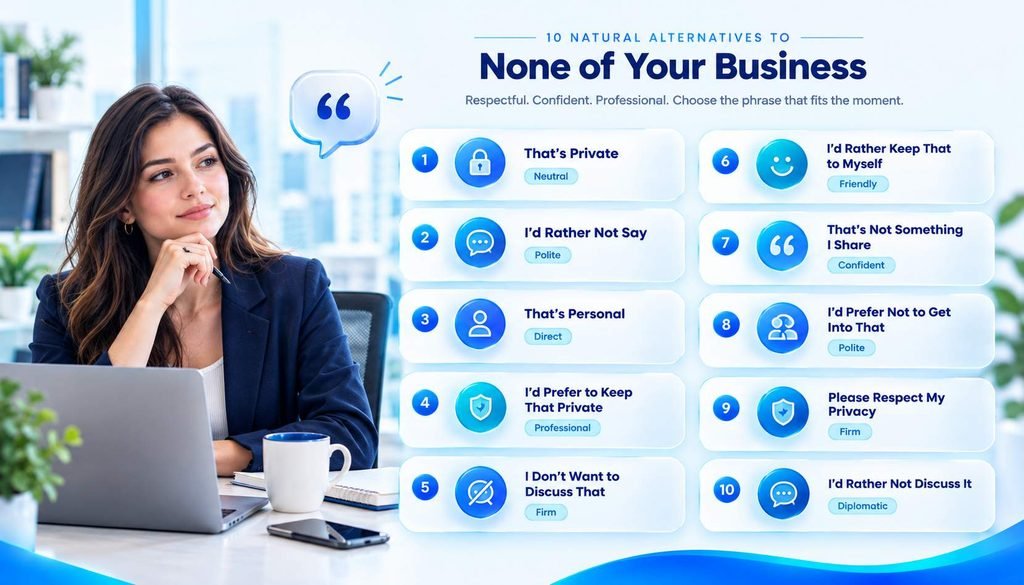
1. That’s Private
Meaning
“That’s private” clearly tells someone that you consider the subject personal and do not want to share it. It sets a boundary without directly criticizing the other person for asking.
Best For
- Professional
- Polite
- Formal
- Casual
Example 1
“I appreciate you asking, but that’s private.”
Example 2
“I keep my financial information private, so I’d rather not discuss it.”
Quick Tip
Use this phrase when you want to be direct without sounding openly hostile.
2. I’d Rather Not Say
Meaning
“I’d rather not say” politely indicates that you do not want to provide an answer. It works especially well when someone asks a personal question but you want to avoid creating tension.
Best For
- Friendly
- Polite
- Casual
- Professional
Example 1
“Where are you staying tonight?”
“I’d rather not say, but thanks for understanding.”
Example 2
“How much did the house cost?”
“I’d rather not say.”
Quick Tip
This is a useful choice when you want to decline without explaining why.
3. That’s Personal
Meaning
“That’s personal” tells the other person that the subject falls within your private life. It is short, natural, and easy to use in everyday conversations.
Best For
- Casual
- Friendly
- Polite
- Direct
Example 1
“Why did you and your partner break up?”
“That’s personal, and I’d rather keep it between us.”
Example 2
“My family situation is a little complicated. That’s personal, so I hope you understand.”
Quick Tip
Add “I hope you understand” when you want the response to sound warmer.
4. I’d Prefer to Keep That Private
Meaning
“I’d prefer to keep that private” is a respectful way to refuse to share information. It sounds more polished than “none of your business” and works well when you want to maintain a calm tone.
Best For
- Professional
- Formal
- Polite
Example 1
“I’d prefer to keep my salary information private.”
Example 2
“I’d prefer to keep the details of that conversation private for now.”
Quick Tip
Use this phrase in professional or sensitive situations where a respectful boundary matters.
5. I Don’t Want to Discuss That
Meaning
“I don’t want to discuss that” directly states that you are not comfortable talking about the subject. Unlike “none of your business,” it focuses on your preference rather than criticizing the other person.
Best For
- Direct
- Professional
- Polite
- Formal
Example 1
“I don’t want to discuss my personal finances at work.”
Example 2
“I understand your curiosity, but I don’t want to discuss that.”
Quick Tip
Choose this option when you need to make your boundary unmistakably clear.
6. I’d Rather Keep That to Myself
Meaning
“I’d rather keep that to myself” means you have decided not to share certain information. It sounds personal and conversational while still making your boundary clear.
Best For
- Casual
- Friendly
- Warm
- Polite
Example 1
“I have a few ideas about the project, but I’d rather keep that to myself for now.”
Example 2
“There’s a reason I made that decision, but I’d rather keep that to myself.”
Quick Tip
This works well when you want to decline without making the other person feel directly rejected.
7. That’s Not Something I Share
Meaning
“That’s not something I share” communicates that you have a personal rule about keeping certain information private. It sounds confident without being aggressive.
Best For
- Professional
- Polite
- Formal
- Friendly
Example 1
“My personal finances aren’t something I share with coworkers.”
Example 2
“That’s not something I share publicly, but I appreciate you asking.”
Quick Tip
Use this phrase when the information is consistently private rather than temporarily off-limits.
8. I’d Prefer Not to Get Into That
Meaning
“I’d prefer not to get into that” politely signals that you do not want to discuss a particular subject in detail. It is useful when a conversation is becoming too personal.
Best For
- Professional
- Friendly
- Polite
- Casual
Example 1
“I’d prefer not to get into that during the meeting.”
Example 2
“There are several reasons behind my decision, but I’d prefer not to get into that right now.”
Quick Tip
Use it when you want to redirect the conversation without sounding defensive.
9. Please Respect My Privacy
Meaning
“Please respect my privacy” is a firm but respectful way to establish a boundary. It makes it clear that you do not want further questions about the subject.
Best For
- Formal
- Direct
- Polite
- Serious situations
Example 1
“I understand that you’re concerned, but please respect my privacy.”
Example 2
“I’ve decided not to share those details, so please respect my privacy.”
Quick Tip
Save this phrase for situations where someone continues asking after you have already declined to answer.
10. I Appreciate Your Concern, but I’d Rather Not Discuss It
Meaning
This phrase acknowledges the other person’s interest before politely declining to provide information. It is especially useful when you want to protect your privacy without damaging the relationship.
Best For
- Professional
- Formal
- Warm
- Polite
Example 1
“I appreciate your concern, but I’d rather not discuss it right now.”
Example 2
“Thanks for checking in. I appreciate your concern, but I’d rather not discuss it.”
Quick Tip
Use this option when you want to soften a firm boundary with a polite acknowledgment.
Comparison Table
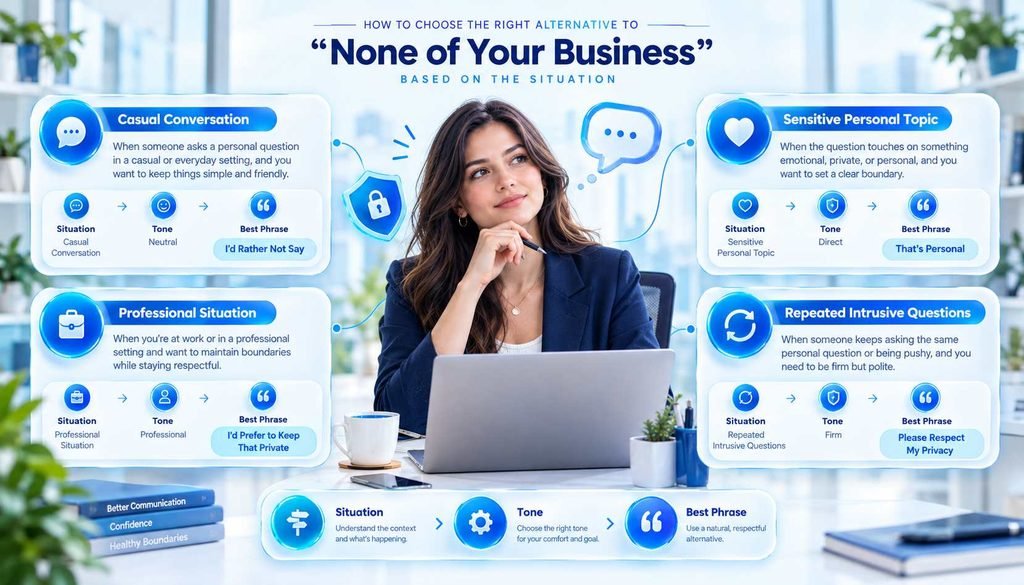
| Alternative | Best Used In | Tone |
|---|---|---|
| That’s Private | Everyday and professional conversations | Direct, neutral |
| I’d Rather Not Say | Personal conversations | Polite, soft |
| That’s Personal | Casual conversations | Direct, respectful |
| I’d Prefer to Keep That Private | Work and sensitive situations | Professional, polite |
| I Don’t Want to Discuss That | Firm boundaries | Direct, clear |
| I’d Rather Keep That to Myself | Personal conversations | Friendly, warm |
| That’s Not Something I Share | Professional and public settings | Confident, polite |
| I’d Prefer Not to Get Into That | Conversations becoming too personal | Polite, restrained |
| Please Respect My Privacy | Repeated or intrusive questions | Firm, respectful |
| I Appreciate Your Concern, but I’d Rather Not Discuss It | Sensitive personal situations | Warm, diplomatic |
Common Mistakes
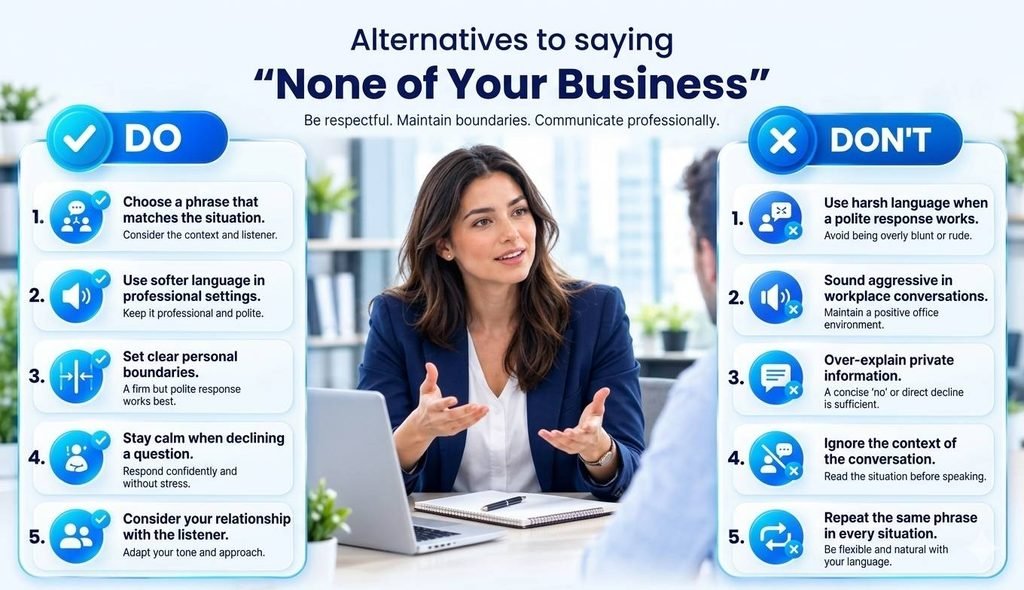
1. Using Casual Phrases in Professional Emails
“None of your business” can sound hostile in workplace communication. A phrase such as “I’d prefer to keep that private” is usually more appropriate.
2. Choosing Language That Is Too Formal
You do not need a highly formal expression for every personal question. In a conversation with a friend, “I’d rather not say” may sound more natural than a formal statement about privacy.
3. Repeating the Same Phrase
Using the same response every time can make your communication sound rigid. Choose different alternatives based on how personal the subject is and how firmly you need to respond.
4. Forgetting the Context
The relationship between the speakers matters. A phrase that works with a close friend may not work with a manager, customer, coworker, or stranger.
5. Sounding More Defensive Than Necessary
A strong response can sometimes create more tension than the original question. If the person is simply curious, start with a softer option before using a firm boundary.
Frequently Asked Questions
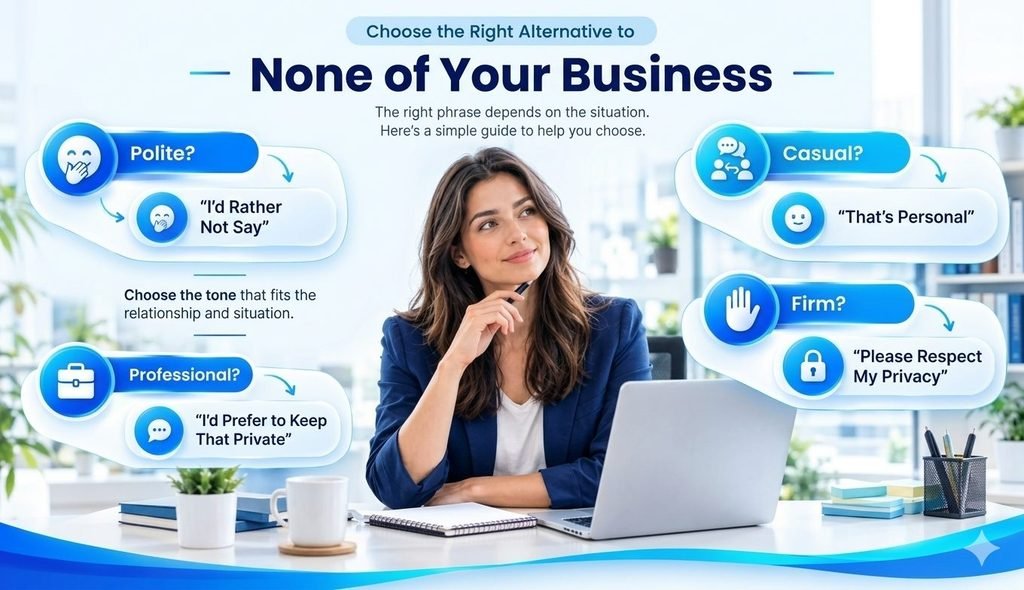
What is a polite way to say “none of your business”?
A polite way to say “none of your business” is “I’d rather not say,” “That’s private,” or “I’d prefer to keep that private.” These phrases communicate that you do not want to share information without directly insulting the person who asked. Choose the softer option when the relationship matters.
What is a professional way to say “none of your business”?
A professional alternative is “I’d prefer not to discuss that” or “I’d prefer to keep that private.” Both phrases establish a clear boundary while maintaining a respectful tone. They work particularly well in workplace conversations involving personal finances, relationships, family matters, or other sensitive subjects.
How can I say “none of your business” without being rude?
Try saying “I’d rather not say,” “That’s personal,” or “That’s not something I share.” These expressions focus on your own decision to keep information private rather than accusing the other person of being intrusive. Your tone of voice also plays an important role in keeping the response respectful.
Is “that’s private” rude?
“That’s private” is usually less confrontational than “none of your business,” but it is still direct. Your tone and the situation can affect how it sounds. If you want a softer response, “I’d rather not say” or “I’d prefer to keep that private” can create a gentler impression.
What is a good way to tell someone to stop asking personal questions?
You can say, “I’d prefer not to discuss that,” or, if the questions continue, “Please respect my privacy.” The first option is calm and polite, while the second establishes a firmer boundary. You do not need to provide a detailed explanation for declining to answer a personal question.
What is another way to say “that’s none of your business” at work?
At work, try “I’d prefer to keep that private,” “I’d rather not discuss that,” or “That’s not something I share.” These alternatives protect your privacy while keeping the conversation professional. Avoid language that could sound insulting or unnecessarily confrontational, especially when speaking with a manager, coworker, or client.
Can I say “I’d rather not say” to a friend?
Yes. “I’d rather not say” is a natural way to respond when a friend asks about something you do not want to share. It is especially useful when you want to maintain a boundary without making the conversation feel hostile. A warm tone can make the response feel even more respectful.
What is the strongest polite alternative to “none of your business”?
“Please respect my privacy” is one of the clearest polite alternatives when someone continues asking about a subject you do not want to discuss. It communicates that the boundary is important without using an insult. For less serious situations, a softer phrase such as “I’d rather not say” may be enough.
Conclusion
There are many ways to say “none of your business” without sounding unnecessarily harsh. “I’d rather not say” is a gentle choice for everyday conversations, while “That’s private” gives a short and direct response. In professional situations, “I’d prefer to keep that private” or “I’d prefer not to get into that” can help you maintain a respectful tone.
If someone continues asking personal questions, “Please respect my privacy” creates a firmer boundary. The key is to consider your relationship with the person, the sensitivity of the subject, and how strongly you need to respond. You can protect your privacy without turning a simple boundary into an argument. Choose the phrase that communicates your limits clearly while keeping the tone appropriate for the situation.

Sajid Ali is a web developer and digital publisher with experience in website development, WordPress, content publishing, and digital projects. He is interested in creating useful, well-structured online resources that make information easier to discover and understand.
At Majestic Studio, Sajid focuses on website development, content publishing, SEO-focused site structure, and maintaining a clear and user-friendly reading experience. He works with a practical, research-driven approach and continuously improves content and website usability based on reader needs and search behavior.