

Another way to say “to get” depends on the meaning and context. Common alternatives include obtain, receive, acquire, gain, secure, earn, achieve, retrieve, purchase, and become. Use a more specific verb when possible because it can make professional, academic, and everyday writing clearer and more precise.
Key Takeaways
- “To get” has many meanings, so the best replacement depends on context.
- Use obtain or acquire for formal and professional writing.
- Use receive when someone is given or sent something.
- Use gain or achieve when discussing benefits, knowledge, or results.
- Replacing “get” with a precise verb can make your writing stronger and clearer.
What Does “Another Way to Say to Get” Mean?
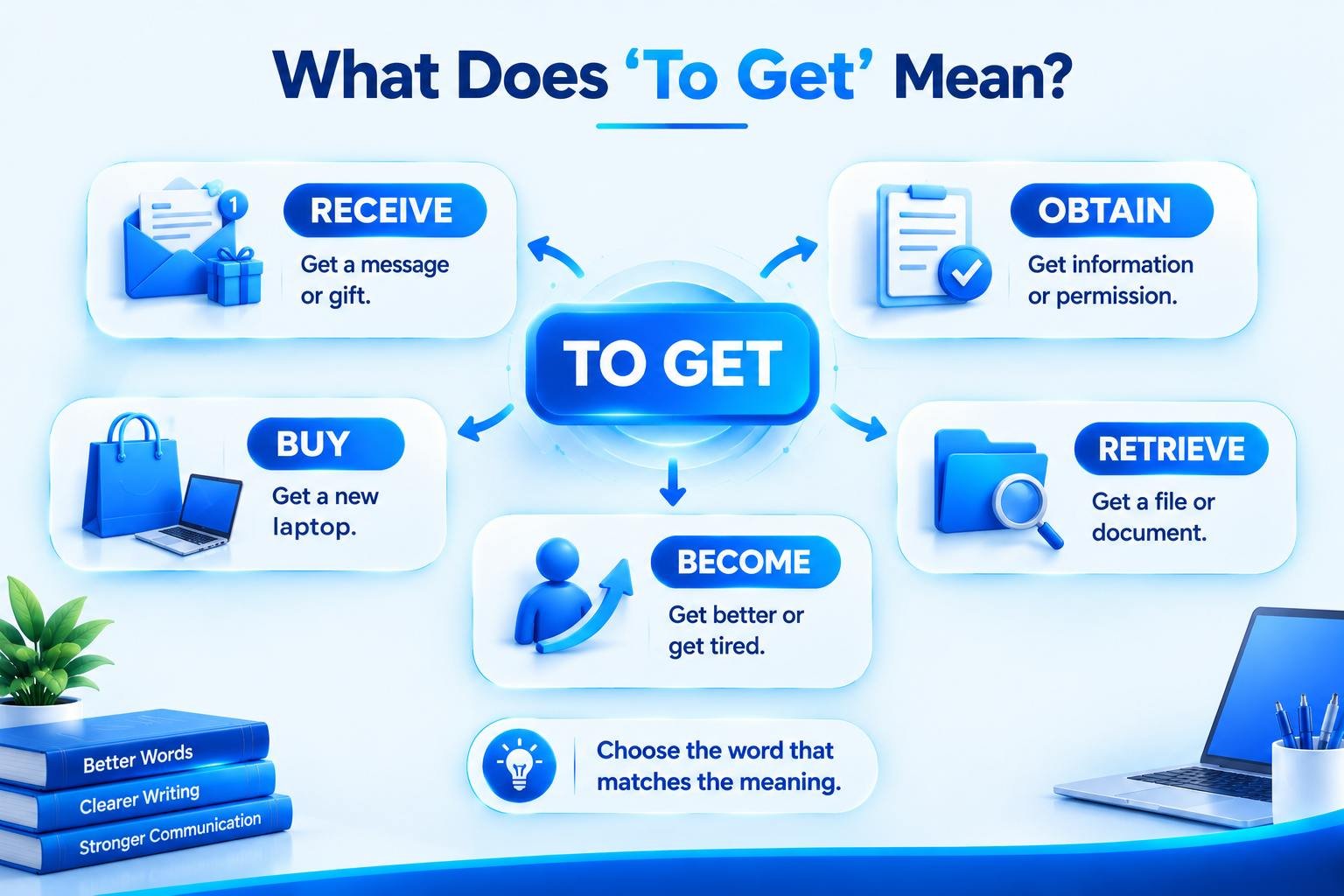
The phrase “to get” is one of the most common expressions in English. It can mean many different things, including receiving something, obtaining something, buying something, becoming something, understanding an idea, or reaching a particular result.
For example, “I need to get a new laptop” could mean buy a laptop. However, “I need to get more information” could mean obtain or receive information.
Because “get” has so many meanings, there is no single replacement that works in every sentence. Choosing a more specific verb can make your writing more precise and professional.
Why Use Other Ways to Say “To Get”?
Replacing “get” with a more precise word can improve both spoken and written English. This is especially helpful when you want your message to sound polished without using unnecessarily complicated vocabulary.
Consider another expression when you want to:
- Avoid repetition: Prevent “get” from appearing too often.
- Improve precision: Show exactly what happened.
- Sound professional: Use stronger vocabulary in workplace writing.
- Match the context: Choose a verb that reflects the intended meaning.
- Strengthen your writing: Replace a general verb with a more descriptive one.
10 Best Other Ways to Say “To Get”
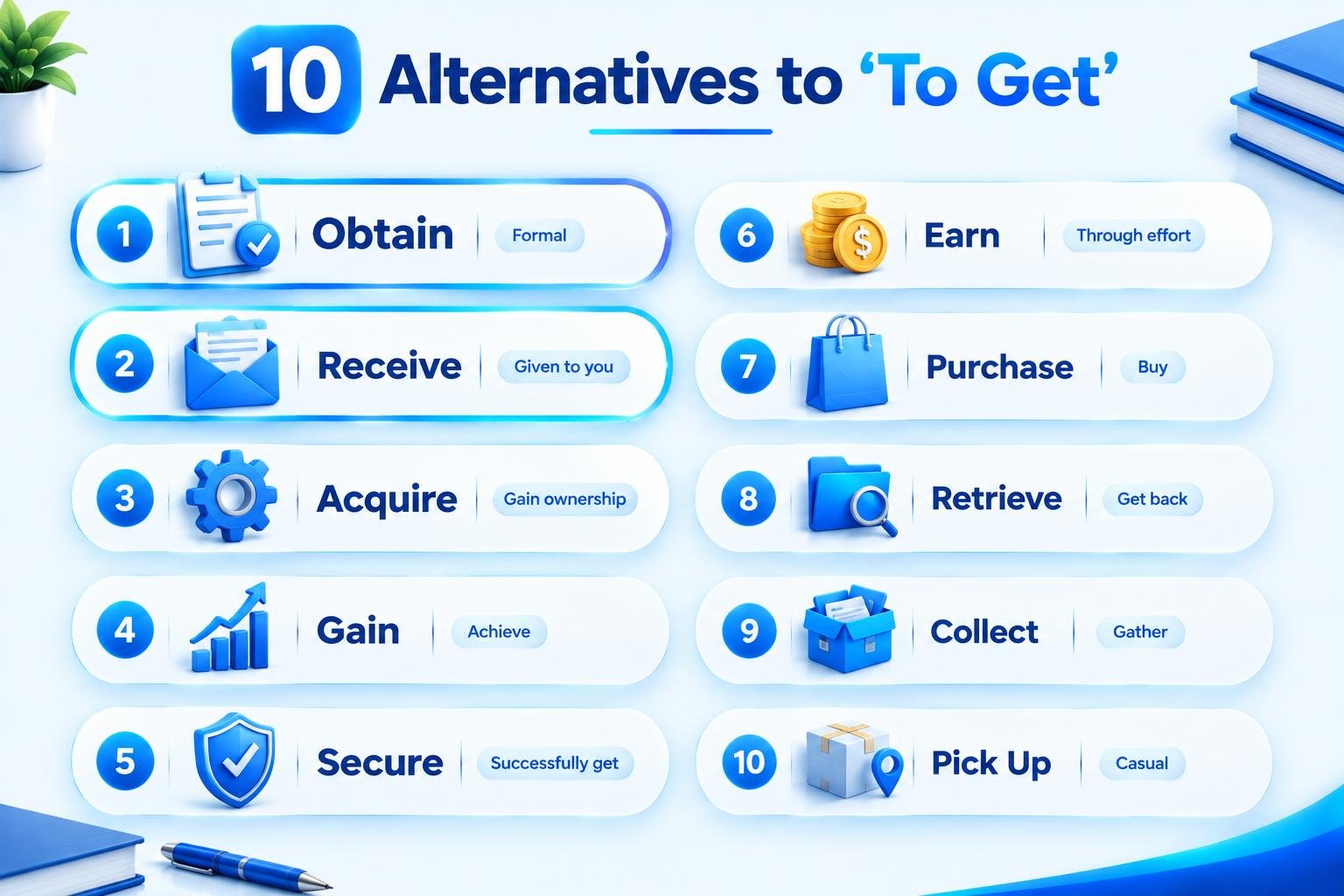
1. Obtain
Meaning
“Obtain” means to get, receive, or acquire something, usually through a deliberate effort or process. It is more formal than “get” and works particularly well when discussing information, documents, permission, or resources.
Best For
- Professional
- Formal
- Polite
Example 1
You must obtain approval from the department manager before starting the project.
Example 2
Researchers obtained valuable information from the customer survey.
Quick Tip
Use “obtain” when you want a polished alternative to “get” in professional, academic, or official writing.
2. Receive
Meaning
“Receive” means to be given, sent, or provided with something. It is the best replacement when someone gets an item, message, payment, invitation, or other thing from another source.
Best For
- Professional
- Formal
- Polite
Example 1
We received your application earlier this morning.
Example 2
All registered guests will receive a confirmation email.
Quick Tip
Choose “receive” when the important idea is that something comes to you from another person or organization.
3. Acquire
Meaning
“Acquire” means to gain possession of something or develop something over time. It often suggests a gradual process and is common in business, education, finance, and professional writing.
Best For
- Professional
- Formal
Example 1
The company acquired several smaller businesses during its expansion.
Example 2
Students acquire new skills through regular practice and experience.
Quick Tip
Use “acquire” for assets, skills, knowledge, experience, or businesses rather than ordinary everyday items.
4. Gain
Meaning
“Gain” means to obtain something beneficial, such as knowledge, experience, confidence, support, attention, or an advantage. It often emphasizes improvement or a positive result.
Best For
- Professional
- Formal
- Polite
Example 1
She gained valuable experience during her summer internship.
Example 2
The organization gained support from several community leaders.
Quick Tip
“Gain” is especially useful when what you get represents progress, growth, or an advantage.
5. Secure
Meaning
“Secure” means to successfully obtain or arrange something, often after making an effort. It can suggest that getting the desired result required planning, negotiation, or competition.
Best For
- Professional
- Formal
- Polite
Example 1
The startup secured funding for its next phase of development.
Example 2
Our team secured a meeting with the regional director.
Quick Tip
Use “secure” when obtaining something feels like an achievement or requires effort.
6. Earn
Meaning
“Earn” means to get something as a result of effort, work, performance, or behavior. It is commonly used with money, respect, trust, recognition, rewards, and achievements.
Best For
- Professional
- Formal
- Casual
- Polite
Example 1
He earned the trust of his colleagues through consistent leadership.
Example 2
The restaurant earned several positive reviews after its renovation.
Quick Tip
Use “earn” when the person receives something because their actions or performance deserved it.
7. Achieve
Meaning
“Achieve” means to successfully reach a goal or desired result. It is more specific than “get” when you are talking about accomplishments, targets, milestones, or personal goals.
Best For
- Professional
- Formal
- Polite
Example 1
The team achieved its sales target ahead of schedule.
Example 2
She achieved her goal of completing the certification program.
Quick Tip
Use “achieve” for results that require effort rather than simply receiving or obtaining an object.
8. Retrieve
Meaning
“Retrieve” means to get something back or obtain something from a particular place or system. It is commonly used for files, information, objects, records, and data.
Best For
- Professional
- Formal
Example 1
You can retrieve your account information from the customer portal.
Example 2
The technician retrieved the deleted files from the backup system.
Quick Tip
Choose “retrieve” when the idea involves finding, recovering, or bringing something back.
9. Purchase
Meaning
“Purchase” means to get something by paying for it. It is a more formal alternative to “buy” and can replace “get” when the sentence refers specifically to obtaining a product or service through payment.
Best For
- Professional
- Formal
- Polite
Example 1
Customers can purchase tickets through the company’s official website.
Example 2
We purchased new equipment for the updated training room.
Quick Tip
Use “purchase” when “get” means buy. Do not use it for things that are free or simply received.
10. Become
Meaning
“Become” is an appropriate replacement for “get” when “get” describes a change in condition, role, or state. For example, “get tired” can become “become tired,” while “get ready” can become “become ready,” although the latter may sound less natural depending on context.
Best For
- Professional
- Formal
- Casual
- Polite
Example 1
The weather became colder as the evening progressed.
Example 2
She became more confident after gaining experience in the role.
Quick Tip
Use “become” when “get” means that someone or something changes into a new state or condition.
Comparison Table
| Alternative | Best Used In | Tone |
| Obtain | Information, documents, permission | Formal |
| Receive | Messages, payments, items, applications | Professional |
| Acquire | Skills, knowledge, assets, businesses | Formal |
| Gain | Experience, support, confidence, advantages | Professional |
| Secure | Funding, opportunities, agreements | Professional |
| Earn | Trust, respect, money, recognition | Neutral |
| Achieve | Goals, results, milestones | Professional |
| Retrieve | Files, data, records, objects | Formal |
| Purchase | Products and services | Formal |
| Become | Changes in condition or status | Neutral |
Common Mistakes
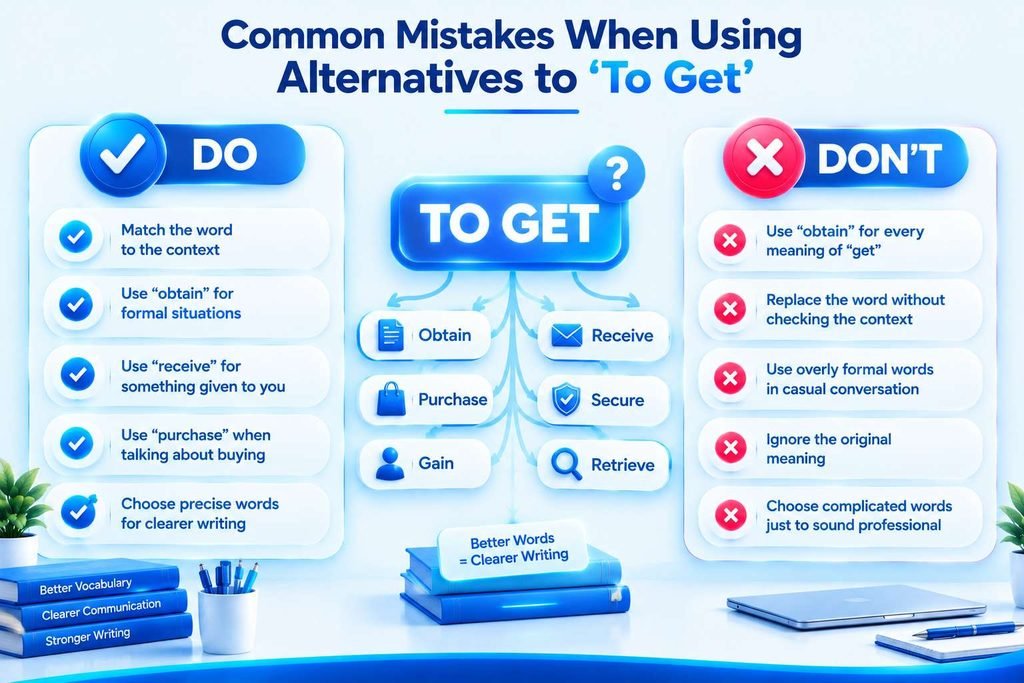
1. Using one synonym for every meaning of “get”
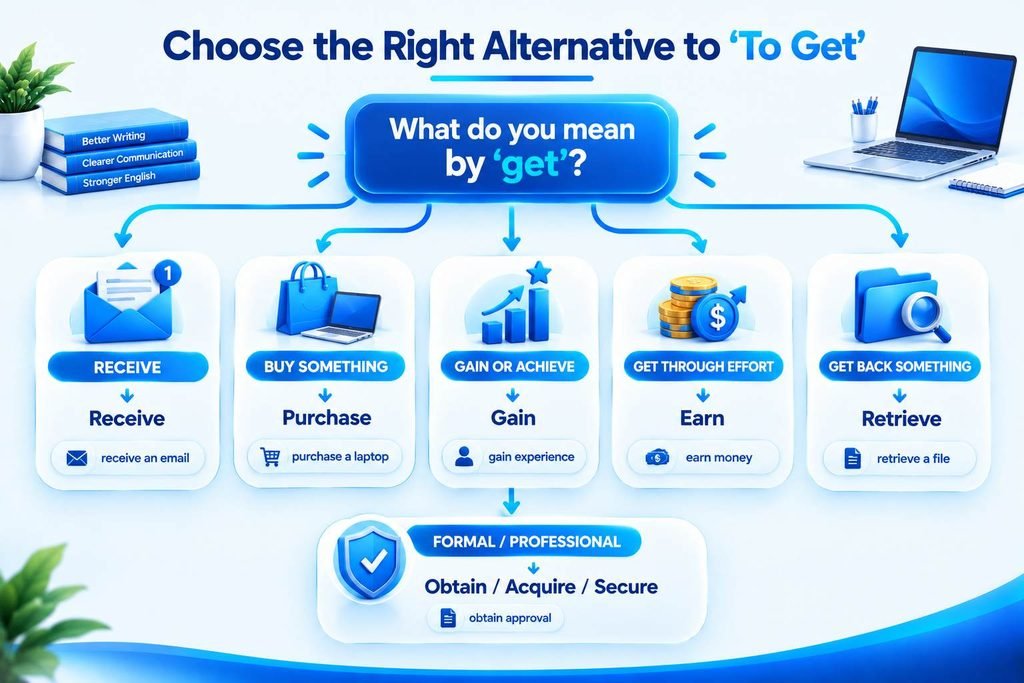
“Get” has numerous meanings, so no single replacement works everywhere. For example, receive works for an email, while purchase works for something you pay for.
2. Choosing overly formal language
Replacing every “get” with words such as “obtain” or “acquire” can make casual writing sound stiff. Use formal alternatives when the audience and situation call for them.
3. Changing the meaning of the sentence
A synonym should preserve the original meaning. For example, “get a gift” means receive a gift, not “obtain” in every context.
4. Using “achieve” for physical objects
“Achieve” normally refers to goals, results, or accomplishments. Saying “I achieved a new phone” is incorrect; “I purchased a new phone” or “I got a new phone” would be appropriate.
5. Ignoring the audience
The best word depends on who will read your message. A casual text might naturally use “get,” while a business report may benefit from a more precise verb such as “obtain,” “secure,” or “acquire.”
Frequently Asked Questions
1. What is another way to say “to get”?
Common alternatives include obtain, receive, acquire, gain, secure, earn, achieve, retrieve, purchase, and become. The correct choice depends on what “get” means in your sentence. For example, use “receive” for something given to you, “purchase” for something you buy, and “achieve” for a goal or result.
2. What is a professional word for “get”?
Obtain is one of the most useful professional alternatives to “get.” Depending on the context, you can also use “acquire,” “receive,” “secure,” or “gain.” For example, “We need to get approval” can become “We need to obtain approval,” which sounds more precise in professional writing.
3. What is another word for “get” in formal writing?
Formal alternatives include obtain, acquire, receive, secure, achieve, and retrieve. However, the best choice depends on the sentence. “Obtain information” is natural, while “achieve information” is not. Always choose a word based on the intended meaning rather than simply replacing “get” with a more formal-looking verb.
4. How can I replace “get” in an essay?
First, determine what “get” means in the sentence. Use “obtain” for resources or information, “gain” for knowledge or experience, “achieve” for goals, “receive” for something provided, and “acquire” for skills or assets. This approach improves clarity without making your essay sound unnecessarily complicated.
5. What is another way to say “get” professionally in an email?
In a professional email, you might use obtain, receive, acquire, secure, or gain, depending on the context. For example, instead of “Please get approval from your manager,” you could write, “Please obtain approval from your manager.” The more specific verb makes the request clearer and more polished.
6. Is “obtain” a synonym for “get”?
Yes, “obtain” can be a synonym for “get” when “get” means to receive, acquire, or secure something. However, the two words are not interchangeable in every situation. “Get tired,” “get home,” and “get angry” have different meanings that “obtain” cannot express.
7. What is another way to say “get” when talking about buying something?
When “get” means buy, use purchase in formal or professional writing. For example, “We need to get new computers” can become “We need to purchase new computers.” In casual conversation, however, “buy” is usually more natural than the formal word “purchase.”
8. What is another way to say “get” when talking about achieving something?
When “get” refers to reaching a goal or obtaining a desired result, achieve is often the best alternative. Depending on the sentence, you might also use “attain,” “reach,” “accomplish,” or “earn.” For example, “She got her goal” should be rewritten as “She achieved her goal.”
Conclusion

There is no single perfect replacement for “to get” because the verb has many meanings in English. The best alternative depends on what you actually mean. For a deeper look at the different meanings of “get,” see the meanings of “get” before choosing the most precise alternative.
For skills, knowledge, or experience, acquire and gain are strong choices. If you are talking about a goal or accomplishment, achieve is more precise. Meanwhile, secure works well for opportunities, funding, or agreements, and retrieve fits information or items that you recover.
The key is to choose a verb that communicates the exact action rather than replacing “get” simply to sound more sophisticated. A precise word will make your writing clearer, more natural, and more effective.

The Majestic Studio Editorial Team creates practical resources about synonyms, alternative phrases, vocabulary, and English usage. Our content is designed to help readers choose clearer, more natural words and communicate effectively in everyday, professional, and academic contexts.
Each article is researched, edited, and reviewed for clarity, context, usefulness, and language accuracy. We regularly update our content to keep examples and recommendations relevant.