

Another way to say maybe includes “perhaps,” “possibly,” “it’s possible,” “I might,” and “there’s a chance.” Use “perhaps” for polite suggestions, “possibly” in professional communication, and “I might” when discussing uncertain plans. The best alternative depends on your level of confidence, your audience, and the situation.
Key Takeaways
- “Perhaps” and “possibly” are useful alternatives for polite and professional communication.
- “I might” works well when discussing plans you have not confirmed.
- “There’s a chance” highlights a possible outcome without making a promise.
- “I’m not sure yet” communicates uncertainty honestly and clearly.
- Choose alternatives based on context, tone, and how certain you feel.
What Does Another Way to Say Maybe Mean?
The phrase “another way to say maybe” refers to different words or expressions that communicate possibility, uncertainty, or hesitation. These alternatives help you express an idea without making a definite statement.
For example, instead of saying, “Maybe we should leave early,” you could say, “Perhaps we should leave early.” Both sentences suggest an idea without insisting that it must happen.
People use these expressions in everyday conversations, text messages, workplace discussions, professional emails, and social situations. The right wording can make you sound more confident, thoughtful, polite, or natural.
Why Use Other Ways to Say Maybe?
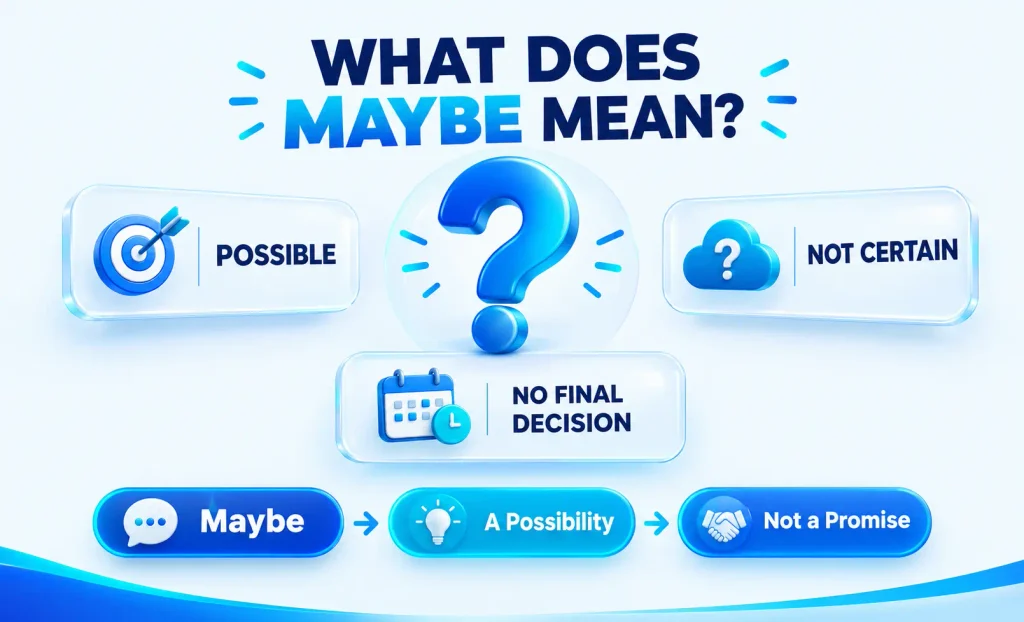
Using different expressions helps you communicate more clearly and avoid repeating the same word. It also lets you show whether you are considering an option, delaying a decision, or expressing a realistic possibility.
Here are a few benefits:
- Avoid repetition: Make conversations and writing more engaging.
- Sound natural: Match your language to everyday or professional situations.
- Express uncertainty clearly: Show how confident you are about an idea.
- Improve workplace communication: Discuss possibilities without making promises.
- Respond politely: Give yourself time to consider an invitation or request.
For example, “I might attend” suggests a possible action, while “I’m not sure yet” emphasizes that you have not made a decision.
12 Best Alternatives to Maybe
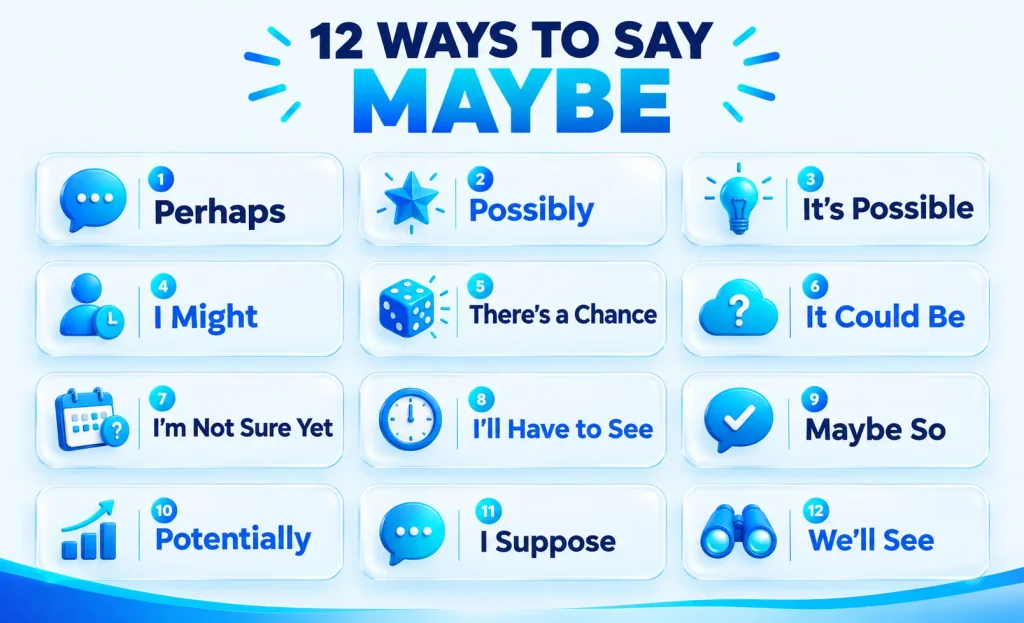
1. Perhaps
Meaning: “Perhaps” expresses a possibility or introduces a suggestion without presenting it as a certainty. It often sounds more polished than “maybe,” making it useful in professional writing and thoughtful conversations.
Best for: Professional, formal, polite.
Example 1: Perhaps we should review the proposal before making a final decision.
Example 2: Perhaps I’ll visit my cousins during the holidays.
Quick tip: Use “perhaps” when you want to suggest an idea in a measured, respectful way.
2. Possibly
Meaning: “Possibly” indicates that something could happen or be true, although the outcome is uncertain. It also works in polite requests when you want to sound considerate.
Best for: Professional, formal, polite.
Example 1: We could possibly finish the project by Friday if everyone stays on schedule.
Example 2: Could you possibly send me the updated report today?
Quick tip: Use “possibly” to discuss potential outcomes or soften a request without promising a result.
3. It’s Possible
Meaning: “It’s possible” acknowledges that an event or outcome could occur without confirming that it will. This phrase is useful when you want to give a balanced answer.
Best for: Professional, friendly, polite.
Example 1: It’s possible that the package will arrive before the weekend.
Example 2: It’s possible we could find a better solution with more research.
Quick tip: Choose this expression when you want to recognize an option while remaining realistic.
4. I Might
Meaning: “I might” expresses the possibility that you will do something. It is especially useful for personal plans, invitations, and activities you have not committed to yet.
Best for: Casual, friendly, professional.
Example 1: I might join you for lunch after my appointment.
Example 2: I might apply for that position if the opening is still available.
Quick tip: Use “I might” when the uncertainty concerns something you may do yourself.
5. There’s a Chance
Meaning: “There’s a chance” suggests that an event or outcome could happen. It often highlights a realistic possibility and can sound encouraging without guaranteeing success.
Best for: Casual, friendly, warm.
Example 1: There’s a chance we’ll get tickets if we check the website early.
Example 2: There’s a chance the weather will clear up before our picnic.
Quick tip: Use this phrase to discuss opportunities or outcomes that remain uncertain.
6. It Could Be
Meaning: “It could be” presents a possible explanation, answer, or outcome. It works well when you are considering different ideas but lack enough information to confirm one.
Best for: Professional, casual, polite.
Example 1: It could be a minor software issue rather than a problem with the entire system.
Example 2: It could be the perfect place for our family reunion.
Quick tip: Use this expression when discussing possible explanations or evaluating different options.
7. I’m Not Sure Yet
Meaning: “I’m not sure yet” communicates that you have not reached a decision or formed a definite opinion. The word “yet” leaves room for your answer to change later.
Best for: Professional, casual, polite.
Example 1: I’m not sure yet whether I can take time off next month.
Example 2: I’m not sure yet which color would look best in the living room.
Quick tip: Use this phrase when you need more time to check your schedule or gather information.
8. I’ll Have to See
Meaning: “I’ll have to see” means you cannot give a definite answer right now because something still needs consideration. It is common in American English when responding to invitations or discussing plans.
Best for: Casual, friendly, polite.
Example 1: I’ll have to see how much homework I have before agreeing to go out.
Example 2: I’ll have to see whether my schedule allows me to attend the concert.
Quick tip: If someone needs an answer, explain when you expect to confirm your plans.
9. Maybe So
Meaning: “Maybe so” acknowledges that something might be true without expressing complete agreement. Depending on your tone, it can sound open-minded, hesitant, or slightly skeptical.
Best for: Casual, friendly, polite.
Example 1: Maybe so, but I think we should compare the prices before buying anything.
Example 2: Maybe so, although we still need more information before deciding.
Quick tip: Use this expression in informal discussions, especially when you want to acknowledge another person’s point without fully agreeing.
10. Potentially
Meaning: “Potentially” describes something that could happen or develop under certain circumstances. It is common in business discussions, project planning, and conversations about possible risks or opportunities.
Best for: Professional, formal, polite.
Example 1: This partnership could help us reach a wider audience.
Example 2: The proposed changes may reduce the time required to process orders.
Quick tip: Use “potentially” in professional contexts, but avoid combining it with several other uncertainty words in the same sentence.
11. I Suppose
Meaning: “I suppose” expresses a tentative opinion, acceptance, or conclusion. It can suggest that you think something is reasonable, although you may not feel entirely convinced.
Best for: Casual, friendly, polite.
Example 1: I suppose we could try the new restaurant if everyone agrees.
Example 2: I suppose the earlier train would be more convenient for us.
Quick tip: Pay attention to your tone. A warm delivery sounds thoughtful, while a flat delivery may suggest reluctance.
12. We’ll See
Meaning: “We’ll see” means the answer depends on what happens next or what information becomes available. It keeps your options open without requiring an immediate commitment.
Best for: Casual, friendly, polite.
Example 1: We’ll see how the team performs before deciding whether to extend the project.
Example 2: We’ll see if we can fit another activity into Saturday’s schedule.
Quick tip: In professional situations, provide a timeline for your next update instead of leaving the decision open indefinitely.
Comparison Table: Alternatives to Maybe
| Alternative | Best Used In | Tone |
|---|---|---|
| Perhaps | Suggestions and formal discussions | Polished |
| Possibly | Requests and potential outcomes | Neutral, polite |
| It’s Possible | Explanations and predictions | Measured |
| I Might | Personal plans | Casual, flexible |
| There’s a Chance | Opportunities and outcomes | Hopeful |
| It Could Be | Explanations and ideas | Thoughtful |
| I’m Not Sure Yet | Undecided plans | Honest |
| I’ll Have to See | Invitations and scheduling | Casual, cautious |
| Maybe So | Informal discussions | Tentative |
| Potentially | Workplace planning | Professional |
| I Suppose | Opinions and tentative agreement | Hesitant |
| We’ll See | Future decisions | Open-ended |
Common Mistakes When Using Alternatives to Maybe
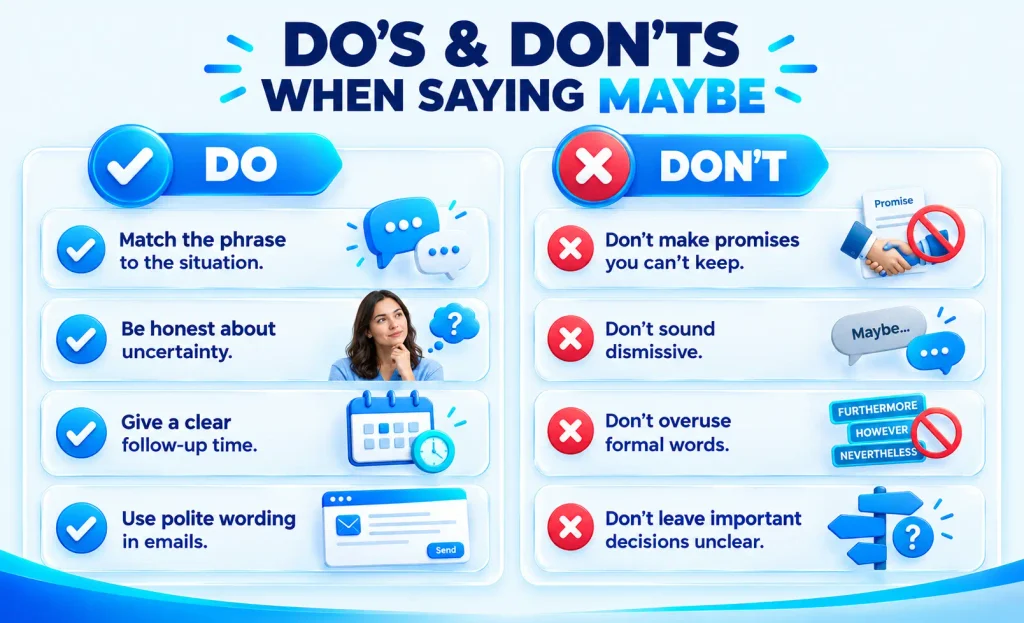
Choosing the right expression matters because similar phrases can communicate different levels of certainty.
- Using casual expressions in formal emails. “Maybe so” may sound too informal in a business discussion. Consider “perhaps” or “it’s possible” instead.
- Making simple conversations too formal. Using “potentially” in every casual exchange can sound unnatural. “I might” is often a better fit when talking with friends.
- Repeating the same phrase. Repeatedly using “perhaps” or “maybe” can make your writing monotonous. Vary your wording when the meaning allows it.
- Ignoring the context. “I might attend” describes a possible action, while “I’m not sure yet” emphasizes an undecided position. Choose the expression that matches your actual intention.
- Sounding dismissive. A brief “we’ll see” may sound like you are avoiding a question. If someone needs a clear answer, explain what you need to consider and when you can respond.
Frequently Asked Questions About Maybe
1. What is another word for maybe?
“Perhaps” and “possibly” are two common alternatives. Other options include “conceivably,” “potentially,” and “there’s a chance.” However, these expressions do not always mean exactly the same thing. Choose the word that best matches your level of confidence and the context in which you are speaking.
2. What is a professional way to say maybe?
Professional alternatives include “perhaps,” “it’s possible,” and “I’m not certain at this stage.” For example, “It’s possible that we can complete the project this week” acknowledges uncertainty without making a firm promise. In workplace communication, add relevant details or a follow-up date whenever the recipient needs a clear decision.
3. What is a polite way to say maybe?
“I’m not sure yet,” “I’ll have to see,” and “I’ll let you know” can all be polite options. The best choice depends on the situation. When responding to an invitation, explain that you need to check your schedule and, if possible, say when you can give a definite answer.
4. How can I say maybe without using the word?
You can say “I might,” “there’s a chance,” “perhaps,” “it could be,” or “we’ll see.” For example, instead of saying, “Maybe I’ll call you later,” you could say, “I might give you a call later.” Both communicate a possible action without making a firm commitment.
5. What is a casual way to say maybe?
In casual American English, try “I might,” “we’ll see,” “I’ll have to see,” or “there’s a chance.” These expressions work well with friends and family. For example, “I might stop by after work” sounds relaxed while making it clear that your plans are not final.
6. How do you say maybe in a professional email?
Use “perhaps,” “it’s possible,” or “I’m not sure yet,” depending on your meaning. For example, “It’s possible that we could reschedule the meeting for Thursday” sounds professional and specific. If you need more time, explain when you expect to provide a definite answer.
7. Do perhaps and maybe mean the same thing?
Yes, both words express possibility or uncertainty. However, “perhaps” often sounds more polished, while “maybe” is especially common in everyday conversation. For example, “Perhaps we should leave early” and “Maybe we should leave early” communicate the same general suggestion but have slightly different tones.
8. What is the difference between maybe and possibly?
Both words express uncertainty, but their usage can differ. “Maybe” is common in everyday conversation, while “possibly” often appears in discussions about options, outcomes, and polite requests. For instance, “Maybe we’ll go hiking” suggests a tentative plan, while “Could you possibly send the report today?” makes a polite request.
Conclusion
Finding another way to say maybe helps you express uncertainty without sounding repetitive or unclear. Whether you are chatting with friends, responding to an invitation, or writing a professional email, the right phrase makes your message more natural.
Use “perhaps” for polished suggestions, “possibly” for potential outcomes, and “I might” when discussing your own plans. If you need more time to decide, “I’m not sure yet” communicates your position honestly. Meanwhile, “there’s a chance” highlights a possibility, and “we’ll see” keeps your options open.
Remember that these alternatives are not always interchangeable. Some suggest a realistic opportunity, while others express hesitation or an unfinished decision. Consider your audience, your level of certainty, and the message you want to communicate. The best expression is the one that says exactly what you mean without promising more than you can deliver.

The Majestic Studio Editorial Team creates practical resources about synonyms, alternative phrases, vocabulary, and English usage. Our content is designed to help readers choose clearer, more natural words and communicate effectively in everyday, professional, and academic contexts.
Each article is researched, edited, and reviewed for clarity, context, usefulness, and language accuracy. We regularly update our content to keep examples and recommendations relevant.