

Another way to say “sorry for the confusion” includes “I apologize for the misunderstanding,” “I’m sorry for any misunderstanding,” and “I apologize for the mix-up.” For professional communication, choose a phrase that sounds polite and takes responsibility without being overly formal. The best option depends on the situation, relationship, and level of seriousness.
Key Takeaways
- Choose an alternative based on the situation and level of formality.
- “I apologize for the misunderstanding” works well in professional settings.
- “Sorry about the mix-up” sounds natural and friendly.
- Specific wording can make an apology feel more sincere.
- Avoid overly formal or casual language when the context does not fit.
“Sorry for the confusion” is a polite way to acknowledge that your words or actions may have caused uncertainty or misunderstanding. While the phrase works in many situations, using another expression can help you sound more natural, professional, or sincere.
What Does “Another Way to Say Sorry for the Confusion” Mean?

Looking for another way to say “sorry for the confusion” means you want a different phrase to apologize for causing, contributing to, or failing to prevent a misunderstanding.
People commonly use this wording in emails, workplace conversations, customer service messages, and everyday communication. Depending on the situation, you may want to sound professional, warm, direct, or casual.
For example, a business email might use “I apologize for the misunderstanding,” while a quick message to a friend could simply say, “Sorry about the mix-up.”
Why Use Other Ways to Say “Sorry for the Confusion”?
Using different expressions can make your communication more precise and natural. It also lets you match your apology to the situation.
- Avoid repetition: Use fresh wording when communicating often.
- Sound more natural: Choose expressions that fit everyday American English.
- Match the situation: Formal emails and casual conversations need different tones.
- Improve professional communication: A thoughtful apology can maintain trust.
- Show sincerity: Specific wording can make your message feel more genuine.
12 Best Other Ways to Say “Sorry for the Confusion”

1. I Apologize for the Misunderstanding
Meaning
This phrase directly acknowledges that something was misunderstood. It sounds professional and takes responsibility without being overly emotional.
Best For
Professional, Formal, Polite
Example 1
“I apologize for the misunderstanding regarding the meeting time.”
Example 2
“I apologize for the misunderstanding and appreciate your patience.”
Quick Tip
Use this when the main issue is that someone interpreted information differently than you intended.
2. I’m Sorry for Any Misunderstanding
Meaning
This is a softer apology that recognizes there may have been a misunderstanding. It works well when you want to remain polite without assigning blame.
Best For
Professional, Polite, Warm
Example 1
“I’m sorry for any misunderstanding about the updated schedule.”
Example 2
“I’m sorry for any misunderstanding caused by my earlier message.”
Quick Tip
Use “any misunderstanding” when you want to keep the tone diplomatic.
3. I Apologize for the Mix-Up
Meaning
“Mix-up” suggests that information, details, or actions became confused. The phrase is professional but sounds slightly more conversational than “misunderstanding.”
Best For
Professional, Friendly, Polite
Example 1
“I apologize for the mix-up with your appointment.”
Example 2
“We apologize for the mix-up and have corrected the order.”
Quick Tip
This is especially natural when two sets of information were accidentally switched or confused.
4. Sorry About the Mix-Up
Meaning
This is a shorter and more casual version of the previous phrase. It acknowledges a mistake without sounding stiff or overly serious.
Best For
Casual, Friendly, Polite
Example 1
“Sorry about the mix-up—I sent you the wrong file.”
Example 2
“Sorry about the mix-up with the reservation.”
Quick Tip
Use it with coworkers, friends, customers, or familiar contacts when a formal apology is unnecessary.
5. I’m Sorry for the Miscommunication
Meaning
This phrase focuses on communication that did not go as intended. It is useful when unclear wording or incomplete information contributed to the problem.
Best For
Professional, Formal, Polite
Example 1
“I’m sorry for the miscommunication about the project deadline.”
Example 2
“I’m sorry for the miscommunication and will clarify the next steps.”
Quick Tip
Choose this phrase when the problem specifically involved how information was communicated.
6. Please Accept My Apologies for the Confusion
Meaning
This is a more formal way to apologize. It communicates respect and is appropriate when the situation calls for a serious or polished tone.
Best For
Formal, Professional, Polite
Example 1
“Please accept my apologies for the confusion surrounding your request.”
Example 2
“Please accept my apologies for the confusion in our previous correspondence.”
Quick Tip
Reserve this for formal emails, customer concerns, or situations where a stronger apology is appropriate.
7. I’m Sorry I Wasn’t Clear
Meaning
This phrase takes personal responsibility for unclear communication. It sounds honest and direct because it identifies the speaker’s role in the problem.
Best For
Professional, Friendly, Warm
Example 1
“I’m sorry I wasn’t clear about which document you needed.”
Example 2
“I’m sorry I wasn’t clear about the changes to the schedule.”
Quick Tip
Use this when your own wording caused the misunderstanding.
8. I Hope I Can Clarify
Meaning
Instead of focusing only on the mistake, this phrase moves the conversation toward a solution. It is useful when you want to correct information quickly.
Best For
Professional, Polite, Formal
Example 1
“I hope I can clarify what I meant in my previous email.”
Example 2
“I hope I can clarify the payment details below.”
Quick Tip
Pair it with a clear explanation when the goal is to resolve confusion rather than simply apologize.
9. Let Me Clear That Up
Meaning
This expression is friendly, direct, and solution-focused. It suggests that you are ready to explain something that was unclear.
Best For
Casual, Friendly, Professional
Example 1
“Let me clear that up—the final report is due Friday.”
Example 2
“Let me clear that up so there’s no confusion about the next step.”
Quick Tip
Use this in conversations or informal workplace messages when you want to sound approachable.
10. I’m Sorry for the Confusion This Caused
Meaning
This version directly recognizes the effect of the confusion. It sounds considerate because it acknowledges that the misunderstanding may have created inconvenience.
Best For
Professional, Warm, Polite
Example 1
“I’m sorry for the confusion this caused when you placed the order.”
Example 2
“I’m sorry for the confusion this caused your team.”
Quick Tip
This is a strong choice when the misunderstanding created extra work or inconvenience for someone.
11. Thank You for Your Patience
Meaning
This phrase shifts attention from the problem to appreciation for the other person’s patience. It works especially well after you have explained or corrected an issue.
Best For
Professional, Warm, Polite
Example 1
“Thank you for your patience while we clarified the billing issue.”
Example 2
“Thank you for your patience as we worked through the scheduling problem.”
Quick Tip
Use this after resolving confusion when you want to end the interaction on a positive note.
12. I Appreciate Your Understanding
Meaning
This phrase expresses appreciation for the other person’s willingness to accept or understand the situation. It sounds polished without being excessively formal.
Best For
Professional, Warm, Polite
Example 1
“I appreciate your understanding as we correct the information.”
Example 2
“I appreciate your understanding while we work to resolve the issue.”
Quick Tip
Use it after explaining a mistake, delay, correction, or unexpected change.
Comparison Table
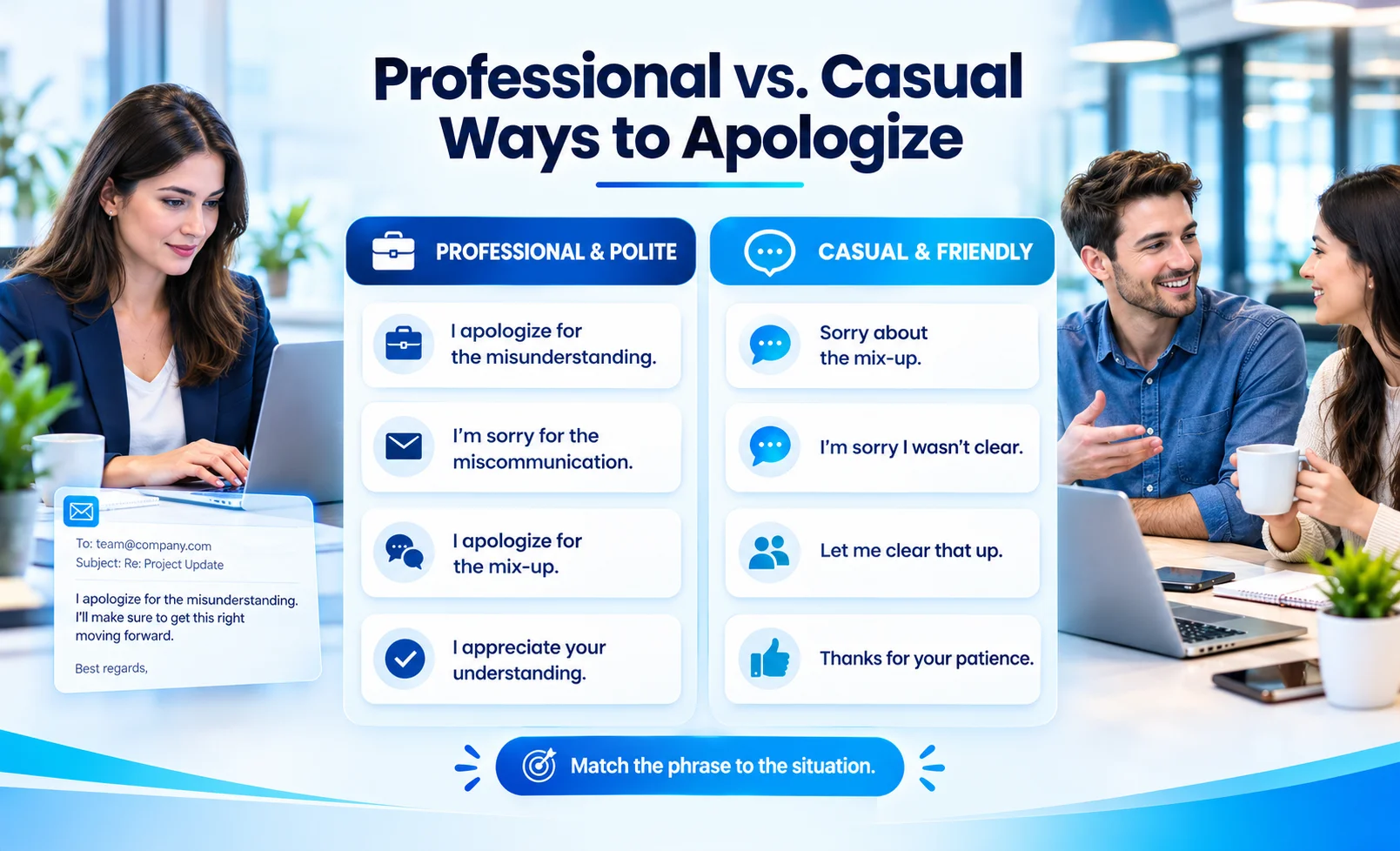
| Alternative | Best Used In | Tone |
|---|---|---|
| I apologize for the misunderstanding | Work emails | Professional |
| I’m sorry for any misunderstanding | Workplace communication | Polite |
| I apologize for the mix-up | Business/customer service | Professional |
| Sorry about the mix-up | Everyday messages | Casual |
| I’m sorry for the miscommunication | Professional discussions | Formal |
| Please accept my apologies for the confusion | Formal correspondence | Formal |
| I’m sorry I wasn’t clear | Direct conversations | Warm |
| I hope I can clarify | Emails and explanations | Professional |
| Let me clear that up | Conversations | Friendly |
| I’m sorry for the confusion this caused | Customer/workplace issues | Warm |
| Thank you for your patience | Problem resolution | Appreciative |
| I appreciate your understanding | Professional follow-up | Polite |
Common Mistakes

- Using casual phrases in professional emails
“Sorry about the mix-up” may sound too casual for a serious business complaint or formal correspondence. - Choosing overly formal language
“Please accept my apologies” can feel stiff when a simple “I’m sorry” would sound more natural. - Repeating the same phrase
Using “sorry for the confusion” in every email can make your writing feel repetitive. - Forgetting context
A misunderstanding, communication error, scheduling mistake, and customer-service issue may each call for different wording. - Sounding insincere
Avoid pairing an apology with excuses or blaming the other person. A brief acknowledgment followed by a clear solution often sounds more genuine.
Frequently Asked Questions
What is a professional way to say “sorry for the confusion”?
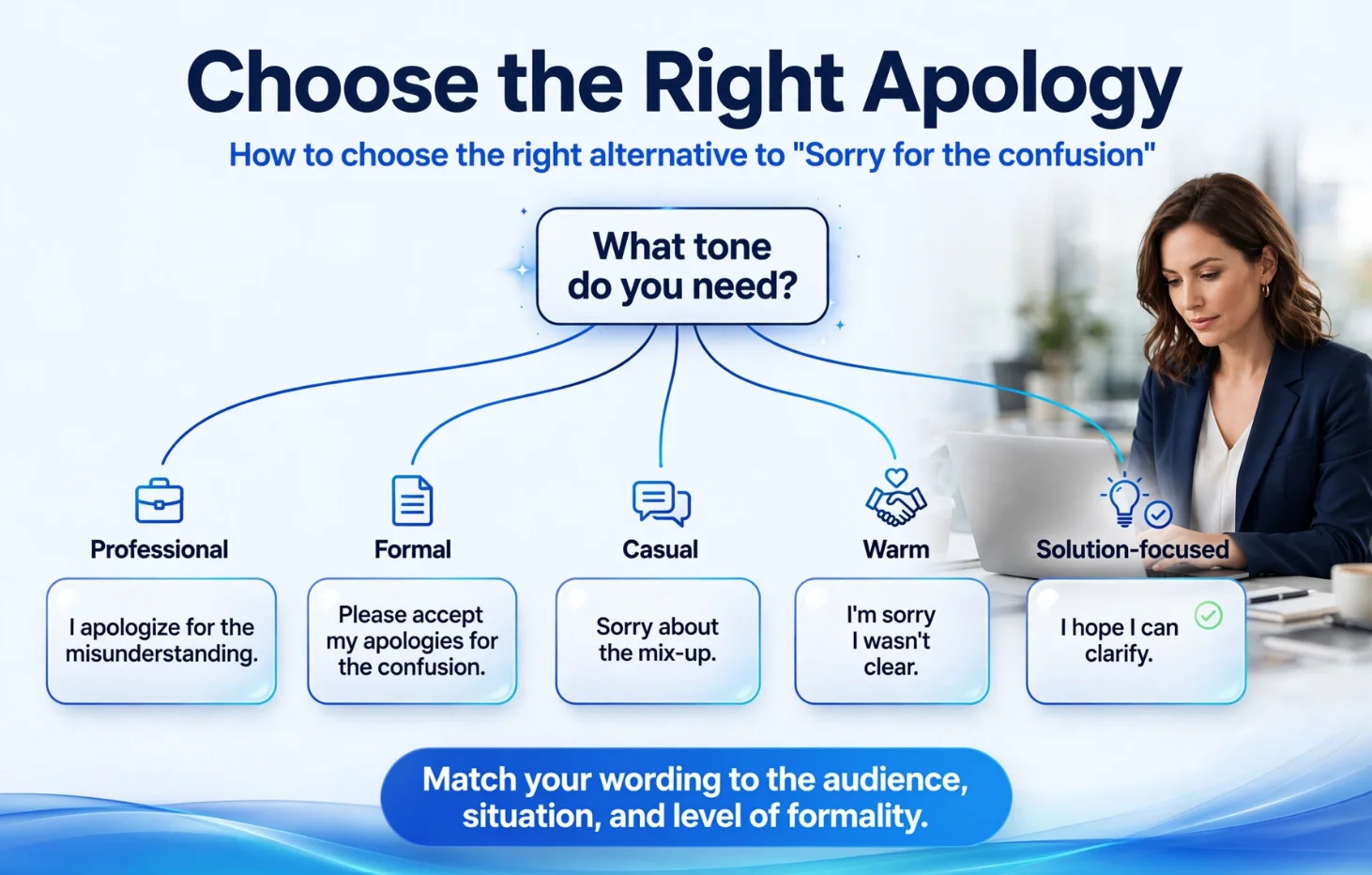
“I apologize for the misunderstanding” is one of the best professional alternatives. It is polite, clear, and appropriate for workplace emails, customer communication, and formal conversations. If you caused the problem through unclear wording, “I’m sorry I wasn’t clear” is also a natural and accountable choice.
What is a polite way to apologize for confusion in an email?
You can say, “I’m sorry for any misunderstanding,” “I apologize for the mix-up,” or “I’m sorry for the confusion this caused.” The best choice depends on the situation. For most workplace emails, “I apologize for the misunderstanding” is professional without sounding unnecessarily formal.
How do you say “sorry for the confusion” without saying sorry?
You can use “I appreciate your understanding,” “Thank you for your patience,” or “I hope I can clarify.” These phrases do not contain an apology, but they can acknowledge the issue and move the conversation toward a solution. They work particularly well when the problem has already been addressed.
What is a casual way to say “sorry for the confusion”?
“Sorry about the mix-up” is a natural casual option. You can also say, “Let me clear that up” when you want to correct the misunderstanding. These expressions work well with friends, familiar coworkers, and people you communicate with regularly.
Is “I apologize for the confusion” better than “sorry for the confusion”?
Neither phrase is always better. “I apologize for the confusion” sounds more formal and professional, while “sorry for the confusion” feels more conversational. Choose based on your audience and situation rather than assuming one phrase is universally better.
How do you apologize for a misunderstanding professionally?
Be direct, acknowledge the issue, and provide clarification. For example, you could say, “I apologize for the misunderstanding. To clarify, the meeting is scheduled for Thursday at 2 p.m.” This approach combines accountability with useful information instead of offering an apology without resolving the problem.
What is another way to say “sorry for the misunderstanding”?
Good alternatives include “I apologize for the misunderstanding,” “I’m sorry for any misunderstanding,” and “I’m sorry for the miscommunication.” If you want to sound more solution-focused, “I hope I can clarify” is another useful option.
How can I apologize without sounding overly formal?
Use simple, direct language such as “I’m sorry I wasn’t clear” or “Sorry about the mix-up.” Avoid unnecessarily formal phrases when the situation is minor or the relationship is casual. A natural apology usually sounds more sincere than language that feels overly polished or distant.
Conclusion
There are many natural ways to say “sorry for the confusion,” and the best choice depends on your audience and situation. For professional communication, “I apologize for the misunderstanding” and “I’m sorry for the miscommunication” are clear, respectful options.
For casual conversations, “Sorry about the mix-up” feels more relaxed. When you want to focus on solving the problem, “I hope I can clarify” or “Let me clear that up” can work better than a direct apology.
The key is to acknowledge what happened, avoid unnecessary excuses, and provide clarification when needed. Choose the phrase that matches the seriousness of the situation and sounds natural for the person you are speaking to.

The Majestic Studio Editorial Team creates practical resources about synonyms, alternative phrases, vocabulary, and English usage. Our content is designed to help readers choose clearer, more natural words and communicate effectively in everyday, professional, and academic contexts.
Each article is researched, edited, and reviewed for clarity, context, usefulness, and language accuracy. We regularly update our content to keep examples and recommendations relevant.