
Another way to say “on the flip side” is “on the other hand,” “conversely,” “in contrast,” or “alternatively.” These expressions help introduce a different perspective, highlight a contrast, or present another option. The best choice depends on whether you are writing a professional email, making a casual comment, or comparing two ideas.
Key Takeaways
- “On the other hand” is a versatile alternative for comparing different perspectives.
- “In contrast” works well when highlighting clear differences between two things.
- “Conversely” suits formal writing and logical comparisons.
- “Alternatively” introduces another choice or possible course of action.
- Match your phrase to the context, tone, and relationship between your ideas.
What Does “On the Flip Side” Mean?

“On the flip side” is a conversational expression that introduces another perspective, a contrasting fact, or a different aspect of a situation. It often helps people explain both the positive and negative sides of an issue.
For example, you might say, “Working from home saves commuting time. On the flip side, it can feel isolating.” The phrase signals that the second statement offers a different perspective.
People commonly use it in everyday conversations, informal writing, presentations, and discussions. Although it is widely understood in American English, more precise alternatives may sound better in academic papers, professional emails, and formal reports.
Why Use Other Ways to Say “On the Flip Side”?
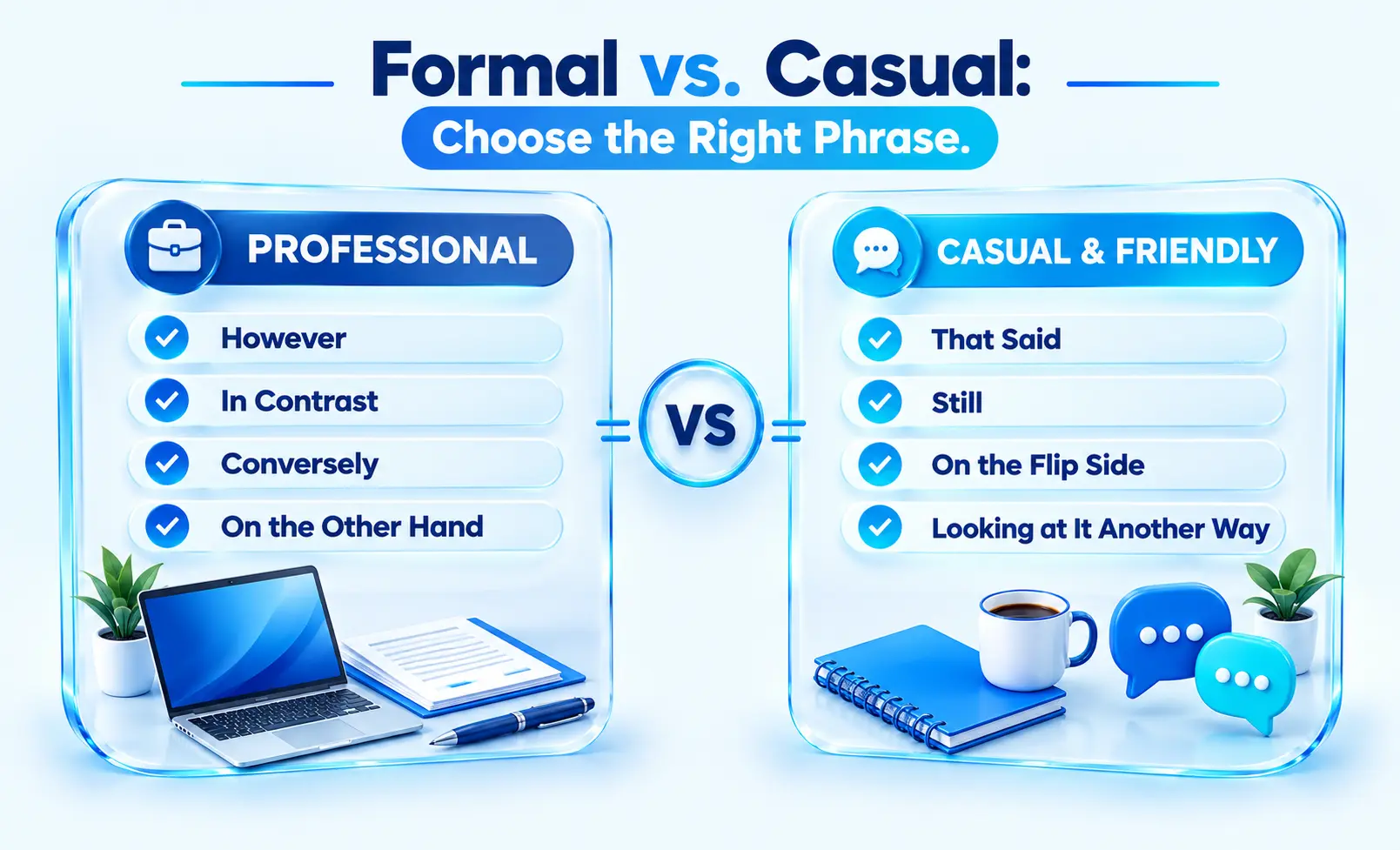
Choosing another expression can make your writing clearer and help you communicate the exact relationship between two ideas.
Here are the main benefits:
- Avoid repetition: Keep articles, emails, and conversations from sounding repetitive.
- Sound more natural: Choose expressions that fit your audience and speaking style.
- Clarify comparisons: Show whether you are presenting a contrast, a consequence, or another option.
- Improve professional communication: Use precise wording in reports, presentations, and business discussions.
- Adjust your tone: Move smoothly between casual conversations and formal writing.
12 Best Other Ways to Say “On the Flip Side”
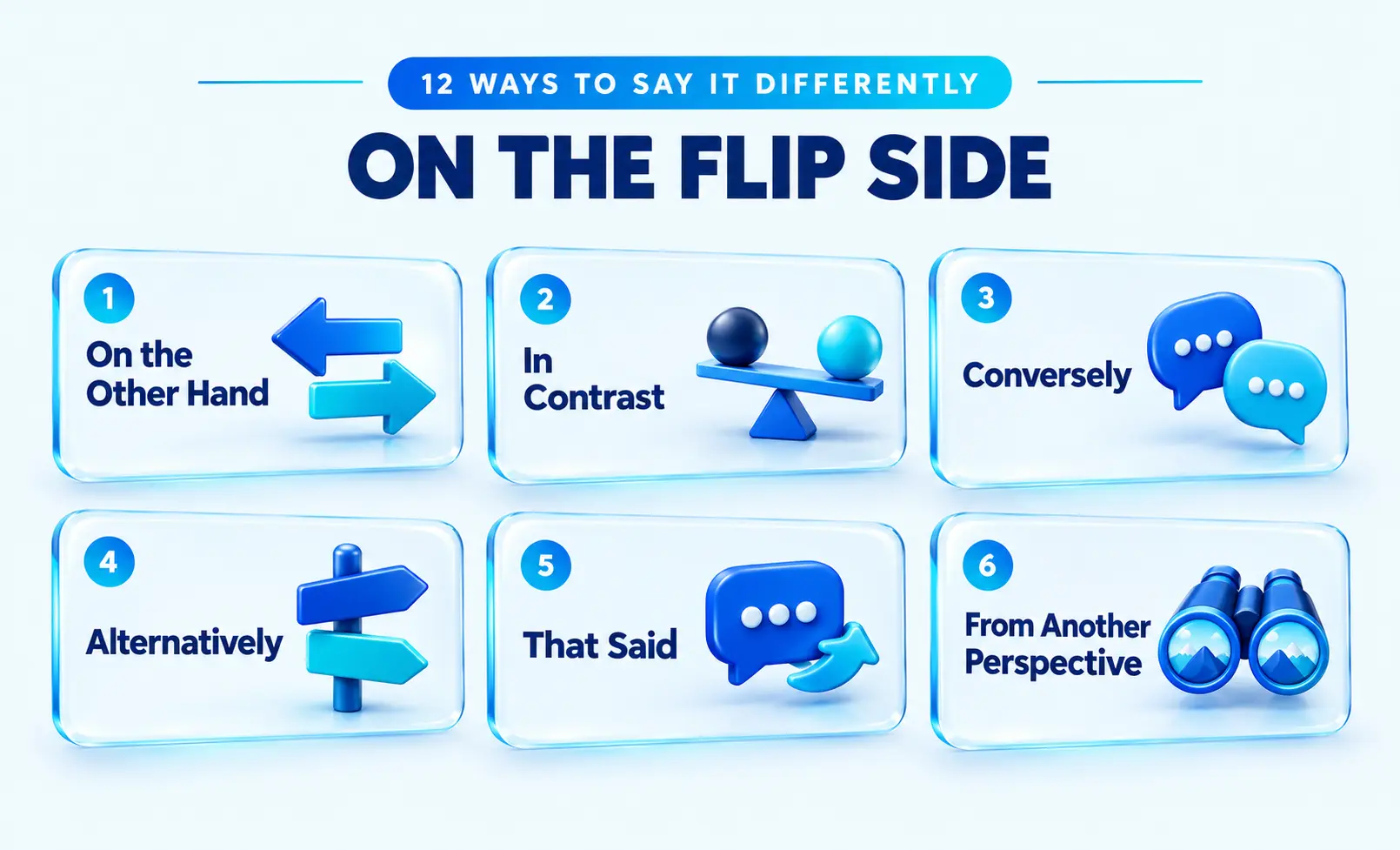
1. On the Other Hand
Meaning
“On the other hand” introduces a contrasting point or a different perspective. It is one of the most versatile alternatives because it works in both casual and professional communication.
Best For
Professional, Friendly, Polite
Example 1
The apartment is close to downtown. On the other hand, the rent is higher than our budget.
Example 2
I enjoy working independently. On the other hand, I appreciate having a team to exchange ideas with.
Quick Tip
Use this phrase when you want to balance one argument with another, especially when discussing advantages and disadvantages.
2. In Contrast
Meaning
“In contrast” highlights a clear difference between two people, things, situations, or outcomes. It is more direct and analytical than “on the flip side.”
Best For
Professional, Formal
Example 1
The first design uses bold colors and large text. In contrast, the second design has a softer palette and a minimalist layout.
Example 2
Sales increased in the eastern region. In contrast, the western region recorded a slight decline.
Quick Tip
Use “in contrast” when you want readers to focus on a noticeable difference rather than simply consider another opinion.
3. Conversely
Meaning
“Conversely” introduces an opposing or reverse relationship between two ideas. It is particularly useful when the second statement shows how a situation differs under opposite conditions.
Best For
Formal, Professional
Example 1
When customers receive quick support, satisfaction often improves. Conversely, delayed responses can damage trust.
Example 2
Some plants thrive in direct sunlight. Conversely, others grow better in shaded areas.
Quick Tip
Choose “conversely” for analytical writing, reports, and explanations. Make sure the second idea genuinely contrasts with or reverses the first.
4. Alternatively
Meaning
“Alternatively” introduces another option, approach, or possible course of action. Unlike some other alternatives, it does not always indicate an opposing viewpoint.
Best For
Professional, Formal, Polite
Example 1
We could schedule the meeting for Tuesday. Alternatively, we could discuss the proposal over email.
Example 2
You can build the page with a predesigned template. Alternatively, a custom layout may better fit your brand.
Quick Tip
Use this expression when presenting a choice, not simply when describing an opposite fact.
5. By Comparison
Meaning
“By comparison” introduces information that becomes meaningful when measured against something mentioned earlier. It helps readers understand differences in size, cost, quality, or performance.
Best For
Professional, Formal
Example 1
The premium package includes weekly consultations. By comparison, the basic package offers support only through email.
Example 2
The old website took five seconds to load. By comparison, the redesigned version loads in under two seconds.
Quick Tip
Use “by comparison” when you have two specific things to evaluate using a shared measure or standard.
6. That Said
Meaning
“That said” introduces a qualification or a point that adds balance to the previous statement. It acknowledges what was just mentioned without letting that point tell the whole story.
Best For
Professional, Casual, Friendly
Example 1
The project requires a larger budget than expected. That said, the long-term benefits may justify the investment.
Example 2
The restaurant was crowded when we arrived. That said, the food and service were excellent.
Quick Tip
Use “that said” when you agree with or acknowledge a point but want to add an important qualification.
7. Still
Meaning
“Still” introduces a fact that remains true despite the situation described earlier. It is brief, natural, and common in everyday American English.
Best For
Casual, Friendly, Professional
Example 1
The weather forecast looks uncertain. Still, we can prepare for the outdoor event.
Example 2
The software takes time to learn. Still, its editing tools make the effort worthwhile.
Quick Tip
Use “still” to keep your writing concise. It often works better than a longer transition when the contrast is easy to understand.
8. However
Meaning
“However” introduces a contrasting statement, limitation, or exception. It is widely accepted in professional and academic writing because it communicates a change in direction clearly.
Best For
Professional, Formal, Polite
Example 1
The candidate has extensive experience. However, the role requires a technical certification she does not yet hold.
Example 2
The first proposal fits our current budget. However, it may require more maintenance over time.
Quick Tip
Place “however” at the beginning of a contrasting sentence when you want a clear, professional transition. Use correct punctuation.
9. At the Same Time
Meaning
“At the same time” can acknowledge a competing consideration while keeping the original point in view. It can also refer to events that happen simultaneously, so context matters.
Best For
Professional, Friendly, Polite
Example 1
The new policy may reduce expenses. At the same time, we need to consider how it will affect employees.
Example 2
I want to finish the redesign quickly. At the same time, I do not want to sacrifice quality.
Quick Tip
Use this phrase when two considerations can both be valid, rather than suggesting that one completely cancels out the other.
10. On the Contrary
Meaning
“On the contrary” directly rejects or corrects a previous statement. It is stronger than “on the flip side” and is best when the second point contradicts an assumption.
Best For
Formal, Professional
Example 1
Some people assume that remote work reduces productivity. On the contrary, our latest results show that the team completed more tasks.
Example 2
The instructions are not difficult to follow. On the contrary, they make the entire process much simpler.
Quick Tip
Do not use “on the contrary” for every ordinary difference. Reserve it for a clear contradiction or correction.
11. From Another Perspective
Meaning
“From another perspective” invites readers to consider the same situation through a different viewpoint. It works well when people may interpret an issue differently because of their experiences or priorities.
Best For
Professional, Friendly, Polite
Example 1
The redesign may seem expensive at first. From another perspective, it could reduce support requests by making the website easier to use.
Example 2
Moving to a smaller city may limit some career options. From another perspective, it could offer a lower cost of living and a calmer lifestyle.
Quick Tip
Choose this phrase when discussing opinions, decisions, or trade-offs that depend on how someone views the situation.
12. Conversely Speaking
Meaning
“Conversely speaking” is sometimes used to introduce an opposing point, but it is not a standard or natural choice in most American English writing. In most cases, “conversely” alone communicates the idea more clearly.
Best For
Formal
Example 1
The first plan prioritizes speed. Conversely, the second prioritizes careful testing.
Example 2
Some customers prefer a simple checkout process. Conversely, others value having more payment options.
Quick Tip
For polished American English, write “conversely” rather than “conversely speaking.” The shorter form is clearer and more idiomatic.
Comparison Table
| Alternative | Best Used In | Tone |
|---|---|---|
| On the other hand | Everyday comparisons and discussions | Neutral |
| In contrast | Reports and clear comparisons | Analytical |
| Conversely | Formal arguments and logical comparisons | Formal |
| Alternatively | Suggestions and choices | Practical |
| By comparison | Evaluating performance, cost, or quality | Analytical |
| That said | Adding a qualification or balancing a point | Conversational |
| Still | Short, direct contrasts | Casual to neutral |
| However | Business writing and academic work | Professional |
| At the same time | Balancing competing considerations | Balanced |
| On the contrary | Correcting an assumption | Emphatic |
| From another perspective | Discussing viewpoints and trade-offs | Thoughtful |
| Conversely speaking | Rare; generally replace with “conversely” | Unnatural |
Common Mistakes When Using Alternatives to “On the Flip Side”
1. Using Casual Language in Formal Writing
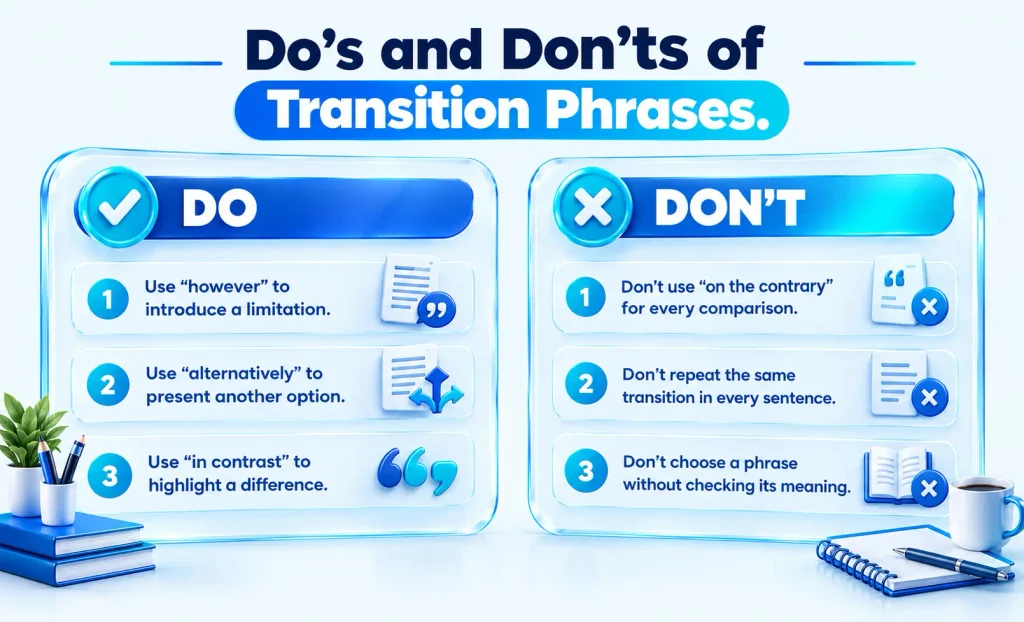
“On the flip side” is understandable, but it may sound conversational in a research paper, formal report, or legal document. Choose “however,” “in contrast,” or “conversely” when the situation calls for a more formal tone.
2. Treating Every Alternative as Interchangeable
These expressions do not all mean the same thing. “Alternatively” introduces another option, while “on the contrary” corrects an opposing claim. Selecting the wrong phrase can change your intended meaning.
3. Overusing Transition Phrases
Starting every other sentence with “however,” “still,” or “on the other hand” can make writing feel mechanical. Sometimes, a direct sentence or a simple conjunction communicates the relationship more naturally.
4. Ignoring the Relationship Between Ideas
A contrasting phrase should connect ideas in a meaningful way. If the second statement adds a reason, result, or example instead of a contrast, a word such as “therefore,” “for example,” or “as a result” may be more accurate.
5. Using “On the Contrary” for a Simple Difference
“On the contrary” usually signals that a previous claim is wrong or needs correction. For ordinary comparisons, use “in contrast” or “on the other hand” instead.
Frequently Asked Questions
1. What is another way to say “on the flip side”?
“On the other hand” is the most versatile alternative. You can also use “however,” “in contrast,” “conversely,” or “that said,” depending on the context. If you are presenting another choice rather than a contrasting idea, “alternatively” is usually more accurate.
2. Is “on the flip side” formal or informal?
“On the flip side” is generally conversational and informal, although it can appear in less formal business communication. For academic papers, official reports, or formal correspondence, expressions such as “however,” “in contrast,” and “conversely” often sound more appropriate.
3. What is a professional way to say “on the flip side”?
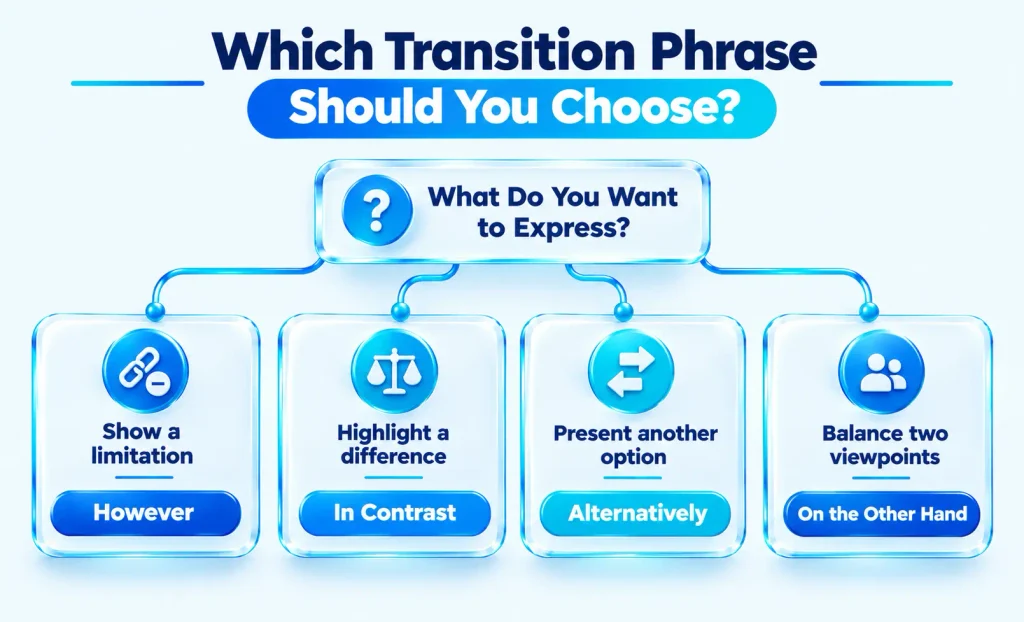
“However,” “on the other hand,” and “in contrast” are reliable professional alternatives. Use “however” to introduce a limitation, “on the other hand” to balance two viewpoints, and “in contrast” to highlight a clear difference between two situations.
4. What is a formal synonym for “on the flip side”?
“Conversely” is a useful formal alternative when the second point presents an opposing or reverse relationship. “In contrast” is another strong choice when you want to emphasize differences. The best option depends on whether you are contrasting facts, balancing an argument, or describing a reverse relationship.
5. Can I use “on the flip side” in a business email?
Yes, especially when writing to colleagues you know or using a conversational tone. However, “however,” “that said,” and “on the other hand” may be more suitable for client emails, formal proposals, or discussions involving sensitive decisions. Consider your audience before choosing a transition.
6. What is the difference between “on the flip side” and “on the other hand”?
Both expressions introduce another perspective or a contrasting consideration. “On the flip side” sounds more conversational, while “on the other hand” is more neutral and widely suitable for professional writing. Neither phrase automatically means that the second statement is the complete opposite of the first.
7. Is “on the contrary” the same as “on the flip side”?
Not exactly. “On the contrary” usually rejects or corrects a previous statement, whereas “on the flip side” often presents another aspect of a situation. For example, you might use “on the contrary” to challenge a claim, but “on the other hand” to compare two reasonable options.
8. How do I choose the best alternative to “on the flip side”?
First, identify the relationship between your ideas. Use “however” for a limitation, “in contrast” for a clear difference, “conversely” for a reverse relationship, and “alternatively” for another option. For a balanced discussion or a casual conversation, “on the other hand” is often a safe choice.
Conclusion
Choosing another way to say “on the flip side” helps you communicate contrasts more clearly and adapt your writing to different audiences. Although the original expression works well in everyday American English, another phrase may better suit your message.
For professional emails and reports, consider “however,” “in contrast,” or “conversely.” When presenting a different option, use “alternatively.” If you want to acknowledge one point while adding a qualification, “that said” can sound natural and thoughtful. For everyday conversations, “still” and “on the other hand” are easy to use.
The most important step is to understand how your ideas relate to each other. A clear transition should guide readers from one point to the next without changing your intended meaning. Choose the expression that fits your tone, context, and purpose, and your writing will sound more precise, confident, and natural.

Editorial contributors help develop practical English-language resources covering vocabulary, expressions, synonyms, and writing. Contributions focus on clear explanations, useful examples, and context so readers can understand not only what a phrase means, but when and how to use it naturally.