

Looking for another way to say sounds good? Try “That works for me,” “Sounds great,” “I agree,” “Absolutely,” or “That sounds perfect.” These expressions help you agree with a plan, accept a suggestion, or respond positively. The best alternative depends on your audience, situation, and desired tone.
Key Takeaways
- Use “That works for me” to confirm a meeting, schedule, or arrangement.
- Say “Sounds great!” to express enthusiasm in casual conversations.
- Choose “I agree” to communicate agreement in professional discussions.
- Use “That sounds perfect” when a suggestion meets your needs.
- Try “I’m on board” to show support for a plan or proposal.
- Match your response to the situation to sound natural and confident.
What Does “Another Way to Say Sounds Good” Mean?

The phrase “another way to say sounds good” refers to alternative expressions that communicate agreement, approval, acceptance, or enthusiasm. People use these phrases when they like an idea, accept a suggestion, or confirm that a proposed arrangement is suitable.
For example, if a coworker suggests meeting at 10 a.m., you can respond, “That works for me.” If a friend invites you to dinner, “Sounds great!” is a friendly response.
Although these expressions share a similar meaning, they are not always interchangeable. Some confirm arrangements, while others express enthusiasm, acknowledge reasoning, or communicate a commitment.
Choosing the right phrase helps you communicate clearly in professional emails, workplace meetings, text messages, and everyday conversations.
Why Use Another Way to Say Sounds Good?
“Sounds good” is a natural and widely used expression, especially in American English. However, repeating it in every conversation can make your responses feel predictable.
Learning other ways to say sounds good gives you more options for expressing your intentions.
Here are five reasons to use alternatives:
- Avoid repetition: Make your emails and conversations sound more varied.
- Sound professional: Choose appropriate wording for clients, managers, and colleagues.
- Show enthusiasm: Communicate excitement when you genuinely like an idea.
- Confirm plans: Clearly accept proposed meeting times, schedules, or arrangements.
- Express your intentions: Distinguish between understanding an idea and agreeing to move forward.
For example, “That makes sense” shows that you understand someone’s reasoning, while “That works for me” confirms that an arrangement is acceptable.
12 Best Ways to Say Sounds Good
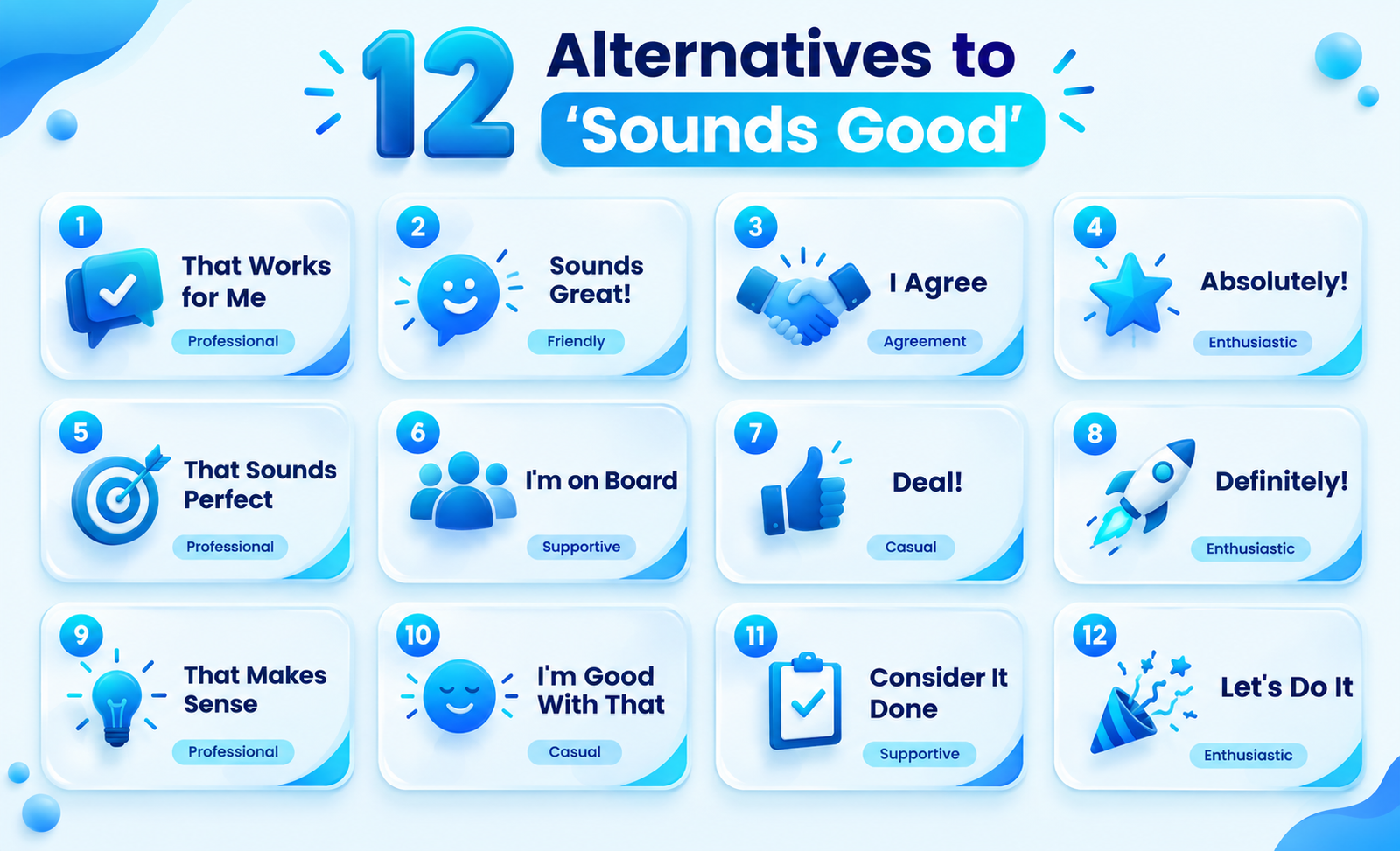
If you need another way to say sounds good, the following alternatives can help you respond naturally in different situations. Each expression includes its meaning, examples, and practical usage tips.
1. That Works for Me
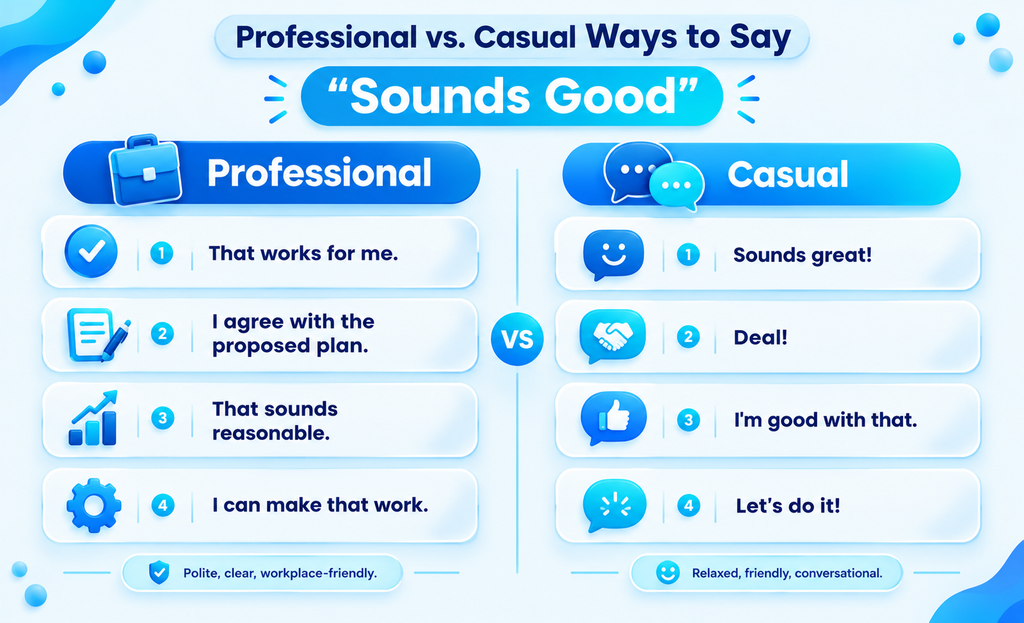
Meaning: “That works for me” means you agree with a proposed plan, time, or arrangement. It is a versatile expression that sounds polite, practical, and professional.
Examples:
- “Would Thursday at 2 p.m. work for our meeting?” “That works for me.”
- “We can pick up the groceries after work.” “That works for me.”
Best for: Workplace emails, meeting arrangements, scheduling, and everyday conversations.
Quick tip: Use this expression when a suggested time or arrangement fits your schedule. It is one of the safest alternatives to “sounds good” in professional communication.
2. Sounds Great!
Meaning: “Sounds great!” expresses positive agreement with more enthusiasm than “sounds good.” It shows that you like an idea and feel happy about the proposed plan.
Examples:
- “I’m planning a picnic at the lake this Saturday.” “Sounds great! I’ll bring some snacks.”
- “Let’s celebrate after we finish the project.” “Sounds great! We’ve earned it.”
Best for: Friendly conversations, invitations, casual workplace chats, and social plans.
Quick tip: Choose “Sounds great!” when you want to sound warm and enthusiastic without making your response overly formal.
3. I Agree
Meaning: “I agree” communicates that you share someone’s opinion, viewpoint, or position. Unlike expressions used mainly to accept arrangements, it directly confirms agreement with an idea.
Examples:
- “We should update the website before launching the campaign.” “I agree. The current design needs improvement.”
- “Clear instructions would help reduce customer complaints.” “I agree with that assessment.”
Best for: Professional discussions, meetings, debates, and formal conversations.
Quick tip: Use “I agree” when discussing opinions, strategies, or decisions. If you are accepting a meeting time, “That works for me” usually sounds more natural.
4. Absolutely!
Meaning: “Absolutely!” is a confident, enthusiastic way to express strong agreement or accept a request. It communicates a clear yes and often sounds more energetic than “sounds good.”
Examples:
- “Could you review the final design before I send it to the client?” “Absolutely! I’ll check it this afternoon.”
- “Would you like to join us for lunch?” “Absolutely! That sounds like fun.”
Best for: Requests, invitations, positive responses, and friendly professional conversations.
Quick tip: Use this expression when you genuinely agree or are willing to help. Avoid making a commitment if you are uncertain about your availability.
5. That Sounds Perfect
Meaning: “That sounds perfect” means a suggestion meets your needs particularly well. It communicates approval and shows that you are pleased with the proposed arrangement.
Examples:
- “We can move your appointment to Friday morning.” “That sounds perfect. Thank you for accommodating me.”
- “How about ordering pizza and watching a movie tonight?” “That sounds perfect!”
Best for: Scheduling, invitations, personal plans, and polite conversations.
Quick tip: Choose this phrase when a proposal fits your preferences especially well. It communicates stronger approval than a neutral acknowledgment.
6. I’m on Board
Meaning: “I’m on board” means you support an idea, proposal, or decision and are willing to participate. It can communicate both agreement and readiness to contribute.
Examples:
- “We’re considering a new process to make client onboarding faster.” “I’m on board. Let’s discuss how we can implement it.”
- “Our neighborhood could organize a community cleanup next month.” “I’m on board! I can help recruit volunteers.”
Best for: Team projects, workplace proposals, group activities, and collaborative decisions.
Quick tip: Use “I’m on board” when you want to show support for a plan. If you are simply confirming a time or appointment, “That works for me” is more precise.
7. Deal!
Meaning: “Deal!” is a short, informal expression used to accept an offer or agree to an arrangement. It often suggests that both people have reached an understanding.
Examples:
- “I’ll buy the movie tickets if you bring the popcorn.” “Deal!”
- “Let’s finish the assignment tonight and submit it tomorrow morning.” “Deal! I’ll handle the research section.”
Best for: Friends, informal agreements, casual chats, and relaxed conversations.
Quick tip: “Deal!” sounds friendly and direct, but it may be too informal for a formal business email or communication with a new client.
8. Definitely!
Meaning: “Definitely!” expresses a clear and confident yes. It works when you want to accept a suggestion, confirm your willingness, or show strong interest.
Examples:
- “Can we schedule another session to review the results?” “Definitely! I’ll check my calendar.”
- “Are you interested in attending the design conference?” “Definitely! I’ve wanted to go for years.”
Best for: Invitations, suggestions, plans, and confident confirmations.
Quick tip: Use “Definitely!” when your agreement is certain. If you still need to check your schedule, confirm your availability before making a promise.
9. That Makes Sense
Meaning: “That makes sense” means you understand someone’s explanation or recognize the logic behind an idea. It can express agreement, but it does not necessarily mean you accept the proposal.
Examples:
- “We should compress the images to improve the website’s loading speed.” “That makes sense. Let’s test the results.”
- “I’d rather leave early to avoid evening traffic.” “That makes sense. We can meet there at six.”
Best for: Explanations, discussions, workplace conversations, and problem-solving.
Quick tip: Use this phrase when you understand someone’s reasoning. If you also agree to a plan, make your acceptance clear by adding, “Let’s go ahead with it.”
10. I’m Good With That
Meaning: “I’m good with that” means you are comfortable with a suggestion and have no objections. This conversational expression is common in American English.
Examples:
- “We can divide the presentation into three sections and each take one.” “I’m good with that.”
- “Would you prefer the window seat or the aisle seat?” “I’m good with the aisle seat.”
Best for: Casual conversations, team discussions, shared decisions, and familiar colleagues.
Quick tip: This phrase sounds relaxed and natural. For formal communication, consider using “That works for me” instead.
11. Consider It Done
Meaning: “Consider it done” means you accept a request and intend to complete it. It sounds confident and reassuring because it communicates a commitment to take action.
Examples:
- “Could you send the updated proposal to the client before noon?” “Consider it done.”
- “Please save a seat for my sister at the ceremony.” “Consider it done!”
Best for: Task assignments, requests for help, workplace responsibilities, and practical arrangements.
Quick tip: Use this expression only when you can realistically fulfill the request. Unlike “sounds good,” it implies that you will follow through.
12. Let’s Do It
Meaning: “Let’s do it” expresses enthusiasm and readiness to move forward with a plan. It suggests that you are prepared to take action rather than simply acknowledge an idea.
Examples:
- “We have everything ready to launch the new landing page.” “Let’s do it!”
- “Would you like to sign up for the charity walk with me?” “Let’s do it. It’ll be a great experience.”
Best for: Decisions, group activities, project launches, and plans that are ready to move forward.
Quick tip: Use “Let’s do it” when you have decided to proceed. If you only want to acknowledge a suggestion without committing, choose a less action-oriented expression.
Comparison Table: Other Ways to Say Sounds Good
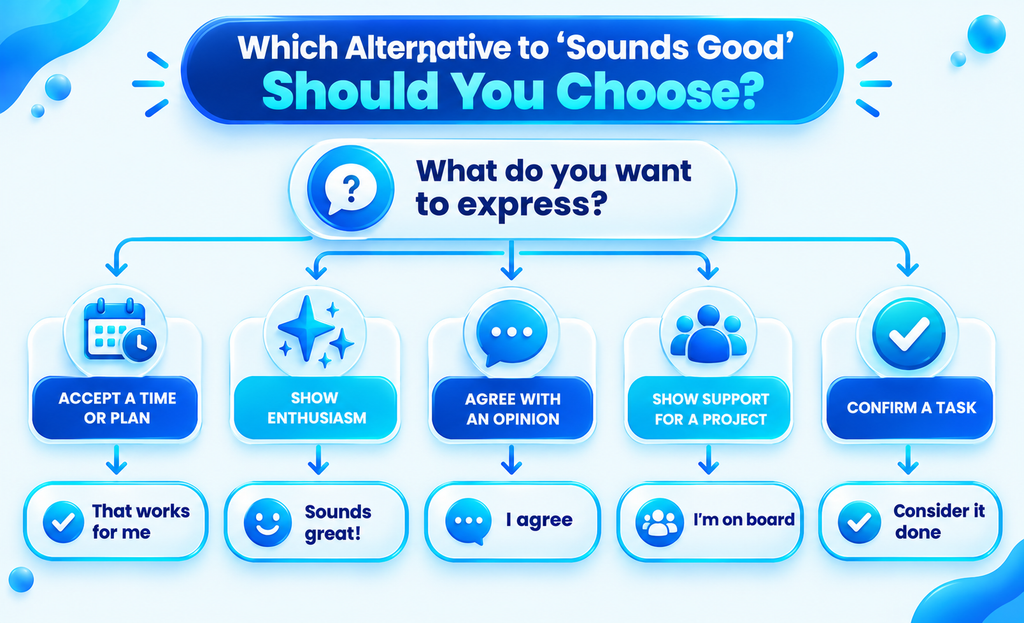
Use this comparison to find the best alternative based on your situation and intended tone.
| Alternative | Best Used In | Tone |
|---|---|---|
| That works for me | Scheduling and arrangements | Polite, practical |
| Sounds great! | Everyday conversations | Enthusiastic |
| I agree | Discussions and meetings | Direct, professional |
| Absolutely! | Requests and invitations | Confident, positive |
| That sounds perfect | Plans that suit your needs | Warm, approving |
| I’m on board | Team projects and proposals | Supportive |
| Deal! | Informal agreements | Casual, playful |
| Definitely! | Clear confirmations | Confident |
| That makes sense | Explanations and reasoning | Understanding |
| I’m good with that | Shared decisions | Relaxed, agreeable |
| Consider it done | Tasks and requests | Reassuring |
| Let’s do it | Decisions and next steps | Energetic, action-oriented |
Professional Ways to Say Sounds Good in an Email
In professional communication, your response should be clear, courteous, and appropriate for the recipient. Although “sounds good” is acceptable in many workplace emails, some alternatives communicate your agreement more precisely.
Here are five professional options.
1. That works for me.
Use this expression to confirm a schedule or arrangement.
Example: “Tuesday at 11 a.m. works for me. I look forward to our discussion.”
2. I agree with the proposed plan.
Choose this phrase when you support a strategy, decision, or recommendation.
Example: “I agree with the proposed plan and am ready to move forward.”
3. That sounds reasonable.
Use this expression when a suggestion seems practical and appropriate.
Example: “That sounds reasonable. Let’s review the timeline before finalizing the details.”
4. I can make that work.
This phrase communicates flexibility and willingness to accommodate a request.
Example: “I can make that work. I’ll adjust my schedule accordingly.”
5. Thank you for confirming.
Choose this option when someone has provided details or confirmed an arrangement.
Example: “Thank you for confirming. I’ll attend the meeting on Thursday.”
For more workplace communication tips, see our related guide to professional and workplace language on Majestic Studio. Replace this link with the most relevant published article on your website if your homepage is not the intended destination.
Casual Ways to Say Sounds Good in Text Messages
Casual conversations allow you to use shorter, warmer, and more expressive responses. The best phrase depends on whether you are accepting an invitation, joining an activity, or confirming a plan.
Here are five useful alternatives.
- Sounds awesome! Use it when you are excited about an idea or activity.
- I’m in! Say this when you want to join an event or participate in a plan.
- Deal! Use it to accept an informal agreement.
- Perfect! Choose it when a suggestion suits you well.
- Let’s do it! Say this when you are ready to take action.
For example, if your friend texts, “Want to try that new restaurant on Friday?” you could reply, “Sounds awesome! What time should we meet?”
If someone says, “Let’s meet at the coffee shop at noon,” you can respond, “Perfect! See you there.”
These alternatives help you sound natural without making a short text message unnecessarily complicated.
Common Mistakes When Choosing Another Way to Say Sounds Good
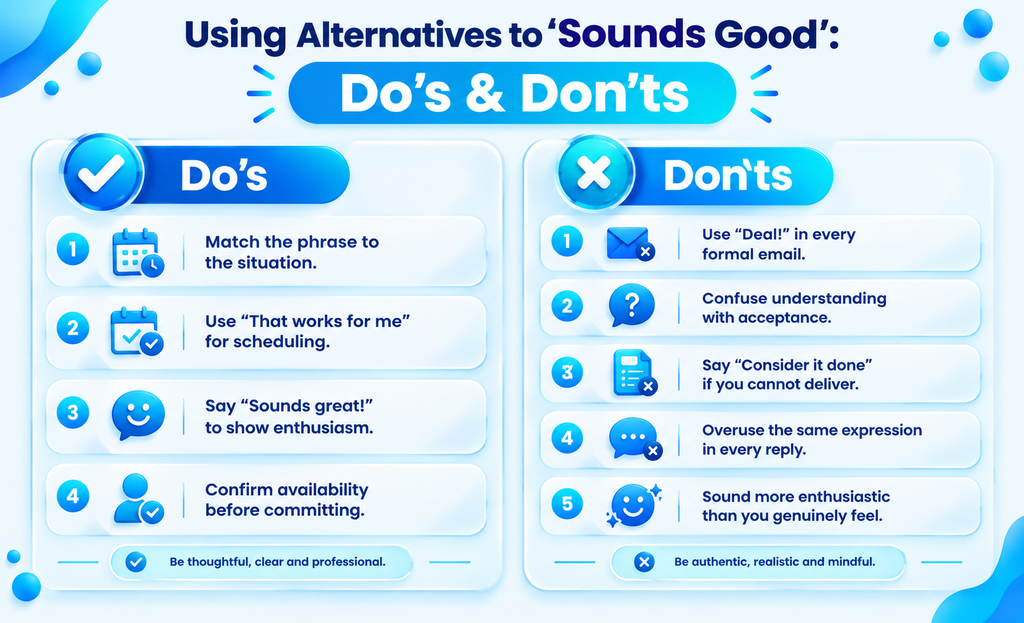
Although many expressions communicate agreement, using the wrong one can create confusion or give the wrong impression.
Avoid these common mistakes when choosing another way to say sounds good.
1. Using overly casual language in formal emails.
Phrases such as “Deal!” may sound too relaxed when communicating with a new client or senior manager. Use “That works for me” or “I agree with the proposed plan” instead.
2. Treating every alternative as interchangeable.
“That makes sense” communicates understanding, but it does not always confirm acceptance. If you agree to a meeting time, say, “That time works for me.”
3. Repeating the same expression in every conversation.
Constantly replying with “Sounds good” can make your communication feel predictable. Vary your wording according to the situation and your relationship with the other person.
4. Sounding more enthusiastic than you feel.
“Absolutely!” and “That sounds perfect” communicate strong approval. If you are uncertain, use a neutral response such as “That could work” while you consider the details.
5. Making promises too quickly.
“Consider it done” implies that you intend to complete a task. Do not use it if you cannot confidently fulfill the request.
6. Forgetting to confirm important details.
A simple “Sounds good” may acknowledge a plan without clarifying the next step. For important arrangements, confirm the date, time, deadline, or responsibility explicitly.
Frequently Asked Questions
1. What is the best professional way to say sounds good?
“That works for me” is one of the best professional alternatives because it sounds clear, polite, and natural. You can also use “I agree,” “That sounds reasonable,” or “I can make that work,” depending on the situation.
2. Is “sounds good” professional?
Yes, “sounds good” is acceptable in many workplace conversations, emails, and messages. It works especially well with familiar colleagues and during routine discussions. For formal business communication, “That works for me” or “That sounds reasonable” may sound more polished.
3. How do you say sounds good in an email?
You can write “That works for me,” “Thank you for confirming,” or “I agree with the proposed plan.” For example, “Tuesday at 11 a.m. works for me. I look forward to our discussion.” This response confirms the arrangement and maintains a professional tone.
4. What is a casual way to say sounds good?
Casual alternatives include “Sounds great,” “Deal,” “I’m in,” “I’m good with that,” and “Let’s do it.” Use “Deal” to accept an agreement, “I’m in” to join an activity, and “Let’s do it” when you’re ready to act.
5. What can I say instead of sounds good to show excitement?
Try “That sounds amazing,” “Absolutely!” or “I can’t wait!” These expressions communicate more enthusiasm than a simple acknowledgment. Choose a phrase that reflects your genuine feelings and suits the situation.
6. What is a polite way to agree with a suggestion?
“That sounds like a good idea,” “That would work well,” and “I think that makes sense” are polite ways to respond. You can also explain your agreement briefly, such as, “That sounds like a good idea. It should help us meet the deadline.”
7. Is “sounds good to me” different from “sounds good”?
The expressions have nearly the same meaning, but “sounds good to me” makes your personal agreement more explicit. Both are natural in American English and work well when accepting a suggestion or confirming a plan.
8. How should I reply when someone says sounds good?
Your reply depends on whether the conversation needs another response. You might say “Great, see you then,” “Thanks for confirming,” or “Perfect, I’ll take care of it.” If the plan is already settled, you may not need to reply at all.
Conclusion
There are many natural alternatives to “sounds good,” and the best choice depends on your audience, situation, and intended meaning. “That works for me” is a reliable option for professional emails, meetings, and scheduling. “Sounds great!” adds warmth and enthusiasm, while “I agree” clearly communicates your position during a discussion.
For casual conversations, expressions such as “Deal!” and “I’m good with that” feel relaxed and friendly. When you want to show commitment, “Consider it done” or “Let’s do it” can communicate that you’re ready to take action.
Remember that these expressions are not always interchangeable. Some confirm a plan, others show understanding, and a few create an expectation that you’ll follow through. Choose words that accurately reflect your intentions and make your response easy to understand. A thoughtful phrase can make even a short message sound more natural, professional, and confident.