

Another way to say “made up of” is composed of, consists of, consists mainly of, comprises, includes, contains, or formed from. These phrases describe the parts, people, materials, or elements that create a whole.
The best alternative depends on your sentence, tone, and context, especially in professional writing, academic work, and everyday conversation.
Key Takeaways
- Composed of works well in professional, academic, and technical writing.
- Consists of clearly identifies the parts that form a whole.
- Includes highlights the items or people present without suggesting an exhaustive list.
- Comprises offers a concise option for formal writing.
- Made from is especially useful when describing materials or ingredients.
- Choose an alternative based on meaning, sentence structure, and audience.
What Does “Made Up Of” Mean?
The phrase “made up of” describes the parts, elements, people, or materials that form something as a whole. It helps explain what something contains or how its different components fit together.
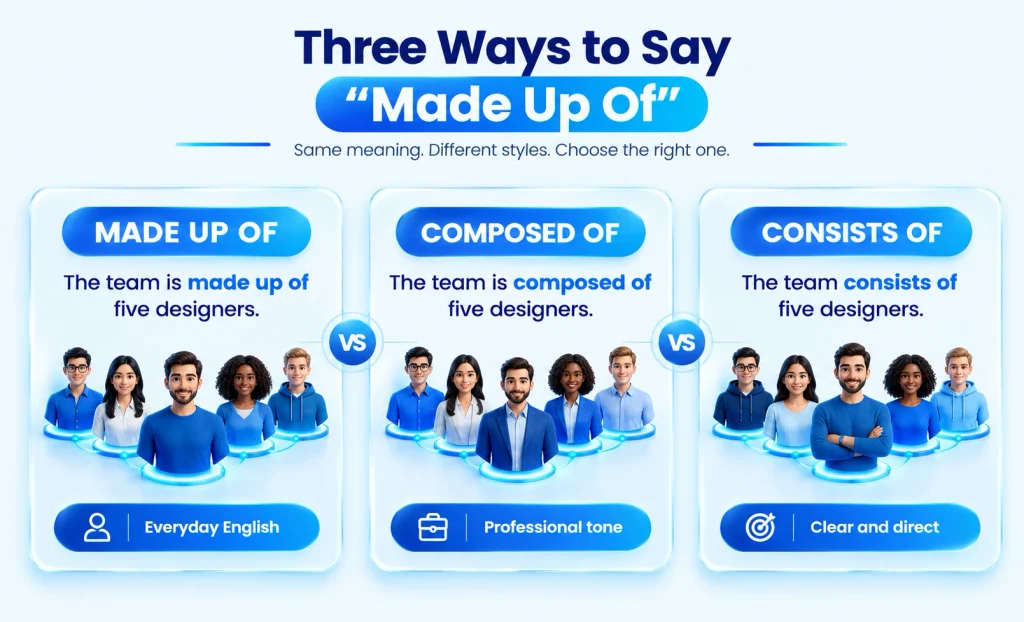
For example, “The team is made up of five designers” means five designers form the team. Similarly, “The mixture is made up of water and salt” identifies its main ingredients.
People commonly use this phrase in everyday conversation, business reports, educational writing, science, and product descriptions. Although it is clear and natural, using alternatives can make your writing more precise and less repetitive.
Why Use Other Ways to Say “Made Up Of”?
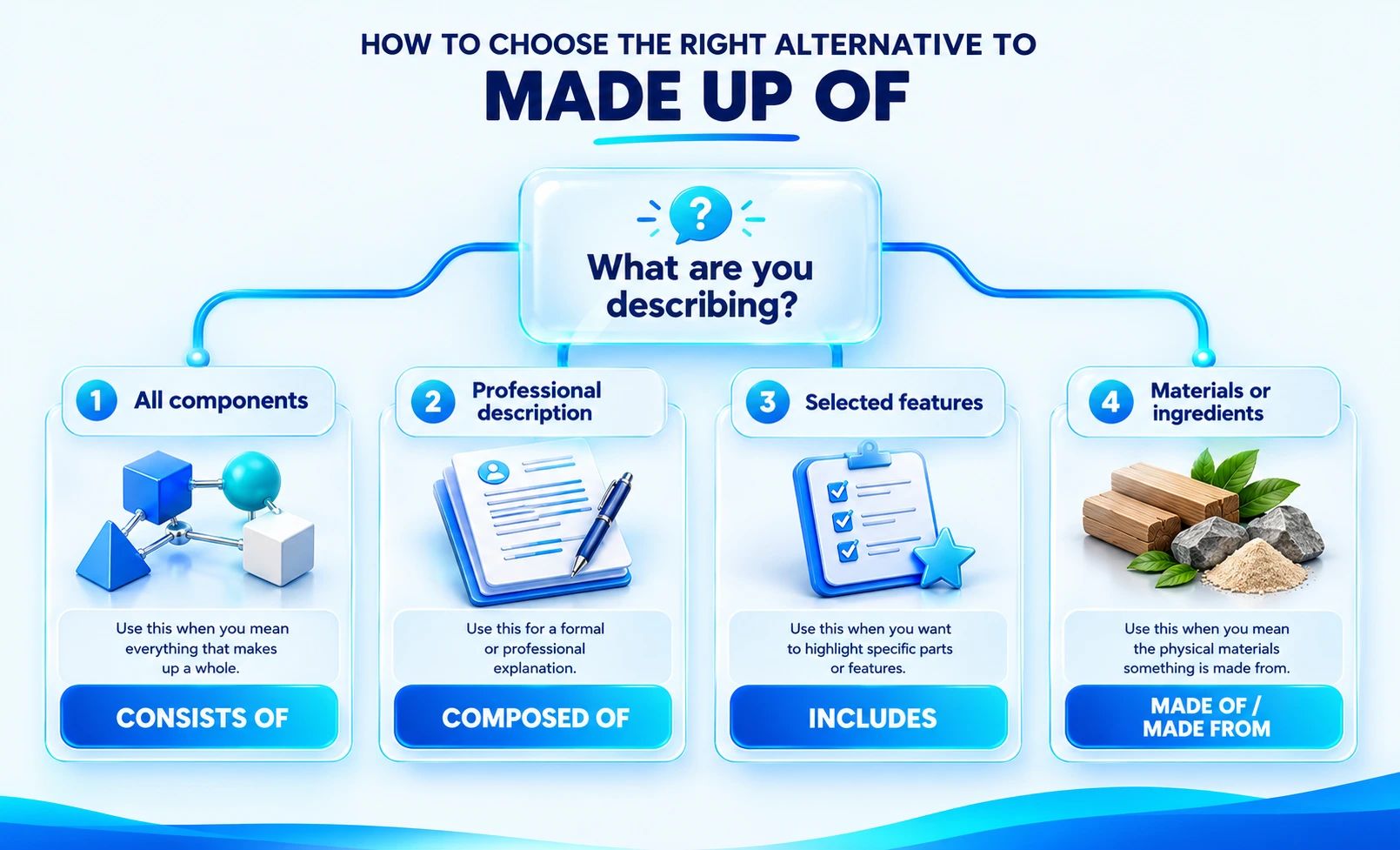
Choosing a suitable alternative helps you communicate the relationship between a whole and its parts more accurately. It also makes your writing sound more polished when you need to explain teams, organizations, materials, systems, or ideas.
Here are the main benefits:
- Avoid repetition: Keep longer articles and reports interesting.
- Improve clarity: Show whether something contains, includes, or consists entirely of certain elements.
- Sound more professional: Choose language that fits workplace emails, proposals, and academic assignments.
- Match your audience: Use straightforward expressions in casual conversations and precise wording in technical documents.
- Describe materials accurately: Distinguish between ingredients, components, and the process used to create something.
12 Best Other Ways to Say “Made Up Of”
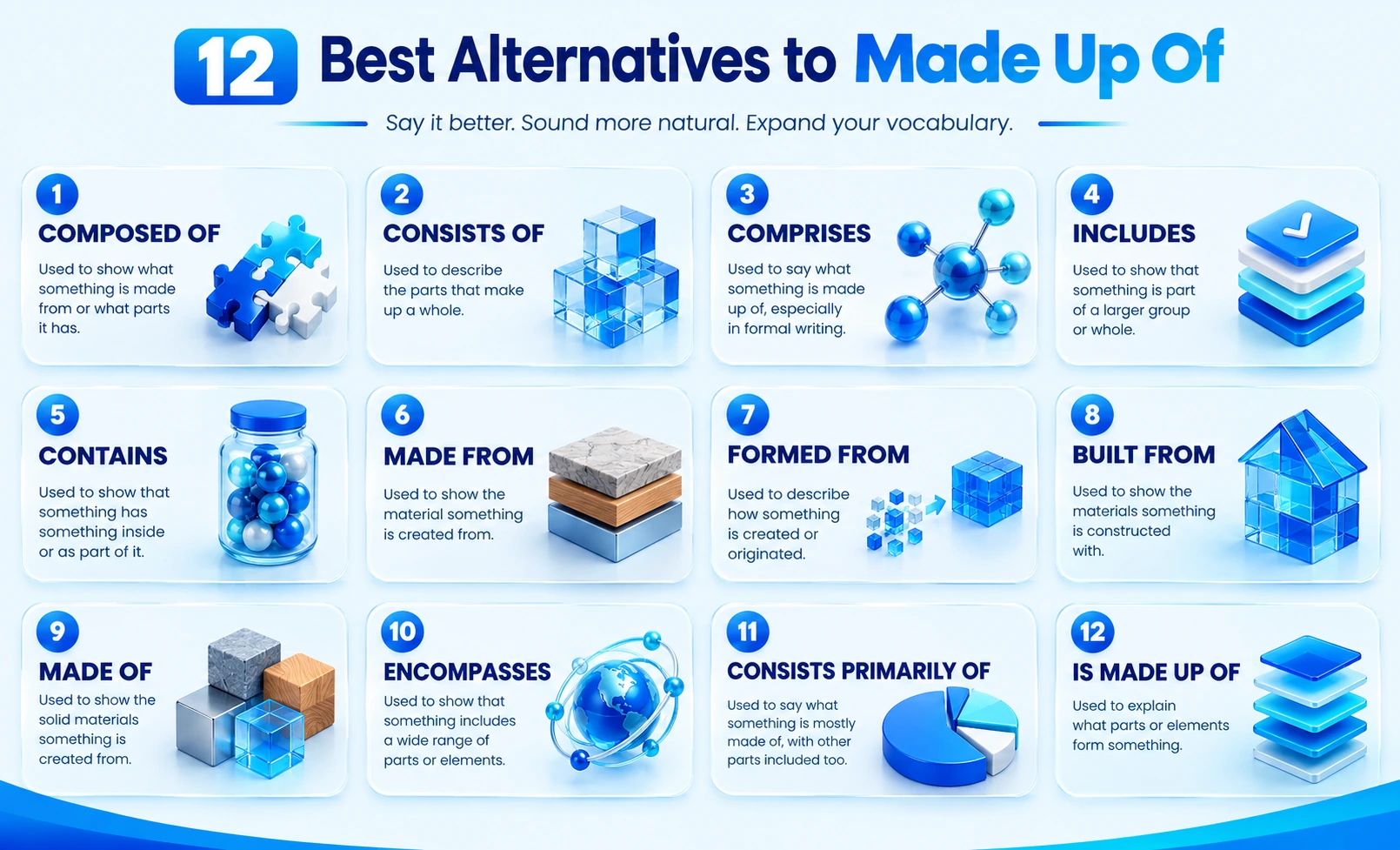
1. Composed Of
Meaning
“Composed of” means that several parts or elements combine to form a complete thing. It sounds polished and works particularly well when describing teams, systems, structures, and written works.
Best For: Professional, Formal
Example 1: The marketing department is composed of six specialists with different skills.
Example 2: The report is composed of three main sections and a detailed appendix.
Quick Tip: Use “composed of” in business reports and academic writing when you want to emphasize the components of a whole.
2. Consists Of
Meaning
“Consists of” identifies the parts or elements that form something. It is a direct, natural expression that works in both everyday and professional English.
Best For: Professional, Formal, Casual
Example 1: The training program consists of four weekly workshops.
Example 2: Her breakfast consists of oatmeal, fresh fruit, and yogurt.
Quick Tip: Use “consists of” when you want to present the main components clearly. Avoid adding “of” twice, as in “consists of of.”
3. Comprises
Meaning
“Comprises” means to include or consist of the parts that make up a whole. It is concise and especially useful in formal reports, research papers, and professional descriptions.
Best For: Professional, Formal
Example 1: The research project comprises interviews, surveys, and data analysis.
Example 2: The committee comprises representatives from eight regional offices.
Quick Tip: Use “comprises” directly before the components. In formal writing, avoid the traditional error “is comprised of” if you want the simplest, clearest construction.
4. Includes
Meaning
“Includes” indicates that something contains particular parts, features, or members. Unlike “consists of,” it does not necessarily mean the list covers every component.
Best For: Professional, Friendly, Casual
Example 1: The software package includes cloud storage, automatic backups, and customer support.
Example 2: Our weekend itinerary includes a museum visit and a walking tour.
Quick Tip: Choose “includes” when you are giving examples or highlighting selected features rather than listing every component.
5. Contains
Meaning
“Contains” means that something has particular items, substances, or elements within it. It is especially suitable for physical objects, ingredients, documents, and digital files.
Best For: Professional, Formal, Casual
Example 1: This snack contains almonds, dried cranberries, and dark chocolate.
Example 2: The downloaded folder contains all the images needed for the website.
Quick Tip: Use “contains” when the focus is on what is inside something, rather than how its parts work together.
6. Made From
Meaning
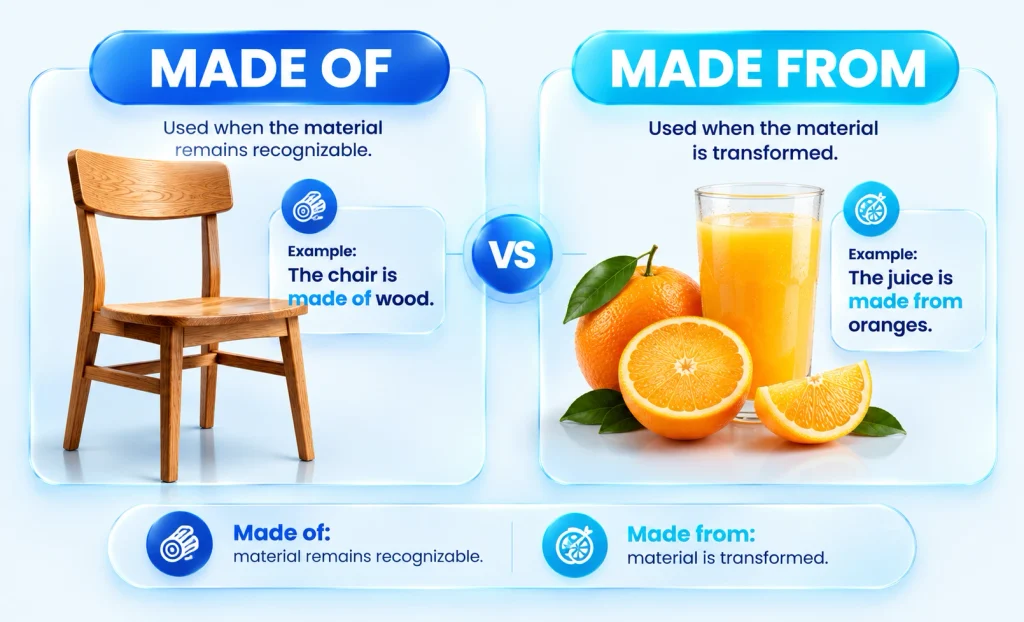
“Made from” describes the materials or ingredients used to create a product or substance. It is often more precise than “made up of” when explaining how raw materials become a finished product.
Best For: Professional, Casual, Friendly
Example 1: The packaging is made from recycled paper.
Example 2: This juice is made from freshly squeezed oranges.
Quick Tip: Use “made from” when processing transforms the original materials, such as grapes into wine or wood pulp into paper.
7. Formed From
Meaning
“Formed from” emphasizes how separate elements, materials, or parts come together to create something. It can describe physical structures, natural features, groups, or abstract concepts.
Best For: Professional, Formal
Example 1: The new partnership was formed from three smaller regional organizations.
Example 2: These rock formations were formed from layers of sediment over millions of years.
Quick Tip: Choose “formed from” when the process of creation or development matters as much as the final result.
8. Built From
Meaning
“Built from” describes something assembled or developed using specific materials, components, or ideas. It is common in construction, technology, business strategy, and discussions about systems.
Best For: Professional, Casual
Example 1: The prototype was built from lightweight aluminum and durable plastic.
Example 2: Their business model was built from years of customer feedback.
Quick Tip: Use “built from” for things that are assembled, developed, or established over time.
9. Made Of
Meaning
“Made of” identifies the materials that an object consists of, particularly when those materials remain recognizable in the finished product. It is a natural and widely used alternative in everyday English.
Best For: Casual, Friendly, Professional
Example 1: The dining table is made of solid oak.
Example 2: Her necklace is made of silver and freshwater pearls.
Quick Tip: Use “made of” for the material an object is constructed from. Compare it with “made from” when the original material undergoes a noticeable transformation.
10. Encompasses
Meaning
“Encompasses” means to include or cover a broad range of elements, activities, or ideas. It is useful when describing a subject that extends beyond a simple list of physical components.
Best For: Professional, Formal
Example 1: The role encompasses project planning, client communication, and quality assurance.
Example 2: The course encompasses several topics, from basic design principles to advanced prototyping.
Quick Tip: Choose “encompasses” when you want to emphasize the breadth or scope of a subject, responsibility, or concept.
11. Consists Primarily Of
Meaning
“Consists primarily of” indicates that most of something comes from particular parts or materials, while smaller amounts of other elements may also be present. It offers more precision than simply saying “consists of.”
Best For: Professional, Formal
Example 1: The local economy consists primarily of agriculture and small businesses.
Example 2: This skincare formula consists primarily of water and plant-based ingredients.
Quick Tip: Use this expression when the main components are more important than the minor ones. The word “primarily” signals that the list may not be complete.
12. Is Made Up Of
Meaning
“Is made up of” is the standard passive form of the original expression and can be useful when you want to describe the composition of something without changing your sentence structure. It is clear, conversational, and widely understood.
Best For: Casual, Friendly, Professional
Example 1: The volunteer group is made up of residents from across the county.
Example 2: The presentation is made up of five slides and a short demonstration.
Quick Tip: Use this expression when it sounds natural in your sentence. You do not need to replace a clear phrase just to make your writing sound more sophisticated.
Comparison Table
| Alternative | Best Used In | Tone |
|---|---|---|
| Composed of | Reports, academic writing | Professional |
| Consists of | General descriptions | Clear, neutral |
| Comprises | Formal documents | Formal |
| Includes | Features, examples, lists | Friendly, neutral |
| Contains | Ingredients, objects, files | Neutral |
| Made from | Materials, ingredients | Conversational |
| Formed from | Natural processes, groups | Formal |
| Built from | Construction, systems, ideas | Practical |
| Made of | Physical materials | Casual, neutral |
| Encompasses | Broad topics, responsibilities | Professional |
| Consists primarily of | Main components | Technical, formal |
| Is made up of | Everyday descriptions | Conversational |
Common Mistakes When Using Alternatives to “Made Up Of”
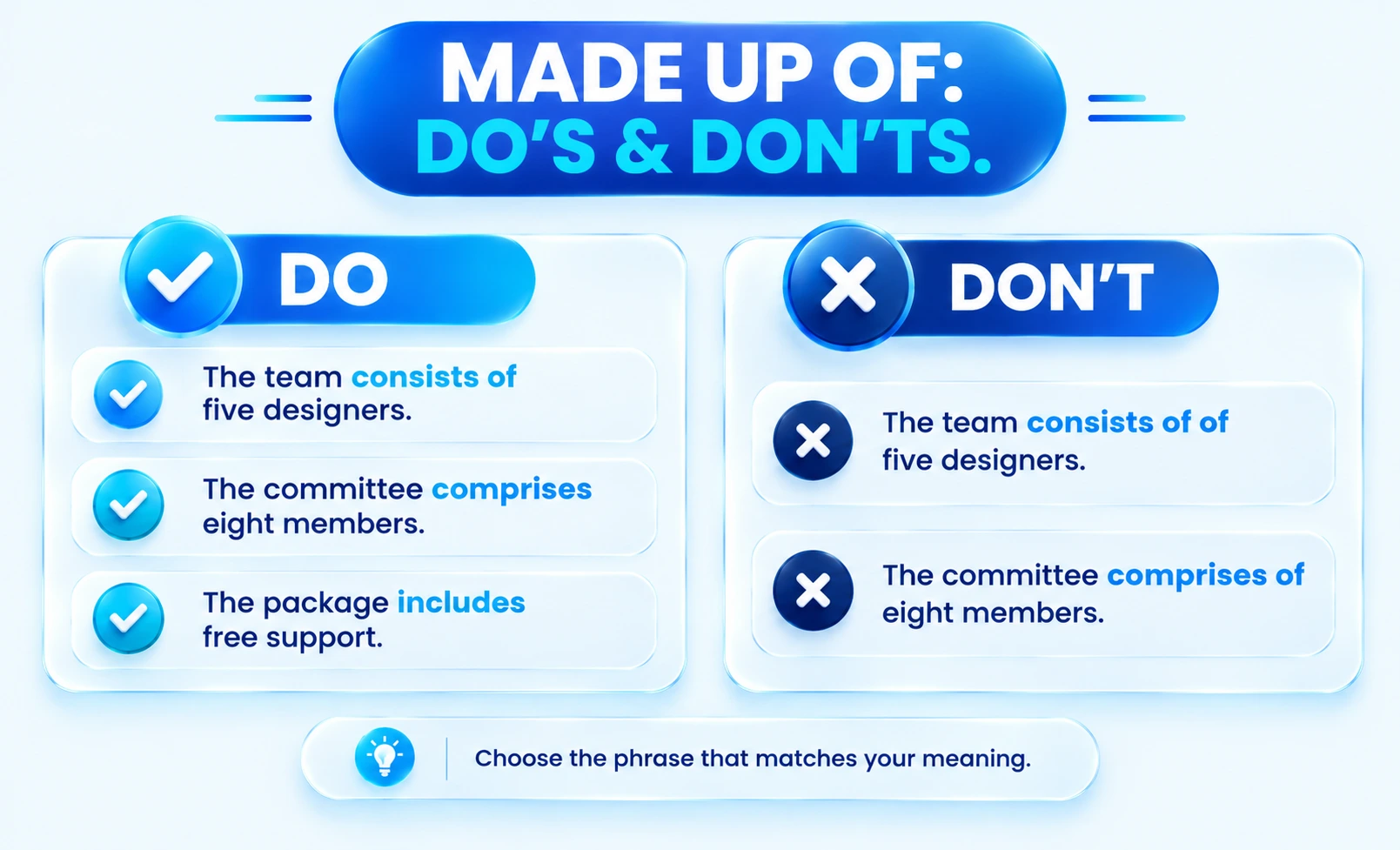
Choosing a synonym without considering the sentence can change your meaning. Avoid these five common mistakes.
1. Using “includes” when you mean every component. “Includes” can introduce only some of the parts. If you mean to identify the complete composition, “consists of” may be more precise.
2. Using casual language in formal documents. Phrases such as “made of” work in professional writing, but technical reports may benefit from “composed of” or a more specific term.
3. Using “comprises of.” In standard formal English, “comprises” takes its components directly: “The team comprises five engineers.” Alternatively, write “The team consists of five engineers.”
4. Confusing materials with components. “Made from” often emphasizes transformed materials, while “composed of” can describe distinct parts of a system. Select the phrase that reflects the actual relationship.
5. Replacing simple wording unnecessarily. A longer word is not automatically better. If “made up of” communicates your meaning clearly, keeping it may be the best choice.
Frequently Asked Questions
1. What is the best synonym for “made up of”?
“Composed of” is one of the best general alternatives because it works in professional, academic, and technical writing. However, “consists of” is often clearer when listing all the parts of something, while “includes” is better when mentioning selected features or examples. Choose the phrase that fits your intended meaning.
2. Is “composed of” the same as “made up of”?
Yes, both expressions describe the parts or elements that form a whole. For example, “The team is made up of five people” and “The team is composed of five people” communicate essentially the same idea. “Composed of” may sound more formal, but both expressions are grammatically correct and widely understood.
3. What is a formal way to say “made up of”?
“Composed of,” “comprises,” and “consists of” are strong choices for formal writing. You might write, “The study consists of three phases” or “The study comprises three phases.” These expressions work well in research papers, business reports, proposals, and technical documents.
4. Is “consists of” better than “includes”?
Neither expression is always better; they serve different purposes. “Consists of” generally presents the components that make up the whole, whereas “includes” can introduce only some of its components. For example, a package may include free support without consisting entirely of support services. Choose based on whether your list is complete.
5. What is the difference between “made of” and “made from”?
“Made of” often describes materials that remain recognizable in the finished object, such as a chair made of wood. “Made from” commonly describes materials that undergo a transformation, such as paper made from wood pulp. The distinction is a useful guideline rather than an absolute rule.
6. Can I use “comprises of” in a sentence?
In standard formal English, use “comprises” without “of” when introducing the components: “The panel comprises seven members.” If you prefer to use “of,” write “The panel consists of seven members.” This approach avoids an unnecessary preposition and keeps your writing clear.
7. What is another way to say “made up of” in academic writing?
“Composed of,” “consists of,” and “comprises” are suitable for academic writing. For example, “The sample consists of 120 participants” clearly identifies the sample’s composition. When describing the scope of a field or theory, “encompasses” may be more appropriate. Always choose terminology that accurately represents your research.
8. What is another way to say “made up of” when describing a team?
You can say that a team is “composed of,” “consists of,” or “includes” particular people. For example, “The project team consists of two developers, a designer, and a project manager.” Use “includes” if you are highlighting some members without suggesting that you have listed everyone.
Conclusion
Finding another way to say “made up of” can help you write with greater clarity, variety, and precision. The best choice depends on what you are describing and how formal your writing needs to be.
Use “composed of” for polished professional writing, “consists of” when identifying a whole’s components, and “includes” when highlighting selected items. For materials and ingredients, “made of” and “made from” can communicate the relationship more naturally. Meanwhile, “encompasses” works well for broad topics, responsibilities, and ideas.
Remember that synonyms are not always interchangeable. Consider whether you are describing every component, a selection of features, or the materials used to create something. The best alternative is the one that preserves your meaning while making your sentence easier to understand.

Sajid Ali is a web developer and digital publisher with experience in website development, WordPress, content publishing, and digital projects. He is interested in creating useful, well-structured online resources that make information easier to discover and understand.
At Majestic Studio, Sajid focuses on website development, content publishing, SEO-focused site structure, and maintaining a clear and user-friendly reading experience. He works with a practical, research-driven approach and continuously improves content and website usability based on reader needs and search behavior.