

Another way to say dead depends on the situation and tone. Common alternatives include deceased, passed away, no longer living, late, gone, and lost their life. Use “deceased” in formal or legal contexts, “passed away” when speaking sensitively about a loss, and “no longer functioning” when referring to a device or machine.
Key Takeaways
- “Deceased” is appropriate for formal, legal, and official communication.
- “Passed away” is a gentle, respectful way to discuss someone’s death.
- “Late” describes someone who has died, especially in references to a loved one or respected person.
- “Lost their life” often appears in news reports and discussions of tragic events.
- For objects, technology, or machines, alternatives such as “no longer working” or “nonfunctional” are more accurate.
What Does “Another Way to Say Dead” Mean?
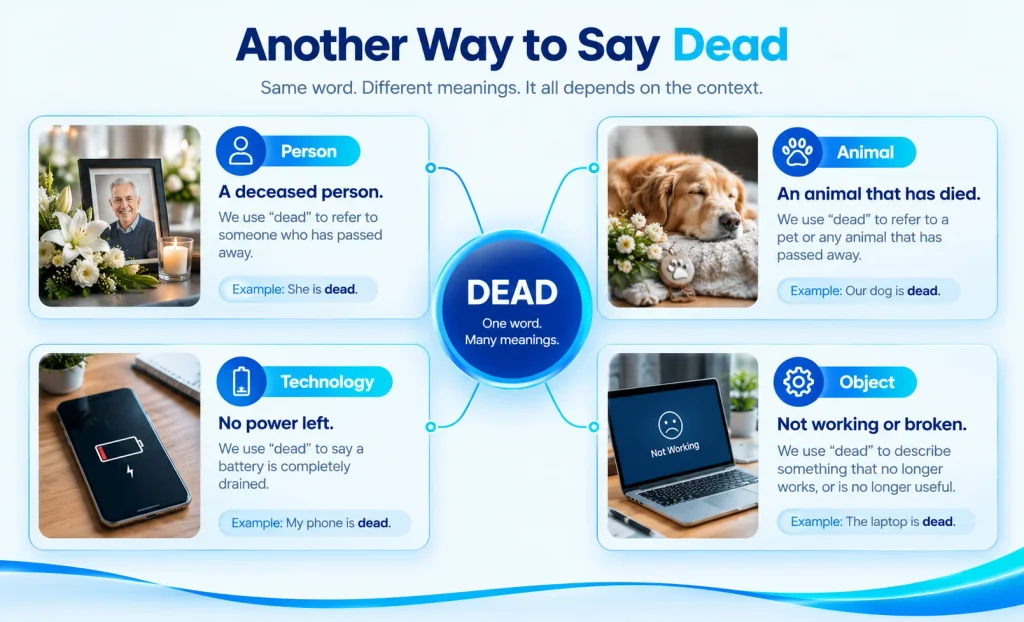
The phrase “another way to say dead” refers to alternative words and expressions that communicate death, the loss of a living being, or the end of something’s functioning. The best choice depends on the subject, audience, and situation.
People often look for alternatives to “dead” because the word can sound blunt or emotionally harsh when discussing a person’s death. Expressions such as “passed away” and “deceased” offer more sensitive or formal ways to communicate the same basic idea.
The word can also describe nonliving things, such as a dead phone battery, a dead plant, or a dead website. In these situations, phrases such as “out of power,” “withered,” and “offline” may be more precise.
Why Use Other Ways to Say “Dead”?
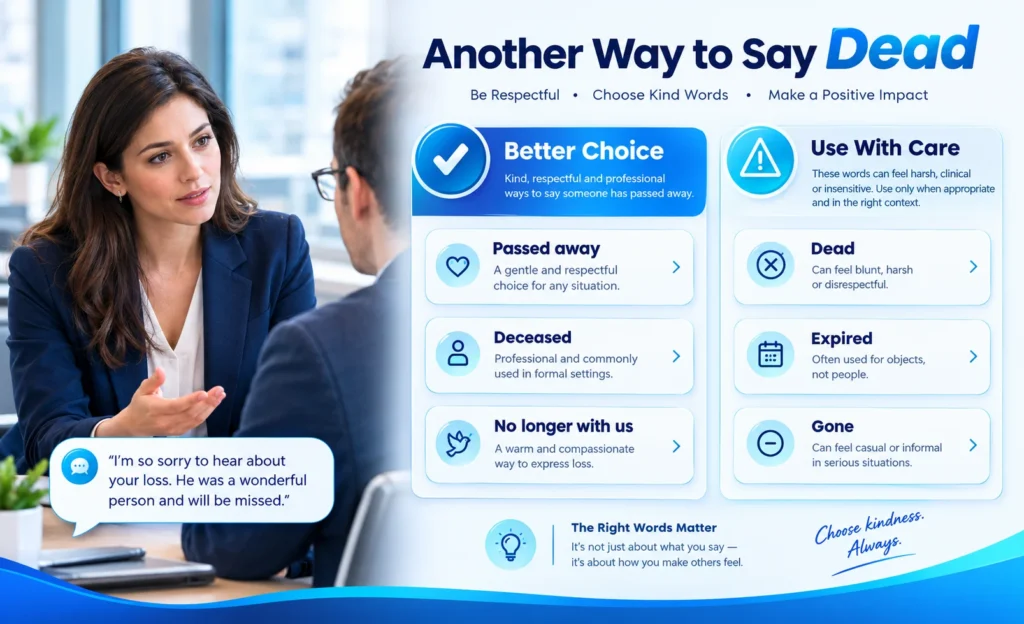
Choosing the right expression helps you communicate clearly while respecting the feelings of your audience. Although “dead” is a correct and widely understood word, it may not suit every conversation or piece of writing.
Here are several reasons to consider alternatives:
- Show compassion: Gentle expressions can make conversations about bereavement less painful.
- Maintain professionalism: Formal terms are useful in reports, records, and official correspondence.
- Avoid repetition: Different expressions can improve the flow of an article, story, or speech.
- Match the context: The best wording differs between a condolence message, a news report, and a technical explanation.
- Improve clarity: Specific terms can distinguish human death from a machine that no longer works.
12 Best Other Ways to Say “Dead”
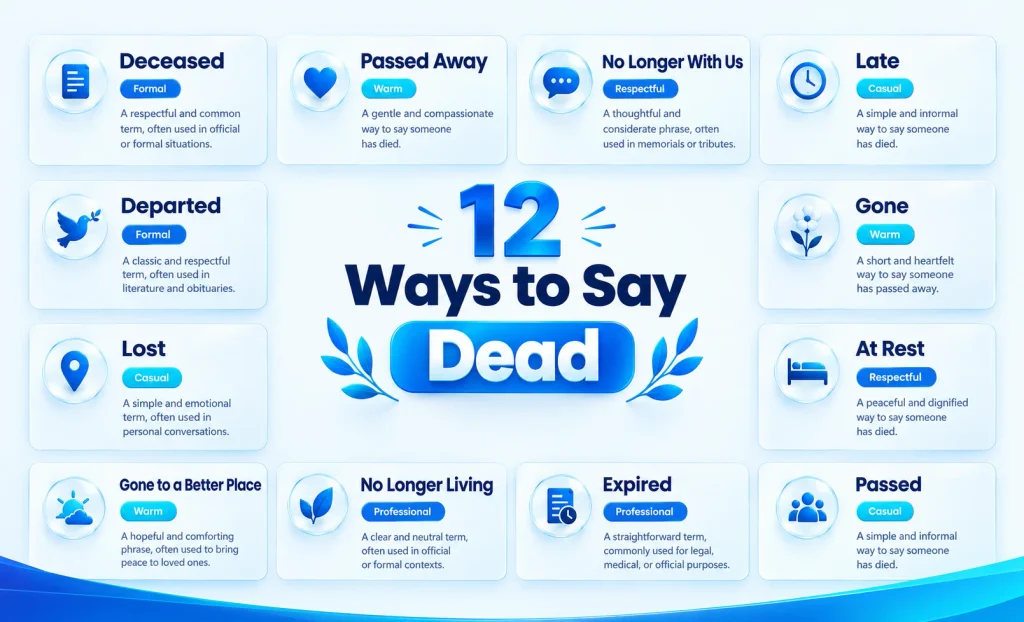
1. Deceased
Meaning
“Deceased” is a formal adjective that means a person has died. It is common in legal documents, official records, medical paperwork, and professional communication.
Best For
- Professional
- Formal
- Polite
Example 1
“The deceased person’s family has been notified of the arrangements.”
Example 2
“Please provide the full name of the deceased on the required form.”
Quick Tip
Use “deceased” when accuracy and formality matter more than emotional warmth. In a personal conversation, “passed away” may sound more compassionate.
2. Passed Away
Meaning
“Passed away” is a gentle expression meaning that someone has died. It is widely used in everyday American English, especially when speaking to family members, friends, or people experiencing grief.
Best For
- Friendly
- Warm
- Polite
Example 1
“My neighbor told me that her grandfather passed away peacefully last night.”
Example 2
“We were saddened to hear that your former teacher passed away.”
Quick Tip
Choose this expression for condolence messages and sensitive conversations. It communicates the loss without sounding unnecessarily blunt.
3. No Longer Living
Meaning
“No longer living” states that a person or other living organism is not alive anymore. It is a straightforward alternative that can sound less abrupt than “dead” while remaining clear.
Best For
- Formal
- Polite
- Professional
Example 1
“The historical records confirm that both individuals are no longer living.”
Example 2
“The family tree identifies several relatives who are no longer living.”
Quick Tip
This phrase works well in factual explanations, family histories, and educational writing. Avoid it when a warmer, more personal expression would better suit the conversation.
4. Late
Meaning
“Late” is commonly placed before a person’s name or title to indicate that the person has died. It is especially useful when referring respectfully to someone who is no longer alive.
Best For
- Formal
- Professional
- Polite
Example 1
“The late Dr. Harris established the community health program in 1985.”
Example 2
“Her late husband always encouraged her to pursue her dreams.”
Quick Tip
Use “late” before a noun, as in “the late professor” or “my late aunt.” Do not confuse this meaning with being behind schedule.
5. Gone
Meaning
“Gone” is an informal expression that can suggest someone has died, particularly when the meaning is clear from the conversation. It may communicate sadness, affection, or a sense of absence.
Best For
- Casual
- Friendly
- Warm
Example 1
“Even years after he was gone, his kindness remained part of our family stories.”
Example 2
“She still visits the garden where her beloved dog is gone from her daily life.”
Quick Tip
Use “gone” carefully because it can also mean absent or missing. In sensitive situations, “passed away” is usually clearer and less likely to be misunderstood.
6. Lost Their Life
Meaning
“Lost their life” is an expression commonly used when someone dies in an accident, disaster, conflict, or other tragic event. It often emphasizes the circumstances or seriousness of the loss.
Best For
- Formal
- Professional
- Polite
Example 1
“Several passengers lost their lives in the highway collision.”
Example 2
“The firefighter lost his life while rescuing residents from the burning building.”
Quick Tip
This expression is especially useful in news reports and factual accounts of tragedies. For an individual condolence message, “passed away” may feel more personal.
7. Perished
Meaning
“Perished” means to die, often under dangerous, harsh, or tragic circumstances. It appears frequently in historical accounts, disaster reporting, and literary writing.
Best For
- Formal
- Professional
Example 1
“Many explorers perished during the expedition across the frozen landscape.”
Example 2
“The ancient records describe how travelers perished during the severe famine.”
Quick Tip
Reserve “perished” for serious or dramatic situations. It can sound overly intense when describing an ordinary death or speaking casually about a loved one.
8. Departed
Meaning
“Departed” is a formal or sometimes spiritual expression referring to someone who has died. The phrase “the departed” is often used when discussing people who are no longer alive.
Best For
- Formal
- Warm
- Polite
Example 1
“The ceremony included a moment of silence to honor the departed.”
Example 2
“Each year, the family gathers to remember their departed loved ones.”
Quick Tip
This expression suits memorial services, reflective writing, and certain cultural or spiritual settings. Consider your audience because it may sound old-fashioned in casual conversation.
9. No Longer with Us
Meaning
“No longer with us” is a gentle expression that indicates someone has died without stating it directly. It can be useful when discussing a loss with people who may find direct language upsetting.
Best For
- Friendly
- Warm
- Polite
Example 1
“Our beloved coach is no longer with us, but his lessons continue to guide the team.”
Example 2
“Although her parents are no longer with us, she keeps their traditions alive.”
Quick Tip
Use this expression when you want to emphasize remembrance and connection. Make sure the context is clear because the phrase can sometimes refer to absence rather than death.
10. Deceased Individual
Meaning
“Deceased individual” is a formal noun phrase referring to a person who has died. It is particularly suitable for official reports, case summaries, and administrative or legal documents.
Best For
- Professional
- Formal
Example 1
“The report lists the deceased individual’s age and place of residence.”
Example 2
“Investigators are working to identify the deceased individual.”
Quick Tip
Use this wording when a neutral, factual tone is necessary. In personal communication, it may sound distant, so choose a warmer phrase when appropriate.
11. Gone to Rest
Meaning
“Gone to rest” is a gentle, somewhat poetic expression sometimes used to refer to death. It can suggest peace and comfort, although some readers may associate it with religious or spiritual beliefs.
Best For
- Warm
- Friendly
- Polite
Example 1
“Her grandmother has gone to rest, leaving behind a lifetime of cherished memories.”
Example 2
“The family described their beloved companion as having gone to rest peacefully.”
Quick Tip
Use this phrase when its comforting tone suits the audience. Avoid presenting it as a universal expression because cultural, religious, and personal preferences vary.
12. No Longer Functioning
Meaning
“No longer functioning” means that a device, machine, system, or piece of equipment has stopped working. It is a useful alternative when “dead” describes technology or machinery rather than a living being.
Best For
- Professional
- Formal
- Casual
Example 1
“The technician confirmed that the old printer was no longer functioning.”
Example 2
“My laptop is no longer functioning after the unexpected power surge.”
Quick Tip
Use this expression for equipment and systems, not people. For a dead phone battery, “completely drained” or “out of power” may be even more precise.
Comparison Table
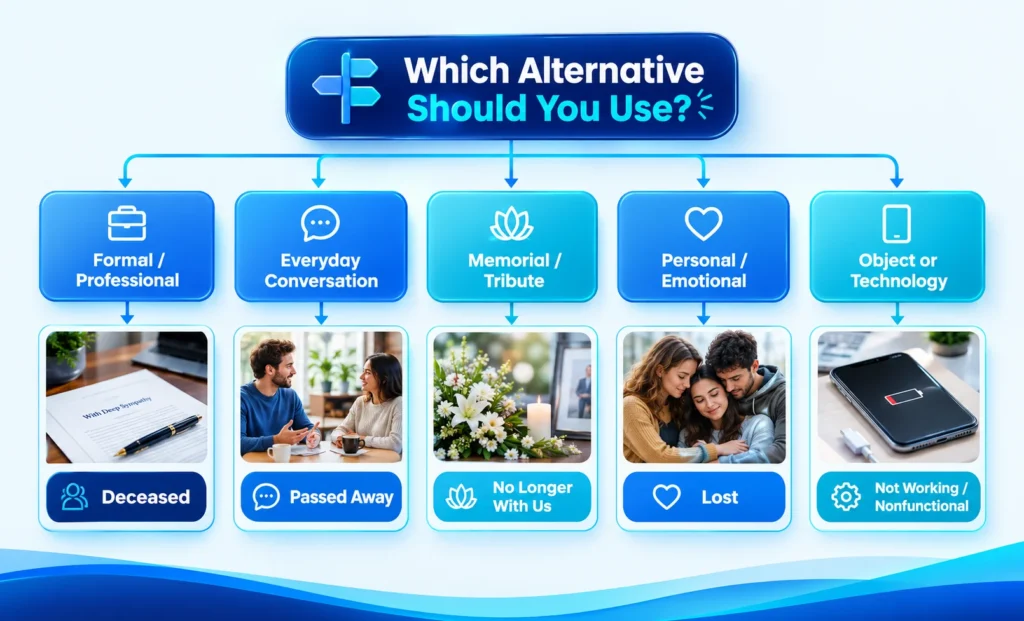
| Alternative | Best Used In | Tone |
|---|---|---|
| Deceased | Legal documents and official records | Formal |
| Passed away | Condolences and personal conversations | Gentle |
| No longer living | Factual writing and family histories | Neutral |
| Late | Names, biographies, and tributes | Respectful |
| Gone | Informal conversations and reflective writing | Casual |
| Lost their life | News reports and tragic events | Serious |
| Perished | Disasters and historical accounts | Dramatic |
| Departed | Memorials and reflective writing | Formal, solemn |
| No longer with us | Tributes and sensitive conversations | Warm |
| Deceased individual | Reports and administrative records | Professional |
| Gone to rest | Memorials and comforting messages | Poetic |
| No longer functioning | Equipment and technical explanations | Neutral |
Common Mistakes When Choosing Another Word for “Dead”

1. Using a Casual Expression in a Formal Document
Words such as “gone” may sound vague in legal, medical, or administrative writing. Choose “deceased” or another precise term that fits the document’s purpose.
2. Using Overly Formal Language in a Condolence Message
Calling a loved one “the deceased individual” can sound cold when speaking to a grieving friend. “Passed away” or a direct, heartfelt expression of sympathy is usually more appropriate.
3. Assuming Every Alternative Means Exactly the Same Thing
“Perished” often suggests a tragic or dangerous death, while “late” simply identifies someone who has died. Check the meaning and emotional tone before selecting a substitute.
4. Using Euphemisms That Create Confusion
Phrases such as “gone to rest” can be comforting, but readers may interpret them differently. If clarity is important, use a more direct expression such as “passed away.”
5. Ignoring the Subject of the Sentence
A person, a plant, a battery, and a computer system require different wording. Say a plant “withered,” a battery “ran out of power,” or a system “stopped working” when those descriptions are more accurate.
Frequently Asked Questions
1. What is the most polite way to say dead?
“Passed away” is one of the most widely used polite alternatives when referring to a person’s death. It sounds gentle without being difficult to understand. For official paperwork, “deceased” is often more appropriate, while a condolence message may benefit from a personal expression of sympathy.
2. What is a formal word for dead?
“Deceased” is a common formal alternative to “dead.” It appears in legal documents, official records, medical paperwork, and professional reports. Depending on the sentence, “late” can also work when identifying someone who has died, as in “the late Professor Williams.”
3. What is another way to say someone has passed away?
You can say that someone “has died,” “is no longer living,” or “is no longer with us.” “Passed away” remains a gentle and natural choice for everyday conversation. Select the expression according to your audience, the purpose of the message, and the level of directness you want.
4. What is a synonym for dead in a professional setting?
“Deceased” is often the best choice in a professional or administrative setting. “Lost their life” may be suitable when reporting a fatal accident or tragedy. For legal and medical documents, follow the terminology required by the organization or applicable reporting standards.
5. How do you say dead in a more sensitive way?
“Passed away,” “no longer with us,” and “departed” can communicate death more gently. The most appropriate choice depends on the person’s beliefs, the relationship you share, and the situation. In a condolence message, simple and sincere wording is often more comforting than an elaborate euphemism.
6. What is another word for dead in a news report?
News reports commonly use “died,” “was killed,” “lost their life,” or “perished,” depending on the facts. “Died” is often the clearest and most neutral option. “Was killed” indicates a death caused by another person or event, while “perished” often carries a more dramatic tone.
7. What is another way to say dead when talking about a phone or battery?
For a phone or battery, use “out of power,” “completely drained,” or “no longer functioning,” depending on the situation. For example, “My phone battery is completely drained” clearly describes a loss of charge. If the device itself has stopped working, “broken” or “nonfunctional” may be more accurate.
8. Is “passed away” better than “died”?
Neither expression is always better. “Died” is direct, clear, and appropriate in many factual or professional contexts. “Passed away” is generally softer and may feel more considerate when speaking with someone who is grieving. Choose based on the audience, purpose, and level of directness required.
Conclusion
Choosing another way to say “dead” depends on what you are describing and how you want your words to sound. For sensitive conversations about a person’s death, “passed away” and “no longer with us” offer gentle alternatives. In legal documents, official records, and professional reports, “deceased” provides a clear, formal option.
Other expressions have more specific uses. “Lost their life” works well when discussing tragic events, while “perished” often describes deaths under dangerous circumstances. If you are talking about technology, “no longer functioning” or “out of power” is more accurate than a phrase intended for human death.
Before choosing a synonym, consider your audience, the context, and the meaning you need to communicate. The best alternative is one that expresses your message clearly while showing the right level of respect, sensitivity, and precision.

Editorial contributors help develop practical English-language resources covering vocabulary, expressions, synonyms, and writing. Contributions focus on clear explanations, useful examples, and context so readers can understand not only what a phrase means, but when and how to use it naturally.