
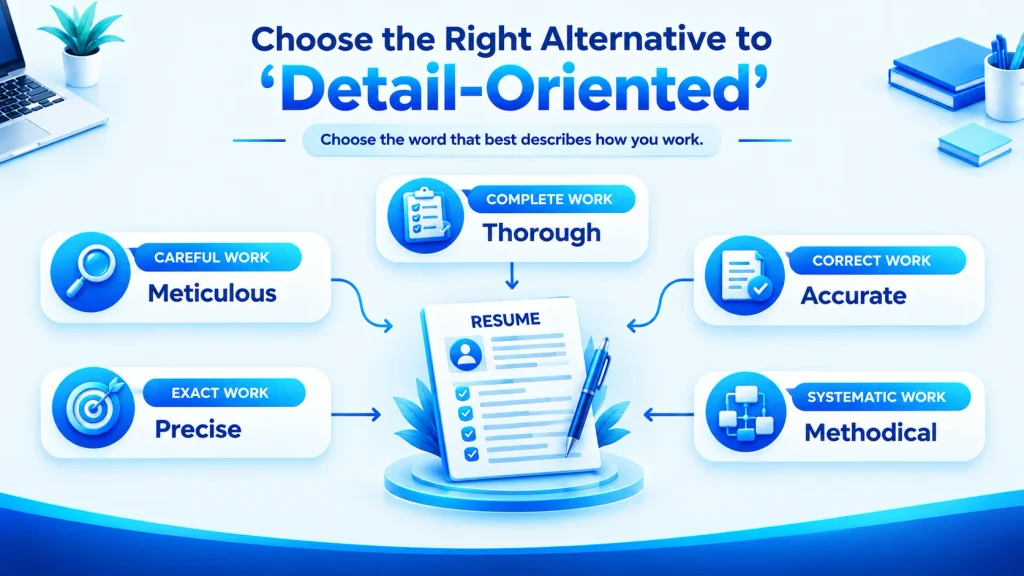
If you need another way to say detail-oriented on a resume, try words such as meticulous, thorough, precise, accurate, methodical, organized, attentive, or quality-focused. The best choice depends on your role. Whenever possible, support the phrase with a specific accomplishment that proves your attention to detail.
Key Takeaways
- Strong alternatives to “detail-oriented” include meticulous, precise, thorough, accurate, and methodical.
- Choose a synonym that matches the actual strength you want to emphasize.
- “Meticulous” works well for careful, high-standard work, while “precise” fits technical or accuracy-driven roles.
- Resume examples are stronger when they show what you did rather than simply naming a soft skill.
- Use measurable results, error reductions, accuracy rates, or quality improvements when available.
What Does “Another Way to Say Detail Oriented on a Resume” Mean?
Looking for another way to say detail-oriented on a resume usually means finding a stronger or more specific way to describe your ability to notice small details, maintain accuracy, and produce reliable work.
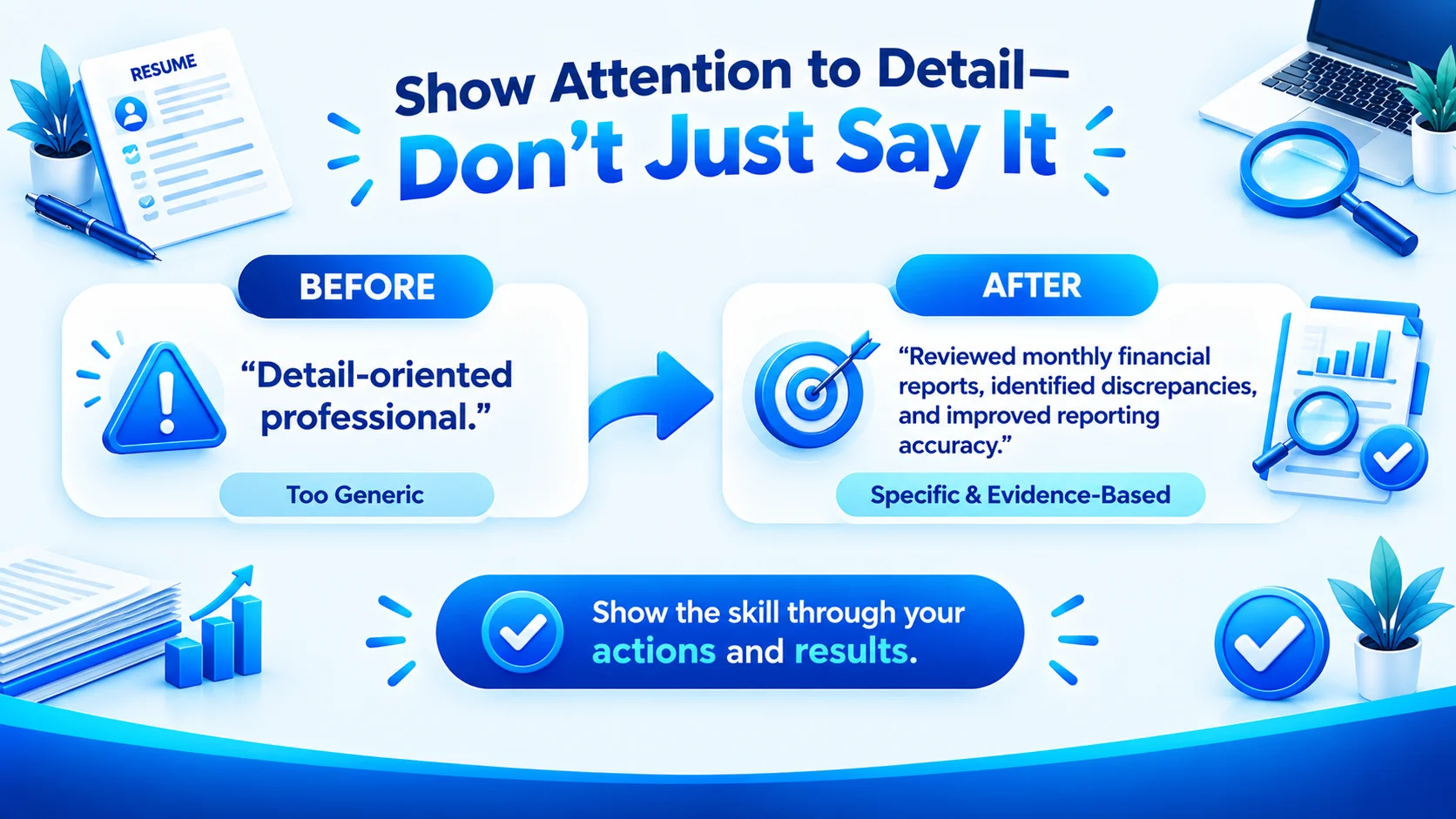
“Detail-oriented” is a legitimate resume phrase, but it is common and can sound generic when it appears without evidence. Employers generally want to see how your attention to detail improves your work, not just a claim that you possess the trait.
For example, instead of writing:
Detail-oriented administrative assistant.
You could write:
Meticulous administrative assistant who maintains accurate records and catches documentation errors before submission.
The second version gives the reader a clearer picture of your value.
Why Use Other Ways to Say “Detail Oriented on a Resume”?
Using a more specific alternative can make your resume sound more natural and better aligned with the position.
Benefits include:
- Avoiding repetition: You can vary your wording throughout your resume.
- Showing specialization: Words like “precise” or “methodical” communicate different strengths.
- Improving clarity: A targeted term can explain your work style more clearly.
- Matching the job: Different careers value different forms of attention to detail.
- Supporting your accomplishments: Specific wording makes it easier to connect the skill to measurable results.
Most importantly, don’t replace “detail-oriented” with a fancy synonym just to sound impressive. The word should accurately describe how you work and should ideally be supported by an example.
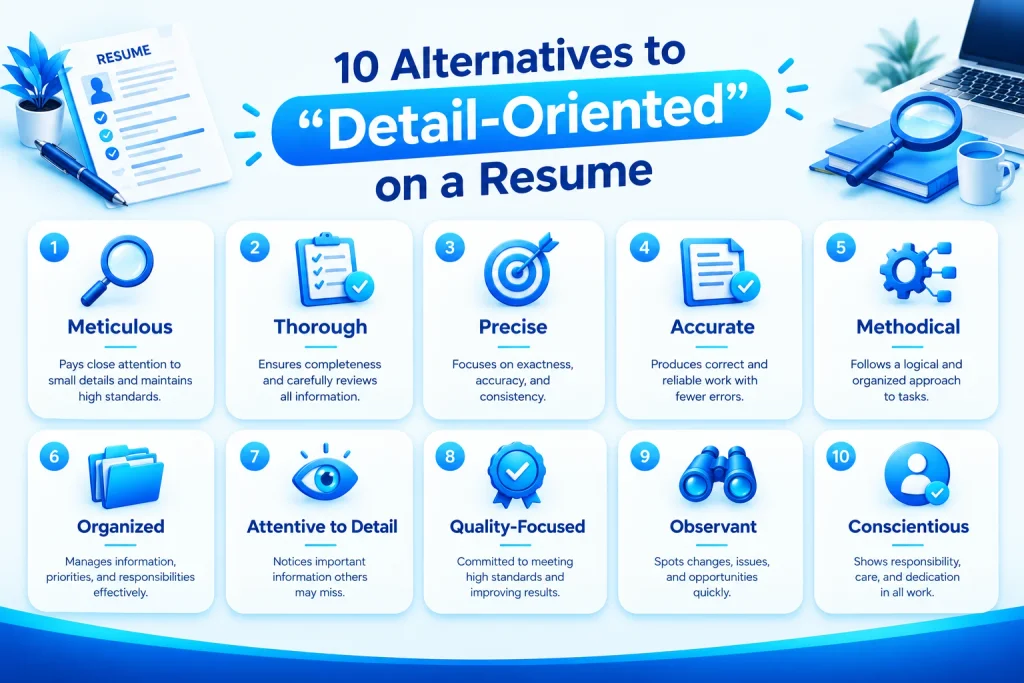
10 Best Other Ways to Say “Detail Oriented on a Resume”
1. Meticulous
Meaning
Meticulous describes someone who pays extremely close attention to small details and maintains high standards. It is one of the strongest professional alternatives when your work requires careful review or precision.
Best For
- Professional
- Formal
Example 1
Meticulous financial analyst with a strong record of reviewing reports for discrepancies.
Example 2
Meticulous project coordinator who keeps documentation accurate and deadlines organized.
Quick Tip
Use “meticulous” when your work involves careful checking, reviewing, or quality control.
2. Thorough
Meaning
Thorough emphasizes completeness and careful execution. It works especially well when you want to show that you don’t overlook important information or leave tasks unfinished.
Best For
- Professional
- Formal
- Polite
Example 1
Thorough researcher who verifies sources and organizes findings before presenting recommendations.
Example 2
Known for thorough reviews of client documents, contracts, and project requirements.
Quick Tip
Choose “thorough” when completeness matters as much as accuracy.
3. Precise
Meaning
Precise focuses on exactness, accuracy, and consistency. It is particularly effective for technical, analytical, financial, scientific, or data-focused positions.
Best For
- Professional
- Formal
Example 1
Precise data analyst experienced in identifying inconsistencies across large datasets.
Example 2
Produced precise technical documentation that improved consistency across engineering projects.
Quick Tip
Use “precise” when your job depends on exact numbers, measurements, specifications, or information.
4. Accurate
Meaning
Accurate directly communicates correctness and reliability. It is simple, professional, and useful when your work involves records, numbers, reports, transactions, or data.
Best For
- Professional
- Formal
- Polite
Example 1
Maintained accurate customer records across multiple internal databases.
Example 2
Prepared accurate monthly reports while verifying figures against source documents.
Quick Tip
“Accurate” is strongest when you can connect it to a measurable responsibility or result.
5. Methodical
Meaning
Methodical describes someone who follows a logical, organized, and consistent process. It suggests that you approach complicated tasks systematically instead of relying on guesswork.
Best For
- Professional
- Formal
Example 1
Methodical operations specialist who follows structured processes to identify workflow issues.
Example 2
Used a methodical review process to verify records before final approval.
Quick Tip
Use this word for operations, research, project management, compliance, or technical roles.
6. Organized
Meaning
Organized emphasizes your ability to manage information, priorities, files, schedules, and responsibilities effectively. It is broader than “detail-oriented,” but often more practical on a resume.
Best For
- Professional
- Casual
- Friendly
Example 1
Organized office coordinator managing schedules, records, correspondence, and vendor information.
Example 2
Kept project files organized to help teams access accurate information quickly.
Quick Tip
Choose “organized” when your attention to detail is closely connected to planning and workflow management.
7. Attentive to Detail
Meaning
Attentive to detail is a direct alternative that keeps the original meaning while sounding slightly more natural in certain resume sentences. It highlights awareness of small but important details.
Best For
- Professional
- Formal
- Polite
Example 1
Attentive to detail when reviewing customer orders, invoices, and account information.
Example 2
Attentive to detail and committed to maintaining accurate project documentation.
Quick Tip
This phrase is useful when you want to preserve the familiar meaning without repeating “detail-oriented.”
8. Quality-Focused
Meaning
Quality-focused emphasizes your commitment to producing work that meets defined standards. It shifts attention from simply noticing details to using them to improve the final result.
Best For
- Professional
- Formal
Example 1
Quality-focused production specialist committed to consistent standards and process accuracy.
Example 2
Quality-focused editor who reviews content for accuracy, consistency, and readability.
Quick Tip
This is especially useful for quality assurance, manufacturing, editing, healthcare, and operations roles.
9. Observant
Meaning
Observant highlights your ability to notice changes, inconsistencies, errors, or important information that others may overlook. It can be a strong choice when observation is central to the job.
Best For
- Professional
- Formal
- Casual
Example 1
Observant customer service professional who quickly identifies account discrepancies and customer concerns.
Example 2
Highly observant quality inspector skilled at identifying product defects during routine checks.
Quick Tip
Use “observant” when noticing problems or changes is a major part of your responsibilities.
10. Conscientious
Meaning
Conscientious describes someone who is responsible, careful, dependable, and committed to doing work properly. It communicates more than attention to detail by suggesting a strong sense of responsibility.
Best For
- Professional
- Formal
Example 1
Conscientious accounting professional committed to accurate records and timely reporting.
Example 2
Conscientious team member who follows procedures carefully and consistently meets quality standards.
Quick Tip
Choose “conscientious” when you want to emphasize both careful work and professional responsibility.
Comparison Table
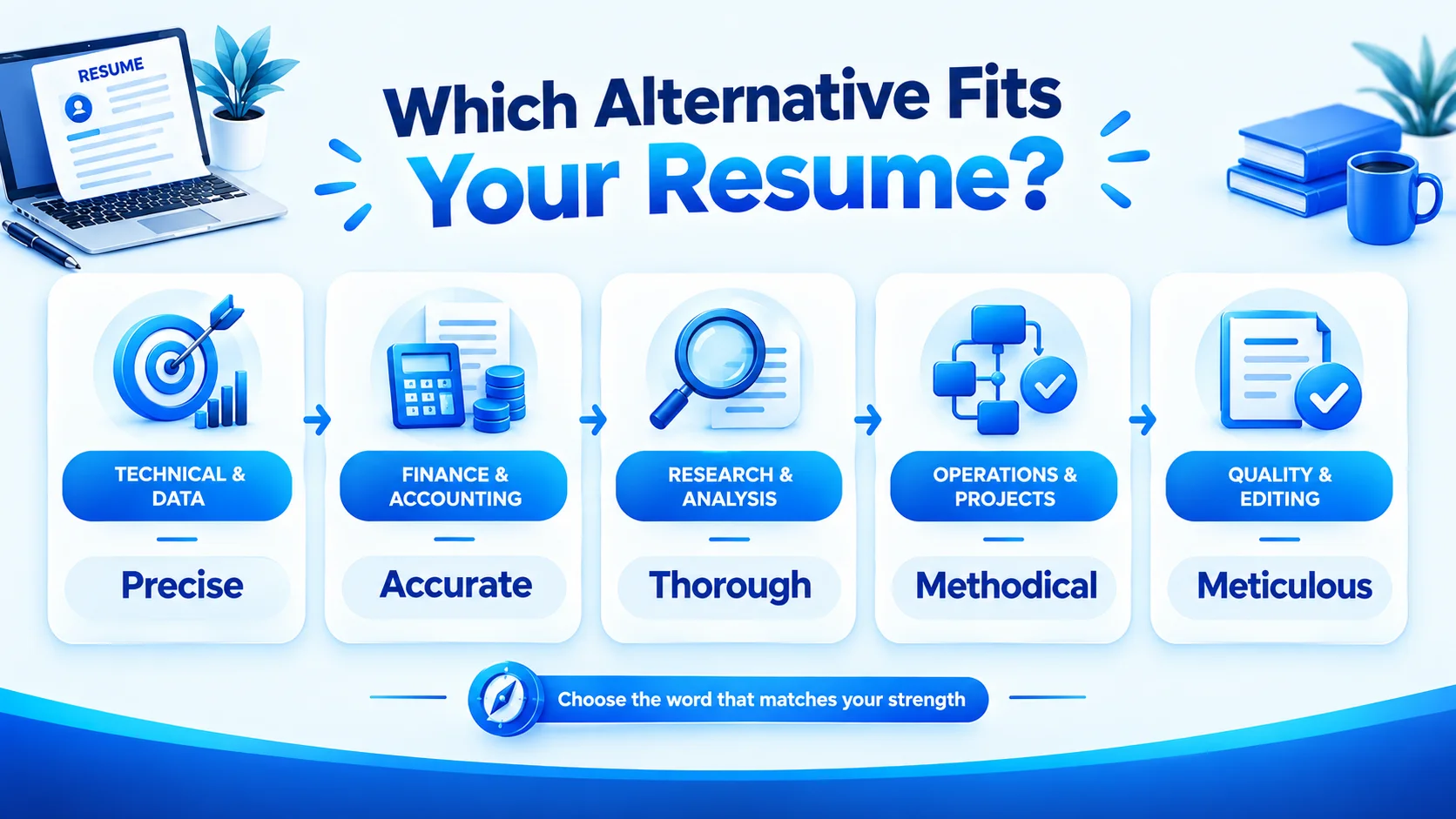
| Alternative | Best Used In | Tone |
| Meticulous | Reviews, quality control, finance | Professional |
| Thorough | Research, documentation, analysis | Professional |
| Precise | Technical, data, engineering | Formal |
| Accurate | Finance, records, administration | Professional |
| Methodical | Operations, compliance, research | Formal |
| Organized | Administration, coordination, management | Professional |
| Attentive to Detail | General professional resumes | Polite |
| Quality-Focused | QA, manufacturing, editing | Professional |
| Observant | Inspection, customer service, quality | Professional |
| Conscientious | Finance, administration, corporate roles | Formal |
Common Mistakes
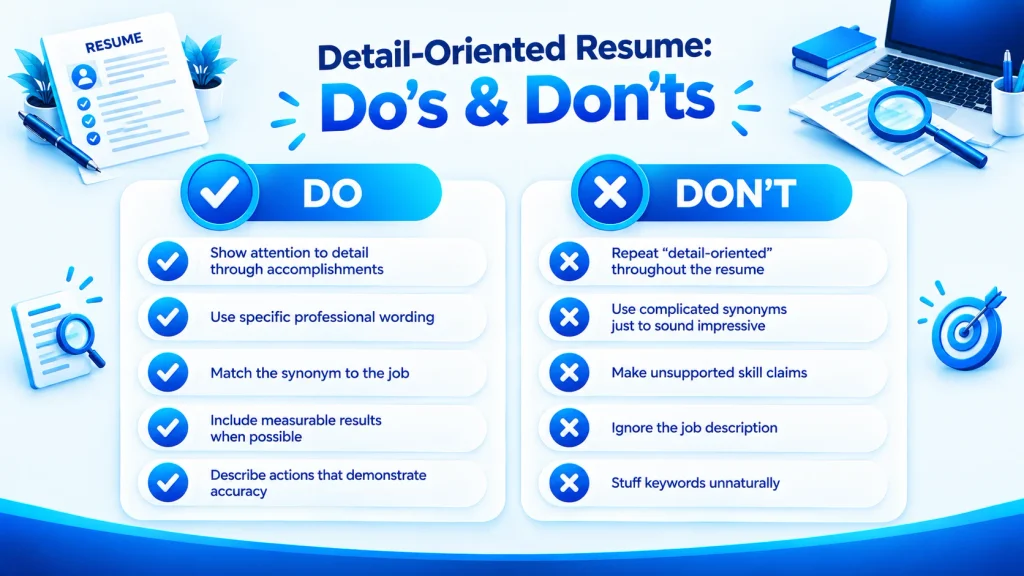
1. Using “detail-oriented” without evidence
Simply claiming that you are detail-oriented does not tell an employer how you demonstrate that skill. Add a specific task, accomplishment, or result whenever possible.
2. Choosing casual phrases for professional resumes
Expressions such as “I catch the little things” may sound natural in conversation but usually lack the professional tone expected on a resume.
3. Choosing overly formal language
Words such as “punctilious” or “scrupulous” may technically relate to carefulness, but they can sound unnatural or overly complicated in a modern resume. Simple, relevant wording is usually stronger.
4. Repeating the same phrase
Using “detail-oriented” in your summary, skills section, and every job description wastes valuable space. Vary your wording while making sure each alternative accurately reflects your experience.
5. Forgetting context
“Precise,” “organized,” and “meticulous” do not communicate exactly the same strength. Match the word to the actual job requirement instead of treating every synonym as interchangeable.
Frequently Asked Questions
What is the best word for detail-oriented on a resume?
Meticulous is one of the strongest choices when you want to emphasize careful, high-quality work. However, the best word depends on the position. “Precise” fits technical roles, “accurate” works well for finance and data, while “methodical” is useful for operations and structured processes.
Is “detail-oriented” a good skill to put on a resume?
Yes. “Detail-oriented” remains a valid professional skill, and employers value the ability to produce accurate, thorough work. However, it is stronger when supported by evidence. Instead of relying only on the adjective, describe a task where you identified errors, maintained accurate records, or improved quality.
What is a more professional way to say detail-oriented?
Professional alternatives include meticulous, thorough, precise, methodical, conscientious, accurate, and quality-focused. Select the term that best matches your experience. For example, “precise” can be particularly effective for technical work, while “conscientious” emphasizes responsibility and care.
How do I show I am detail-oriented without saying it?
Use an accomplishment that demonstrates attention to detail. For example, instead of writing “detail-oriented accountant,” write “Reconciled monthly account records and investigated discrepancies before closing.” Specific actions give employers evidence of the skill rather than asking them to take a general claim at face value.
Should I use “meticulous” on my resume?
Yes, if it accurately describes your work. “Meticulous” suggests a particularly careful approach, so it works well for roles involving editing, research, quality assurance, finance, documentation, and detailed reviews. Avoid using it simply because it sounds impressive; support it with relevant accomplishments.
What is another way to say “attention to detail” on a resume?
Useful alternatives include precision, accuracy, thoroughness, quality focus, careful review, and meticulous work. You can also rewrite the sentence to focus on an action, such as “reviewed reports for discrepancies” or “verified records before submission.”
Is “precise” better than “detail-oriented” on a resume?
It can be, depending on the job. “Precise” specifically emphasizes exactness, making it a strong choice for engineering, data analysis, finance, laboratory work, and technical positions. For broader administrative work, “organized,” “thorough,” or “meticulous” may communicate your strengths more effectively.
Should I put “detail-oriented” in my resume skills section?
You can, but don’t rely on the skills section alone. A soft skill becomes more convincing when your experience bullets demonstrate it through specific actions and results. Employers can then see how your attention to detail has actually contributed to your work.
Conclusion
Finding another way to say detail-oriented on a resume can make your application more specific and professional. Strong options include meticulous, thorough, precise, accurate, methodical, organized, attentive to detail, quality-focused, observant, and conscientious.
The best choice depends on what you actually do. Use “precise” for accuracy-driven technical work, “methodical” for structured processes, “organized” for workflow management, and “meticulous” when careful review is central to the role.
Most importantly, don’t stop at the synonym. Show the skill through your accomplishments. Instead of simply saying you are detail-oriented, explain how you verified records, caught errors, improved accuracy, maintained quality, or completed complex work. For more guidance, see how to show attention to detail on a resume. The strongest resume doesn’t just claim attention to detail—it demonstrates it.

Sajid Ali is a web developer and digital publisher with experience in website development, WordPress, content publishing, and digital projects. He is interested in creating useful, well-structured online resources that make information easier to discover and understand.
At Majestic Studio, Sajid focuses on website development, content publishing, SEO-focused site structure, and maintaining a clear and user-friendly reading experience. He works with a practical, research-driven approach and continuously improves content and website usability based on reader needs and search behavior.