

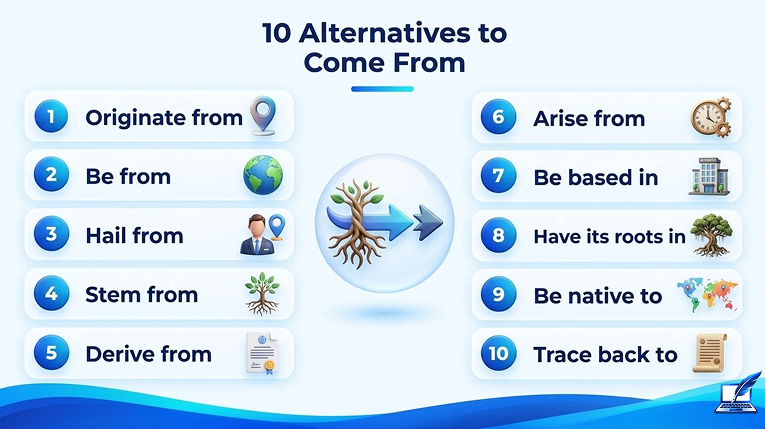
Another way to say come from depends on the context. Common alternatives include originate from, be from, hail from, stem from, derive from, arise from, be based in, have its roots in, be native to, and trace back to. The best choice depends on whether you mean a person’s location, an object’s origin, or the cause of something.
Key Takeaways
- Originate from is a clear, versatile alternative to “come from.”
- Be from works well in everyday American English when discussing people or places.
- Stem from and arise from usually describe causes or reasons.
- Hail from is natural for people, especially in introductions or profiles.
- The right phrase depends on context, tone, and what you mean by “come from.”
What Does “Another Way to Say Come From” Mean?

The phrase “come from” can describe a person’s origin, the source of an object, the starting point of an idea, or the cause of a situation. For example, you might say, “She comes from Texas,” “This cheese comes from Italy,” or “The problem comes from poor planning.”
People often search for another way to say “come from” because they want to avoid repetition, make their writing more precise, or choose language that fits a specific situation.
The phrase appears often in everyday conversations, emails, essays, business writing, biographies, academic work, and professional communication.
Why Use Other Ways to Say “Come From”?

Using different expressions can make your writing clearer and more natural. However, not every synonym works in every sentence.
Other ways to say “come from” can help you:
- Avoid repeating the same phrase.
- Make your meaning more precise.
- Adjust your tone for professional or casual writing.
- Describe origins, sources, causes, or locations more accurately.
- Make essays and business writing sound less repetitive.
- Choose wording that fits the specific context.
10 Best Other Ways to Say “Come From”
1. Originate From
Meaning
Originate from means that something began, developed, or first existed in a particular place or source. It is especially useful when talking about products, traditions, ideas, customs, or historical developments.
Best For
- Professional
- Formal
Example 1
Many traditional dishes originate from regions with rich agricultural histories.
Example 2
The company’s current design concept originated from a simple customer suggestion.
Quick Tip
Use originate from when you want to emphasize the starting point of something rather than simply state where it is located.
2. Be From
Meaning
Be from is the simplest everyday alternative to “come from.” It works especially well when talking about where a person lives, grew up, or identifies as being from.
Best For
- Casual
- Friendly
- Professional
Example 1
My new coworker is from Denver and moved here last year.
Example 2
They’re from a small town in northern Michigan.
Quick Tip
Choose be from when you want a natural, conversational expression without adding extra formality.
3. Hail From
Meaning
Hail from means to come from or have one’s origins in a particular place. It often appears in profiles, introductions, biographies, sports writing, and other descriptions of people.
Best For
- Friendly
- Formal
- Professional
Example 1
The award-winning chef hails from a coastal town in Maine.
Example 2
Several members of the band hail from different parts of California.
Quick Tip
Use hail from mainly for people or groups. It can sound more polished than “be from” but may feel slightly formal in casual conversation.
4. Stem From
Meaning
Stem from usually means that something is caused by or develops from a particular source. It is better for explaining reasons, problems, beliefs, or situations than for simply naming a person’s hometown.
Best For
- Professional
- Formal
Example 1
Most of the confusion stems from unclear instructions.
Example 2
Her interest in science stems from a childhood fascination with the natural world.
Quick Tip
Use stem from when “come from” means “be caused by” rather than “originate in a place.”
5. Derive From
Meaning
Derive from means that something is obtained, developed, or formed from another source. It works well when discussing words, materials, concepts, products, or information.
Best For
- Formal
- Professional
Example 1
The English word derives from an older term used in medieval literature.
Example 2
The supplement contains ingredients derived from natural plant extracts.
Quick Tip
Use derive from when you want to highlight the source from which something was developed or obtained.
6. Arise From
Meaning
Arise from means that something develops or happens as a result of a particular situation, condition, or event. It is common in formal and professional writing.
Best For
- Formal
- Professional
Example 1
Several questions arose from the changes to the company policy.
Example 2
The disagreement arose from different interpretations of the contract.
Quick Tip
Use arise from for issues, questions, conflicts, or situations that develop because of something else.
7. Be Based In
Meaning
Be based in describes the location where a person, organization, company, or operation is primarily located. It is not always a direct synonym for “come from,” but it works when the intended meaning is current location or operational headquarters.
Best For
- Professional
- Formal
Example 1
The software company is based in Austin, Texas.
Example 2
Our design team is based in Chicago but works with clients nationwide.
Quick Tip
Use be based in for a current location. Avoid it when you specifically mean someone’s birthplace or cultural origin.
8. Have Its Roots In
Meaning
Have its roots in means that something developed from or has a deep historical connection to a particular place, tradition, movement, or idea. It often adds a sense of history or background.
Best For
- Formal
- Warm
- Friendly
Example 1
The festival has its roots in a local harvest celebration.
Example 2
Her teaching philosophy has its roots in years of classroom experience.
Quick Tip
Choose this phrase when you want to emphasize history, background, or a long-standing connection.
9. Be Native To
Meaning
Be native to means that a plant, animal, person, language, or cultural feature naturally originated in a particular region. It is more specific than simply saying something “comes from” a place.
Best For
- Formal
- Professional
Example 1
This species is native to parts of the southwestern United States.
Example 2
Several plants native to the Pacific Northwest grow well in this climate.
Quick Tip
Use be native to for natural, geographic, or cultural origins. It is especially common in science and environmental writing.
10. Trace Back To
Meaning
Trace back to means that the history, origin, or development of something can be followed to an earlier source or time. It often works well when discussing traditions, family histories, ideas, or discoveries.
Best For
- Professional
- Formal
- Warm
Example 1
The tradition can be traced back to the early settlers of the region.
Example 2
Researchers traced the building’s design back to a much older architectural style.
Quick Tip
Use trace back to when you want to emphasize a historical connection rather than a simple point of origin.
Comparison Table

| Alternative | Best Used In | Tone |
| Originate from | Origins, products, ideas, traditions | Professional/Formal |
| Be from | People and everyday locations | Casual/Friendly |
| Hail from | People, profiles, groups | Friendly/Formal |
| Stem from | Causes, problems, reasons | Professional/Formal |
| Derive from | Sources, words, materials, concepts | Formal |
| Arise from | Issues, questions, conflicts | Formal/Professional |
| Be based in | Companies, teams, organizations | Professional |
| Have its roots in | History, traditions, ideas | Warm/Formal |
| Be native to | Plants, animals, regions | Formal/Professional |
| Trace back to | History and origins | Formal/Warm |
Common Mistakes

1. Using Casual Phrases in Professional Emails
Phrases such as “be from” are perfectly correct, but a more specific expression may suit formal writing better. Choose wording based on the subject rather than forcing a synonym into every sentence.
2. Choosing Overly Formal Language
Words such as derive from and originate from can sound stiff in casual conversation. If you are simply telling someone where you live, “I’m from Chicago” is usually more natural.
3. Repeating the Same Phrase
Using “come from” several times in a paragraph can make writing feel repetitive. Look at the exact meaning each sentence needs and replace the phrase only when another expression improves clarity.
4. Forgetting Context
Not all alternatives mean exactly the same thing. Stem from usually describes a cause, while be based in describes a current location, so swapping them without checking the meaning can create an inaccurate sentence.
5. Sounding Insincere or Unnatural
A synonym should sound like something a real person would say in that situation. Avoid replacing simple language with an impressive-sounding phrase if it makes the sentence harder to understand.
Frequently Asked Questions
What is another way to say “come from”?
Common alternatives include originate from, be from, hail from, stem from, derive from, arise from, be based in, have its roots in, be native to, and trace back to. The best choice depends on whether you are describing a person’s location, the source of something, its history, or the cause of an event.
What is a professional way to say “come from”?
Originate from, derive from, stem from, and arise from can work well in professional writing. The correct option depends on meaning. For example, “The issue stems from a communication gap” sounds natural when explaining a cause, while “The product originates from Italy” describes an origin.
What is a formal word for “come from”?
There is no single formal replacement for every use of “come from.” Originate from is often appropriate when discussing an origin, while derive from works for something developed from a source. Arise from and stem from are better when “come from” describes a cause or reason.
What is another way to say “come from a place”?
You can say be from, hail from, originate from, be native to, or have roots in, depending on the context. “Be from” is the most natural everyday option for people. “Hail from” works well in profiles, while “be native to” is common for species and geographic origins.
Is “hail from” the same as “come from”?
Hail from and “come from” can have similar meanings when describing a person’s place of origin. However, “hail from” is somewhat more polished and is common in biographies, introductions, sports articles, and profiles. It is less common in ordinary casual conversation than “be from.”
What is another way to say “come from a place” in an essay?
For an essay, consider originate from, have its roots in, trace back to, or derive from, depending on the meaning. For example, “The tradition has its roots in rural communities” provides more historical detail than simply saying “The tradition comes from rural communities.”
Can “stem from” replace “come from”?
Yes, but only when “come from” refers to a cause or source. For example, “The disagreement stems from a misunderstanding” works well. However, you would not normally say “She stems from Texas” to mean that Texas is her hometown.
What is the best synonym for “come from”?
There is no single best synonym for every sentence. Be from is usually the most natural choice for people, originate from works well for origins, stem from describes causes, and trace back to emphasizes history. Choose the phrase that matches your intended meaning.
Conclusion
The best another way to say come from depends on what you are trying to express. For everyday conversations about people, be from is simple and natural. For formal writing about origins, originate from or derive from may be more precise.
When explaining causes, stem from and arise from are stronger choices. For people and profiles, hail from adds a polished tone, while trace back to and have its roots in work well when history matters.
The key is not to replace “come from” automatically. First identify whether you mean a location, source, cause, or historical origin. Then choose the alternative that communicates that meaning clearly and naturally.
For a deeper look at the phrase, explore the meaning and uses of come from in the Cambridge Dictionary.