
Another way to say completed is finished, finalized, accomplished, fulfilled, concluded, or done. The best alternative depends on the context. Use “finalized” for official documents, “accomplished” for goals, “fulfilled” for obligations, and “wrapped up” for casual conversations. Choosing the right phrase makes your writing clearer and more natural.
Key Takeaways
- Use “finished” or “done” for everyday tasks and simple updates.
- Choose “finalized” or “concluded” for formal and professional communication.
- Use “accomplished” when highlighting a goal or achievement.
- Select “fulfilled” when referring to duties, promises, or requirements.
- Match your wording to the situation, audience, and level of formality.
What Does “Another Way to Say Completed” Mean?

The phrase “another way to say completed” refers to alternative words or expressions that communicate that something has reached its end or has been successfully finished.
People use these alternatives to make their writing more precise, avoid repeating the same word, and match the tone of a particular situation. You might need one for a work email, a project report, a school assignment, or a casual conversation.
For example, “I completed the report” could become “I finished the report,” “I finalized the report,” or “I wrapped up the report.” Each version conveys a similar idea but creates a slightly different impression.
Why Use Other Ways to Say “Completed”?
Choosing the right synonym helps you communicate clearly without making your writing sound repetitive or unnatural.
Here are the main benefits:
- Avoid repetition: Use different expressions when discussing several finished tasks.
- Sound more natural: Choose familiar words that fit everyday American English.
- Match the situation: Select professional language for business and casual wording for friends.
- Show achievement: Emphasize results rather than simply stating that something ended.
- Improve clarity: Distinguish between finishing a task, meeting a requirement, and making a final decision.
The key is to choose a phrase that preserves your original meaning instead of replacing “completed” with a word that only partly fits.
15 Best Other Ways to Say “Completed”

1. Finished
Meaning
“Finished” means that an activity, task, or piece of work has reached its end. It is one of the most common and natural alternatives to “completed.”
Best For
- Casual
- Professional
- Friendly
Example 1
“I finished the presentation before the client meeting.”
Example 2
“She finished her training course last Friday.”
Quick Tip
Use “finished” when you want a clear, simple statement without adding extra formality.
2. Done
Meaning
“Done” is a short, everyday word that indicates a task or activity is over. It works well in conversation, instant messages, and brief status updates.
Best For
- Casual
- Friendly
- Professional
Example 1
“The inventory check is done, so we can reopen the store.”
Example 2
“I’m done reviewing the applications and ready to discuss the finalists.”
Quick Tip
“Done” is ideal for quick updates, but use a more specific phrase when writing a formal report.
3. Finalized

Meaning
“Finalized” means that something has reached its final, approved, or settled form. It often suggests that the necessary reviews, edits, or decisions are complete.
Best For
- Professional
- Formal
- Polite
Example 1
“Our legal team finalized the agreement this morning.”
Example 2
“I finalized the event schedule after confirming the speakers.”
Quick Tip
Use “finalized” for documents, schedules, contracts, plans, and decisions that will not need further changes.
4. Accomplished
Meaning
“Accomplished” emphasizes successfully achieving something that required effort, planning, or skill. It highlights the result rather than simply stating that an activity ended.
Best For
- Professional
- Formal
- Warm
Example 1
“The team accomplished its main objective two weeks ahead of schedule.”
Example 2
“She accomplished her goal of earning a professional certification.”
Quick Tip
Choose “accomplished” when you want to highlight success, progress, or a meaningful achievement.
5. Fulfilled
Meaning
“Fulfilled” means that a promise, obligation, expectation, or requirement has been met. It is more specific than “finished” because it focuses on satisfying a responsibility or commitment.
Best For
- Formal
- Professional
- Polite
Example 1
“The supplier fulfilled every requirement listed in the contract.”
Example 2
“He fulfilled his promise to deliver the revised proposal by Monday.”
Quick Tip
Use “fulfilled” for commitments, obligations, promises, expectations, and contractual requirements rather than ordinary tasks.
6. Concluded
Meaning
“Concluded” means that an event, process, discussion, or period has come to an end. It often sounds more formal than “finished.”
Best For
- Formal
- Professional
- Polite
Example 1
“The negotiations concluded after three hours of discussion.”
Example 2
“Our annual review concluded with a clear plan for next quarter.”
Quick Tip
Use “concluded” for meetings, negotiations, investigations, studies, and other processes with a defined endpoint.
7. Wrapped Up
Meaning
“Wrapped up” is an informal expression meaning that an activity or piece of work has been brought to a close. It sounds conversational and approachable.
Best For
- Casual
- Friendly
- Professional
Example 1
“We wrapped up the client presentation just before lunch.”
Example 2
“I’ll send the notes once I’ve wrapped up the final edits.”
Quick Tip
This phrase works well in team chats and everyday business conversations, but avoid it in highly formal documents.
8. Completed Successfully
Meaning
“Completed successfully” confirms both that a task has ended and that it achieved the intended result. It is useful when the outcome matters as much as finishing the work.
Best For
- Professional
- Formal
- Polite
Example 1
“The system migration was completed successfully without any data loss.”
Example 2
“Our team completed the safety inspection successfully and met all required standards.”
Quick Tip
Use this phrase for project updates, technical reports, and tasks with measurable success criteria.
9. Carried Out
Meaning
“Carried out” means that a planned action, procedure, test, or instruction was performed. It focuses on doing the work rather than simply reaching the end.
Best For
- Professional
- Formal
Example 1
“The technicians carried out the equipment inspection before opening.”
Example 2
“The research team carried out three additional tests to confirm the results.”
Quick Tip
Choose “carried out” when the task involves an action or procedure. It is not always interchangeable with “completed.”
10. Executed
Meaning
“Executed” means that a plan, strategy, instruction, or operation was put into action. In business, it often highlights how work was implemented.
Best For
- Professional
- Formal
Example 1
“The marketing department executed the launch plan across all major channels.”
Example 2
“The contractor executed the installation according to the approved specifications.”
Quick Tip
Use “executed” when you want to emphasize implementation, not merely the fact that a task ended.
11. Accomplished Successfully
Meaning
“Accomplished successfully” stresses that an objective was achieved with a positive outcome. It is especially useful when reporting important milestones or results.
Best For
- Professional
- Formal
- Warm
Example 1
“The department accomplished its cost-reduction target successfully this year.”
Example 2
“Together, the volunteers accomplished the community cleanup successfully despite the rain.”
Quick Tip
This phrase can sound wordy. In most sentences, “successfully accomplished” or simply “achieved” may read more smoothly.
12. Brought to a Close
Meaning
“Brought to a close” means that an activity, discussion, or process has been deliberately ended. It often suggests a planned or organized conclusion.
Best For
- Formal
- Professional
- Polite
Example 1
“The chairperson brought the meeting to a close after addressing the final question.”
Example 2
“The company brought the review process to a close once all feedback had been considered.”
Quick Tip
Use this expression when emphasizing how an event or process ended, rather than whether a specific deliverable was finished.
13. Achieved
Meaning
“Achieved” means that a goal, target, standard, or desired result has been reached. It emphasizes the outcome instead of the activity involved in reaching it.
Best For
- Professional
- Formal
- Warm
Example 1
“Our sales team achieved its quarterly target three days early.”
Example 2
“She achieved the required score on her licensing exam.”
Quick Tip
Use “achieved” for measurable results, goals, milestones, and standards—not for every task that has ended.
14. Finalized and Approved
Meaning
“Finalized and approved” indicates that work has reached its final form and received the necessary authorization. It communicates more than completion alone.
Best For
- Professional
- Formal
- Polite
Example 1
“The revised budget has been finalized and approved by senior management.”
Example 2
“Our updated employee handbook was finalized and approved before distribution.”
Quick Tip
Use this phrase only when both finalization and approval have actually occurred. Finishing a document does not automatically mean it has been approved.
15. Signed Off On
Meaning
“Signed off on” means that an authorized person has reviewed and approved a task, document, or decision. It is common in workplace communication, especially in project management.
Best For
- Professional
- Casual
- Polite
Example 1
“The director signed off on the revised project budget yesterday.”
Example 2
“Once the compliance team signs off on the design, production can begin.”
Quick Tip
Use this phrase when approval is the important milestone. If the work is merely finished, “completed” or “finalized” may be more accurate.
Comparison Table
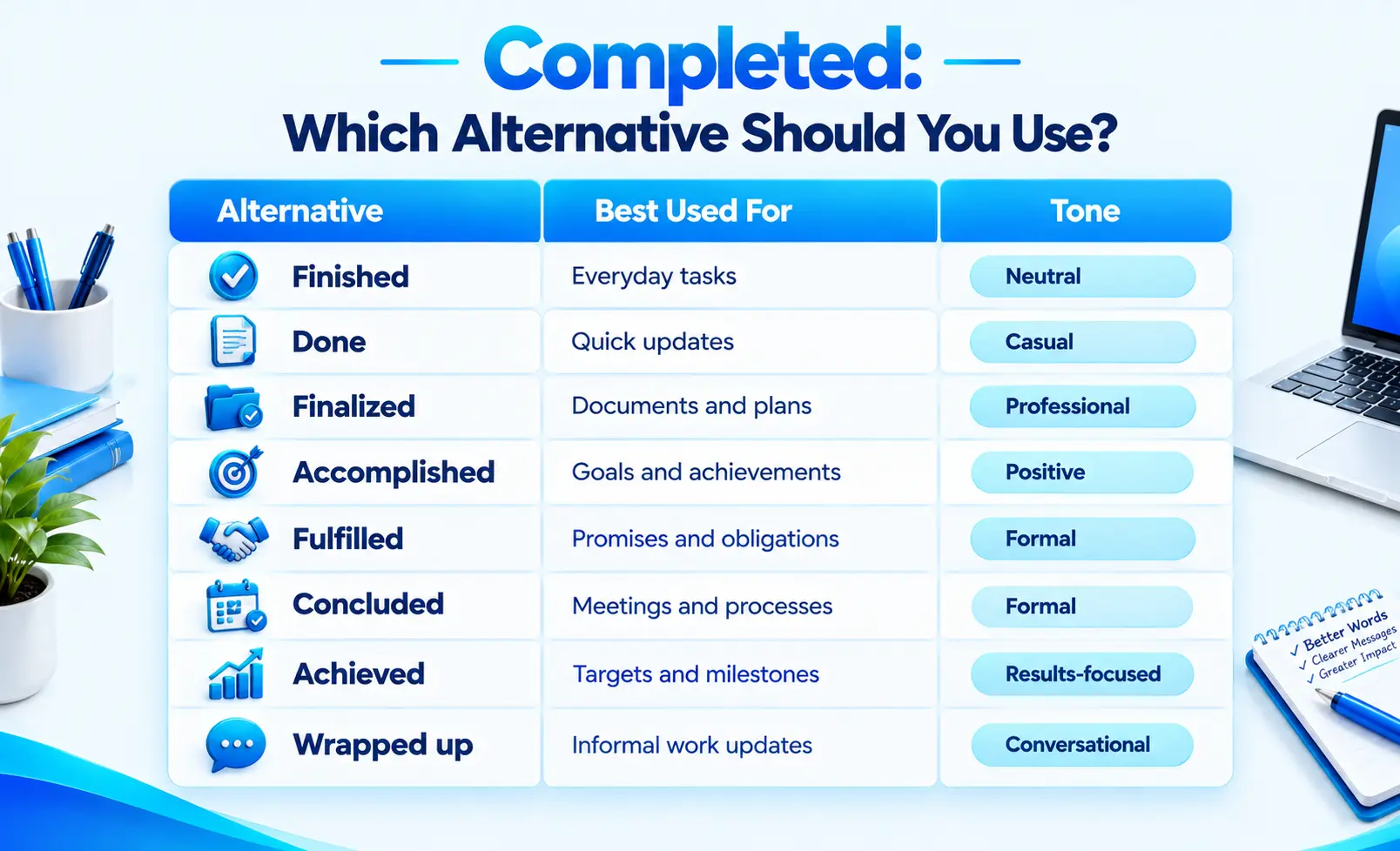
| Alternative | Best Used In | Tone |
|---|---|---|
| Finished | Daily tasks, assignments | Neutral |
| Done | Quick updates, conversations | Casual |
| Finalized | Documents, plans, agreements | Professional |
| Accomplished | Goals, achievements | Positive |
| Fulfilled | Promises, obligations | Formal |
| Concluded | Meetings, studies, negotiations | Formal |
| Wrapped Up | Team chats, informal updates | Conversational |
| Completed Successfully | Projects, technical reports | Professional |
| Carried Out | Tests, procedures, inspections | Formal |
| Executed | Plans, strategies, operations | Businesslike |
| Accomplished Successfully | Milestones, team results | Positive |
| Brought to a Close | Events, reviews, discussions | Formal |
| Achieved | Targets, goals, standards | Results-focused |
| Finalized and Approved | Authorized documents | Professional |
| Signed Off On | Reviews, approvals, projects | Workplace-friendly |
Common Mistakes

1. Using Casual Phrases in Formal Emails
Expressions such as “wrapped up” and “done” are perfectly acceptable in many workplaces, but they may sound too informal in legal documents or executive reports.
Better approach: Choose “finalized,” “concluded,” or “completed” when a more formal tone is needed.
2. Choosing Overly Formal Language
Using “concluded” for a simple household chore can make an ordinary sentence sound stiff.
Better approach: Match the language to the task. “I finished cleaning the kitchen” sounds more natural than “I concluded the kitchen-cleaning process.”
3. Repeating the Same Word Too Often
Using “completed” in every sentence can make a report or email feel repetitive.
Better approach: Vary your wording when the meaning allows it. For example, use “finished” for tasks, “achieved” for goals, and “finalized” for documents.
4. Ignoring the Context
Not every synonym means exactly the same thing. “Approved” indicates authorization, while “completed” only means that the work has reached its endpoint.
Better approach: Check whether you mean that work ended, a goal was reached, a procedure was performed, or a decision was approved.
5. Making the Message Sound Insincere
Phrases that exaggerate an ordinary result may make your writing sound unnatural. Calling a routine task a major accomplishment can distract from the actual message.
Better approach: Use straightforward wording and reserve achievement-focused language for results that genuinely deserve emphasis.
Frequently Asked Questions
1. What is the best synonym for completed?
“Finished” is one of the best general synonyms for “completed” because it is clear, familiar, and suitable for many situations. However, the best choice depends on context. Use “finalized” for documents, “achieved” for goals, “fulfilled” for obligations, and “concluded” for meetings or formal processes.
2. What is another professional way to say completed?
Professional alternatives include “finalized,” “completed successfully,” “concluded,” “carried out,” and “executed.” Choose the phrase that accurately describes the work. For example, say “finalized the proposal” when its content is settled, or “carried out the inspection” when describing a procedure that someone performed.
3. How do I say completed in an email?
For a professional email, you can write “The report is finished,” “The requested updates have been made,” or “The project has been completed successfully.” If you are reporting progress to a manager, state what you finished and mention any remaining steps. This makes your message more useful than a simple completion notice.
4. What is a formal word for completed?
“Concluded,” “finalized,” and “fulfilled” are useful formal alternatives, depending on the intended meaning. “Concluded” works well for discussions and processes, “finalized” suits documents and decisions, and “fulfilled” describes obligations or requirements that have been met. Avoid choosing a formal word simply because it sounds more sophisticated.
5. What is another way to say a task is completed?
You can say that a task is “finished,” “done,” “completed successfully,” or “wrapped up.” For a workplace status update, try “The task is complete, and the results are ready for review.” For an informal message, “All done!” may be enough. Choose wording that fits your audience.
6. What is another way to say completed successfully?
Useful alternatives include “successfully accomplished,” “achieved,” and “finished with the desired results.” The most natural choice depends on what happened. You might say a team “achieved its target,” a test “passed successfully,” or a project “was completed without issues.” Specific wording makes the result easier to understand.
7. Is completed the same as finalized?
Not always. “Completed” means that the work has been finished, while “finalized” usually means that the final details, revisions, or decisions have been settled. A document can be completed as a draft but not yet finalized. Likewise, a finalized document may still need formal approval before it can be used.
8. What is a casual way to say completed?
“Done,” “finished,” “all set,” and “wrapped up” are common casual alternatives. For example, you might text a coworker, “The slides are all set,” or tell a friend, “I finally finished my assignment.” Use these expressions when the conversation is informal and the meaning is clear.
Conclusion
Finding another way to say completed is easier when you focus on what you want to communicate. “Finished” and “done” are excellent choices for everyday tasks, while “finalized” and “concluded” fit formal documents, meetings, and professional updates. If you want to highlight a successful result, choose “achieved” or “accomplished.” For promises and responsibilities, “fulfilled” is usually more precise.
Before choosing a synonym, consider your audience, the purpose of your message, and whether the work was simply finished or also approved. These small distinctions help you avoid awkward wording and communicate more clearly.
The most useful rule is simple: choose the phrase that expresses the exact result, not just one that sounds different. Clear, natural language will always serve your readers better than unnecessary complexity.

The Majestic Studio Editorial Team creates practical resources about synonyms, alternative phrases, vocabulary, and English usage. Our content is designed to help readers choose clearer, more natural words and communicate effectively in everyday, professional, and academic contexts.
Each article is researched, edited, and reviewed for clarity, context, usefulness, and language accuracy. We regularly update our content to keep examples and recommendations relevant.