

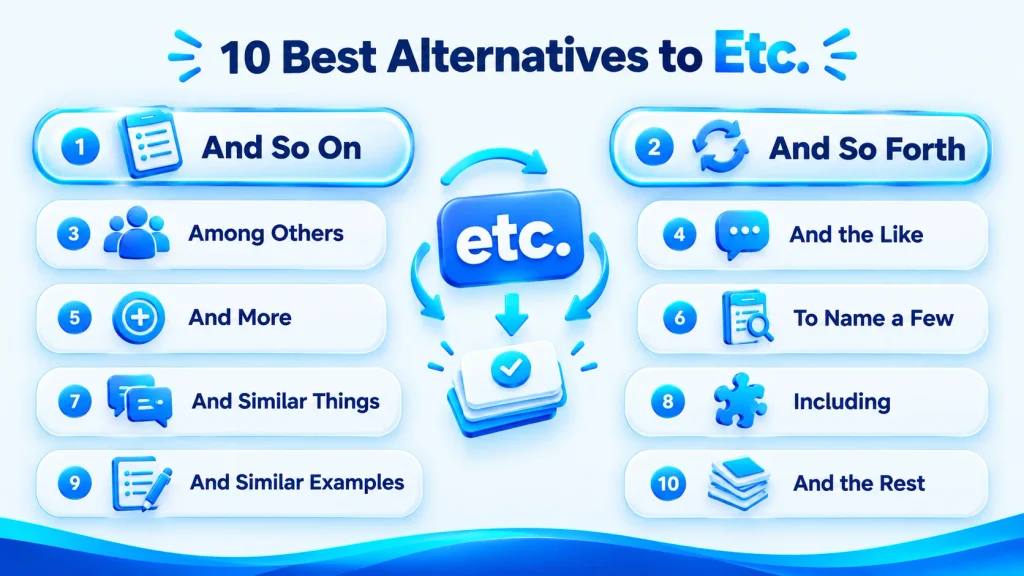
If you need another way to say etc., try and so on, and so forth, among others, and the like, and more, to name a few, and similar things, including, and similar examples, or and the rest. The best choice depends on whether you want your writing to sound casual, professional, formal, or conversational.
Key Takeaways
- And so on is one of the most natural alternatives to “etc.”
- And so forth works well in both casual and formal writing.
- Among others is useful when referring to people, organizations, or items in a group.
- To name a few makes a list sound conversational and intentionally incomplete.
- Choosing the right phrase depends on your audience, context, and level of formality.
What Does “another way to say etc” Mean?
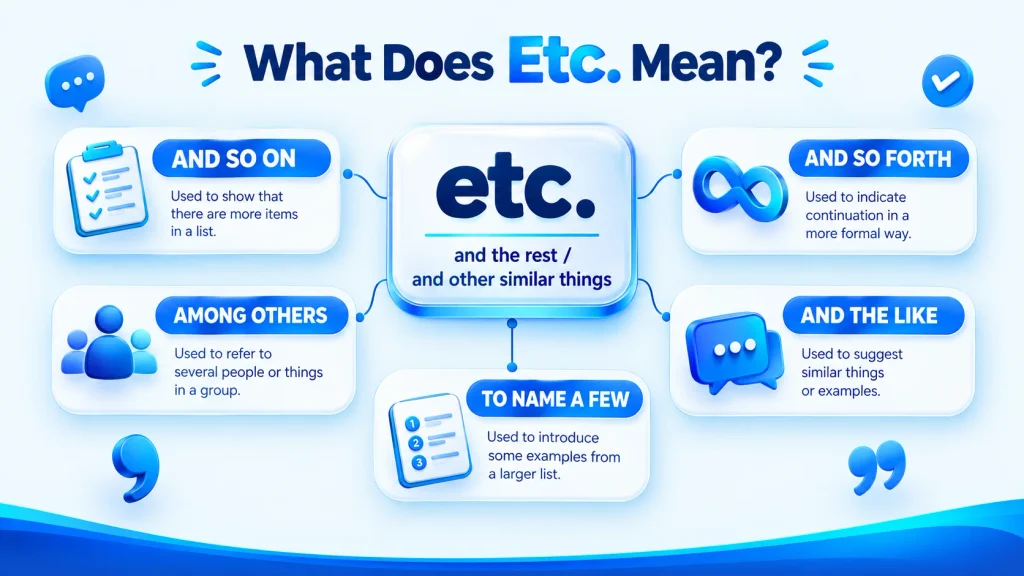
The phrase “another way to say etc” refers to different words or expressions you can use instead of “etc.” The abbreviation comes from the Latin phrase et cetera, meaning “and the rest” or “and other similar things.”
People commonly use “etc.” at the end of a list when they do not want to name every item. For example, you might write, “Bring pens, notebooks, folders, etc.” The abbreviation saves space, but repeating it too often can make writing feel vague or repetitive.
Alternative expressions can make your meaning clearer and help your writing match the situation. A professional email, academic paper, casual text, and conversation may each call for a slightly different expression.
Why Use Other Ways to Say “etc”?
Using an alternative to “etc.” can make your writing more precise, natural, and varied. It can also show readers what kind of additional items you have in mind.
Common reasons include:
- Avoid repetition: Using the same abbreviation repeatedly can make writing feel mechanical.
- Sound more natural: Expressions such as “and so on” often sound smoother in conversation.
- Match the situation: Some alternatives work better in professional or formal writing.
- Improve clarity: A specific phrase can tell readers how the list continues.
- Create a better tone: “To name a few” feels different from the more formal “among others.”
10 Best Other Ways to Say “etc”
1. And So On
Meaning
And so on means that the list continues with other similar examples. It is one of the most natural replacements for “etc.” in everyday American English.
Best For
- Casual
- Friendly
- Professional
- Polite
Example 1
We talked about travel plans, hotel options, rental cars, and so on.
Example 2
The store sells notebooks, pens, folders, and so on.
Quick Tip
Use “and so on” when the pattern in your list is already obvious to the reader.
2. And So Forth
Meaning
And so forth indicates that additional items or examples follow the ones already mentioned. It has a slightly more formal sound than “and so on.”
Best For
- Professional
- Formal
- Polite
Example 1
The report covers sales, expenses, customer retention, and so forth.
Example 2
Students should review grammar, vocabulary, pronunciation, and so forth before the exam.
Quick Tip
Choose “and so forth” when you want a polished alternative without sounding overly formal.
3. Among Others
Meaning
Among others suggests that the people, organizations, or things you named are only some members of a larger group. It works especially well when discussing notable examples.
Best For
- Professional
- Formal
- Polite
Example 1
Several major technology companies, among others, attended the conference.
Example 2
The project involved designers, developers, writers, and marketers, among others.
Quick Tip
“Among others” is particularly useful when your list contains people or groups rather than simple objects.
4. And the Like
Meaning
And the like refers to other things that are similar to the examples already mentioned. It is concise and works well when the category is clear.
Best For
- Formal
- Professional
- Polite
Example 1
The office needs paper, printer ink, folders, and the like.
Example 2
She enjoys activities such as hiking, cycling, swimming, and the like.
Quick Tip
Use this phrase when you want to emphasize similarity among the items in your list.
5. And More
Meaning
And more indicates that additional items exist beyond the examples you have named. It is short, flexible, and common in promotional or conversational writing.
Best For
- Casual
- Friendly
- Professional
- Warm
Example 1
The event will feature food, live music, games, and more.
Example 2
Our service includes design, development, maintenance, and more.
Quick Tip
“And more” works especially well in headlines, advertisements, website copy, and short descriptions.
6. To Name a Few
Meaning
To name a few tells readers that you have mentioned only a small selection from a larger group. It makes the incomplete nature of the list clear.
Best For
- Casual
- Friendly
- Professional
- Warm
Example 1
She has worked with WordPress, Shopify, Wix, and Squarespace, to name a few.
Example 2
The city offers museums, parks, restaurants, and historic sites, to name a few.
Quick Tip
Use “to name a few” when you intentionally want to highlight examples rather than provide a complete list.
7. And Similar Things
Meaning
And similar things means that other items resemble the examples you have already provided. It is straightforward and easy for most readers to understand.
Best For
- Casual
- Friendly
- Polite
Example 1
The children brought toys, books, puzzles, and similar things to the activity center.
Example 2
The website sells home decorations, candles, picture frames, and similar things.
Quick Tip
This phrase is best when the similarity between the listed items is more important than the exact category.
8. Including
Meaning
Including can introduce examples without suggesting that the examples represent the complete list. It is often clearer than “etc.” because it directly signals that other items may also be included.
Best For
- Professional
- Formal
- Polite
Example 1
The package covers several services, including hosting, backups, security, and technical support.
Example 2
We offer several payment options, including credit cards, bank transfers, and digital wallets.
Quick Tip
Use “including” before a list when you want to emphasize examples that are part of a broader category.
9. And Similar Examples
Meaning
And similar examples tells the reader that the list continues with examples that fit the same general pattern. It can be useful in explanatory or educational writing.
Best For
- Professional
- Formal
- Polite
Example 1
The lesson covers common greetings, introductions, requests, and similar examples.
Example 2
The guide explains common workplace situations, such as meetings, presentations, interviews, and similar examples.
Quick Tip
Use this phrase when discussing examples rather than physical objects or people.
10. And the Rest
Meaning
And the rest refers to everything else that belongs to the same group. It is more direct than “etc.” but should be used only when the remaining items are clear from context.
Best For
- Casual
- Friendly
- Polite
Example 1
I packed my shirts, jeans, shoes, and the rest of my clothes.
Example 2
The manager reviewed the budget, timeline, staffing plan, and the rest.
Quick Tip
Use “and the rest” when your audience can easily understand what the remaining items are.
Comparison Table
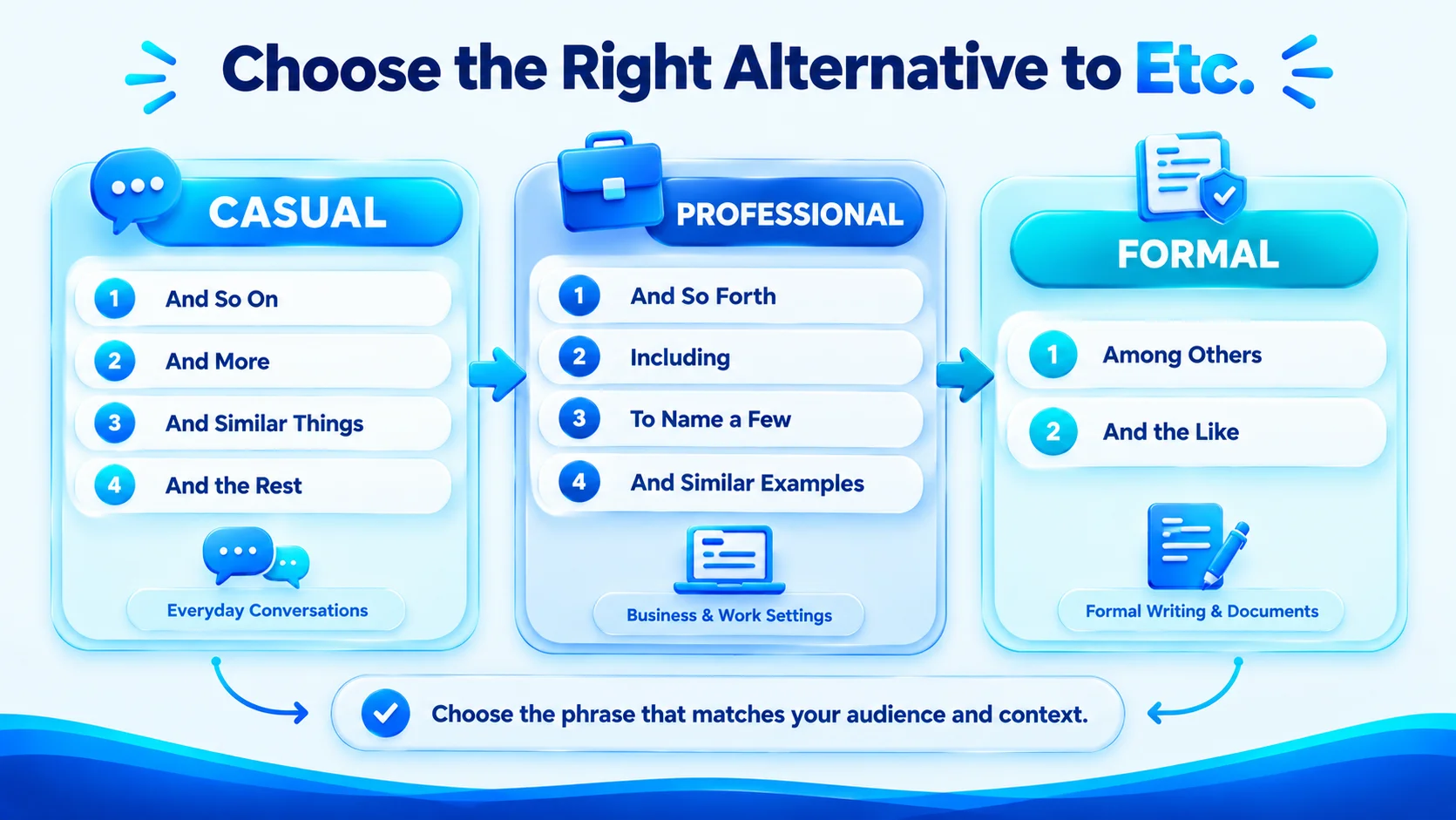
| Alternative | Best Used In | Tone |
| And so on | Conversations, general writing | Natural |
| And so forth | Reports, professional writing | Polished |
| Among others | Lists of people or groups | Formal |
| And the like | Similar categories | Formal |
| And more | Marketing, websites, casual writing | Friendly |
| To name a few | Examples and introductions | Conversational |
| And similar things | Everyday descriptions | Casual |
| Including | Professional explanations | Clear |
| And similar examples | Educational writing | Professional |
| And the rest | Clearly understood groups | Casual |
Common Mistakes
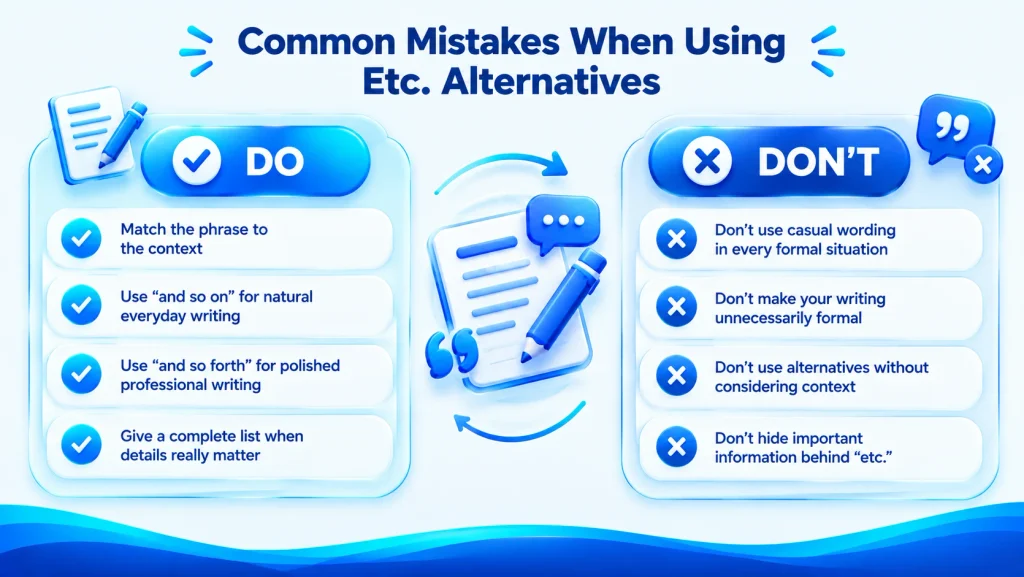
1. Using Casual Phrases in Professional Emails
Phrases such as “and the rest” may sound too informal in certain business situations. When writing a formal email or report, “and so forth” or “among others” may fit better.
2. Choosing Overly Formal Language
Not every situation requires sophisticated wording. Using “among others” in a casual text can sound unnecessarily stiff when “and so on” would be more natural.
3. Repeating the Same Phrase
Replacing “etc.” with “and so on” every time does not solve the underlying repetition problem. Vary your wording when the context supports it.
4. Forgetting Context
An alternative should clearly connect to the items before it. For example, “among others” works naturally with people and groups but may sound awkward when used for unrelated physical objects.
5. Sounding Vague
Sometimes “etc.” hides information that readers actually need. If the missing items are important, provide a more complete list instead of relying on an abbreviation or vague expression.
Frequently Asked Questions
What is the most common alternative to “etc.”?
“And so on” is one of the most common and natural alternatives to “etc.” in American English. It works well when the reader can easily understand that the list continues with similar items. It is especially useful in conversations, emails, general writing, and other everyday situations.
What is a professional way to say “etc.”?
Professional alternatives include “and so forth,” “among others,” “and the like,” and “including.” The best option depends on the sentence. “And so forth” works well for continuing a category, while “among others” is particularly useful when referring to people, organizations, or groups.
Is “and so on” the same as “etc.”?
In many situations, “and so on” has essentially the same function as “etc.” Both indicate that a list continues with additional similar items. However, “and so on” is written as a full phrase, while “etc.” is an abbreviation derived from Latin.
Can I use “and so forth” in formal writing?
Yes. “And so forth” is appropriate in many formal and professional contexts. It can sound slightly more polished than “and so on.” Still, if the additional information is important to your argument, it is usually clearer to identify the relevant items instead of ending a list vaguely.
What can I say instead of “etc.” in an email?
For a professional email, consider “and so forth,” “among others,” “including,” or “and more.” For example, “The package includes hosting, security, backups, and more” sounds natural and clear without relying on the abbreviation “etc.”
Is “to name a few” a replacement for “etc.”?
Yes, in the right context. “To name a few” tells readers that you have selected only some examples from a larger group. It is especially effective when you want to emphasize several notable examples rather than imply that the remaining items are completely unknown.
Is “among others” formal?
Yes, “among others” generally has a professional or formal tone. It is often used when naming several people, organizations, companies, or other members of a larger group. For casual writing, “and so on” or “and more” may feel more conversational.
Should I avoid using “etc.” in writing?
You do not need to avoid “etc.” completely. It is a standard English abbreviation and can be useful when the omitted items are obvious. However, replacing it with a clearer phrase—or providing a complete list—can make your writing more precise and easier to understand.
Conclusion
There are many useful ways to say “etc.”, and the right choice depends on your sentence and audience. “And so on” is a natural everyday option, while “and so forth” gives professional writing a polished tone. “Among others” works well for people and groups, and “to name a few” is useful when you want to emphasize selected examples.
For website copy and marketing, “and more” often sounds concise and inviting. In explanatory writing, “including” can make a sentence clearer by showing that the examples are part of a larger category.
The key is not simply to replace “etc.” with another phrase. Choose wording that tells readers how the list continues and fits the tone of your communication. When the omitted information matters, give a fuller list instead

Sajid Ali is a web developer and digital publisher with experience in website development, WordPress, content publishing, and digital projects. He is interested in creating useful, well-structured online resources that make information easier to discover and understand.
At Majestic Studio, Sajid focuses on website development, content publishing, SEO-focused site structure, and maintaining a clear and user-friendly reading experience. He works with a practical, research-driven approach and continuously improves content and website usability based on reader needs and search behavior.