

Another way to say “God forbid” depends on the context. Common alternatives include “heaven forbid,” “perish the thought,” “I hope not,” “let’s hope that never happens,” “may it never happen,” and “I’d hate for that to happen.” For formal or neutral writing, “I hope that doesn’t happen” is often the clearest choice.
Key Takeaways
- “Heaven forbid” is the closest common substitute for “God forbid.”
- “Perish the thought” works well when you want a dramatic or slightly old-fashioned tone.
- “I hope not” is simple, natural, and suitable for everyday conversation.
- Formal writing usually benefits from a direct phrase such as “I hope that doesn’t happen.”
- Choose your wording based on tone, audience, and whether you want to sound religious, casual, serious, or neutral.
What Does “Another Way to Say God Forbid” Mean?
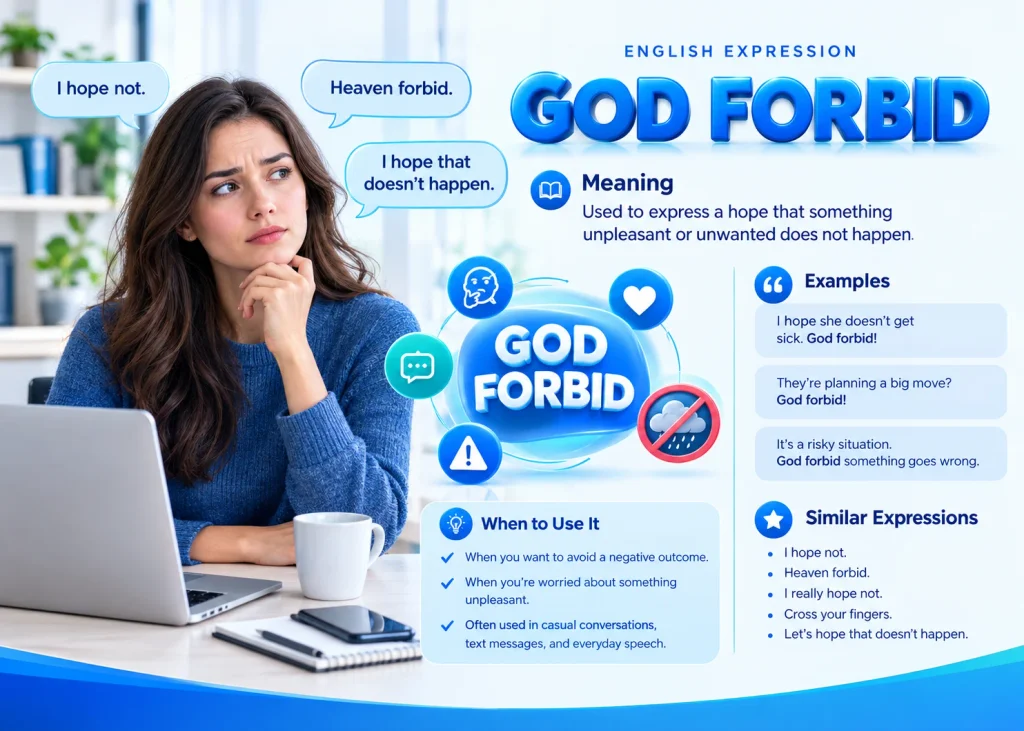
“God forbid” is an expression people use when talking about something undesirable that they strongly hope will not happen. It can express fear, concern, or a sincere wish to avoid a bad outcome.
For example, someone might say, “God forbid we miss the last flight.” The phrase is common in American English, but it has a religious reference. That is why some speakers look for alternatives that sound more neutral, casual, or appropriate for professional settings.
Why Use Other Ways to Say “God Forbid”?

Using a different expression can help you match your words to the situation. “God forbid” may sound natural among friends but may feel too religious or dramatic in certain professional or formal contexts.
Other options can help you:
- Avoid repeating the same expression.
- Sound more natural in everyday conversation.
- Choose a neutral phrase for professional communication.
- Express concern without using religious language.
- Match the seriousness of the situation.
- Make your writing clearer and more direct.
12 Best Other Ways to Say “God Forbid”

1. Heaven Forbid
Meaning
“Heaven forbid” is probably the closest common alternative to “God forbid.” It expresses a strong wish that something bad or unwanted will not happen.
Best For
- Casual
- Friendly
- Warm
- Polite
Example 1
Heaven forbid anything goes wrong during the wedding.
Example 2
Heaven forbid we ever have to deal with a situation like that again.
Quick Tip
Use “heaven forbid” when you want nearly the same meaning and emotional effect as “God forbid.”
2. Perish the Thought
Meaning
“Perish the thought” means that you strongly dislike or reject the idea being mentioned. It can sound dramatic, playful, or slightly old-fashioned depending on the context.
Best For
- Casual
- Friendly
- Warm
Example 1
Perish the thought that we might have to cancel the entire trip.
Example 2
Perish the thought of spending another weekend stuck in traffic.
Quick Tip
This phrase works especially well when you want a little personality rather than a plain statement of concern.
3. I Hope Not
Meaning
“I hope not” is a simple and natural way to express that you do not want something to happen. Unlike “God forbid,” it carries no religious reference.
Best For
- Casual
- Friendly
- Polite
Example 1
“Do you think the store will close before we get there?” “I hope not.”
Example 2
She might have forgotten the appointment, but I hope not.
Quick Tip
Choose this option when the context already makes it clear what unwanted event you mean.
4. Let’s Hope Not
Meaning
“Let’s hope not” expresses shared concern about an unwanted possibility. It sounds conversational and often feels less intense than “God forbid.”
Best For
- Casual
- Friendly
- Warm
Example 1
The forecast says there could be another storm. Let’s hope not.
Example 2
They may have to postpone the concert, but let’s hope not.
Quick Tip
Use this phrase when you want to include the listener in the hope that something does not happen.
5. May It Never Happen
Meaning
“May it never happen” expresses a strong wish that a particular negative event will never occur. It sounds more formal and serious than most everyday alternatives.
Best For
- Formal
- Polite
- Warm
Example 1
May it never happen that our community has to face another disaster like that.
Example 2
May it never happen that you have to choose between your safety and your livelihood.
Quick Tip
This phrase fits serious writing or speeches better than casual conversations.
6. I’d Hate for That to Happen
Meaning
“I’d hate for that to happen” communicates concern without sounding overly dramatic. It is a natural American English expression for situations involving an unwanted outcome.
Best For
- Casual
- Friendly
- Polite
Example 1
I’d hate for that to happen after all the work you put into the project.
Example 2
Take an umbrella—I’d hate for you to get caught in the rain.
Quick Tip
Use this phrase when you want to sound caring and personal rather than religious or dramatic.
7. Let’s Hope That Doesn’t Happen
Meaning
This phrase directly states that you hope an unwanted event will not occur. It is clear, neutral, and easy to understand.
Best For
- Professional
- Casual
- Polite
- Friendly
Example 1
The roads could become dangerous tonight, so let’s hope that doesn’t happen.
Example 2
We could run out of supplies before the shipment arrives, but let’s hope that doesn’t happen.
Quick Tip
This is a strong all-purpose replacement when you want clear language without extra emotion.
8. I Certainly Hope Not
Meaning
“I certainly hope not” adds emphasis to the basic phrase “I hope not.” It shows that you strongly wish a negative possibility will not become reality.
Best For
- Professional
- Polite
- Formal
Example 1
“Could the repairs take another month?” “I certainly hope not.”
Example 2
There is a chance the event could be canceled, but I certainly hope not.
Quick Tip
Use “certainly” when you need more emphasis while still keeping the sentence natural and restrained.
9. Hopefully That Won’t Happen
Meaning
“Hopefully that won’t happen” is a straightforward way to express concern about a possible negative outcome. It is neutral and works in many everyday situations.
Best For
- Professional
- Casual
- Polite
Example 1
The highway may be closed after the storm, but hopefully that won’t happen.
Example 2
We might have to delay the launch, although hopefully that won’t happen.
Quick Tip
This option is useful when you want to sound practical rather than emotional.
10. I Hope That Never Happens
Meaning
“I hope that never happens” communicates a strong desire to prevent or avoid a future event. It is more direct than “I hope not.”
Best For
- Casual
- Friendly
- Warm
- Polite
Example 1
I hope that never happens to another family in our neighborhood.
Example 2
Losing a close friend can be incredibly painful, and I hope that never happens to you.
Quick Tip
Use this version when the unwanted event is serious enough to deserve a clear, heartfelt statement.
11. Let’s Pray That Doesn’t Happen
Meaning
“Let’s pray that doesn’t happen” expresses a strong hope while retaining a religious reference. It can sound more emotional and serious than “let’s hope not.”
Best For
- Casual
- Friendly
- Warm
- Polite
Example 1
The river is still rising, so let’s pray that it doesn’t reach the homes nearby.
Example 2
The treatment has worked so far; let’s pray that the problem doesn’t return.
Quick Tip
Choose this phrase when a religious tone feels natural for the audience and situation.
12. I’d Rather Not Think About That
Meaning
“I’d rather not think about that” shows that an unpleasant possibility makes you uncomfortable. It does not directly express a wish in the same way as “God forbid,” but it works when you want to avoid dwelling on a negative outcome.
Best For
- Casual
- Friendly
- Polite
Example 1
What if we lose all the photos? I’d rather not think about that.
Example 2
I know the flight could be delayed overnight, but I’d rather not think about that yet.
Quick Tip
Use this alternative when the main idea is avoiding an unpleasant thought rather than making a direct wish against an event.
Comparison Table

| Alternative | Best Used In | Tone |
|---|---|---|
| Heaven forbid | Everyday conversation | Religious, expressive |
| Perish the thought | Casual conversation | Dramatic, playful |
| I hope not | Everyday speech | Simple, neutral |
| Let’s hope not | Everyday speech | Friendly, hopeful |
| May it never happen | Serious writing or speech | Formal, serious |
| I’d hate for that to happen | Personal conversations | Caring, warm |
| Let’s hope that doesn’t happen | General conversation | Neutral, practical |
| I certainly hope not | Professional or polite settings | Restrained, emphatic |
| Hopefully that won’t happen | Professional or everyday use | Neutral |
| I hope that never happens | Serious personal situations | Sincere, emotional |
| Let’s pray that doesn’t happen | Faith-based conversations | Religious, heartfelt |
| I’d rather not think about that | Casual conversations | Personal, uneasy |
Common Mistakes

1. Using Casual Phrases in Professional Emails
Expressions such as “perish the thought” can sound too conversational or dramatic in a workplace message. A phrase such as “I hope that doesn’t happen” is usually clearer and more appropriate.
2. Choosing Overly Formal Language
“May it never happen” can sound stiff in a casual conversation. Match the phrase to the relationship and setting instead of choosing the most formal option.
3. Repeating the Same Phrase
Using “God forbid” several times in one conversation or piece of writing can become repetitive. Switching to “I hope not” or “let’s hope that doesn’t happen” can make your language sound more natural.
4. Forgetting the Context
Not every alternative means exactly the same thing. “I’d rather not think about that” focuses on avoiding an unpleasant thought, while “I hope that never happens” directly expresses a wish.
5. Sounding Insincere
Dramatic phrases can seem sarcastic if the situation is serious. When discussing a sensitive subject, a direct expression such as “I sincerely hope that doesn’t happen” may communicate your feelings more clearly.
Frequently Asked Questions
1. What is the closest synonym for “God forbid”?
“Heaven forbid” is the closest common synonym because it has nearly the same meaning, structure, and emotional tone. Both expressions are traditionally used to show that you strongly hope an unpleasant or frightening event does not happen. If you want a neutral alternative without religious language, “I hope not” is a better choice.
2. Is “heaven forbid” the same as “God forbid”?
Yes, in most everyday contexts, “heaven forbid” and “God forbid” serve the same purpose. Both express a strong wish that something undesirable will not happen. The main difference is wording: “heaven forbid” refers to heaven rather than directly naming God, so some speakers may find it slightly less direct.
3. What is a non-religious way to say “God forbid”?
Good non-religious alternatives include “I hope not,” “let’s hope not,” “hopefully that won’t happen,” and “I hope that never happens.” These phrases communicate concern without making a religious reference. For professional communication, “I hope that doesn’t happen” is especially clear and natural.
4. Can I say “perish the thought” instead of “God forbid”?
Yes, but the tone is different. “Perish the thought” rejects an unpleasant idea and can sound humorous, dramatic, or old-fashioned. It works well in casual conversation but may not be appropriate when discussing a deeply serious or sensitive situation.
5. Is “God forbid” formal or informal?
“God forbid” can appear in both formal and informal speech, but it is more common in everyday conversation. Because it has a religious reference, some writers may prefer a neutral expression in professional or formal writing. The best choice depends on the audience and context.
6. How do you say “God forbid” politely?
You can say “I hope that doesn’t happen,” “I certainly hope not,” or “hopefully that won’t happen.” These expressions are polite because they communicate the same general concern without sounding overly dramatic. “I’d hate for that to happen” is another warm option for personal conversations.
7. What can I say instead of “God forbid” in an email?
For a professional email, consider “I hope that doesn’t happen,” “I certainly hope not,” or “hopefully that won’t happen.” These alternatives are direct and neutral. They also avoid the religious reference that may not fit every workplace, client relationship, or professional audience.
8. What does “God forbid” mean in a sentence?
“God forbid” means that the speaker strongly hopes something bad or unwanted will not happen. For example, “God forbid we miss the deadline” means the speaker strongly hopes they do not miss the deadline. The phrase can express concern, fear, or emphasis depending on the context.
Conclusion
There are many natural ways to say “God forbid,” and the best choice depends on the situation. If you want the closest expression, “heaven forbid” is an easy substitute. For casual conversation, “I hope not” and “let’s hope not” sound natural and straightforward.
When you need a neutral or professional expression, “I hope that doesn’t happen” or “hopefully that won’t happen” usually works well. For a warmer personal tone, try “I’d hate for that to happen.” If you want a more dramatic expression, “perish the thought” can fit.
The key is to consider your audience, tone, and intended meaning before choosing an alternative. A simple, natural phrase is often more effective than a dramatic one.

The Majestic Studio Editorial Team creates practical resources about synonyms, alternative phrases, vocabulary, and English usage. Our content is designed to help readers choose clearer, more natural words and communicate effectively in everyday, professional, and academic contexts.
Each article is researched, edited, and reviewed for clarity, context, usefulness, and language accuracy. We regularly update our content to keep examples and recommendations relevant.