

Another way to say “I don’t believe you” depends on your tone and situation. You can say “I’m not convinced,” “I have my doubts,” “I’m skeptical,” “That’s hard to believe,” or “I’m not sure I believe that.” These alternatives can sound more polite, professional, casual, or direct without changing the basic meaning.
Key Takeaways
- “I’m not convinced” is a polite and versatile alternative.
- “I have my doubts” expresses skepticism without sounding overly harsh.
- “I’m skeptical” works well in professional and serious conversations.
- “That’s hard to believe” is more direct and often used casually.
- The best phrase depends on your relationship, setting, and desired tone.
What Does “Another Way to Say I Don’t Believe You” Mean?
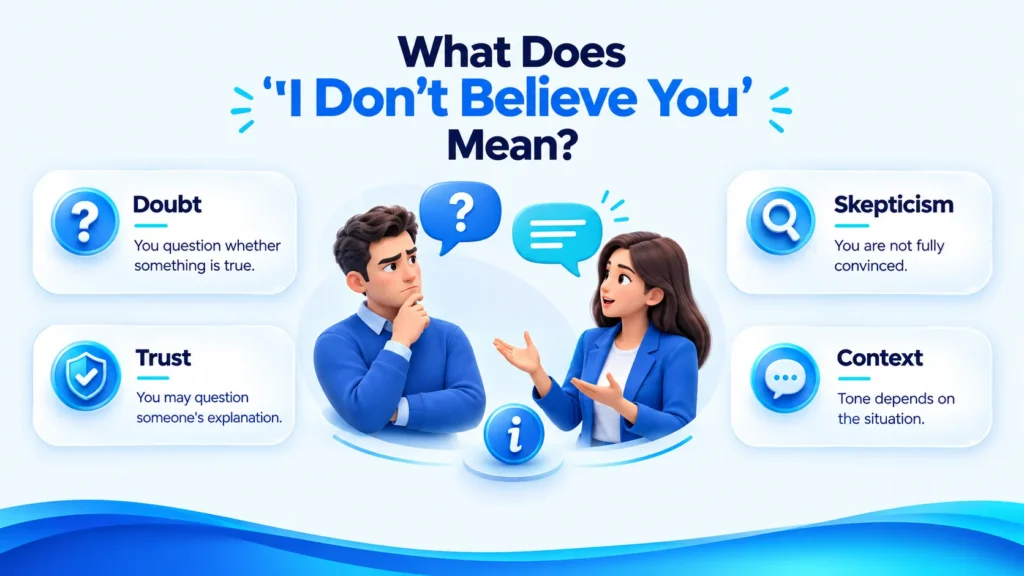
The phrase “I don’t believe you” means that you do not accept what someone has said as true or trustworthy. You might use it when you doubt a person’s story, question a claim, or think that the information they provided is inaccurate.
People often search for another way to say “I don’t believe you” because the original phrase can sound blunt or confrontational. Choosing a softer expression can help you communicate doubt while keeping the conversation respectful.
These alternatives are useful in everyday conversations, text messages, workplace discussions, emails, debates, and situations where you want to question information without immediately accusing someone of lying.
Why Use Other Ways to Say “I Don’t Believe You”?
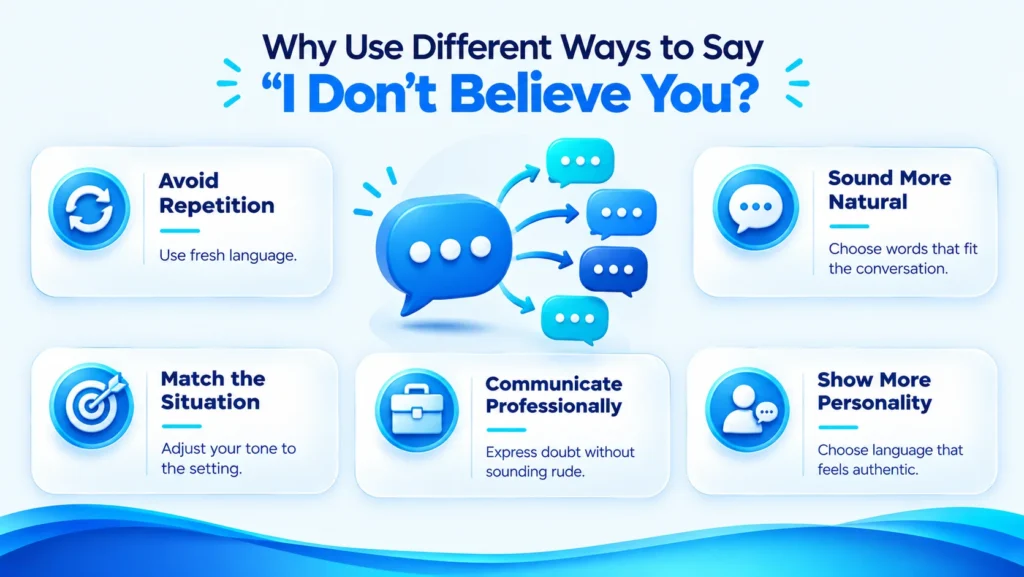
Using a different expression can make your message more appropriate for the situation. Instead of sounding aggressive, you can show skepticism while leaving room for the other person to explain.
Other ways to express disbelief can help you:
- Avoid sounding unnecessarily rude or accusatory.
- Make your communication more natural.
- Match your language to a professional or casual setting.
- Express doubt without directly accusing someone of lying.
- Keep difficult conversations calm and respectful.
- Show skepticism while remaining open to more information.
10 Best Other Ways to Say “I Don’t Believe You”
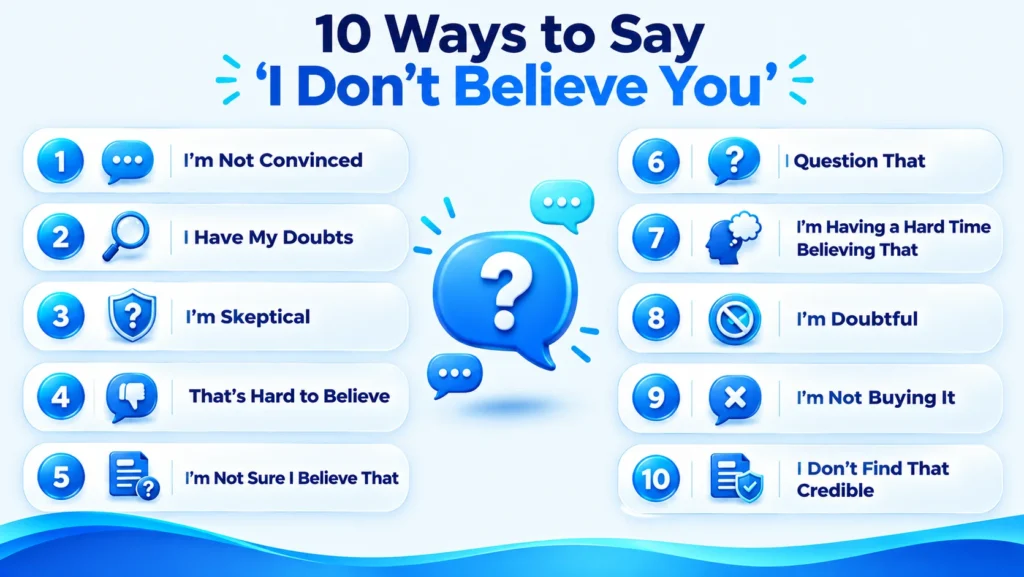
1. I’m Not Convinced
Meaning
“I’m not convinced” means that you have heard someone’s explanation but do not think there is enough evidence to accept it as true. It is less aggressive than directly saying that you do not believe someone.
Best For
- Professional
- Formal
- Polite
- Friendly
Example 1
“I understand your explanation, but I’m not convinced that this was the main reason for the delay.”
Example 2
“You may have a point, but I’m not convinced the plan will work as expected.”
Quick Tip
Use this phrase when you want to express doubt without completely closing the door on the other person’s argument.
2. I Have My Doubts
Meaning
“I have my doubts” shows that you are uncertain about whether something is true. It communicates skepticism in a relatively calm and indirect way.
Best For
- Casual
- Friendly
- Polite
- Professional
Example 1
“He says the project will be finished tomorrow, but I have my doubts.”
Example 2
“She promised there wouldn’t be any problems, although I have my doubts.”
Quick Tip
This is a good choice when you want to sound skeptical without making a direct accusation.
3. I’m Skeptical
Meaning
“I’m skeptical” clearly communicates that you question the truth or reliability of something. Unlike “I don’t believe you,” it focuses more on your level of confidence than on the person’s honesty.
Best For
- Professional
- Formal
- Serious
Example 1
“I’m skeptical about the claim that the software can solve the problem automatically.”
Example 2
“I’m skeptical that we can meet that deadline without additional resources.”
Quick Tip
Use “I’m skeptical” in professional discussions when you want to sound thoughtful rather than confrontational.
4. That’s Hard to Believe
Meaning
“That’s hard to believe” indicates that a statement seems unlikely, surprising, or inconsistent with what you know. It can be softer than directly accusing someone of being dishonest.
Best For
- Casual
- Friendly
- Polite
Example 1
“You finished the entire report in one hour? That’s hard to believe.”
Example 2
“He says he never received the message, but that’s hard to believe.”
Quick Tip
Your tone matters with this phrase because it can sound playful or highly skeptical depending on how you say it.
5. I’m Not Sure I Believe That
Meaning
“I’m not sure I believe that” expresses personal doubt while avoiding an absolute accusation. It leaves some room for the possibility that the statement could be true.
Best For
- Casual
- Friendly
- Polite
Example 1
“You’re saying the package arrived yesterday? I’m not sure I believe that.”
Example 2
“I’m not sure I believe that the restaurant was completely empty at lunchtime.”
Quick Tip
Choose this option when you want to be direct but still somewhat conversational.
6. I Question That
Meaning
“I question that” means you have concerns about whether a statement, explanation, or claim is accurate. It has a more serious and analytical feel.
Best For
- Professional
- Formal
Example 1
“I question whether those numbers accurately represent the company’s current performance.”
Example 2
“I question the claim that the changes had no effect on customer satisfaction.”
Quick Tip
This phrase works especially well when discussing facts, reports, statistics, or business decisions.
7. I’m Having a Hard Time Believing That
Meaning
This expression communicates strong doubt while focusing on your own reaction rather than directly calling the other person dishonest. It sounds natural in everyday American English.
Best For
- Casual
- Friendly
- Warm
Example 1
“I’m having a hard time believing that you forgot about the appointment completely.”
Example 2
“I’m having a hard time believing the store sold out that quickly.”
Quick Tip
Use it when you want to express strong disbelief in a conversational way.
8. I’m Doubtful
Meaning
“I’m doubtful” means you do not have much confidence that something is true or likely to happen. It can refer to a person’s statement, a prediction, or an expected result.
Best For
- Professional
- Formal
- Polite
Example 1
“I’m doubtful that the repairs will be completed by the end of the day.”
Example 2
“I’m doubtful about the accuracy of the information we received.”
Quick Tip
Use “I’m doubtful” when your concern is about the likelihood or reliability of something rather than someone’s character.
9. I’m Not Buying It
Meaning
“I’m not buying it” is an informal way to say that you do not accept or believe an explanation. It often suggests that you think someone is making an excuse or giving an unconvincing story.
Best For
- Casual
- Friendly
Example 1
“He said he missed the meeting because he forgot the time, but I’m not buying it.”
Example 2
“You expect me to believe that you accidentally deleted the entire folder? I’m not buying it.”
Quick Tip
Avoid this expression in formal emails or sensitive workplace conversations because it can sound blunt or dismissive.
10. I Don’t Find That Credible
Meaning
“I don’t find that credible” means you do not consider a statement believable or reliable. It is one of the more formal alternatives and works well when discussing evidence or claims.
Best For
- Professional
- Formal
- Polite
Example 1
“Based on the available evidence, I don’t find that explanation credible.”
Example 2
“The report provides several claims, but I don’t find that conclusion credible.”
Quick Tip
Use this expression when you need to communicate serious doubt in a professional, academic, or formal setting.
Comparison Table
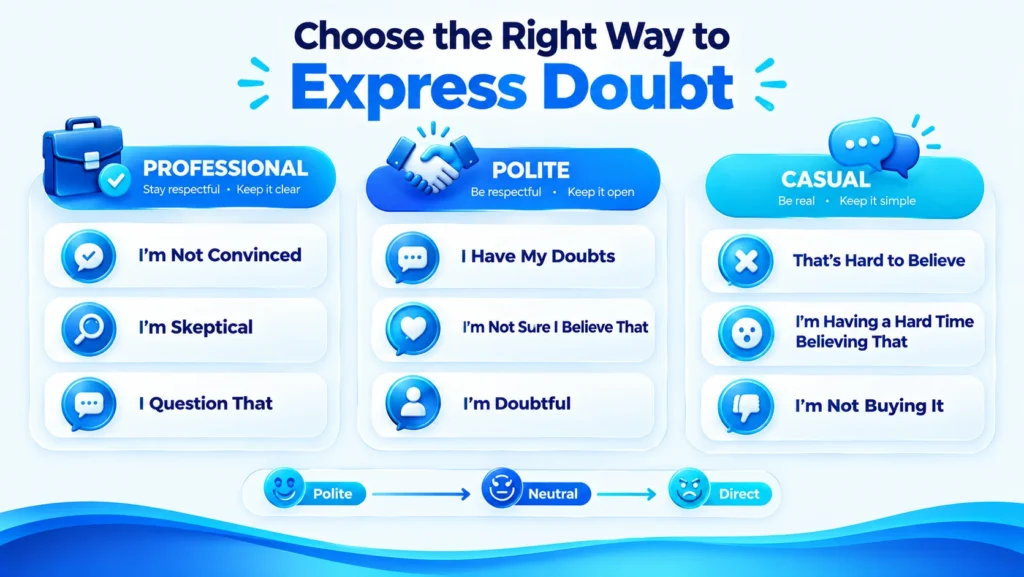
| Alternative | Best Used In | Tone |
| I’m Not Convinced | Professional, everyday discussions | Polite and skeptical |
| I Have My Doubts | Casual, friendly conversations | Mild and doubtful |
| I’m Skeptical | Professional, formal settings | Serious and analytical |
| That’s Hard to Believe | Casual conversations | Direct and conversational |
| I’m Not Sure I Believe That | Everyday conversations | Direct but softer |
| I Question That | Professional or formal discussions | Serious and analytical |
| I’m Having a Hard Time Believing That | Casual conversations | Strong but conversational |
| I’m Doubtful | Professional or formal situations | Reserved and cautious |
| I’m Not Buying It | Casual conversations | Blunt and informal |
| I Don’t Find That Credible | Formal or professional settings | Formal and firm |
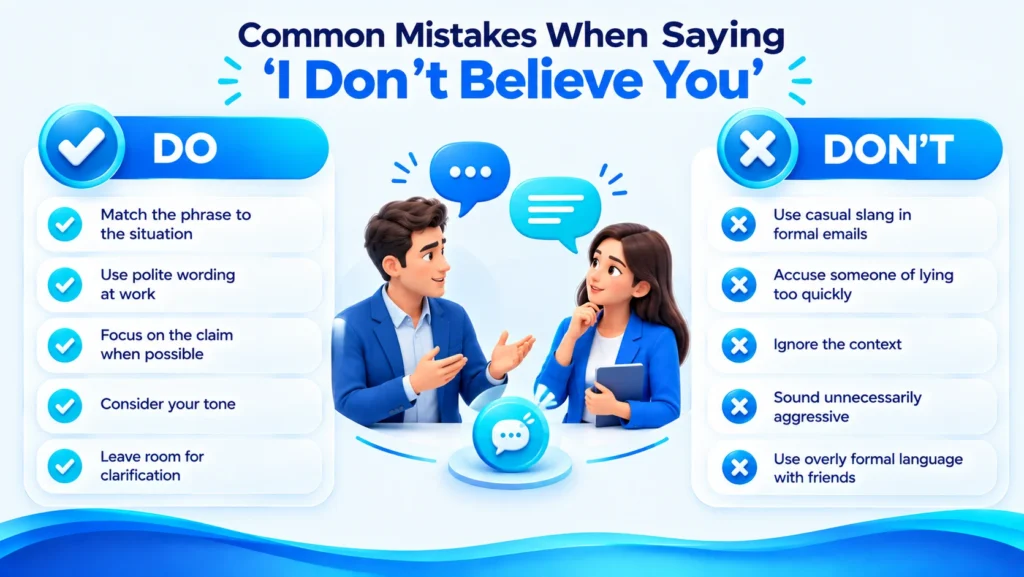
Common Mistakes
1. Using Casual Phrases in Professional Emails
Expressions such as “I’m not buying it” can sound dismissive at work. In professional communication, “I’m not convinced” or “I question that” usually sounds more appropriate.
2. Choosing Language That Is Too Formal
“I don’t find that credible” may sound overly serious during a casual conversation with a friend. Match the phrase to the relationship and setting.
3. Repeating the Same Expression
Using “I don’t believe you” repeatedly can make conversations feel confrontational. Varying your language can help you communicate doubt more naturally.
4. Forgetting the Context
Disbelief can relate to someone’s honesty, a surprising story, a prediction, or questionable evidence. Choose a phrase that accurately reflects what you doubt.
5. Sounding More Accusatory Than Intended
Some expressions can imply that someone is lying. If you simply need more information, use a softer phrase such as “I’m not convinced” instead of making a direct accusation.
Frequently Asked Questions
What is a polite way to say “I don’t believe you”?
A polite way to say “I don’t believe you” is “I’m not convinced.” This phrase communicates doubt without directly accusing someone of lying. You can also say “I have my doubts” or “I’m not sure I believe that” when you want to sound less confrontational.
What is a professional way to say “I don’t believe you”?
In a professional setting, “I’m skeptical,” “I’m not convinced,” or “I question that” are strong choices. They focus on the claim or explanation rather than attacking the person’s honesty. This makes them useful in meetings, emails, workplace discussions, and business conversations.
How do you say “I don’t believe you” without being rude?
Try saying “I’m not sure I believe that,” “I have my doubts,” or “I’m not convinced.” These alternatives express skepticism without sounding as blunt as “I don’t believe you.” Your tone also matters, especially when discussing a sensitive subject.
What is a casual way to say “I don’t believe you”?
For casual conversations, you can say “I’m not buying it,” “That’s hard to believe,” or “I’m having a hard time believing that.” These expressions sound natural in everyday American English, although “I’m not buying it” is more blunt and informal.
Is “I’m skeptical” rude?
“I’m skeptical” is not necessarily rude. It simply means that you have doubts about whether something is true or likely. However, your tone and context can affect how it sounds. In a professional conversation, it can actually be a respectful way to question a claim.
What is another way to say “I don’t believe your story”?
You could say “I’m not convinced by your story,” “I have my doubts,” or “I’m having a hard time believing that.” If you want to remain polite, focus on the explanation rather than accusing the person of lying.
What is a stronger way to say “I don’t believe you”?
“I’m not buying it” is a stronger, more direct option in casual conversation. “I don’t find that credible” is also firm but sounds more formal. Choose based on whether you want to challenge the person’s explanation strongly or simply express reasonable doubt.
Can “I don’t believe you” mean “I think you are lying”?
Yes, depending on the situation. “I don’t believe you” can suggest that you think someone is lying, but it can also simply mean that you doubt their statement. If you want to avoid accusing someone of dishonesty, “I’m not convinced” is usually safer.
Conclusion
There are many natural ways to say “I don’t believe you,” and the best choice depends on your tone and situation. For polite or professional communication, “I’m not convinced,” “I’m skeptical,” and “I question that” are strong options. For everyday conversations, “I have my doubts” or “I’m not sure I believe that” sound more relaxed.
If you want to express stronger disbelief, “That’s hard to believe” or “I’m having a hard time believing that” can work well. Meanwhile, “I’m not buying it” is best reserved for informal situations because it can sound blunt.
The key is to communicate your doubt without creating unnecessary conflict. Choose words that match both the seriousness of the situation and your relationship with the person.

The Majestic Studio Editorial Team creates practical resources about synonyms, alternative phrases, vocabulary, and English usage. Our content is designed to help readers choose clearer, more natural words and communicate effectively in everyday, professional, and academic contexts.
Each article is researched, edited, and reviewed for clarity, context, usefulness, and language accuracy. We regularly update our content to keep examples and recommendations relevant.