
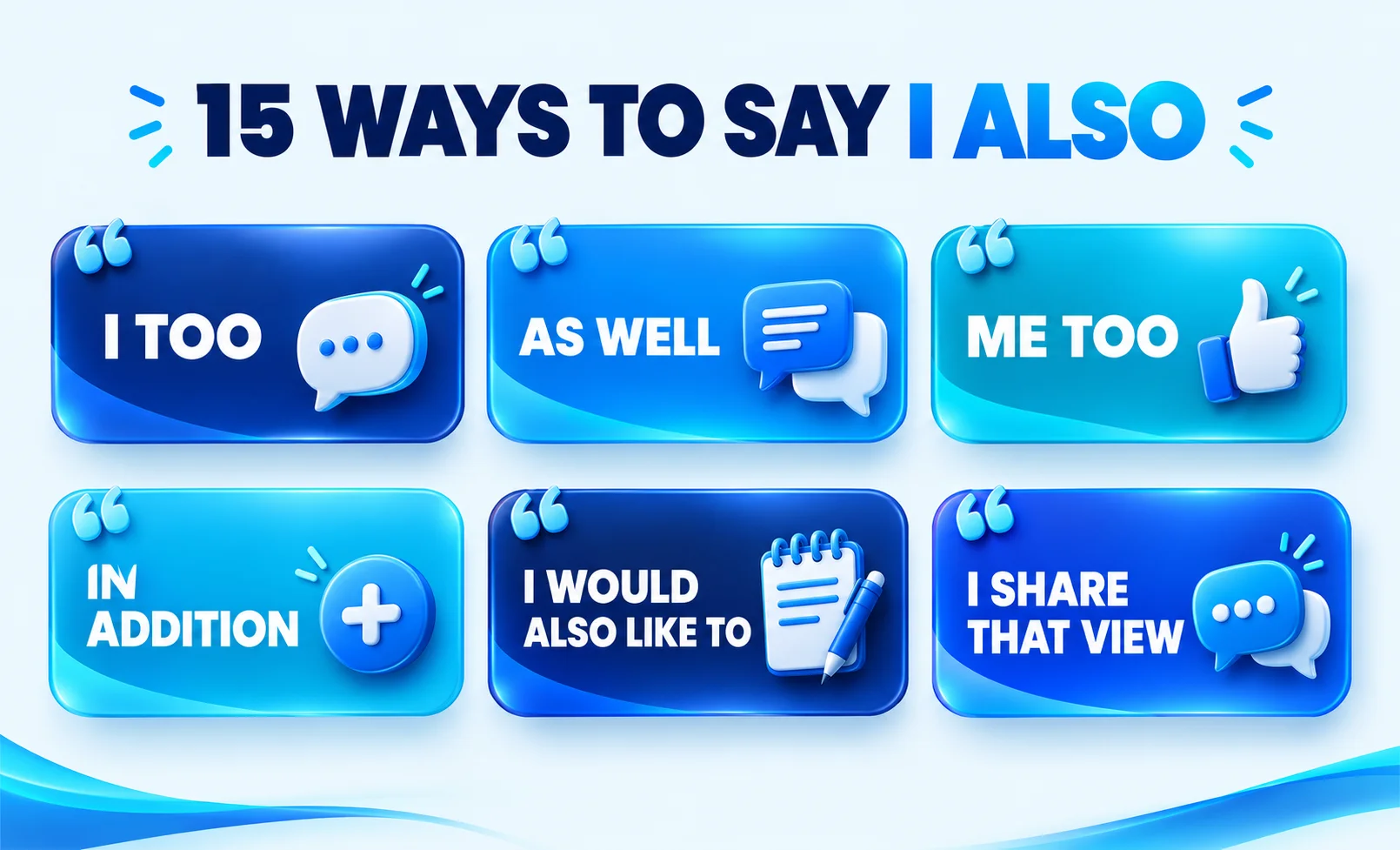
Another way to say “I also” depends on your tone and context. Common alternatives include “I additionally,” “I likewise,” “I too,” “in addition, I,” “I agree, and,” and “I would also like to.” Use “I too” in casual conversations, “in addition” in formal writing, and “I would also like to” in professional emails to sound clear and natural.
Key Takeaways
- Use “I too” or “me too” in casual conversations.
- Choose “in addition, I” or “I would also like to” for professional communication.
- Try “I likewise” when expressing a similar experience or opinion.
- Use “I agree, and” to build on another person’s idea.
- Match your alternative to the sentence’s meaning, audience, and tone.
What Does “Another Way to Say I Also” Mean?
The phrase “another way to say I also” refers to different expressions that communicate the same idea as “I also.” People use this phrase when they want to show that they share an experience, agree with someone, have something else to add, or want to include themselves in an activity.
For example, instead of saying, “I also want to attend the meeting,” you could write, “I would like to attend the meeting as well.” Both sentences express a similar idea, but the second sounds a little more polished.
These alternatives appear in emails, essays, business reports, text messages, social media posts, and everyday conversations. The best choice depends on what you want to communicate.
Why Use Other Ways to Say “I Also”?
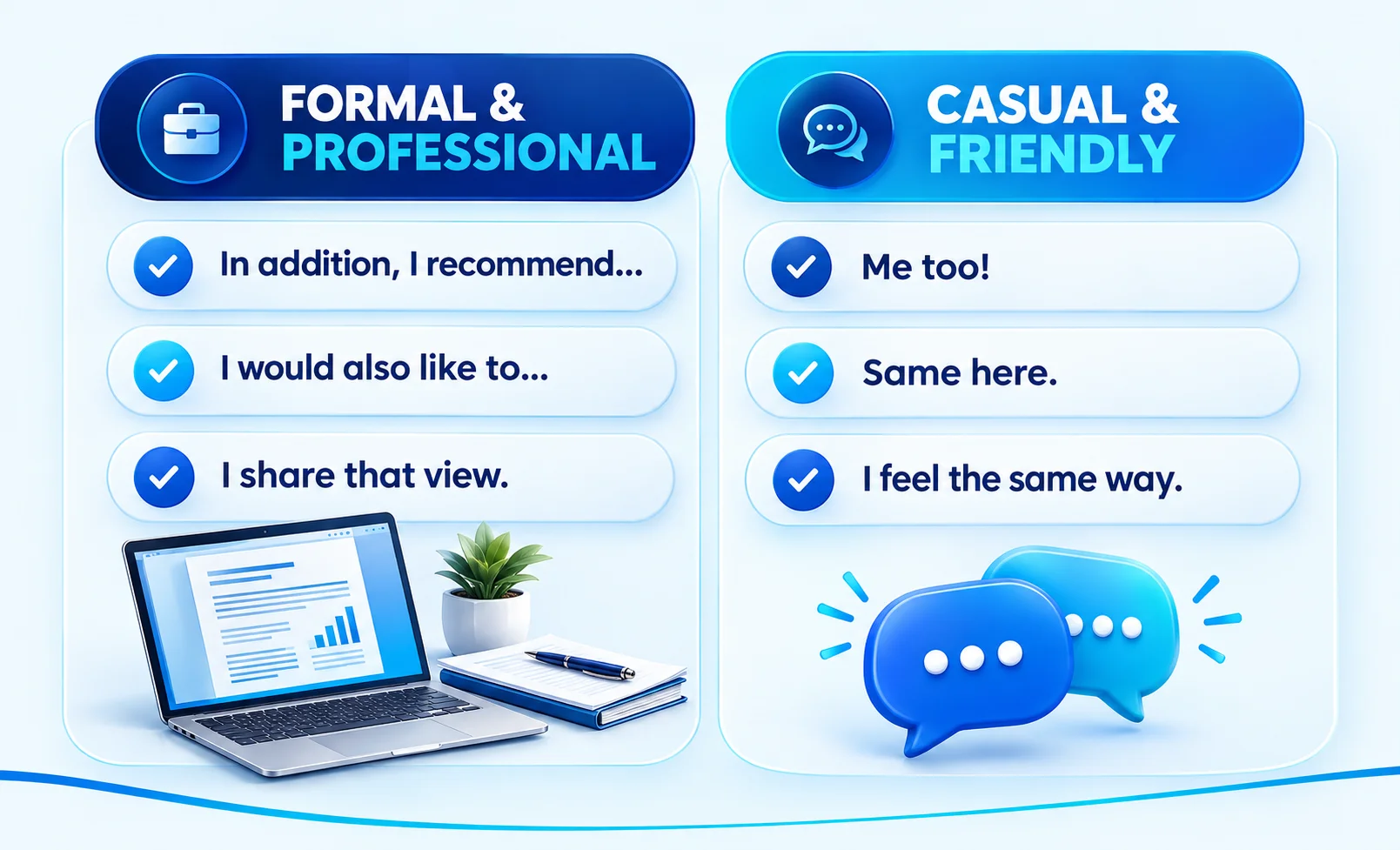
Although “I also” is grammatically correct, repeating it too often can make your writing sound predictable. Choosing different expressions helps your sentences flow naturally and makes your message more engaging.
Here are the main benefits:
- Avoid repetition: Keep paragraphs and conversations from sounding repetitive.
- Sound more natural: Choose phrases that fit everyday American English.
- Improve professional communication: Make emails, reports, and presentations more polished.
- Express agreement: Show that you share another person’s thoughts or experiences.
- Match the situation: Adjust your language for formal, friendly, or casual settings.
15 Best Other Ways to Say “I Also”
1. I Too
Meaning
“I too” means that you share an experience, opinion, or situation with someone else. It is concise and slightly more formal than “me too,” making it useful in both conversation and writing.
Best For
- Professional
- Formal
- Friendly
Example 1
I too believe that every student deserves equal opportunities.
Example 2
I too experienced difficulties when I first started working remotely.
Quick Tip
Use “I too” when you want to emphasize that your experience or opinion matches someone else’s.
2. Me Too
Meaning
“Me too” is a casual expression that shows you feel the same way or share an experience. It is common in everyday American English, especially in conversations with friends, family, and coworkers you know well.
Best For
- Casual
- Friendly
- Warm
Example 1
“I can’t wait for the concert!” “Me too!”
Example 2
Me too, I had trouble finding the right apartment when I moved here.
Quick Tip
Use “me too” in informal conversations. In formal writing, a complete sentence is usually a better choice.
3. As Well
Meaning
“As well” means “also” or “in addition.” It usually appears near the end of a sentence and provides a smooth way to include another person, action, or idea.
Best For
- Professional
- Friendly
- Polite
Example 1
I will review the budget and send you the updated figures as well.
Example 2
I would like to join the volunteer program as well.
Quick Tip
Place “as well” near the end of the sentence to keep your wording natural.
4. In Addition, I
Meaning
“In addition, I” introduces another point, action, or piece of information. It works especially well when you want to add something to an idea you have already mentioned.
Best For
- Professional
- Formal
Example 1
In addition, I will prepare a summary of the customer feedback.
Example 2
In addition, I recommend reviewing the proposal before Friday.
Quick Tip
Use this expression in reports, presentations, and business emails when introducing a separate but related point.
5. I Additionally
Meaning
“I additionally” communicates that you are doing or contributing something extra. However, it can sound stiff in everyday American English, so a phrase such as “I also” or “in addition, I” is often smoother.
Best For
- Formal
- Professional
Example 1
I additionally recommend including a timeline in the project plan.
Example 2
I additionally reviewed the supporting documents before submitting the application.
Quick Tip
Use this phrase sparingly. In most professional emails, a simpler alternative sounds more natural.
6. I Likewise
Meaning
“I likewise” means that you share a similar opinion, experience, or action. It sounds more formal than “me too” and works best when responding to something another person has said or done.
Best For
- Formal
- Professional
- Polite
Example 1
I likewise appreciate the time you spent helping our team.
Example 2
I likewise support the proposed changes to the hiring process.
Quick Tip
Choose “I likewise” when you want to express a parallel opinion or response rather than introduce an unrelated point.
7. I Also Want To
Meaning
“I also want to” expresses an additional desire, goal, or intention. It is direct and easy to understand, making it useful when discussing plans or explaining what you hope to accomplish.
Best For
- Casual
- Professional
- Friendly
Example 1
I also want to learn more about the company’s training program.
Example 2
I also want to thank everyone who helped organize the fundraiser.
Quick Tip
When the phrase appears repeatedly in a paragraph, replace some instances with more specific wording that reflects your actual intention.
8. I Would Also Like To
Meaning
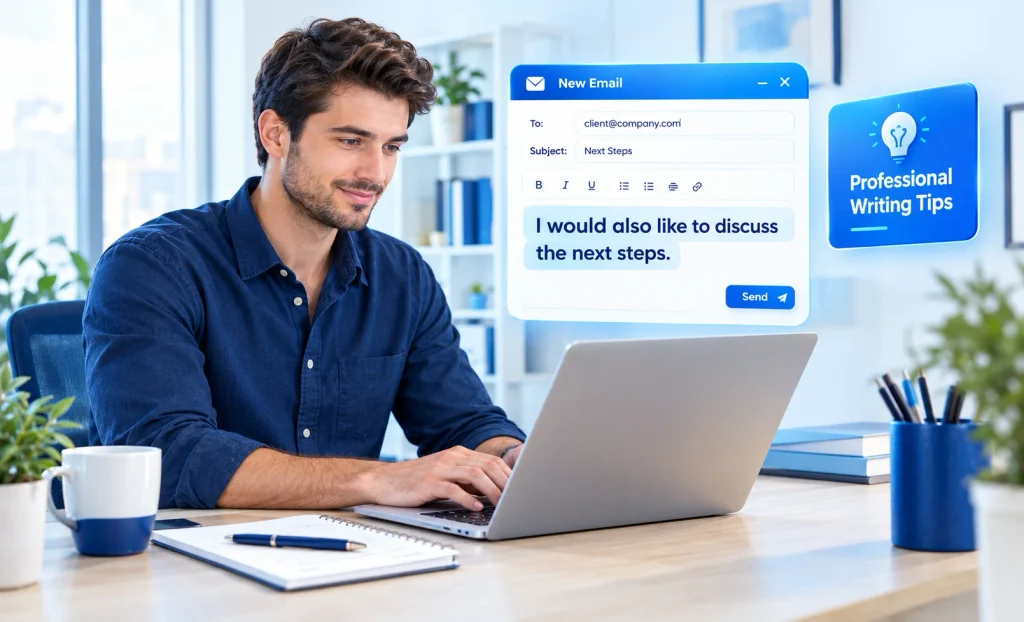
“I would also like to” expresses an additional request, preference, or intention politely. It is especially helpful when communicating with clients, managers, colleagues, or people you do not know well.
Best For
- Professional
- Formal
- Polite
Example 1
I would also like to schedule a brief call to discuss the next steps.
Example 2
I would also like to request a copy of the updated contract.
Quick Tip
Use this phrase in professional emails when you want to make a request without sounding demanding.
9. I Agree, and
Meaning
“I agree, and” shows that you support another person’s idea while adding something of your own. It encourages constructive discussion and helps you contribute without simply repeating what someone else said.
Best For
- Professional
- Friendly
- Polite
Example 1
I agree, and I think we should test the new design with a small group first.
Example 2
I agree, and I would add that customer support needs more resources.
Quick Tip
Follow the phrase with a useful point that moves the discussion forward instead of restating the same idea.
10. I Feel the Same Way
Meaning
“I feel the same way” communicates that your feelings or opinions match another person’s. It sounds more personal than “I also” and is particularly effective when discussing emotions, preferences, or shared concerns.
Best For
- Friendly
- Warm
- Casual
Example 1
I feel the same way about keeping weekends free for family time.
Example 2
I feel the same way about the importance of honest communication.
Quick Tip
Use this phrase when discussing feelings or opinions, not simply when adding a factual detail.
11. I Share That View
Meaning
“I share that view” means that you agree with someone’s position or perspective. It sounds measured and professional, making it useful in discussions about policies, business decisions, or important issues.
Best For
- Professional
- Formal
- Polite
Example 1
I share that view and believe employee feedback should guide the next phase.
Example 2
I share that view regarding the need for clearer project guidelines.
Quick Tip
Use this expression when responding to an argument or opinion rather than describing a shared activity.
12. I Would Like to Add
Meaning
“I would like to add” introduces an additional thought or detail. It is a polite way to contribute to a meeting, discussion, presentation, or written message without interrupting the flow of the conversation.
Best For
- Professional
- Formal
- Polite
Example 1
I would like to add that the new schedule gives us more time for testing.
Example 2
I would like to add one important detail about the application process.
Quick Tip
Use this phrase when introducing a new point. It is not a direct replacement for “I also” in every sentence.
13. Along With That, I
Meaning
“Along with that, I” connects an additional action or point to something already mentioned. It has a conversational tone and works well when explaining several related responsibilities, plans, or contributions.
Best For
- Professional
- Casual
- Friendly
Example 1
Along with that, I will contact the suppliers to confirm delivery dates.
Example 2
Along with that, I plan to update the training materials next week.
Quick Tip
Use this phrase when the new point directly relates to the previous one. Avoid it when the ideas have little connection.
14. I Am Also Interested In
Meaning
“I am also interested in” expresses an additional interest in a topic, opportunity, activity, or subject. It is useful when discussing career goals, hobbies, educational plans, and professional development.
Best For
- Professional
- Friendly
- Polite
Example 1
I am also interested in the internship focused on digital marketing.
Example 2
I am also interested in taking a course on business communication.
Quick Tip
Use this phrase when expressing interest, not when you simply want to add another fact or action.
15. On My End, I Also
Meaning
“On my end, I also” highlights an action, update, or responsibility that belongs to you. It is common in workplace conversations when people coordinate tasks or share progress on a project.
Best For
- Professional
- Casual
- Friendly
Example 1
On my end, I also confirmed the meeting room for Thursday.
Example 2
On my end, I also checked the figures against last month’s report.
Quick Tip
This phrase works best in collaborative workplace conversations. For formal reports, use a more direct sentence.
Comparison Table
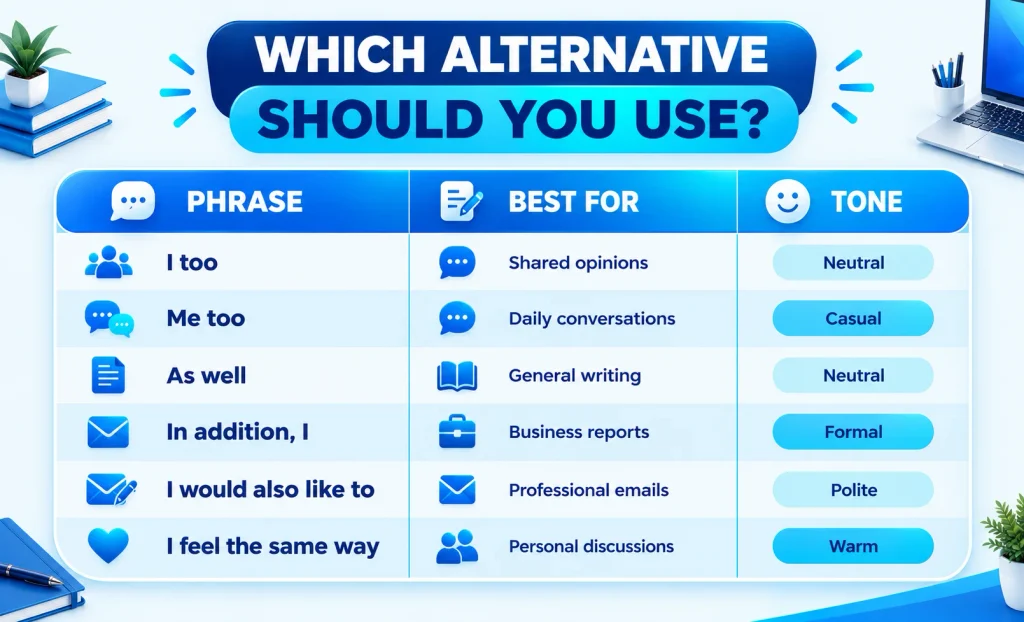
| Alternative | Best Used In | Tone |
|---|---|---|
| I too | Shared experiences or opinions | Neutral to formal |
| Me too | Everyday conversations | Casual |
| As well | Emails and general writing | Neutral |
| In addition, I | Reports and business writing | Formal |
| I additionally | Formal statements | Formal |
| I likewise | Shared opinions or responses | Professional |
| I also want to | Plans and intentions | Direct |
| I would also like to | Requests and emails | Polite |
| I agree, and | Meetings and discussions | Collaborative |
| I feel the same way | Personal conversations | Warm |
| I share that view | Professional discussions | Formal |
| I would like to add | Meetings and presentations | Polite |
| Along with that, I | Related tasks or ideas | Conversational |
| I am also interested in | Career and personal goals | Neutral |
| On my end, I also | Workplace updates | Casual to professional |
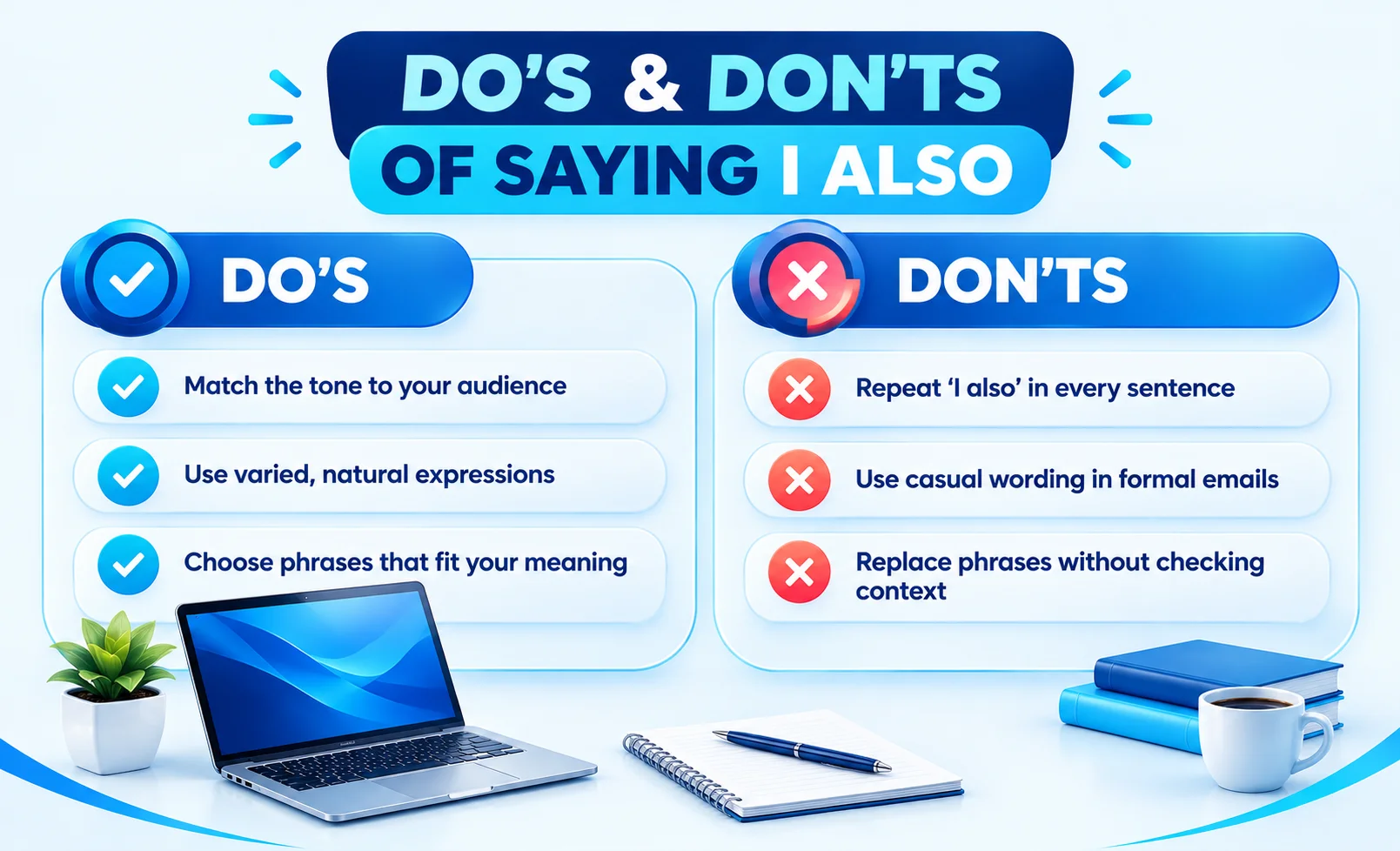
Common Mistakes
1. Using Casual Phrases in Professional Emails
Expressions such as “me too” work well with friends but may sound too informal in a formal business message. Choose “I share that view” or “I would also like to” when the situation calls for a more polished tone.
2. Choosing Overly Formal Language
Words such as “additionally” can sound stiff when used in casual conversations. Use simple expressions like “as well” or “me too” when speaking with friends or familiar coworkers.
3. Repeating the Same Phrase
Using “I also” in every sentence makes your writing feel repetitive. Vary your wording when appropriate, but do not replace every instance if the original phrase already sounds clear and natural.
4. Forgetting Context
Not every alternative expresses the same meaning. For example, “I agree, and” signals agreement, while “I am also interested in” describes an additional interest. Choose the expression that matches your intended message.
5. Sounding Insincere
Formal phrases may feel distant when discussing personal experiences or emotions. If you want to show genuine understanding, “I feel the same way” may sound more natural than a stiff expression such as “I likewise concur.”
Frequently Asked Questions
1. What is another way to say “I also”?
Common alternatives include “I too,” “as well,” “in addition, I,” and “I would also like to.” The best choice depends on your sentence and audience. Use “I too” to emphasize a shared experience, “as well” to add information smoothly, and “in addition” to introduce another point in formal writing.
2. What is a professional way to say “I also”?
Professional alternatives include “I would also like to,” “in addition, I,” “I share that view,” and “I would like to add.” For example, instead of writing, “I also want to discuss the budget,” you could say, “I would also like to discuss the budget.” This sounds polite and clear without being overly formal.
3. What is a formal synonym for “I also”?
“In addition, I” and “I likewise” can work in formal writing, depending on the meaning. “In addition, I” introduces another point, while “I likewise” emphasizes a similar action, opinion, or experience. Neither phrase fits every sentence, so consider the relationship between your idea and the information that comes before it.
4. How can I say “I also agree” differently?
You can say “I agree as well,” “I share that view,” or “I feel the same way.” In a meeting, “I agree, and I would add that…” is especially useful because it shows support while introducing a new idea. Choose the version that best matches your relationship with the speaker and the discussion’s tone.
5. How do I avoid repeating “I also” in an essay?
Use transitions such as “in addition,” “furthermore,” and “similarly” when they accurately connect your ideas. You can also restructure sentences to focus on the main point instead of starting each one with “I also.” Avoid adding transitions just for variety; every expression should show a clear relationship between your ideas.
6. Is “I too” grammatically correct?
Yes, “I too” is grammatically correct when it means that you share an experience, action, or opinion. For example, “I too support the proposal” is correct. In American English, “I do too” or “I feel the same way” may sound more natural in some conversations, depending on what you are agreeing with.
7. Is “as well” more formal than “also”?
“As well” and “also” are both suitable for everyday and professional communication. However, “as well” often sounds natural at the end of a sentence, while “also” frequently appears before the main verb. For example, “I also reviewed the report” and “I reviewed the report as well” communicate nearly the same idea.
8. What is a casual way to say “I also”?
“Me too” is one of the most common casual alternatives. You can also say “same here” or “I feel the same way,” depending on the context. Use “me too” to respond to a shared feeling or experience, and choose “same here” when you want a relaxed, conversational response.
Conclusion
Choosing another way to say “I also” can make your writing clearer, more natural, and less repetitive. The best expression depends on your audience, purpose, and intended meaning. For everyday conversations, “me too” and “same here” sound relaxed and friendly. For professional emails, “I would also like to” and “in addition, I” help you communicate politely and clearly.
When you want to express agreement, try “I share that view” or “I feel the same way.” If you are adding a new point during a meeting, “I would like to add” can help you contribute smoothly. Remember that these phrases are not always interchangeable. Some express agreement, while others introduce new information or describe an additional interest.
The best writing tip is simple: choose the phrase that communicates your meaning clearly, fits your audience, and sounds natural when read aloud.

The Majestic Studio Editorial Team creates practical resources about synonyms, alternative phrases, vocabulary, and English usage. Our content is designed to help readers choose clearer, more natural words and communicate effectively in everyday, professional, and academic contexts.
Each article is researched, edited, and reviewed for clarity, context, usefulness, and language accuracy. We regularly update our content to keep examples and recommendations relevant.