

Another way to say “in the end” includes ultimately, finally, eventually, at last, all things considered, and when all is said and done. These expressions help summarize a result, describe how a situation concluded, or share a final decision. Choose the phrase that best fits your meaning, tone, and audience.
Key Takeaways
- Use ultimately to explain the final result of a decision or situation.
- Choose finally or at last when something happens after a delay.
- Use all things considered to summarize different factors before reaching a conclusion.
- Choose eventually when an outcome happens after some time.
- Match your phrase to the context, especially in professional emails, essays, and everyday conversations.
The phrase “in the end” helps you describe a final result, decision, or outcome after a series of events. It works well in everyday conversations, school assignments, stories, and professional writing. However, using the same expression repeatedly can make your writing feel predictable.
Fortunately, several alternatives can express the same idea with a slightly different meaning or tone. Whether you want to finish an essay, explain a decision, or tell someone how a situation turned out, the right phrase can make your message clearer and more natural.
What Does “In the End” Mean?
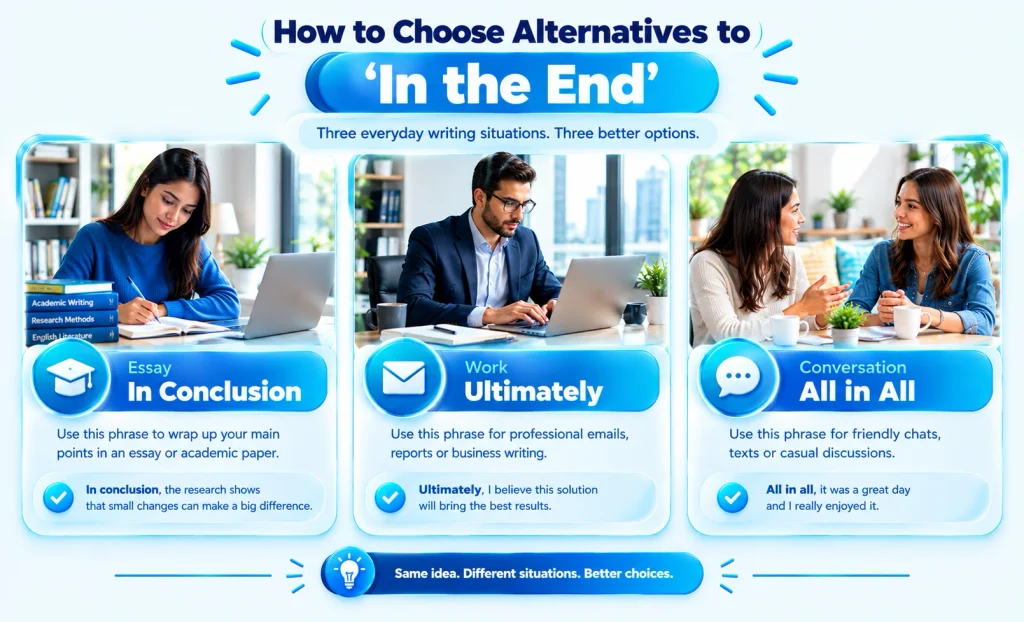
“In the end” means when everything has happened, been considered, or reached its conclusion. People often use it to describe the final outcome of a situation, especially when the result follows a period of uncertainty, effort, discussion, or change.
For example, “In the end, we decided to stay home” means that staying home was the final decision after considering other options.
The expression appears in casual conversations, personal stories, academic writing, and workplace discussions. Depending on the context, it can emphasize a final decision, an unexpected result, or the lesson learned from an experience.
Why Use Other Ways to Say “In the End”?
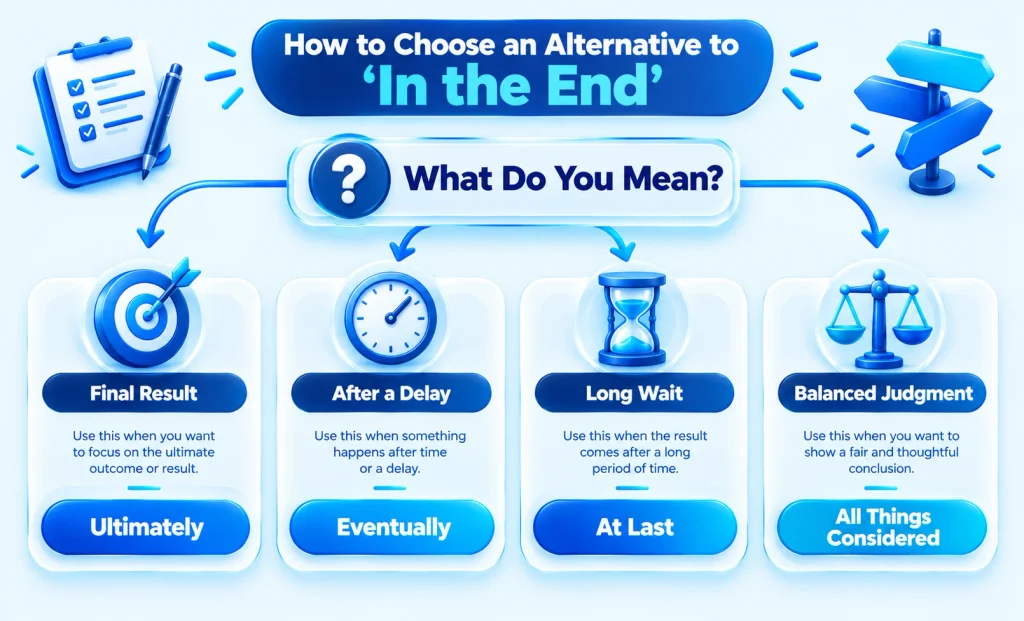
Choosing a suitable alternative can make your writing more precise and engaging. Although these expressions often share a similar meaning, they do not always work in exactly the same situations.
Here are the main benefits:
- Avoid repetition: Keep essays, emails, and articles from sounding repetitive.
- Improve clarity: Show whether you mean a final result, a delayed outcome, or a considered judgment.
- Match your tone: Choose language that sounds appropriate for a friend, teacher, colleague, or client.
- Strengthen conclusions: End paragraphs and arguments with a clear, natural expression.
- Improve professional communication: Present decisions and results in a confident, polished way.
15 Best Other Ways to Say “In the End”
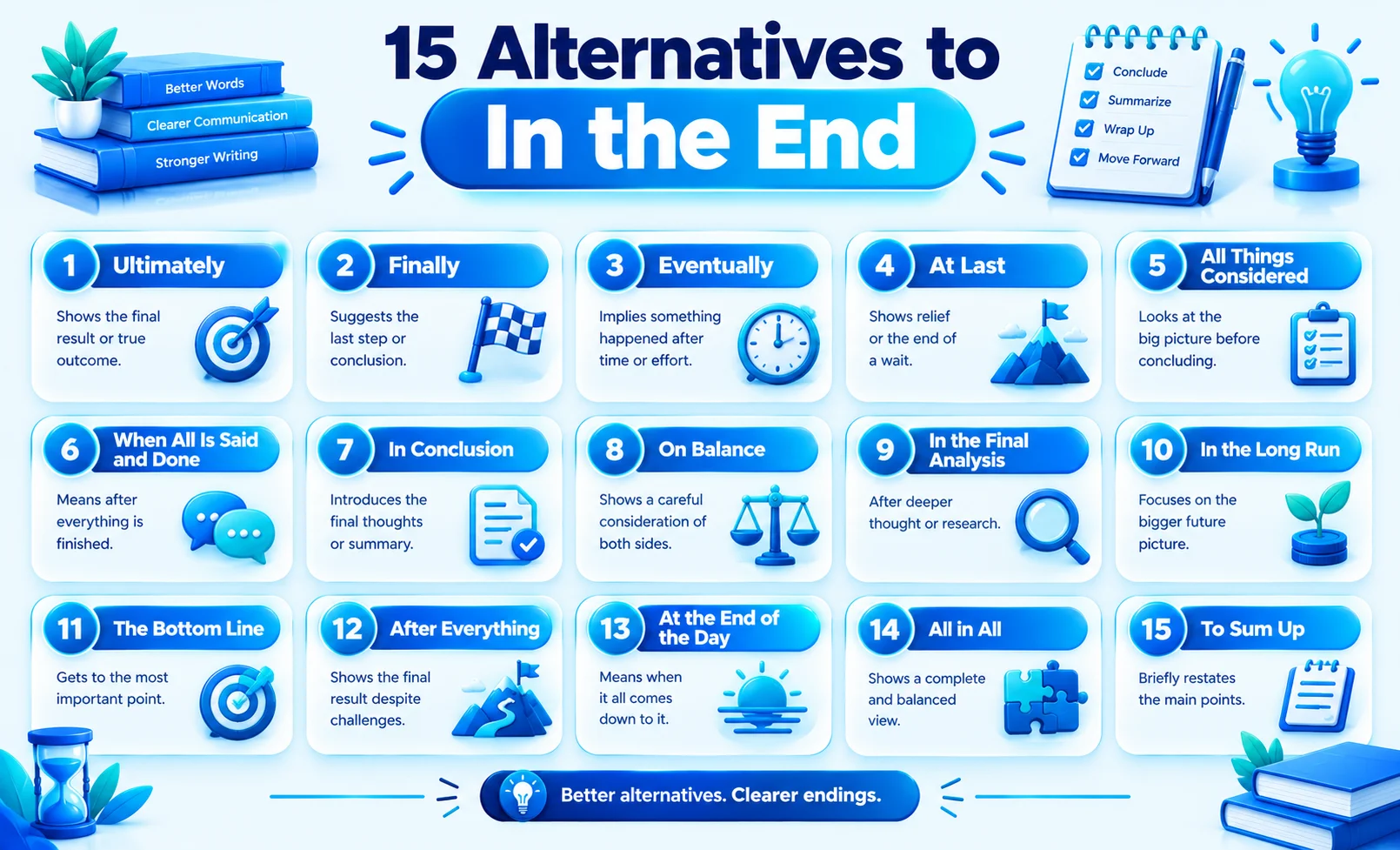
1. Ultimately
Meaning
“Ultimately” describes the final result of a process, decision, or situation. It is especially useful when several factors contribute to one outcome.
Best For
Professional, Formal
Example 1
Ultimately, the company decided to invest in employee training rather than hire additional staff.
Example 2
Ultimately, your daily habits will have a greater effect on your progress than occasional bursts of effort.
Quick Tip
Use “ultimately” when explaining a conclusion or result, particularly in business writing, reports, and essays.
2. Finally
Meaning
“Finally” indicates that something happens at the end of a sequence or after a period of waiting. It can also introduce the last point in a discussion.
Best For
Professional, Casual, Friendly
Example 1
After three rounds of interviews, Maya finally received a job offer.
Example 2
We finally found a quiet restaurant where everyone could relax and talk.
Quick Tip
Use “finally” to emphasize the completion of a process or the relief of reaching a long-awaited outcome.
3. Eventually
Meaning
“Eventually” means that something happens after some time, even if it does not happen immediately. It focuses on the delay between the beginning of a situation and its outcome.
Best For
Casual, Friendly, Professional
Example 1
After months of testing different designs, the team eventually created a product customers loved.
Example 2
We got lost on the way to the cabin, but we eventually found the correct road.
Quick Tip
Choose “eventually” when the passage of time matters. Do not use it simply to introduce every type of conclusion.
4. At Last
Meaning
“At last” describes something that happens after a long wait, struggle, or period of difficulty. It often expresses relief, happiness, or satisfaction.
Best For
Casual, Friendly, Warm
Example 1
At last, the rain stopped, and the children could play outside.
Example 2
After weeks of hard work, Daniel at last completed his first novel.
Quick Tip
Use “at last” when you want readers to feel the importance of reaching a long-awaited moment.
5. All Things Considered
Meaning
“All things considered” means that you have thought about the relevant facts, benefits, drawbacks, and circumstances before reaching a judgment. It highlights a balanced conclusion.
Best For
Professional, Formal, Polite
Example 1
All things considered, the smaller apartment was the better choice for our budget.
Example 2
All things considered, the conference was worth attending despite the travel delays.
Quick Tip
Use this expression when your conclusion reflects several factors rather than one isolated detail.
6. When All Is Said and Done
Meaning
“When all is said and done” refers to what matters most after everything has been discussed or completed. It often emphasizes the lasting result or the most important lesson.
Best For
Casual, Friendly, Warm
Example 1
When all is said and done, the time we spend with family matters most.
Example 2
When all is said and done, we learned more from the failed project than from our earlier successes.
Quick Tip
This phrase works well in reflective conversations, personal writing, and informal conclusions. It may sound wordy in a short business email.
7. In Conclusion
Meaning
“In conclusion” introduces the final point or summary of an argument, presentation, or written discussion. It signals that the main explanation is ending.
Best For
Formal, Professional, Polite
Example 1
In conclusion, the evidence supports expanding the program to additional schools.
Example 2
In conclusion, regular exercise, balanced meals, and sufficient sleep can support a healthier routine.
Quick Tip
Use “in conclusion” for essays, reports, and speeches. Avoid forcing it into casual conversations where a simpler phrase sounds more natural.
8. On Balance
Meaning
“On balance” means that after weighing advantages and disadvantages, one judgment seems more reasonable than the alternatives. It is concise and measured.
Best For
Professional, Formal
Example 1
On balance, the benefits of remote work outweighed the challenges for our team.
Example 2
On balance, the second proposal offered better value despite its higher initial cost.
Quick Tip
Choose “on balance” when your conclusion depends on comparing competing considerations.
9. In the Final Analysis
Meaning
“In the final analysis” introduces a judgment based on the most important facts or underlying principles. It often appears in thoughtful, analytical, or persuasive writing.
Best For
Formal, Professional
Example 1
In the final analysis, a successful partnership depends on trust and clear communication.
Example 2
In the final analysis, the policy must serve the people it was designed to help.
Quick Tip
Use this expression sparingly in analytical writing. It can sound overly formal in a text message or everyday conversation.
10. In the Long Run
Meaning
“In the long run” focuses on the effects of a choice or action over an extended period. Unlike a simple conclusion, it often highlights long-term consequences rather than an immediate result.
Best For
Professional, Casual
Example 1
Investing in quality equipment may save the business money in the long run.
Example 2
Learning to manage your time can reduce stress in the long run.
Quick Tip
Use this phrase when the lasting impact matters more than what happens immediately.
11. In the Final Outcome
Meaning
“In the final outcome” is sometimes used to refer to the result of a process, but the wording is often redundant because “outcome” already means a result. More natural alternatives include “in the end” and “ultimately.”
Best For
Professional, Formal
Example 1
Ultimately, the revised schedule gave every department enough time to complete its work.
Example 2
The final outcome showed that the new approach reduced processing errors.
Quick Tip
For polished writing, avoid using “in the final outcome” as a substitute phrase. Prefer “ultimately” or simply “the final outcome,” depending on your sentence.
12. After Everything
Meaning
“After everything” suggests that a conclusion or feeling remains despite the events, challenges, or changes that occurred. It often carries a personal or emotional tone.
Best For
Casual, Friendly, Warm
Example 1
After everything, I was grateful that we had found a way to work together again.
Example 2
After everything we had been through, the family reunion felt especially meaningful.
Quick Tip
Use “after everything” when the experiences leading to the conclusion are important to the message.
13. At the End of the Day
Meaning
“At the end of the day” is an informal expression used to emphasize the most important point after considering a situation. It often introduces a practical judgment or personal opinion.
Best For
Casual, Friendly, Professional
Example 1
At the end of the day, we need a solution that works for both the customers and the staff.
Example 2
At the end of the day, choosing a career should involve more than earning a high salary.
Quick Tip
This phrase is common in conversation, but avoid overusing it in formal reports or academic essays.
14. All in All
Meaning
“All in all” provides a brief overall judgment after considering the different parts of an experience or situation. It often introduces a positive or balanced summary.
Best For
Casual, Friendly, Polite
Example 1
All in all, our weekend trip was relaxing, affordable, and well worth the drive.
Example 2
The training session was challenging, but all in all, it helped me feel more confident.
Quick Tip
Use “all in all” to summarize an overall impression rather than describe a specific event that happened after a delay.
15. To Sum Up
Meaning
“To sum up” introduces a short summary of the main ideas or most important points. It focuses on bringing information together rather than describing how an event unfolded.
Best For
Professional, Formal, Polite
Example 1
To sum up, the proposal offers lower operating costs and a more flexible schedule.
Example 2
To sum up, students benefit when lessons combine clear explanations with practical activities.
Quick Tip
Use “to sum up” at the end of presentations, reports, and explanations when you want to restate the key message clearly.
Comparison Table: 15 Alternatives to “In the End”

| Alternative | Best Used In | Tone |
|---|---|---|
| Ultimately | Decisions and conclusions | Professional |
| Finally | Completed events and waiting | Neutral |
| Eventually | Delayed outcomes | Neutral |
| At last | Long-awaited results | Warm |
| All things considered | Balanced judgments | Thoughtful |
| When all is said and done | Life lessons and reflections | Conversational |
| In conclusion | Essays and presentations | Formal |
| On balance | Comparing pros and cons | Analytical |
| In the final analysis | Detailed arguments | Formal |
| In the long run | Long-term consequences | Practical |
| In the final outcome | Discussing results; rephrase when possible | Formal |
| After everything | Personal experiences | Emotional |
| At the end of the day | Everyday opinions | Conversational |
| All in all | Overall impressions | Friendly |
| To sum up | Summaries and presentations | Clear and direct |
Common Mistakes When Choosing an Alternative
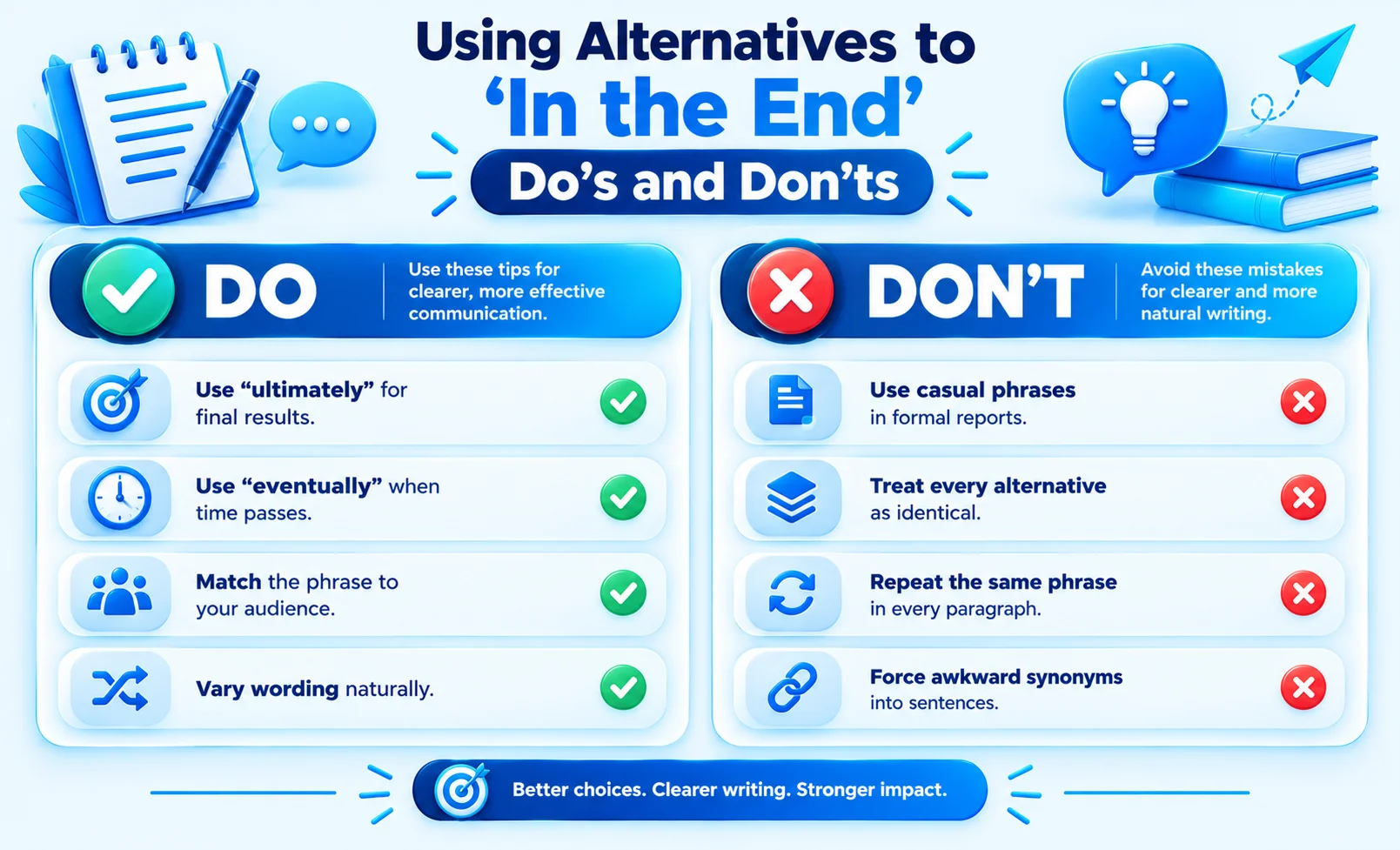
1. Using Casual Phrases in Formal Writing
Expressions such as “at the end of the day” and “when all is said and done” may sound too conversational in an academic paper or formal report. Choose “ultimately,” “in conclusion,” or “on balance” when a more formal tone is appropriate.
2. Treating Every Alternative as Interchangeable
Not every phrase communicates the same idea. “Eventually” emphasizes a delay, while “all things considered” emphasizes careful judgment. Choose the expression that matches the meaning of your sentence.
3. Making Your Writing Sound Too Formal
Phrases such as “in the final analysis” can make a simple message sound unnecessarily complicated. In a friendly email or casual conversation, “finally” or “in the end” may work better.
4. Repeating the Same Expression Too Often
Using “ultimately” in every paragraph can make your writing sound repetitive, even when the word is appropriate. Vary your language naturally, but never replace a clear phrase with an awkward synonym just to avoid repetition.
5. Forgetting the Context
A phrase that works in a personal story may not suit a business report. Consider your audience, purpose, and intended meaning before choosing an alternative.
Frequently Asked Questions
1. What is the best alternative to “in the end”?
“Ultimately” is one of the best general alternatives because it works in professional writing, essays, and everyday explanations. However, “finally” may be better when describing a completed event, while “all things considered” works well when presenting a balanced judgment. The best choice depends on what you want to emphasize.
2. What is a formal way to say “in the end”?
Formal alternatives include “ultimately,” “in conclusion,” “on balance,” and “in the final analysis.” Use “in conclusion” to close an essay or presentation, and choose “on balance” when weighing different factors. “Ultimately” is a flexible option for reports, proposals, and professional communication.
3. What is a casual way to say “in the end”?
Casual alternatives include “finally,” “at last,” “all in all,” and “at the end of the day.” For example, you could say, “All in all, we had a great time,” when describing a trip. Choose a phrase that sounds natural for your audience and the situation.
4. Is “ultimately” the same as “in the end”?
“Ultimately” and “in the end” often have similar meanings because both can describe a final result. However, “ultimately” tends to sound more analytical or polished, while “in the end” is more conversational. “Ultimately” is especially useful when explaining the main result of a decision or process.
5. Can I use “eventually” instead of “in the end”?
Yes, when you want to emphasize that something happened after a period of time. For example, “We eventually reached an agreement” highlights the time it took to reach the decision. However, “eventually” is less suitable when you simply want to summarize an argument or present a final judgment.
6. What is the best alternative for an essay conclusion?
“In conclusion,” “ultimately,” and “to sum up” are useful choices for essays. Use “in conclusion” to introduce your final section, “ultimately” to emphasize your main argument, or “to sum up” to review the key points. Make sure your conclusion adds value instead of merely repeating the introduction.
7. Is “at the end of the day” professional?
“At the end of the day” is widely understood and can work in informal workplace conversations. However, it may sound too casual or repetitive in a formal report, business proposal, or academic paper. In those situations, “ultimately,” “on balance,” or “in the final analysis” may be more suitable.
8. How can I avoid repeating “in the end” in my writing?
Start by identifying what your sentence means. If you are describing a delay, try “eventually”; if you are explaining a final decision, use “ultimately”; and if you are summarizing several factors, consider “all things considered.” Vary your expressions only when the alternative preserves your intended meaning.
Conclusion
There are many natural ways to say “in the end,” and the best alternative depends on your purpose, audience, and tone. Choose ultimately for a clear final result, finally when something is completed, and eventually when an outcome takes time. If you are weighing different factors, “all things considered” or “on balance” can express a more thoughtful judgment.
For essays and reports, “in conclusion” and “to sum up” help introduce a final summary. In everyday conversations, “all in all” and “at the end of the day” may sound more natural. Remember that similar expressions can carry different meanings, so consider the message you want to communicate before choosing a replacement.
The key is to write clearly, match your language to the situation, and use variety where it improves readability. A well-chosen phrase makes your writing sound more natural without changing your meaning.

Editorial contributors help develop practical English-language resources covering vocabulary, expressions, synonyms, and writing. Contributions focus on clear explanations, useful examples, and context so readers can understand not only what a phrase means, but when and how to use it naturally.