

Another way to say “it is important to note” is “it’s worth mentioning,” “please keep in mind,” “it is essential to remember,” or “notably.” These alternatives help you highlight key information, add context, and communicate clearly. The best choice depends on your audience, purpose, and tone, whether you are writing a professional email, an academic paper, or a casual message.
Key Takeaways
- Use “it’s worth mentioning” to introduce useful additional information.
- Choose “please keep in mind” when giving a reminder or explaining a condition.
- Use “it is essential to remember” to emphasize a critical point.
- Try “notably” or “in particular” to highlight specific details in formal writing.
- Match your alternative to the audience, context, and importance of the information.
What Does “It Is Important to Note” Mean?
“It is important to note” is a phrase used to draw attention to information that readers should notice, understand, or remember. Writers often use it before sharing a key fact, explaining an exception, or adding context that could affect how someone understands a topic.
You will commonly see this expression in business emails, academic papers, reports, articles, instructions, and presentations. For example, a manager might use it to explain a deadline, while a researcher might use it to clarify the limits of a study.
Although the phrase is clear and professional, repeating it too often can make writing sound formal or repetitive. Choosing a suitable alternative helps your message feel more natural while keeping the main point clear.
Why Use Other Ways to Say “It Is Important to Note”?

Using different expressions can improve your writing and help readers understand why a particular detail matters. The right phrase can also make your message sound more direct, friendly, or authoritative.
Consider using alternatives to:
- Avoid repetition: Keep articles, reports, and emails interesting.
- Improve clarity: Tell readers whether they should remember, consider, or act on a detail.
- Match the situation: Choose wording that suits professional, academic, or casual communication.
- Emphasize key information: Make important facts stand out without overstating them.
- Sound more natural: Replace wordy introductions with concise expressions.
The goal is not to replace every use of the original phrase. Instead, choose wording that communicates the intended meaning as clearly as possible.
15 Best Other Ways to Say “It Is Important to Note”
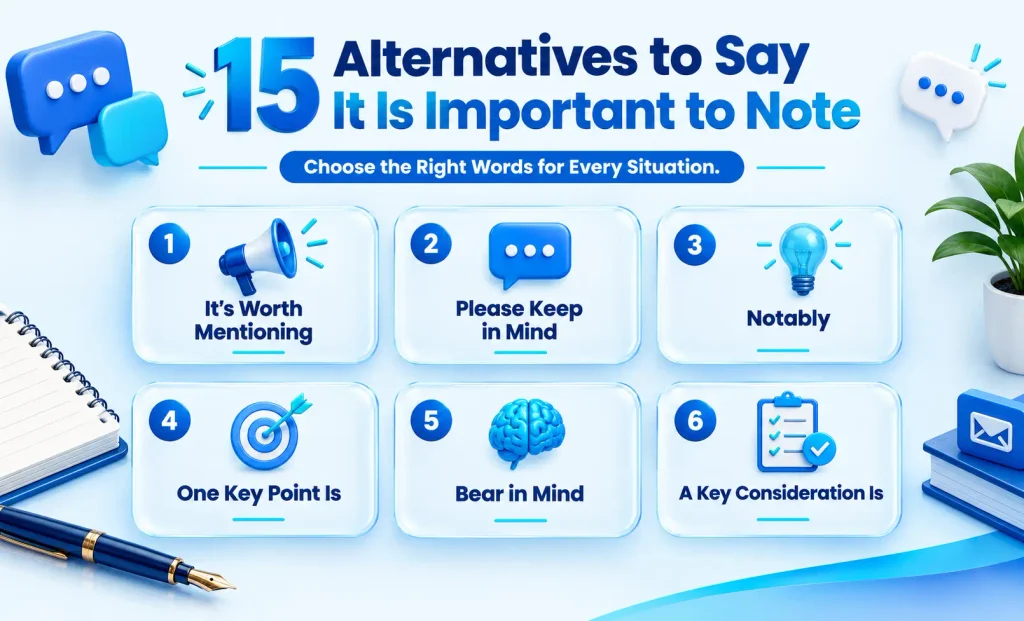
1. It’s Worth Mentioning
Meaning
“It’s worth mentioning” introduces information that adds value to the discussion. It suggests that the detail deserves attention but does not necessarily mean it is critical.
Best For: Professional, Friendly, Polite
Example 1: It’s worth mentioning that our customer satisfaction scores improved after the latest website update.
Example 2: It’s worth mentioning that the restaurant offers free parking on weekends.
Quick Tip: Use this phrase for helpful additional details rather than urgent warnings or essential requirements.
2. Please Keep in Mind
Meaning
“Please keep in mind” asks readers to remember a fact, condition, or limitation while considering other information. It sounds polite and works well when you want to guide someone’s expectations.
Best For: Professional, Polite, Friendly
Example 1: Please keep in mind that all application materials must arrive before Friday.
Example 2: Please keep in mind that delivery times may vary during the holiday season.
Quick Tip: Use this phrase when the information may affect someone’s decision, schedule, or next steps.
3. It Is Essential to Remember
Meaning
This expression emphasizes a point that readers should not overlook. It is stronger than “it’s worth mentioning” and works when a fact has a major effect on the outcome.
Best For: Formal, Professional
Example 1: It is essential to remember that regular backups protect your business from unexpected data loss.
Example 2: It is essential to remember that each applicant must meet the minimum eligibility requirements.
Quick Tip: Reserve this phrase for genuinely important information so your writing does not sound unnecessarily dramatic.
4. Notably
Meaning
“Notably” is a concise way to introduce a significant fact, feature, or result. It works especially well when you want to draw attention to one detail within a larger discussion.
Best For: Formal, Professional
Example 1: Notably, the revised training program reduced onboarding time by two weeks.
Example 2: The neighborhood has several appealing features, notably its public parks and walking trails.
Quick Tip: Place “notably” near the beginning of a sentence when highlighting a specific result or characteristic.
5. It’s Important to Remember
Meaning
This phrase reminds readers of a fact that should remain in their thoughts as they consider the subject. It sounds direct and accessible without being overly formal.
Best For: Professional, Friendly, Polite
Example 1: It’s important to remember that progress may look different for every student.
Example 2: It’s important to remember that a strong password should be unique to each account.
Quick Tip: Use it in educational content, practical advice, and explanations where readers may benefit from a clear reminder.
6. One Key Point Is
Meaning
“One key point is” introduces a central idea that deserves attention. Unlike a general reminder, it helps readers identify a specific takeaway from a larger explanation.
Best For: Professional, Formal, Friendly
Example 1: One key point is that customer feedback should guide future product improvements.
Example 2: One key point is that the new schedule gives employees more flexibility without reducing coverage.
Quick Tip: Follow this phrase with one clear idea instead of combining several unrelated details in the same sentence.
7. It’s Crucial to Understand
Meaning
This expression signals that understanding a particular fact is necessary for making a sound decision or interpreting information correctly. It carries a stronger sense of urgency than many other alternatives.
Best For: Professional, Formal
Example 1: It’s crucial to understand the contract terms before agreeing to the proposed changes.
Example 2: It’s crucial to understand how interest rates affect the total cost of a loan.
Quick Tip: Use “crucial” when misunderstanding the information could lead to a meaningful problem or poor decision.
8. Bear in Mind
Meaning
“Bear in mind” encourages someone to consider a fact while evaluating a situation. It is concise and natural, although it can sound slightly more conversational than “please keep in mind.”
Best For: Professional, Casual, Polite
Example 1: Bear in mind that the final design may look different on smaller screens.
Example 2: Bear in mind that local traffic can add time to your morning commute.
Quick Tip: This phrase works well in advice and explanations. Add “please” if you want a more courteous tone.
9. It’s Worth Highlighting
Meaning
“It’s worth highlighting” introduces a detail that deserves special attention. It is particularly useful when discussing achievements, differences, findings, or features that support your main point.
Best For: Professional, Formal
Example 1: It’s worth highlighting that the team completed the project ahead of schedule.
Example 2: It’s worth highlighting the improvements in accessibility across the redesigned website.
Quick Tip: Use this expression when you want readers to notice a particular strength, result, or contrast.
10. A Key Consideration Is
Meaning
“A key consideration is” introduces a factor that should influence a decision or evaluation. It shifts attention toward practical implications rather than simply asking readers to notice a fact.
Best For: Professional, Formal
Example 1: A key consideration is whether the software can support the company’s future growth.
Example 2: A key consideration is the amount of maintenance the new equipment will require.
Quick Tip: Follow this phrase with a relevant factor that readers can weigh when comparing options.
11. Of Particular Importance Is
Meaning
This formal expression places strong emphasis on a specific fact, requirement, or issue. It is suitable for reports, academic writing, and other contexts where a measured, authoritative tone is appropriate.
Best For: Formal, Professional
Example 1: Of particular importance is the need to protect confidential customer information.
Example 2: Of particular importance is the project’s compliance with current safety standards.
Quick Tip: Use this construction sparingly because it can sound stiff in casual conversations and everyday emails.
12. Don’t Overlook
Meaning
“Don’t overlook” warns readers not to miss a detail that may be easy to ignore. It is more direct than the original phrase and can be useful when pointing out hidden costs, small requirements, or overlooked opportunities.
Best For: Professional, Casual, Friendly
Example 1: Don’t overlook the annual renewal fee when comparing subscription plans.
Example 2: Don’t overlook the role that customer reviews play in building trust.
Quick Tip: Use this phrase when a detail is easy to miss and could affect the reader’s decision.
13. It’s Important to Recognize
Meaning
This phrase encourages readers to acknowledge a fact, pattern, contribution, or limitation. It often works well when discussing broader perspectives or helping people understand why a situation deserves careful thought.
Best For: Professional, Formal, Warm
Example 1: It’s important to recognize the effort that every team member contributed to the launch.
Example 2: It’s important to recognize that early estimates may change as new information becomes available.
Quick Tip: Choose “recognize” when the goal is acknowledgment or understanding rather than a simple reminder.
14. In Particular
Meaning
“In particular” directs attention to one specific person, detail, example, or issue within a broader subject. It is useful when narrowing a discussion to the point most relevant to your argument.
Best For: Professional, Formal, Friendly
Example 1: The new policy affects several departments, in particular the customer support team.
Example 2: We reviewed several design elements, in particular the navigation menu and mobile layout.
Quick Tip: Use it to identify a specific item rather than to introduce a general statement about importance.
15. Keep in Mind That
Meaning
“Keep in mind that” introduces a fact readers should consider as they interpret information or make a choice. It is direct, conversational, and suitable for both workplace communication and everyday writing.
Best For: Casual, Friendly, Professional
Example 1: Keep in mind that the free version does not include advanced reporting features.
Example 2: Keep in mind that a short break can help you return to a difficult task with fresh attention.
Quick Tip: This expression works well in guides and recommendations, but use a more formal alternative when writing a highly academic document.

Comparison Table
| Alternative | Best Used In | Tone |
|---|---|---|
| It’s worth mentioning | Articles and emails | Friendly, professional |
| Please keep in mind | Instructions and reminders | Polite |
| It is essential to remember | Important requirements | Formal |
| Notably | Reports and summaries | Concise, formal |
| It’s important to remember | Advice and educational content | Clear, friendly |
| One key point is | Presentations and explanations | Direct |
| It’s crucial to understand | High-impact decisions | Strong, professional |
| Bear in mind | Everyday advice | Conversational |
| It’s worth highlighting | Reports and achievements | Professional |
| A key consideration is | Evaluations and planning | Analytical |
| Of particular importance is | Formal reports | Authoritative |
| Don’t overlook | Warnings and recommendations | Direct |
| It’s important to recognize | Discussions and acknowledgments | Thoughtful |
| In particular | Detailed explanations | Neutral, professional |
| Keep in mind that | Guides and everyday communication | Conversational |
Common Mistakes When Choosing an Alternative

1. Using Casual Language in Formal Emails
Phrases such as “don’t overlook” can sound too direct in sensitive workplace situations. Consider “please keep in mind” or “it is essential to remember” when addressing clients, managers, or formal requirements.
2. Choosing Overly Formal Language
Expressions such as “of particular importance is” may make a simple message sound stiff. Choose everyday wording when writing for a general audience or communicating with colleagues you know well.
3. Repeating the Same Alternative
Replacing every instance of “it is important to note” with “please keep in mind” does not solve repetition. Vary your wording based on the purpose of each sentence, and remove unnecessary introductory phrases when possible.
4. Ignoring the Context
Not every important detail needs a warning. Use “notably” to highlight a finding, “a key consideration is” to introduce a decision factor, and “it’s crucial to understand” when comprehension is essential.
5. Overstating the Importance
Words such as “essential” and “crucial” suggest that something matters greatly. Using them for minor details can weaken their impact. Choose a softer phrase when the information is helpful but not critical.
Frequently Asked Questions

1. What is the most professional way to say “it is important to note”?
“Please keep in mind,” “it is essential to remember,” and “a key consideration is” are professional alternatives. The best option depends on your message. Use “please keep in mind” for reminders, “essential to remember” for important requirements, and “a key consideration is” when explaining a factor that affects a decision.
2. What is a shorter way to say “it is important to note”?
“Notably” is one of the shortest alternatives. “Importantly” can also work when introducing a significant point, while “remember” is useful for direct reminders. Choose the word that fits the sentence instead of replacing the original phrase automatically. In some cases, removing the introductory phrase makes your writing even clearer.
3. How can I say “it is important to note” in an academic paper?
Academic writing often benefits from concise phrases such as “notably,” “it is worth noting,” and “a key consideration is.” When presenting research, be specific about the finding, limitation, or condition you want readers to understand. Avoid adding formal phrases to every paragraph when the evidence can speak for itself.
4. What can I use instead of “it is important to note” in a business email?
Use “please keep in mind” for reminders, “it’s worth mentioning” for additional information, or “one key point is” to clarify a main takeaway. For example, you might write, “Please keep in mind that the revised proposal is due Monday.” Choose a direct phrase that helps the recipient understand what matters and what action may be needed.
5. Is “it is worth noting” grammatically correct?
Yes. “It is worth noting” is grammatically correct and widely used in professional, academic, and informational writing. It introduces a fact that deserves attention without necessarily suggesting urgency. However, it can become repetitive if used too often, so alternatives such as “notably” or “one key point is” may improve variety.
6. Is “importantly” a good replacement for this phrase?
Yes, “importantly” can introduce a significant point, especially when the information affects how readers interpret an argument. However, it should connect naturally to the sentence. For example, “Importantly, the revised policy applies to all new employees.” Avoid using it merely to make an ordinary detail sound more significant than it is.
7. How do I emphasize an important point without sounding repetitive?
Use a mix of direct statements, transitions, and context-specific phrases. You can write “the main concern is,” “one key point is,” or “a critical factor is,” depending on your purpose. You can also use headings, bullet points, or sentence structure to draw attention to a key detail without repeating the same expression.
8. Should I use “it is important to note” or “please note”?
Use “it is important to note” when explaining why a fact deserves attention. Use “please note” when directing readers to a specific instruction, update, or detail. For example, a report might introduce a limitation with the first phrase, while an event announcement might use the second to highlight a change in the schedule.
Conclusion
Choosing another way to say “it is important to note” can make your writing clearer, more engaging, and better suited to your audience. The best alternative depends on what you want readers to do with the information.
For professional emails, “please keep in mind” offers a polite way to communicate reminders. In reports and academic writing, “notably” and “a key consideration is” help highlight findings and important factors. When a detail has serious implications, “it is essential to remember” or “it’s crucial to understand” provides stronger emphasis.
You do not need to replace the original phrase every time. Sometimes, a direct sentence communicates the message more effectively than an introductory expression. Focus on clarity, accuracy, and tone, and choose words that reflect the true importance of the information. The most effective writing helps readers recognize what matters without making them work harder to understand your point.

The Majestic Studio Editorial Team creates practical resources about synonyms, alternative phrases, vocabulary, and English usage. Our content is designed to help readers choose clearer, more natural words and communicate effectively in everyday, professional, and academic contexts.
Each article is researched, edited, and reviewed for clarity, context, usefulness, and language accuracy. We regularly update our content to keep examples and recommendations relevant.