
Another way to say “it is” depends on the meaning and context of your sentence. You can use phrases such as “that means,” “in other words,” “namely,” “this suggests,” or “the fact is.” These alternatives help clarify ideas, reduce repetition, and make everyday conversations, essays, and professional writing sound more natural.
Key Takeaways
- Choose an alternative based on what you want to explain, emphasize, or clarify.
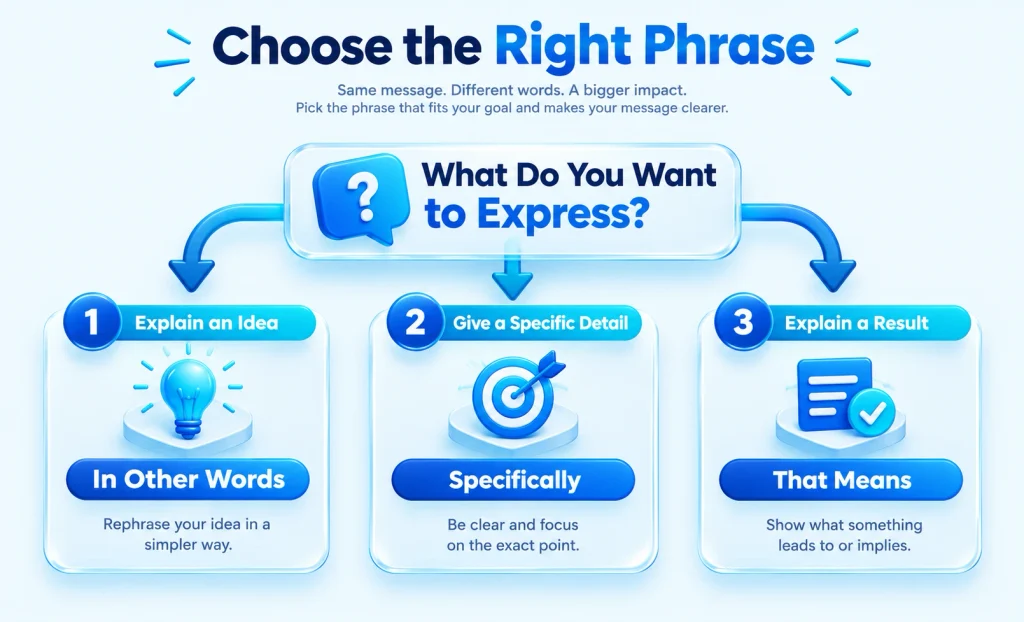
- Use “in other words” to restate an idea in simpler language.
- Choose “namely” or “specifically” when introducing exact details.
- Use “that means” to explain a result or consequence.
- Match your wording to the audience, tone, and purpose of your message.
Finding another way to say “it is” can make your writing clearer, more engaging, and less repetitive. The best replacement depends on what follows the phrase and whether you want to explain a meaning, introduce a fact, clarify a point, or emphasize an opinion.
Although “it is” works in many situations, varying your wording can help you communicate more naturally. Below are 15 alternatives, with meanings, examples, and practical tips to help you choose the right expression.
What Does “Another Way to Say It Is” Mean?
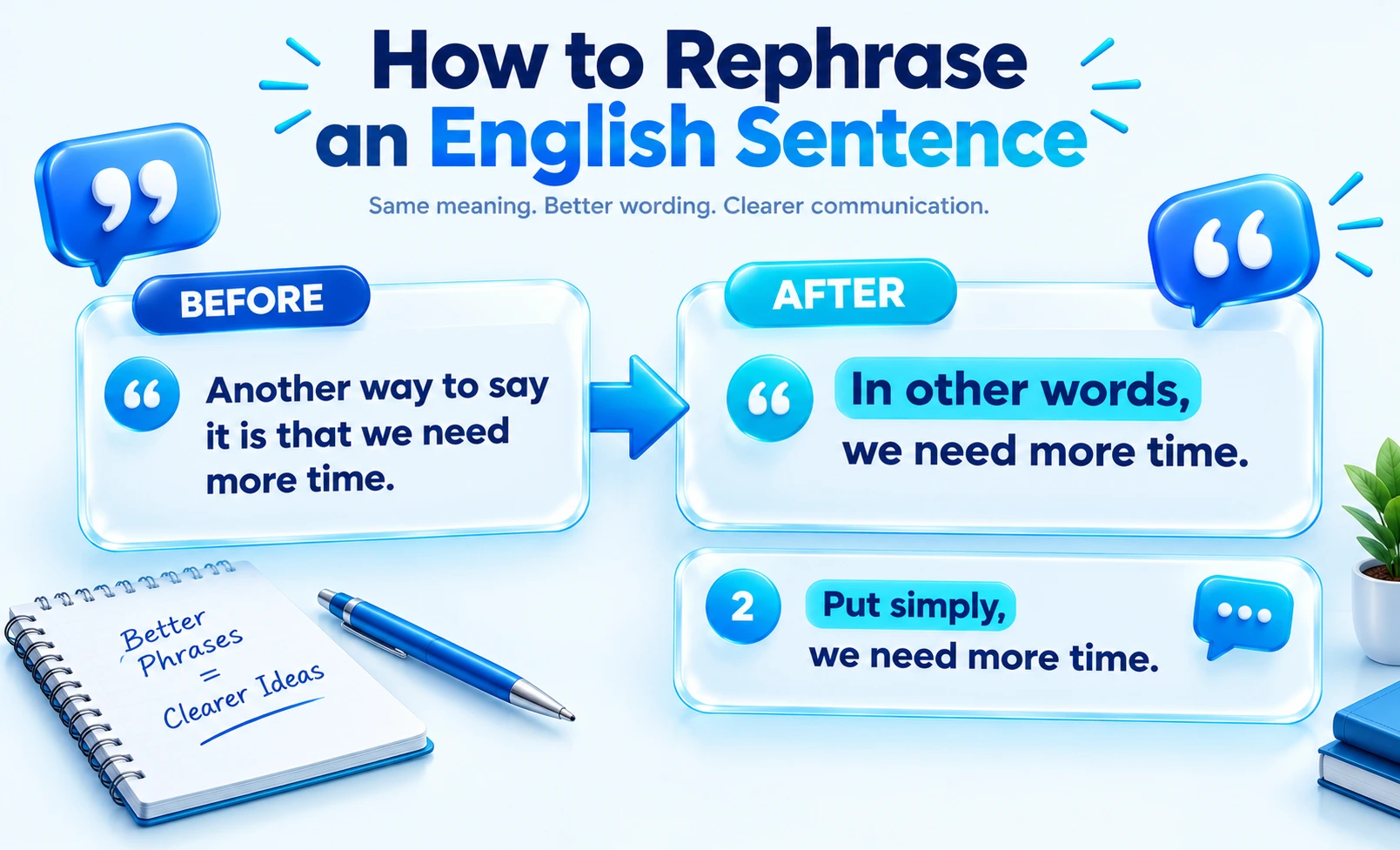
The phrase “another way to say it is” introduces a different expression for communicating the same idea. People often use it to simplify a complicated statement, explain something more clearly, or offer an alternative description.
For example, you might say, “Another way to say it is that we need more time.” This signals that you are about to restate an idea in a way that may be easier to understand.
The phrase appears in everyday conversations, workplace discussions, school assignments, presentations, and online writing. Depending on the context, shorter alternatives such as “in other words” or “that means” may communicate the same idea more smoothly.
Why Use Other Ways to Say “It Is”?
Using different expressions helps your writing sound natural and keeps readers engaged. It also lets you express the exact relationship between two ideas instead of relying on the same words repeatedly.
Consider these benefits:
- Avoid repetition: Keep paragraphs from sounding monotonous.
- Improve clarity: Explain complicated information in simpler terms.
- Match the situation: Choose wording that suits a casual conversation or a formal report.
- Emphasize key points: Draw attention to important facts or conclusions.
- Improve professional communication: Present ideas clearly in emails, meetings, and presentations.
The goal is not to replace every instance of “it is.” Instead, choose an alternative when it makes your meaning clearer or your sentence easier to read.
15 Best Other Ways to Say “It Is”
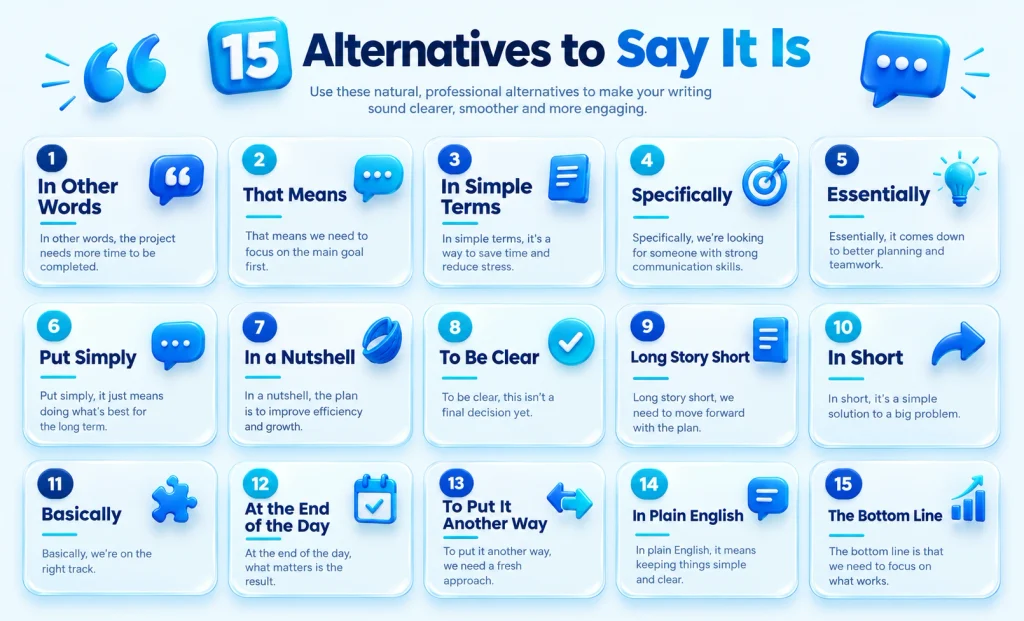
The following alternatives work in different situations. Some introduce an explanation, while others identify a specific detail, express a conclusion, or emphasize a fact.
1. In Other Words
Meaning: “In other words” introduces a restatement of something you have already said. It is especially helpful when you want to make an idea easier to understand without changing its meaning.
Best For: Professional, Friendly, Polite
Example 1: The deadline cannot be extended. In other words, we need to finish the project by Friday.
Example 2: She wants to work remotely. In other words, she prefers working from home.
Quick Tip: Use this phrase when the second statement explains or simplifies the first one.
2. That Means
Meaning: “That means” explains the meaning, result, or consequence of a previous statement. It works well when you want to connect information to a practical conclusion.
Best For: Casual, Friendly, Professional
Example 1: Your application has been approved. That means you can begin training next week.
Example 2: The store closes at six. That means we should leave before five.
Quick Tip: Choose this expression when you are explaining what a fact means for someone.
3. In Simple Terms
Meaning: “In simple terms” introduces an explanation that avoids unnecessary complexity. It is useful when discussing technical subjects, unfamiliar concepts, or detailed instructions.
Best For: Professional, Friendly, Polite
Example 1: In simple terms, inflation means that prices rise and money buys less than before.
Example 2: In simple terms, the new software helps our team finish routine tasks faster.
Quick Tip: Use it before an accessible explanation, especially when your audience may be unfamiliar with the subject.
4. To Put It Another Way
Meaning: This phrase signals that you are expressing an idea differently to improve understanding. It is slightly longer than “in other words” but sounds natural in explanations and presentations.
Best For: Professional, Formal, Friendly
Example 1: The proposal needs more detail. To put it another way, we need stronger evidence before approval.
Example 2: He values quality over speed. To put it another way, he would rather do the job correctly than rush it.
Quick Tip: Use it when you want to rephrase a point without sounding abrupt.
5. The Fact Is
Meaning: “The fact is” introduces a statement that you consider important, true, or worth acknowledging. It can add emphasis, particularly when correcting a misunderstanding or addressing a difficult issue.
Best For: Professional, Casual, Direct
Example 1: The fact is, we do not have enough staff to handle another project.
Example 2: The fact is that she completed the assignment before the deadline.
Quick Tip: Use this expression sparingly because it can sound forceful when discussing sensitive subjects.
6. Specifically
Meaning: “Specifically” narrows a general statement by identifying an exact detail, requirement, or example. It helps readers understand precisely what you mean.
Best For: Professional, Formal, Polite
Example 1: We need to improve customer service, specifically our response time to complaints.
Example 2: Please bring the required documents, specifically your ID and proof of address.
Quick Tip: Follow “specifically” with the precise detail you want to highlight.
7. Namely
Meaning: “Namely” introduces the particular person, thing, or detail you are referring to. It is useful when you want to identify something clearly in formal or informational writing.
Best For: Formal, Professional
Example 1: Two factors influenced our decision, namely cost and delivery time.
Example 2: One employee will lead the training, namely our senior project manager.
Quick Tip: Use “namely” when identifying exact items rather than introducing a broad explanation.
8. Essentially
Meaning: “Essentially” summarizes the main point of a statement while leaving out minor details. It helps readers focus on the central idea behind a complicated situation.
Best For: Professional, Casual, Friendly
Example 1: Essentially, the new policy gives employees more flexibility over their schedules.
Example 2: The two plans are essentially the same, although their prices differ slightly.
Quick Tip: Use it for a concise summary, but avoid it when important details or exceptions need to remain visible.
9. In Effect
Meaning: “In effect” describes what a rule, decision, or situation means in practice. It can also indicate that something has the same practical result as another action.
Best For: Professional, Formal
Example 1: In effect, the new policy gives every department the same approval process.
Example 2: The agreement is, in effect, a commitment to provide support for another year.
Quick Tip: This phrase works best when discussing practical consequences, policies, or agreements.
10. This Means That
Meaning: “This means that” connects a previous fact or observation to its explanation or consequence. It is a clear option for showing readers how one piece of information affects another.
Best For: Professional, Friendly, Polite
Example 1: The supplier has delayed the shipment. This means that our delivery dates may need to change.
Example 2: Your account is now verified. This means that you can access the additional features.
Quick Tip: Make sure the word “this” clearly refers to the preceding idea.
11. The Point Is
Meaning: “The point is” directs attention to the main idea of a discussion. It is useful when you want to bring a conversation back to its central message.
Best For: Casual, Friendly, Direct
Example 1: We can discuss the design later. The point is that we need to meet the launch date.
Example 2: The point is, everyone deserves a fair chance to contribute.
Quick Tip: Use it to emphasize a central message, but choose a softer phrase when a discussion is already tense.
12. What This Shows Is
Meaning: “What this shows is” introduces an interpretation based on evidence, observations, or results. It helps explain what information reveals about a situation.
Best For: Professional, Formal
Example 1: What this shows is that customers respond well to faster support.
Example 2: What this shows is the importance of checking every figure before submitting the report.
Quick Tip: Use this expression when your statement is supported by facts or observations rather than personal opinion alone.
13. Put Simply
Meaning: “Put simply” introduces a brief explanation of an idea in straightforward language. It works well when the original subject is complicated or the reader needs a quick summary.
Best For: Professional, Friendly, Casual
Example 1: Put simply, we need more time and a larger budget to complete the project.
Example 2: Put simply, a balanced budget means spending no more than you can afford.
Quick Tip: Keep the explanation that follows short and easy to understand.
14. In Essence
Meaning: “In essence” presents the central meaning of an idea while setting aside less important details. It is often used in essays, reports, and discussions that require a thoughtful summary.
Best For: Formal, Professional
Example 1: In essence, the proposal aims to make public transportation more accessible.
Example 2: In essence, her argument is that good communication prevents avoidable mistakes.
Quick Tip: Choose “in essence” for a polished summary, especially in analytical writing.
15. This Suggests That
Meaning: “This suggests that” introduces a possible conclusion based on available evidence. Unlike a phrase that states a definite fact, it leaves room for uncertainty or other explanations.
Best For: Professional, Formal, Polite
Example 1: Website visits increased after the redesign. This suggests that the new layout may be easier to navigate.
Example 2: Several customers requested the same feature. This suggests that it could be worth adding to the next release.
Quick Tip: Use this phrase when the evidence supports a conclusion but does not prove it beyond doubt.
Comparison Table
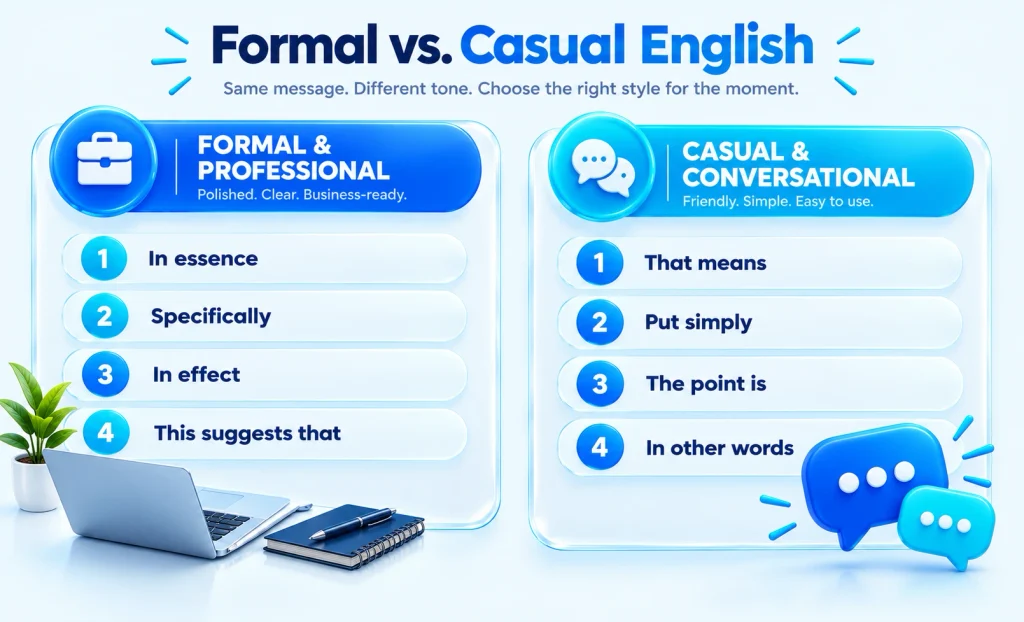
| Alternative | Best Used In | Tone |
|---|---|---|
| In other words | Explanations and restatements | Neutral |
| That means | Everyday explanations | Clear and direct |
| In simple terms | Complex topics | Accessible |
| To put it another way | Presentations and discussions | Polished |
| The fact is | Emphasizing a point | Firm |
| Specifically | Details and instructions | Precise |
| Namely | Identifying exact items | Formal |
| Essentially | Summaries | Neutral |
| In effect | Policies and consequences | Formal |
| This means that | Explaining results | Clear |
| The point is | Central arguments | Direct |
| What this shows is | Evidence-based analysis | Analytical |
| Put simply | Brief explanations | Conversational |
| In essence | Summaries and essays | Formal |
| This suggests that | Interpreting evidence | Cautious |
Common Mistakes When Choosing an Alternative
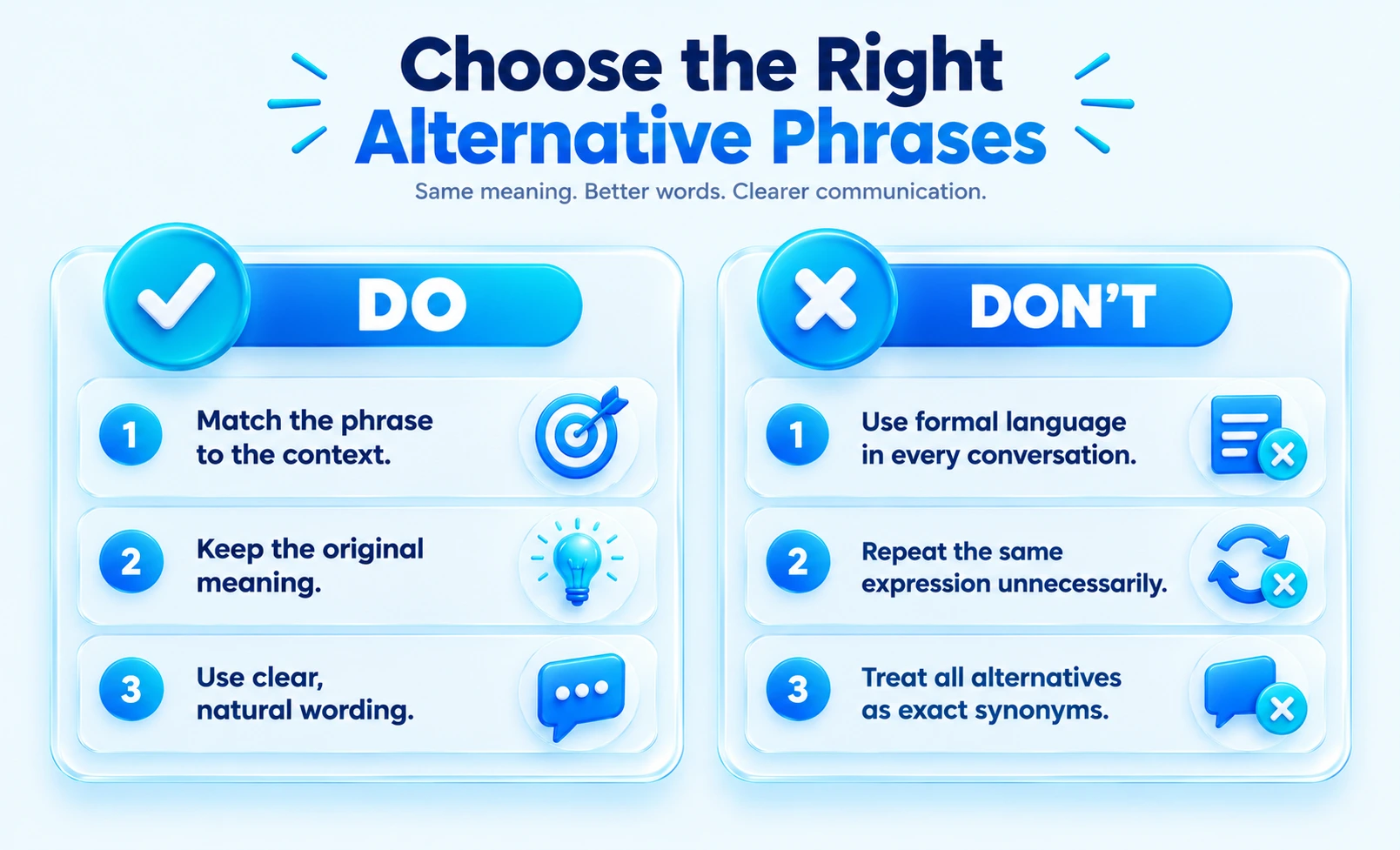
Choosing the right phrase involves more than finding words with a similar meaning. Pay attention to context, sentence structure, and the level of certainty you want to express.
- Using a casual phrase in a formal report. Expressions such as “the point is” may sound too conversational in a formal document. Choose “in essence” or “specifically” when appropriate.
- Choosing overly formal wording. “Namely” may feel unnatural in a casual text message. A simpler expression, such as “that means,” usually works better.
- Repeating the same alternative. Replacing every instance of “it is” with “in other words” can create another repetitive pattern. Vary your wording only when it improves clarity.
- Ignoring the original meaning. “This suggests that” expresses a possible conclusion, while “that means” often introduces a more direct consequence. Choose the phrase that accurately reflects your intended message.
- Adding emphasis where it is not needed. “The fact is” can sound confrontational, particularly in a disagreement. Use a neutral expression if your goal is to keep the conversation constructive.
Frequently Asked Questions
1. What is another way to say “it is”?
Useful alternatives include “that means,” “in other words,” “specifically,” “essentially,” and “the fact is.” The right choice depends on the sentence. For example, use “specifically” to introduce a precise detail and “in other words” to explain an idea differently.
2. What is a more professional way to say “it is”?
Professional alternatives include “in essence,” “specifically,” “in effect,” and “this indicates that.” Each serves a different purpose. Use “in effect” to describe a practical consequence, while “this indicates that” can introduce a conclusion supported by evidence.
3. How can I say “another way to say it is” more naturally?
Try “in other words,” “to put it another way,” or “put simply.” These expressions introduce a restatement without requiring the longer original phrase. For everyday conversations, “that means” can also work well when you are explaining the result of something.
4. What is a formal synonym for “in other words”?
Depending on the context, you can use “in essence,” “namely,” or “specifically.” However, these expressions are not interchangeable in every sentence. “In essence” summarizes the central idea, “namely” identifies exact details, and “specifically” narrows the focus.
5. Is “that means” the same as “in other words”?
Not exactly. “That means” usually explains the meaning or consequence of a statement, while “in other words” restates the original idea. For example, a delayed shipment means the delivery date may change, whereas “in other words” can introduce a simpler version of the same message.
6. What can I use instead of “it is” in an essay?
For essays, consider “in essence,” “this indicates that,” “specifically,” and “in effect.” Choose according to your argument. Use “this indicates that” when interpreting evidence, and use “in essence” when summarizing the main point without repeating every detail.
7. How do I avoid repeating “it is” in my writing?
First, decide whether “it is” is actually repetitive or simply the clearest grammatical choice. When another phrase adds meaning, replace it with an appropriate alternative. You can also restructure the sentence, use a more precise verb, or combine closely related ideas.
8. Which alternative is best for explaining a complicated idea?
“In simple terms” and “put simply” are excellent choices when your goal is to make an explanation easier to follow. “To put it another way” works when you want to restate a previous sentence. Follow any of these expressions with a short explanation that preserves the original meaning.
Conclusion
Choosing another way to say “it is” can make your writing more precise, natural, and engaging. The best expression depends on what you want to communicate, who will read your message, and how formal the situation is.
Use “in other words” to restate an idea, “that means” to explain a consequence, and “specifically” to introduce exact details. For essays and professional documents, “in essence” and “in effect” can provide a more formal tone. When discussing evidence, “this suggests that” helps you communicate a possible conclusion without overstating the facts.
Remember that you do not need to replace every occurrence of “it is.” Sometimes the original wording is the clearest option. Read your sentence aloud, check that the alternative preserves your intended meaning, and choose the expression that helps your reader understand your point.

The Majestic Studio Editorial Team creates practical resources about synonyms, alternative phrases, vocabulary, and English usage. Our content is designed to help readers choose clearer, more natural words and communicate effectively in everyday, professional, and academic contexts.
Each article is researched, edited, and reviewed for clarity, context, usefulness, and language accuracy. We regularly update our content to keep examples and recommendations relevant.