

Need a better way to introduce an example in your writing? Expressions such as “for instance,” “to illustrate,” and “a case in point” can help you explain ideas clearly without repeating the same words.
The best phrase depends on your audience and purpose. Some expressions work well in professional emails, while others fit academic essays, reports, and everyday conversations.
In this guide, you’ll learn 15 useful alternatives, what they mean, when to use them, and how to include them naturally in a sentence.
Key Takeaways
- Use “for instance” or “for example” for clear, everyday explanations.
- Choose “to illustrate” for formal reports and academic writing.
- Use “a case in point” to support an argument with a relevant situation.
- Use “such as” and “including” to introduce items within a sentence.
- Match your wording to your audience, purpose, and sentence structure.
What Does “One Example” Mean?

“One example” refers to a specific person, situation, item, or event that helps explain a broader idea. It makes abstract information easier to understand by connecting it to something concrete.
For instance, you might explain that exercise supports good health and mention walking as one activity people can try. In a business report, you could describe a successful project to demonstrate effective teamwork.
These expressions are common in essays, presentations, business emails, reports, and everyday conversations. A suitable alternative can make your explanation clearer and help readers understand why the example matters.
Why Use Different Example Phrases?
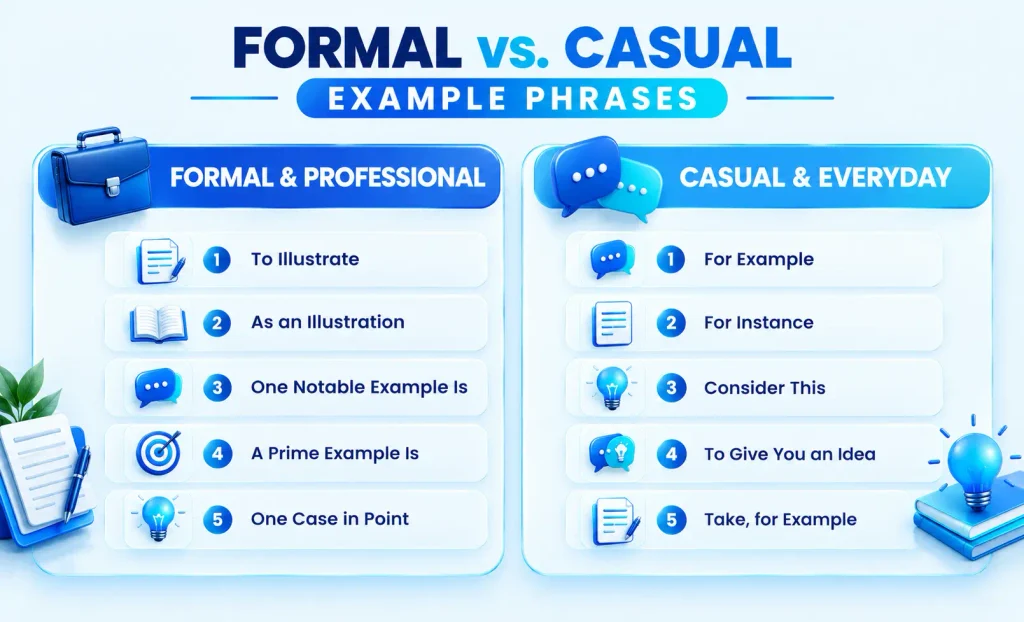
Repeating the same expression can make an article feel monotonous. Choosing an appropriate alternative can improve the flow of your writing and help you communicate with different audiences.
Here are a few benefits:
- Reduce repetition: Vary your wording when the same transition appears too often.
- Improve clarity: Connect specific details to your main idea.
- Sound professional: Choose expressions that suit workplace communication.
- Strengthen arguments: Introduce relevant evidence to support your point.
- Keep readers engaged: Make explanations flow naturally from one sentence to the next.
However, variety should not become your main goal. Clear, familiar language is often more effective than an unusual phrase that distracts readers.
15 Best Alternatives to “One Example”
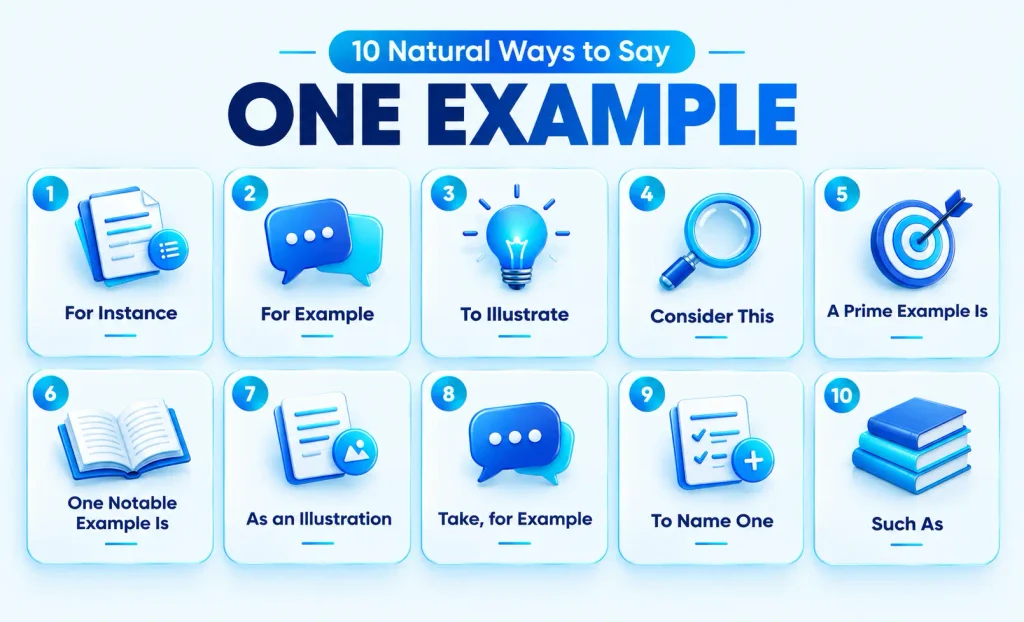
1. For Instance
Meaning: This expression introduces a specific case that explains a general statement. It has nearly the same meaning as “for example” and works in many situations.
Best for: Professional, friendly, casual, and formal writing.
Example 1: Some employees prefer flexible schedules. For instance, parents may need time to pick up their children from school.
Example 2: You can make a small room look larger. For instance, light-colored walls can create a more open feel.
Quick tip: Use this expression when you want a natural alternative to “for example.”
2. For Example
Meaning: This is a straightforward way to introduce a particular case that supports or explains a point. It is widely understood and suitable for most audiences.
Best for: Emails, essays, reports, and everyday conversations.
Example 1: You can improve your writing in several ways. For example, reading your work aloud can help you spot awkward sentences.
Example 2: Many businesses use digital tools to save time. For example, scheduling software can reduce manual work.
Quick tip: Choose this phrase when clarity matters more than stylistic variety.
3. To Illustrate
Meaning: This expression introduces a situation or detail that makes an idea easier to understand. It is especially useful when explaining a concept or supporting a point.
Best for: Formal, academic, and professional writing.
Example 1: To illustrate the value of preparation, the manager described how the team finished its presentation early.
Example 2: To illustrate this principle, the teacher compared two essays with different organizational structures.
Quick tip: Use it when the example explains how an idea works, not merely when listing items.
4. A Case in Point
Meaning: This phrase highlights a specific situation that supports a broader statement. It often suggests that the example provides convincing evidence.
Best for: Reports, arguments, and formal discussions.
Example 1: Reliable customer service can encourage repeat business. A case in point is a local store known for resolving complaints quickly.
Example 2: Accessible websites can serve more users. A case in point is a company that added keyboard navigation to its website.
Quick tip: Make sure the situation directly supports your claim.
5. A Prime Example Is
Meaning: This phrase introduces a particularly strong or clear illustration of an idea. It suggests that the example represents the point especially well.
Best for: Presentations, persuasive writing, and professional articles.
Example 1: Consistent practice builds confidence. A prime example is a speaker who improves through regular rehearsals.
Example 2: Good planning can prevent delays. A prime example is a project team that assigns responsibilities before work begins.
Quick tip: Reserve “prime example” for a case that stands out.
6. Consider This
Meaning: This expression invites readers to think about a situation or possibility. It can help emphasize a point or encourage the audience to reconsider an assumption.
Best for: Presentations, discussions, and persuasive writing.
Example 1: Consider this: a customer who receives helpful support may be more likely to return.
Example 2: Consider this situation: two candidates have similar qualifications, but only one communicates clearly during the interview.
Quick tip: Use it to draw attention to an important point, rather than in every paragraph.
7. One Example Is
Meaning: This direct expression introduces a specific item or situation that supports the statement before it. It is simple, clear, and easy to use.
Best for: General, professional, and academic writing.
Example 1: There are several ways to reduce household waste. One example is using reusable containers instead of disposable packaging.
Example 2: Many skills improve with practice. One example is public speaking, which often becomes easier with preparation.
Quick tip: Choose this phrase when you want a direct introduction without extra formality.
8. One Notable Example Is
Meaning: This expression highlights a relevant or significant case. It tells readers that the example deserves attention because of its importance.
Best for: Reports, articles, and professional explanations.
Example 1: Several cities have improved public transportation. One notable example is a city that expanded bus routes to underserved neighborhoods.
Example 2: Some employers have improved their hiring processes. One notable example is a company that introduced structured interviews.
Quick tip: Use “notable” only when the case is genuinely significant.
9. Take, for Example
Meaning: This phrase asks readers to consider a particular person, object, or situation as an illustration. It connects a general idea with a concrete case.
Best for: Conversations, presentations, and explanations.
Example 1: Take, for example, a small business that uses customer feedback to improve its services.
Example 2: Take, for example, a student who studies for twenty minutes daily instead of cramming before an exam.
Quick tip: Put the subject immediately after the phrase to keep the sentence easy to follow.
10. Such As
Meaning: This expression introduces specific items that belong to a larger category. It is useful for giving examples within a sentence.
Best for: Lists, descriptions, reports, and general writing.
Example 1: Creative hobbies, such as painting and photography, can provide a relaxing break after work.
Example 2: Communication skills, such as active listening and clear writing, help teams work together.
Quick tip: Use it within a sentence rather than as a standalone transition.
11. To Give You an Idea
Meaning: This conversational expression provides information that helps someone understand the scale, nature, or practical details of a situation.
Best for: Friendly conversations and informal business communication.
Example 1: To give you an idea of the workload, our support team handles about 200 customer requests each week.
Example 2: To give you an idea of the cost, repairing the damaged part is cheaper than replacing the entire appliance.
Quick tip: Use it when explaining quantities, costs, timelines, or practical details.
12. As an Illustration
Meaning: This formal expression introduces a case that demonstrates or explains a point. It is useful in structured writing and professional presentations.
Best for: Academic, formal, and professional writing.
Example 1: As an illustration, the report compares sales figures from the first and second quarters.
Example 2: As an illustration of effective planning, the manager shared a timeline that helped the team meet its deadlines.
Quick tip: In casual messages, “for example” may sound more natural.
13. To Name One
Meaning: This phrase identifies one item from a larger group of possible examples. It is useful when you want to mention one case without listing every option.
Best for: Conversations, articles, and general writing.
Example 1: Several tools help people organize their schedules; Google Calendar, to name one, offers reminders and shared calendars.
Example 2: Many national parks attract hikers; Yosemite, to name one, is famous for its granite cliffs.
Quick tip: Use it when readers already understand that other examples exist.
14. Including
Meaning: “Including” introduces one or more items that form part of a larger group. It does not suggest that the list contains every possible item.
Best for: Business writing, descriptions, reports, and everyday English.
Example 1: The training covers several communication skills, including active listening, clear writing, and conflict resolution.
Example 2: We offer several editing services, including proofreading, sentence-level revisions, and content feedback.
Quick tip: Use it when the items are members of a broader category.
15. To Put This in Context
Meaning: This phrase introduces background information that helps readers understand why a fact or situation matters. It emphasizes the circumstances surrounding a point.
Best for: Reports, analytical writing, and formal explanations.
Example 1: To put this in context, the department received twice as many customer requests this month as it did last month.
Example 2: To put this in context, the proposed budget covers three regional offices rather than just the main location.
Quick tip: Choose it when readers need additional background, not simply another item in a list.
Comparison Table: 15 Alternative Phrases

| Alternative | Best Used In | Tone |
|---|---|---|
| For instance | Emails and conversations | Natural |
| For example | General writing | Neutral |
| To illustrate | Essays and presentations | Formal |
| A case in point | Arguments and reports | Authoritative |
| A prime example is | Persuasive writing | Emphatic |
| Consider this | Discussions | Persuasive |
| One example is | General explanations | Direct |
| One notable example is | Articles and reports | Professional |
| Take, for example | Explanations | Conversational |
| Such as | Lists and descriptions | Neutral |
| To give you an idea | Conversations | Friendly |
| As an illustration | Formal documents | Formal |
| To name one | Discussions and articles | Conversational |
| Including | Reports and descriptions | Neutral |
| To put this in context | Analytical writing | Explanatory |
Common Mistakes When Choosing an Alternative

1. Using Casual Phrases in Formal Writing
Expressions such as “consider this” can sound conversational in a research paper. Choose “to illustrate” when a more formal tone is appropriate.
2. Making Simple Ideas Sound Complicated
Long expressions do not automatically improve your writing. In most situations, “for example” communicates the point more clearly than an unnecessarily formal alternative.
3. Repeating the Same Phrase Too Often
Using the same transition in every paragraph can make an article feel repetitive. Vary your wording when appropriate, but do not sacrifice clarity for variety.
4. Ignoring Sentence Structure
Some expressions serve different grammatical roles. “Such as” usually introduces items within a sentence, while “for instance” can introduce a complete sentence.
5. Giving Irrelevant Examples
An example should help readers understand your point. An unrelated detail can distract from your argument, even when you introduce it with the correct phrase.
Frequently Asked Questions
What is a simple alternative to “one example”?
“For example” and “for instance” are simple, widely understood options. Both introduce a specific case that explains a broader point. They work well in everyday conversations, emails, reports, and essays. Choose whichever fits the rhythm of your sentence.
What is a professional alternative?
“To illustrate,” “one notable example is,” and “a case in point” are useful in professional communication. For instance, a report might say, “To illustrate the issue, the attached document identifies three delays.” Choose a phrase that suits the document and audience.
What can I use in an academic essay?
Try “for instance,” “to illustrate,” or “a prime example is.” You can also use “such as” to introduce items within a sentence. Ensure that each example supports your argument, and explain its relevance instead of expecting readers to make the connection themselves.
Is “for instance” the same as “for example”?
Yes. The expressions have almost the same meaning and are interchangeable in many contexts. Both introduce a specific case that supports a general statement. They have a similar tone, so either can work in professional emails, essays, and everyday conversations.
How do I introduce an example in a formal email?
Use “for instance,” “to illustrate,” or “one example is.” For example, write, “To illustrate the issue, the attached report identifies three delays in the approval process.” Keep the example relevant, provide enough context, and explain any action you want the recipient to take.
Can “such as” replace “for example”?
Sometimes. “Such as” generally introduces examples within a sentence, as in “We offer services such as editing and proofreading.” “For example” can introduce a separate sentence. Both are correct when used with the appropriate sentence structure.
How can I avoid repeating “for example”?
Alternate naturally between “for example,” “for instance,” and “to illustrate.” You can also use “such as” within a sentence or include the example without a transition. Prioritize clarity rather than replacing every repeated phrase with a more complicated expression.
Which phrase is best for supporting an argument?
“A case in point” is useful when a specific situation supports a broader claim. “A prime example” works when the case is particularly strong or representative. Whichever expression you choose, make sure the example is relevant and supported by accurate information.
Conclusion
The right expression can make your writing clearer, more natural, and easier to follow. For everyday communication, “for example” and “for instance” are reliable choices. In academic essays and professional reports, “to illustrate” and “as an illustration” may be more appropriate.
When you want to support an argument, consider “a case in point.” To introduce items within a sentence, use “such as” or “including.” Meanwhile, “to put this in context” helps explain why a fact or situation matters.
Before choosing a phrase, think about your audience, purpose, and sentence structure. Make sure the example supports the point you are making. You do not need to use a different expression every time. Clear, accurate language matters more than variety alone.

The Majestic Studio Editorial Team creates practical resources about synonyms, alternative phrases, vocabulary, and English usage. Our content is designed to help readers choose clearer, more natural words and communicate effectively in everyday, professional, and academic contexts.
Each article is researched, edited, and reviewed for clarity, context, usefulness, and language accuracy. We regularly update our content to keep examples and recommendations relevant.