

Another way to say “you guys” includes everyone, all of you, you all, folks, everyone here, and your group. The best choice depends on the setting and tone. “You all” works well in everyday conversation, while “everyone” or “all of you” can sound more neutral and polished.
Key Takeaways
- “You guys” is common in casual American English, but it may not suit every audience or setting.
- “You all” and “everyone” are natural, neutral alternatives for most situations.
- “Folks” adds a friendly, approachable tone and works well in casual or community settings.
- “All of you” can add emphasis when you are addressing a specific group.
- Choose your wording based on the audience, relationship, and level of formality.
Another Way to Say You Guys
“You guys” is one of the most common ways Americans address two or more people at once. It sounds natural in casual conversation, but you may want another way to say “you guys” when writing professionally, speaking to a mixed audience, or simply trying to vary your language.
Fortunately, English offers plenty of natural alternatives. Some sound casual and friendly, while others are more neutral, polished, or formal.
What Does “Another Way to Say You Guys” Mean?
The phrase “another way to say you guys” refers to alternative expressions for addressing a group of two or more people. For example, instead of saying, “Are you guys ready?” you could say, “Is everyone ready?” or “Are you all ready?”
“You guys” is widely used in American English, especially in informal speech, texting, social media, and friendly conversations. Although many speakers use it as a gender-neutral expression, some people prefer alternatives that clearly include everyone.
The best replacement depends on the situation. A phrase that sounds natural with friends may feel too casual in a workplace email.
Why Use Other Ways to Say “You Guys”?
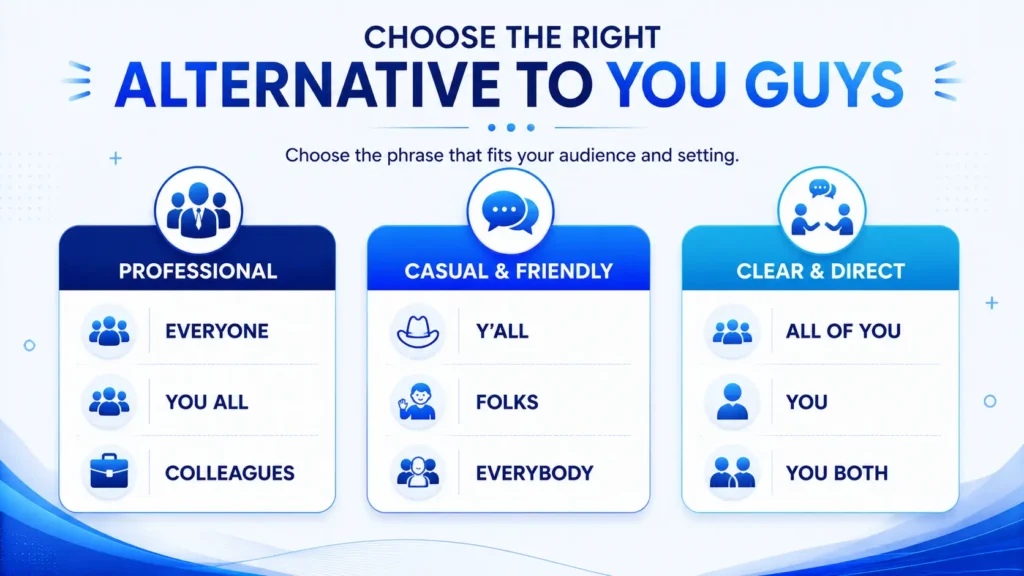
Using alternatives can make your communication more flexible and appropriate for different audiences.
- Avoid repetition: Vary your wording when addressing groups frequently.
- Sound more inclusive: Choose expressions that work naturally for diverse audiences.
- Match the situation: Use casual, friendly, neutral, or formal language as needed.
- Improve professional communication: Some alternatives fit meetings, emails, and presentations better.
- Sound more natural: The right expression can make your sentence flow more smoothly.
10 Best Other Ways to Say “You Guys”
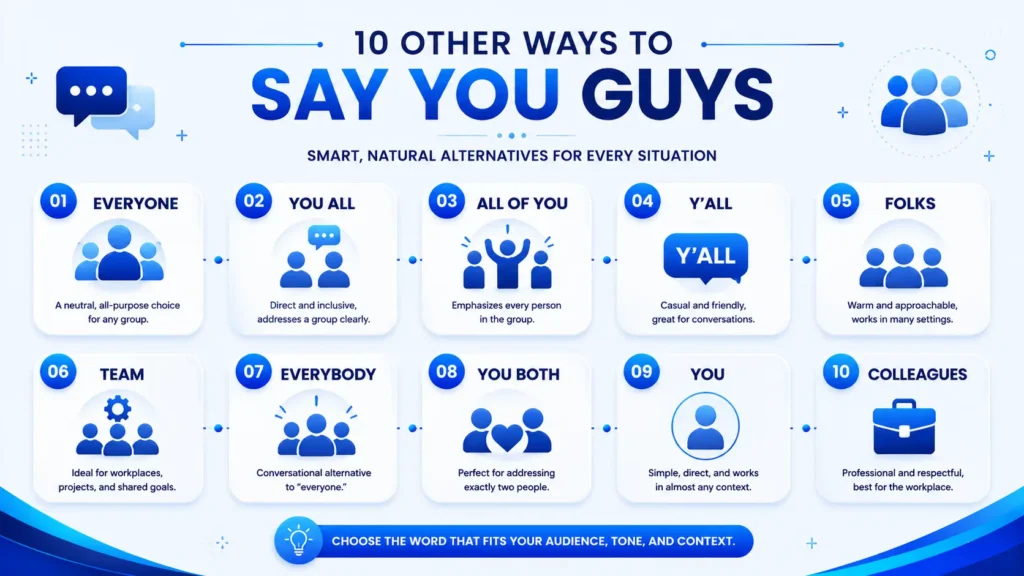
1. You All
Meaning
“You all” is a natural way to address a group directly. It is friendly and conversational while being more explicitly inclusive than “you guys.”
It works particularly well in everyday American English and can be used with friends, coworkers, classmates, or customers.
Best For
- Casual
- Friendly
- Polite
Example 1
“Are you all planning to attend the workshop on Saturday?”
Example 2
“I hope you all had a great time at the event.”
Quick Tip
Use “you all” when you want a simple replacement that still feels warm and conversational.
2. Everyone
Meaning
“Everyone” is one of the most versatile alternatives to “you guys.” It refers naturally to every person in a group and works in both spoken and written English.
It also sounds more neutral, making it a strong choice when you do not know your audience well.
Best For
- Professional
- Formal
- Friendly
- Polite
Example 1
“Is everyone ready to begin the presentation?”
Example 2
“Thank you, everyone, for helping with the fundraiser.”
Quick Tip
Choose “everyone” when you want a neutral expression that works in almost any setting.
3. All of You
Meaning
“All of you” directly addresses every member of a group. It can sound neutral in ordinary conversation but can also add emphasis when needed.
The phrase is especially useful when you want to make it clear that your statement applies to every person present.
Best For
- Casual
- Formal
- Polite
- Warm
Example 1
“I appreciate all of you for staying late to finish the project.”
Example 2
“Please make sure all of you have completed the registration form.”
Quick Tip
Use “all of you” when you want to emphasize that nobody in the group is being left out.
4. Folks
Meaning
“Folks” is a friendly and approachable way to address a group. It has a relaxed American feel and is often used by speakers who want to sound welcoming without being overly informal.
It can work especially well in community messages, customer communication, and friendly announcements.
Best For
- Casual
- Friendly
- Warm
- Polite
Example 1
“Thanks for joining us, folks!”
Example 2
“Folks, please take a moment to review the updated schedule.”
Quick Tip
“Folks” creates a warm tone, but avoid using it if your workplace or audience requires highly formal language.
5. Everyone Here
Meaning
“Everyone here” specifically refers to the people who are currently present or participating. It makes the audience clear without directly using “you.”
This expression is useful during meetings, presentations, classes, events, and group discussions.
Best For
- Professional
- Friendly
- Formal
- Polite
Example 1
“I’d like to thank everyone here for making this event possible.”
Example 2
“Can everyone here see the screen clearly?”
Quick Tip
Use “everyone here” when you are speaking to a group physically or virtually present at the moment.
6. The Group
Meaning
“The group” is a neutral expression that refers to several people collectively. Unlike “you guys,” it does not directly address the listeners, so it can sound slightly more objective.
It is particularly useful when talking about a team or gathering rather than directly calling for someone’s attention.
Best For
- Professional
- Formal
- Polite
Example 1
“The group will meet again next Thursday to review the results.”
Example 2
“I sent the updated document to the group this morning.”
Quick Tip
Use “the group” when discussing people collectively rather than speaking directly to them.
7. Your Team
Meaning
“Your team” is a useful alternative when addressing coworkers, employees, clients, or another organized group. It recognizes the people as a team rather than simply as individuals.
This phrase is especially appropriate in workplace and business communication.
Best For
- Professional
- Formal
- Polite
Example 1
“Could you let me know when your team is available for a meeting?”
Example 2
“Your team did an excellent job handling the client presentation.”
Quick Tip
Use “your team” only when the people you are addressing actually function as a team or group with a shared role.
8. Team
Meaning
“Team” is a short, energetic way to address a group, especially in workplaces, sports, schools, and collaborative environments. It creates a sense of unity and shared purpose.
It can sound encouraging without being overly formal.
Best For
- Professional
- Friendly
- Warm
- Casual
Example 1
“Team, let’s review the final numbers before we send the report.”
Example 2
“Great work today, team. We finished ahead of schedule.”
Quick Tip
Use “team” when the group shares a common goal or responsibility.
9. All
Meaning
“All” can serve as a concise way to address a group, particularly when used at the beginning or end of a sentence. It is common in phrases such as “Thank you all” and “I appreciate you all.”
It sounds natural but depends heavily on sentence structure.
Best For
- Casual
- Friendly
- Warm
- Polite
Example 1
“Thank you all for coming out tonight.”
Example 2
“I really appreciate you all helping with the move.”
Quick Tip
“All” works best as part of a complete expression such as “thank you all” or “you all.”
10. Everyone in the Room
Meaning
“Everyone in the room” is a specific alternative that identifies the entire audience in a particular setting. It is clear, inclusive, and useful when addressing people gathered in one place.
Although it is somewhat more descriptive than “you guys,” it can make announcements sound organized and professional.
Best For
- Formal
- Professional
- Polite
Example 1
“Everyone in the room will receive a copy of the new guidelines.”
Example 2
“I’d like everyone in the room to introduce themselves briefly.”
Quick Tip
Use this phrase when you need to clearly identify the complete audience in a meeting, classroom, event, or presentation.
Comparison Table
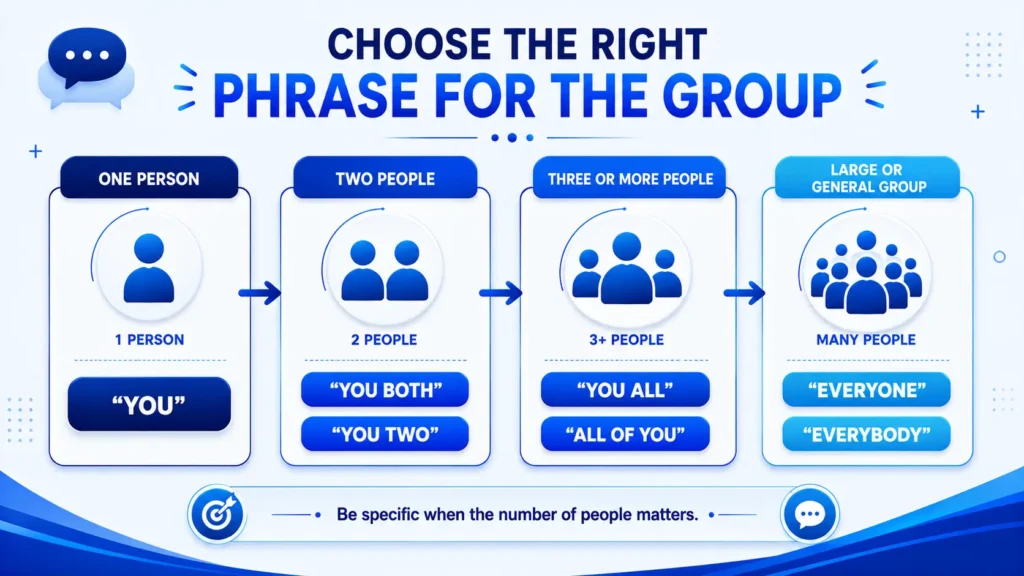
| Alternative | Best Used In | Tone |
| You all | Everyday conversations | Friendly, casual |
| Everyone | Most situations | Neutral, polite |
| All of you | Direct or emphasized communication | Warm, clear |
| Folks | Friendly conversations and announcements | Warm, approachable |
| Everyone here | Meetings and group settings | Polished, inclusive |
| The group | Workplace or organizational communication | Neutral, professional |
| Your team | Business and workplace settings | Professional, respectful |
| Team | Collaborative environments | Encouraging, friendly |
| All | Casual group communication | Warm, conversational |
| Everyone in the room | Meetings, events, and presentations | Formal, clear |
Common Mistakes
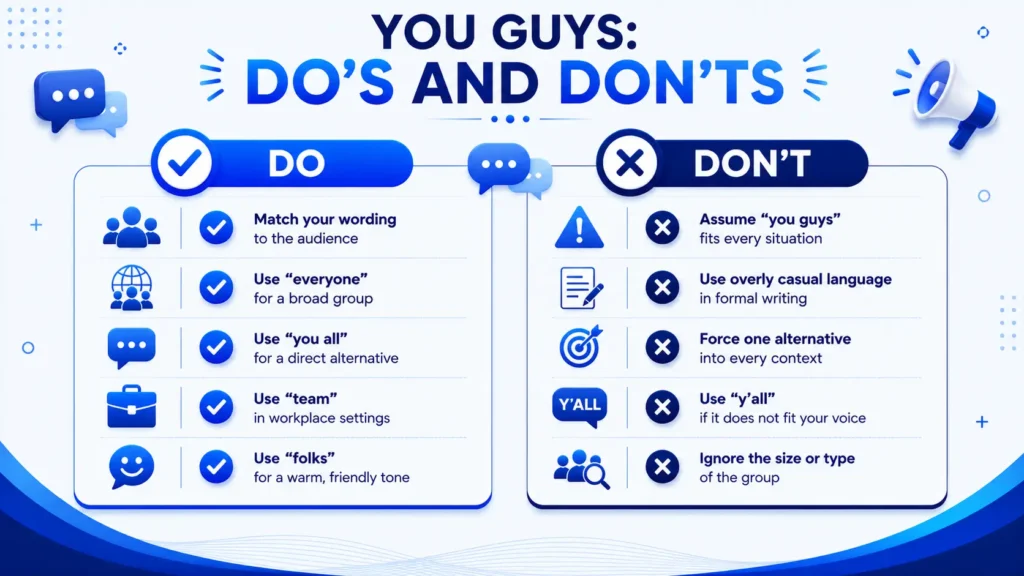
- Using casual phrases in professional emails
“You guys” may sound too informal in a formal business message. “Everyone,” “your team,” or “all of you” may fit better. - Choosing overly formal language
Not every conversation requires polished wording. Saying “everyone in attendance” to close friends can sound unnecessarily stiff. - Repeating the same phrase
Constantly using “you guys” can make your speech or writing feel repetitive. Switching naturally between “you all,” “everyone,” and other options adds variety. - Forgetting the context
“Team” makes sense when people share a common role, while “everyone” works more broadly. Choose an expression that accurately describes your audience. - Sounding insincere or unnatural
Avoid replacing “you guys” with an alternative simply because it sounds more formal. The best choice should feel natural for your relationship with the audience.
Frequently Asked Questions

What is a professional way to say “you guys”?
“Everyone,” “your team,” “all of you,” and “you all” can work professionally, depending on the context. “Everyone” is usually the safest choice because it sounds neutral and polished. In workplace communication, “your team” is useful when speaking specifically to colleagues or employees who work together.
What is a more inclusive way to say “you guys”?
“You all” and “everyone” are two strong inclusive alternatives. They address the entire group without using the word “guys.” “Everyone” is especially useful in professional or mixed-audience settings, while “you all” feels more conversational and personal.
Is “you guys” considered gender-neutral?
Many Americans use “you guys” as a gender-neutral way to address a group, regardless of gender. However, not everyone interprets it the same way. If you want wording that clearly includes every person, alternatives such as “everyone” or “you all” can be better choices.
What is another casual way to say “you guys”?
“You all,” “folks,” and “team” can all work in casual conversations. “You all” is the closest general substitute, while “folks” sounds friendly and “team” works naturally when the people share a common activity or goal.
Can I use “you all” in professional communication?
Yes. “You all” can sound perfectly natural in professional conversations, especially when speaking to a group. However, “everyone” may sound slightly more polished in formal emails, reports, presentations, or other business writing.
What is a polite way to address a group?
“Everyone” is one of the safest polite choices. You can also use “all of you,” “folks,” or “everyone here,” depending on the situation. The right option should match the formality of the conversation and your relationship with the audience.
Is “folks” a good replacement for “you guys”?
Yes, “folks” can be a warm and friendly replacement, particularly in American English. It is common in casual communication, community messages, customer interactions, and informal announcements. It may not be the best choice for highly formal documents or very traditional business writing.
What should I say instead of “you guys” in an email?
For most professional emails, “everyone,” “all of you,” or “your team” works well. For example, instead of “Can you guys send the files?” you could write, “Could everyone send the files?” The best option depends on whether you are addressing individuals, a team, or a larger group.
Conclusion
There are many natural alternatives to “you guys,” and the best choice depends on your audience, relationship, and setting. “You all” is an easy, conversational option, while “everyone” works across casual, professional, and formal situations. “Folks” adds warmth, and “all of you” is useful when you want to emphasize the entire group.
In workplace communication, “your team” or “everyone” can sound more polished. For meetings and presentations, “everyone here” provides a clear way to address the people present.
The key is not to avoid “you guys” at all costs. It is a common and natural American expression. Instead, choose the alternative that best matches the tone, audience, and purpose of your communication.