
Another way to say “you make a good point” includes “That’s a good point,” “I see what you mean,” “You’re right about that,” and “That’s a valid point.” The best choice depends on your tone and situation. For professional conversations, “That’s a valid point” sounds polished, while “You’re absolutely right” feels more direct and supportive.
Key Takeaways
- “That’s a good point” is natural, clear, and suitable for most conversations.
- “You’re right about that” directly shows agreement with someone’s idea.
- “I see what you mean” is useful when you understand another person’s reasoning.
- Professional settings often call for phrases such as “That’s a valid point.”
- Choose your wording based on the level of agreement, formality, and warmth you want to express.
What Does “Another Way to Say You Make a Good Point” Mean?
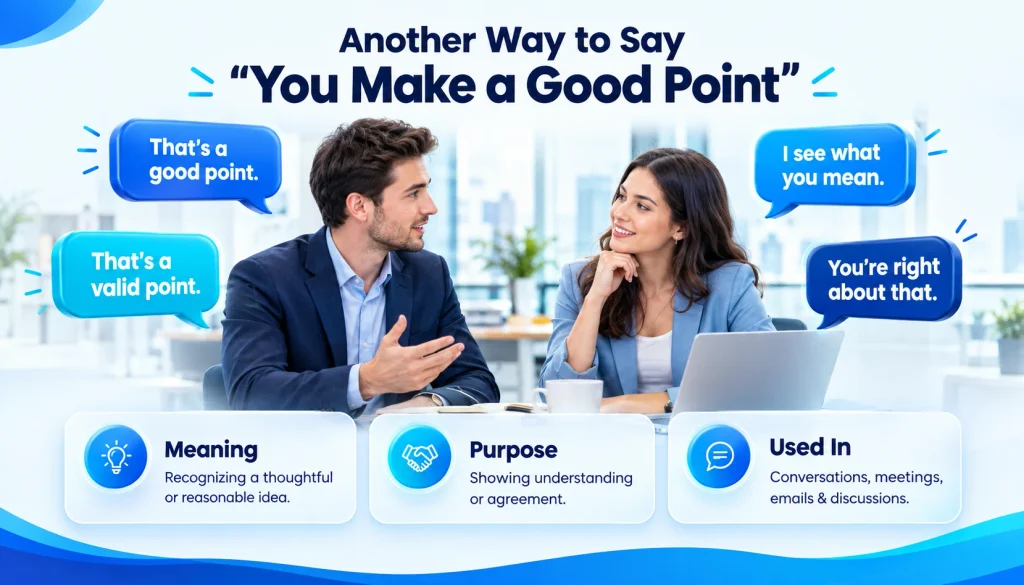
Looking for another way to say “you make a good point” usually means you want to show that someone has shared a reasonable, thoughtful, or convincing idea. The phrase communicates agreement or recognition without necessarily saying that you agree with everything the person believes.
You might use it during a conversation, meeting, debate, email, class discussion, or friendly exchange. Choosing a different phrase can also help you sound more natural and match the tone of the situation.
Why Use Other Ways to Say “You Make a Good Point”?
Using different expressions can make your communication sound more natural and precise. The best phrase depends on whether you want to show full agreement, acknowledge someone’s reasoning, or simply recognize the value of their idea.
Other options can help you:
- Avoid repeating the same expression.
- Show agreement in a natural way.
- Match professional or casual situations.
- Acknowledge another person’s reasoning.
- Make conversations feel more respectful and engaging.
- Express stronger or softer agreement when needed.
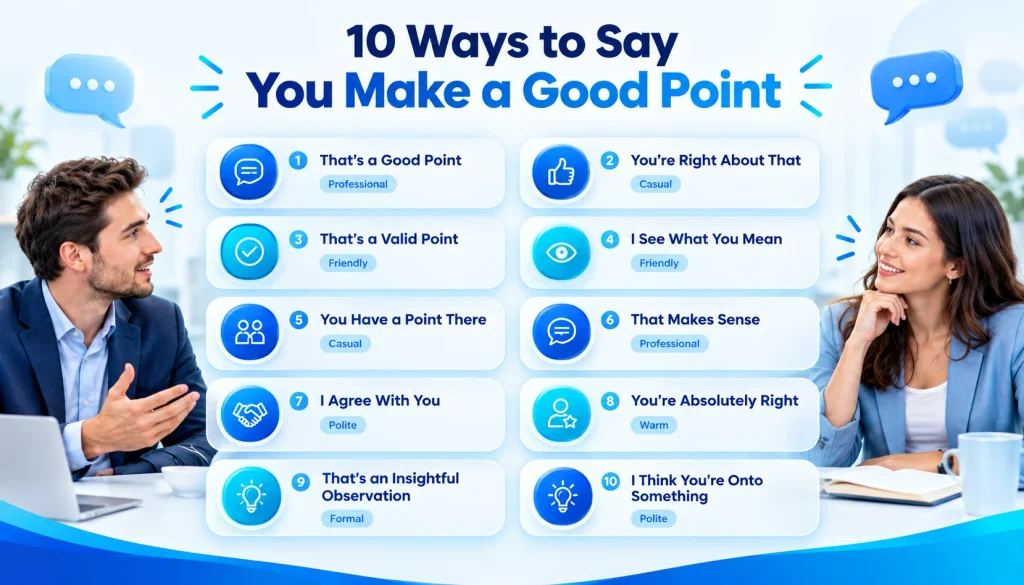
10 Best Other Ways to Say “You Make a Good Point”
1. That’s a Good Point
Meaning
“That’s a good point” is one of the closest and most natural alternatives to “you make a good point.” It shows that you recognize the value of what someone has just said.
The phrase is flexible and does not sound overly formal, making it useful in both personal and professional conversations.
Best For
- Professional
- Friendly
- Polite
- Casual
Example 1
“That’s a good point. We should consider the customer’s perspective before making a final decision.”
Example 2
“That’s a good point about the timing. Maybe we should wait until Monday.”
Quick Tip
Use this option when you want a safe, natural phrase that works in almost any situation.
2. You’re Right About That
Meaning
“You’re right about that” directly tells someone that you agree with a specific statement they made. It sounds sincere and conversational without being overly formal.
It works especially well when you want to confirm that someone has identified an important detail.
Best For
- Casual
- Friendly
- Polite
Example 1
“You’re right about that. The first version was much easier for new users to understand.”
Example 2
“You’re right about that; we probably should have checked the schedule first.”
Quick Tip
Use this phrase when you genuinely agree with the specific point being discussed.
3. That’s a Valid Point
Meaning
“That’s a valid point” recognizes that another person’s argument or observation is reasonable. It can show respect even when you are still considering whether you completely agree.
Because it sounds measured and thoughtful, it is especially useful in professional or structured discussions.
Best For
- Professional
- Formal
- Polite
Example 1
“That’s a valid point. We need to consider how the change could affect smaller teams.”
Example 2
“That’s a valid point, although we should also look at the long-term costs.”
Quick Tip
Choose this phrase when you want to acknowledge an argument without necessarily expressing complete agreement.
4. I See What You Mean
Meaning
“I see what you mean” tells someone that you understand the reasoning behind their comment. It does not always mean that you fully agree, which makes it useful when discussing different opinions.
The expression has a friendly and respectful tone.
Best For
- Friendly
- Casual
- Polite
Example 1
“I see what you mean. The shorter route does make more sense during rush hour.”
Example 2
“I see what you mean about the design. It could be easier for customers to navigate.”
Quick Tip
Use this when you want to show understanding before deciding whether you fully agree.
5. You Have a Point There
Meaning
“You have a point there” acknowledges that someone’s argument contains a reasonable idea or important detail. It sounds conversational and slightly more relaxed than “that’s a valid point.”
It is useful when a discussion has involved different opinions.
Best For
- Casual
- Friendly
- Polite
Example 1
“You have a point there. We haven’t considered what happens if demand increases.”
Example 2
“You have a point there; taking the train might actually be easier.”
Quick Tip
Use this expression in relaxed discussions when you want to recognize a strong part of someone’s argument.
6. That Makes Sense
Meaning
“That makes sense” shows that you understand why someone reached a particular conclusion. It can express agreement, understanding, or both.
The phrase is especially natural in everyday conversations, workplace discussions, and situations where someone is explaining their reasoning.
Best For
- Professional
- Casual
- Friendly
Example 1
“That makes sense. If most customers shop in the evening, we should adjust the support schedule.”
Example 2
“That makes sense. You wanted to finish the project before starting anything new.”
Quick Tip
Use this phrase when the person’s reasoning is clear and logical to you.
7. I Agree With You
Meaning
“I agree with you” is a direct way to show that you share someone’s opinion. Unlike softer expressions, it clearly communicates agreement rather than simply acknowledging an idea.
It is useful when you want to remove uncertainty about your position.
Best For
- Professional
- Formal
- Friendly
- Polite
Example 1
“I agree with you. The proposal needs more detail before we present it to the client.”
Example 2
“I agree with you about the importance of keeping the instructions simple.”
Quick Tip
Use this phrase when you want your agreement to be clear and unmistakable.
8. You’re Absolutely Right
Meaning
“You’re absolutely right” expresses strong agreement with another person. It has more emphasis than simply saying “you’re right” and can sound supportive or enthusiastic.
Because it communicates firm agreement, use it when you genuinely feel strongly about the point being made.
Best For
- Friendly
- Warm
- Polite
- Casual
Example 1
“You’re absolutely right. We should focus on solving the main issue first.”
Example 2
“You’re absolutely right about the neighborhood. It has changed a lot over the past few years.”
Quick Tip
Save this stronger expression for situations where you want to show clear and confident agreement.
9. That’s an Insightful Observation
Meaning
“That’s an insightful observation” compliments someone for noticing something thoughtful, important, or less obvious. It sounds more polished than everyday alternatives.
This expression works well when someone has offered a thoughtful analysis rather than simply stated an opinion.
Best For
- Professional
- Formal
- Polite
Example 1
“That’s an insightful observation. The survey results do suggest a different trend among younger customers.”
Example 2
“That’s an insightful observation about the team’s communication style.”
Quick Tip
Use this option when you want to praise the thoughtfulness behind someone’s observation.
10. I Think You’re Onto Something
Meaning
“I think you’re onto something” suggests that someone has discovered a promising idea or direction. It expresses positive interest without claiming that the idea has been completely proven.
The phrase is conversational and often encourages someone to explore their idea further.
Best For
- Casual
- Friendly
- Warm
Example 1
“I think you’re onto something. Maybe the simpler layout would work better.”
Example 2
“I think you’re onto something with that marketing idea.”
Quick Tip
Use this phrase when someone presents an interesting idea that deserves further thought or development.
Comparison Table

| Alternative | Best Used In | Tone |
|---|---|---|
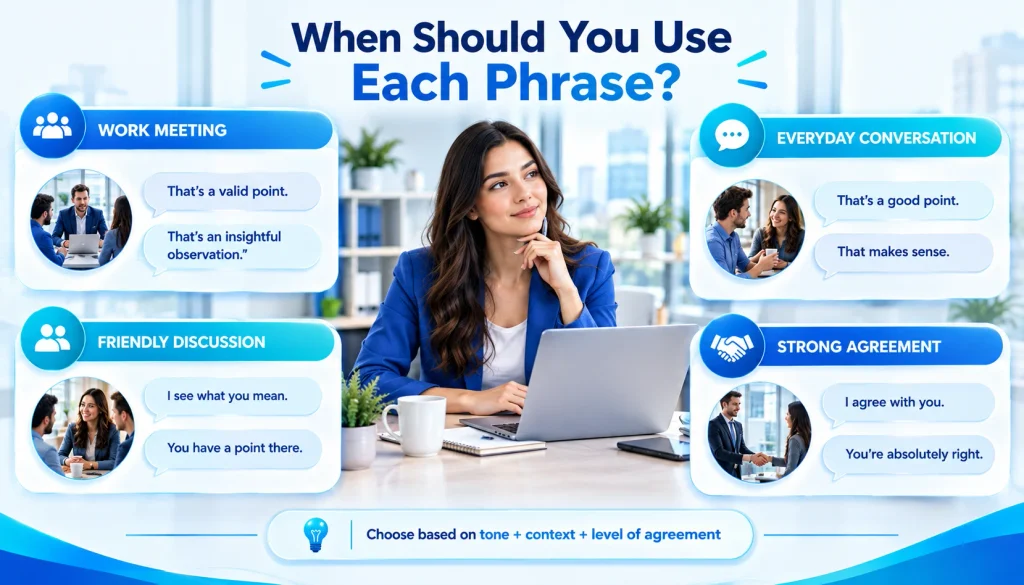
| That’s a Good Point | Everyday and professional conversations | Natural |
| You’re Right About That | Friendly discussions | Direct |
| That’s a Valid Point | Meetings and formal discussions | Professional |
| I See What You Mean | Conversations and discussions | Understanding |
| You Have a Point There | Informal discussions | Conversational |
| That Makes Sense | Explanations and everyday talk | Agreeable |
| I Agree With You | Professional and personal conversations | Direct |
| You’re Absolutely Right | Supportive conversations | Strong |
| That’s an Insightful Observation | Professional or academic settings | Thoughtful |
| I Think You’re Onto Something | Brainstorming and casual discussions | Encouraging |
Common Mistakes
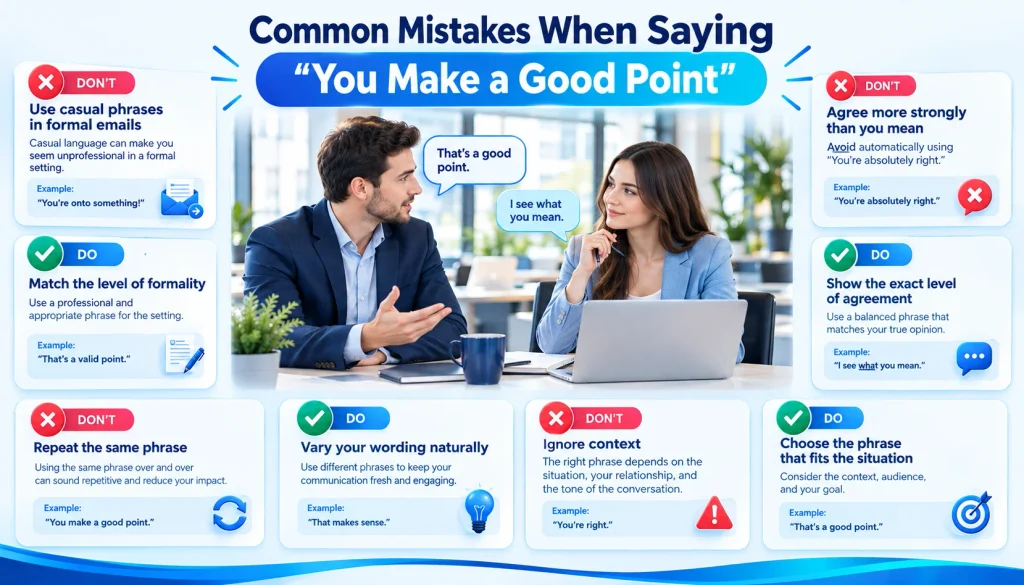
- Using casual phrases in professional emails
Expressions such as “You’re onto something” can sound too relaxed in a formal business message. Choose “That’s a valid point” when a more polished tone is appropriate. - Showing stronger agreement than you intend
“You’re absolutely right” communicates strong agreement. If you only want to acknowledge someone’s reasoning, “I see what you mean” may be more accurate. - Choosing overly formal language
Saying “That’s an insightful observation” in every casual conversation can sound unnatural. Match the phrase to the relationship and setting. - Ignoring the context
Some expressions acknowledge an idea without showing complete agreement. Consider whether you want to recognize, support, or fully agree with the person’s point. - Sounding insincere
Avoid automatically agreeing just to be polite. Your wording should reflect what you actually think about the person’s idea.
Frequently Asked Questions
What is another way to say “you make a good point”?
Common alternatives include “That’s a good point,” “That’s a valid point,” “You’re right about that,” “I see what you mean,” and “That makes sense.” The best choice depends on how strongly you agree and whether you are speaking casually or in a professional setting.
What is a professional way to say “you make a good point”?
“That’s a valid point” is a strong professional option because it acknowledges someone’s reasoning without sounding overly casual. “That’s an insightful observation” can also work when the person has identified something thoughtful or important during a meeting, presentation, or formal discussion.
How do you politely agree with someone?
You can politely agree by saying “That’s a good point,” “I agree with you,” or “That’s a valid point.” If you want to sound less direct, “I see what you mean” can acknowledge the person’s reasoning without suggesting that you completely agree with every part of their argument.
Is “you’re right about that” professional?
Yes, “you’re right about that” can be used professionally, especially in a conversation or meeting. However, it has a more conversational tone than “that’s a valid point.” For formal emails or reports, the latter may sound more polished and measured.
What can I say instead of “good point” in an argument?
In a discussion or argument, you can say “That’s a valid point,” “I see what you mean,” or “You have a point there.” These phrases let you recognize a reasonable part of another person’s argument without necessarily saying that you agree with their entire position.
Does “I see what you mean” mean I agree?
Not necessarily. “I see what you mean” primarily means that you understand another person’s reasoning. You may use it even when you are not fully convinced. If you want to clearly communicate agreement, “I agree with you” is more direct.
What is a warm way to say someone makes a good point?
“You’re absolutely right” is a warm and supportive option when you strongly agree. “I think you’re onto something” is another friendly choice, especially when someone has shared a promising idea and you want to encourage them to explore it further.
What is a formal alternative to “you make a good point”?
“That’s a valid point” is a concise formal alternative. In academic or professional settings, “That’s an insightful observation” can also work when you want to recognize the thoughtfulness or significance of someone’s comment rather than simply agreeing with it.
Conclusion
There are many natural ways to say “you make a good point,” and the best choice depends on your meaning and situation. “That’s a good point” is the most flexible option for everyday communication, while “that’s a valid point” works well in professional or formal discussions.
If you want to clearly show agreement, try “I agree with you” or “you’re absolutely right.” When you want to acknowledge someone’s reasoning without fully agreeing, “I see what you mean” is a better fit. For thoughtful comments, “that’s an insightful observation” adds a more polished touch.
The key is to match the phrase to your tone, relationship, and level of agreement. Choosing the right level of formality can also help you communicate more naturally and appropriately in different situations. Choose the expression that sounds natural for the conversation and accurately reflects what you mean.

The Majestic Studio Editorial Team creates practical resources about synonyms, alternative phrases, vocabulary, and English usage. Our content is designed to help readers choose clearer, more natural words and communicate effectively in everyday, professional, and academic contexts.
Each article is researched, edited, and reviewed for clarity, context, usefulness, and language accuracy. We regularly update our content to keep examples and recommendations relevant.