

Another way to say family includes relatives, loved ones, household, kin, family members, and loved ones at home. The best alternative depends on your meaning and tone. Use “relatives” for people related to you, “loved ones” for a warm, emotional message, and “household” when referring to people who live together.
Key Takeaways
- Relatives works well when referring to people connected through blood or marriage.
- Loved ones expresses affection and includes people who feel like family.
- Household describes people living together in one home.
- Kin offers a traditional or literary alternative to family.
- Choose a phrase that reflects your relationship, audience, and situation.
Family is one of the most meaningful words in everyday English. It can describe relatives, people who share a home, or those who offer love, care, and support.
However, repeating the word “family” can make writing sound less natural. Finding another way to say family helps you express your thoughts more clearly, whether you’re writing a greeting card, a social media caption, a professional message, or a personal letter.
Below are 15 alternatives, along with their meanings, examples, and tips to help you choose the right phrase.
What Does “Another Way to Say Family” Mean?

The phrase “another way to say family” refers to alternative words or expressions that communicate the idea of family while adding a different meaning or tone.
For example, “relatives” focuses on relationships through blood or marriage, while “loved ones” highlights emotional bonds. “Household” refers to people living in the same home, and “kin” is a traditional word for relatives.
People look for family synonyms to avoid repetition, improve their writing, express affection, or describe different kinds of relationships. These alternatives appear in personal conversations, workplace communication, creative writing, invitations, and social media posts.
Why Use Other Ways to Say Family?
Using different words for family makes your communication more precise and engaging. The right expression can show whether you’re talking about relatives, people who live together, or those who provide emotional support.
Consider using alternatives to:
- Avoid repeating the same word in an article or conversation.
- Make personal messages sound warmer and more meaningful.
- Choose language that fits formal or casual situations.
- Describe close relationships beyond biological connections.
- Improve clarity in professional writing and everyday communication.
The key is to choose a synonym that matches your intended meaning. Not every alternative to family works in every situation.
15 Best Other Ways to Say Family

1. Relatives
Meaning
Relatives are people connected to you through blood, marriage, or legal family relationships. This term is useful when you want to identify family connections without suggesting that everyone shares the same household or emotional closeness.
Best For: Professional, Formal, Polite
Example 1: Several relatives traveled from different states to attend the wedding.
Example 2: She invited her closest relatives to celebrate her graduation.
Quick Tip: Use “relatives” when discussing extended family, such as cousins, aunts, uncles, and in-laws.
2. Loved Ones
Meaning
Loved ones are people who hold an important place in your life. They often include family members, romantic partners, and close friends who provide love, care, and emotional support.
Best For: Warm, Friendly, Polite
Example 1: Spending the holidays with loved ones makes the season feel special.
Example 2: He asked his loved ones to keep him in their thoughts during surgery.
Quick Tip: Choose “loved ones” for emotional messages, sympathy notes, holiday greetings, and heartfelt social media captions.
3. Household
Meaning
A household consists of the people who live together in a home. They may be related, but they do not have to be. This word is especially useful when discussing living arrangements, budgets, expenses, or home responsibilities.
Best For: Professional, Formal
Example 1: Our household follows a monthly budget to manage expenses.
Example 2: Every household has different routines and responsibilities.
Quick Tip: Use “household” when the living arrangement matters more than the relationship between the people.
4. Kin
Meaning
Kin is a traditional term for relatives or people connected through family relationships. It often appears in literature, storytelling, cultural discussions, and expressions about ancestry or belonging.
Best For: Formal, Warm
Example 1: After years abroad, he returned to his hometown to reconnect with his kin.
Example 2: The old farmhouse had belonged to her kin for generations.
Quick Tip: Use “kin” when you want a traditional or literary tone. In everyday American conversation, “relatives” is usually more common.
5. Family Members
Meaning
“Family members” is a direct and clear expression for the individuals who belong to a family. It works in both formal and casual writing and helps identify people individually rather than treating a family as one group.
Best For: Professional, Formal, Polite
Example 1: All family members are welcome to attend the school celebration.
Example 2: The doctor explained the care plan to the patient’s family members.
Quick Tip: Choose this phrase when clarity matters, especially in announcements, reports, and official communication.
6. Loved Ones at Home
Meaning
This phrase emphasizes the people who share your home or provide a sense of comfort and belonging. It is more descriptive than “family” and can create a personal, welcoming tone.
Best For: Warm, Friendly, Casual
Example 1: She looked forward to returning home to her loved ones at home.
Example 2: A quiet dinner with the people who make home special was all he wanted.
Quick Tip: Avoid using this phrase when you need a short, precise synonym. A simpler expression such as “loved ones” may sound more natural.
7. Immediate Family
Meaning
Immediate family usually refers to a person’s closest family relationships, such as parents, children, and siblings. Depending on the context, spouses or partners may also be included. The exact definition can vary by organization or situation.
Best For: Professional, Formal, Polite
Example 1: The company allows employees to take leave after the loss of an immediate family member.
Example 2: Only immediate family attended the small ceremony.
Quick Tip: Check the relevant policy or context before using this term in legal, workplace, or insurance documents.
8. Extended Family
Meaning
Extended family refers to relatives beyond the immediate family, including grandparents, cousins, aunts, uncles, and other relatives. The phrase is helpful when describing larger family gatherings or relationships across generations.
Best For: Friendly, Warm, Formal
Example 1: Our extended family meets every summer for a weekend reunion.
Example 2: Her extended family helped organize the anniversary celebration.
Quick Tip: Use “extended family” when you want to emphasize a wider network of relatives rather than parents, children, or siblings alone.
9. Clan
Meaning
A clan is a group of people connected through ancestry, shared identity, or a recognized social tradition. It may refer to an extended family group, but it can also describe a cultural or historical community.
Best For: Casual, Warm
Example 1: The entire clan gathered at the lake for their annual summer picnic.
Example 2: Stories about the clan’s early years were passed down through generations.
Quick Tip: Use “clan” for an informal or historical feel. Be aware that it can carry specific cultural meanings in some contexts.
10. The People Closest to You
Meaning
This expression describes the people with whom you share strong personal connections. It can include relatives, friends, partners, or other trusted people, making it useful when family relationships are defined by care rather than biology.
Best For: Warm, Friendly, Polite
Example 1: The people closest to you can offer comfort when life becomes difficult.
Example 2: She wanted to share the good news with the people closest to her first.
Quick Tip: Use this phrase when you want to emphasize trust and emotional closeness rather than legal or biological relationships.
11. Support System
Meaning
A support system is a group of people who provide practical help, emotional encouragement, or guidance. Family members may be part of it, but friends, mentors, neighbors, and community members can also play this role.
Best For: Professional, Warm, Polite
Example 1: His support system encouraged him throughout his career change.
Example 2: Building a reliable support system helped her adjust to life in a new city.
Quick Tip: Choose “support system” when discussing the help people provide, not simply their relationship to you.
12. Circle of Loved Ones
Meaning
A circle of loved ones is a close group of people who care deeply about one another. It emphasizes connection, trust, and emotional belonging without limiting the group to biological relatives.
Best For: Warm, Friendly, Polite
Example 1: She celebrated her birthday with a small circle of loved ones.
Example 2: His circle of loved ones stood beside him during a challenging year.
Quick Tip: This expression works well in heartfelt writing, but “loved ones” alone is usually more concise.
13. Ancestral Line
Meaning
An ancestral line refers to the generations of people from whom someone descends. It focuses on heritage and lineage rather than everyone currently considered part of a family.
Best For: Formal
Example 1: The historian traced the family’s ancestral line back several centuries.
Example 2: The family records helped researchers document her ancestral line.
Quick Tip: Use this phrase when discussing genealogy, family history, or ancestry. It is not a general substitute for family in everyday conversation.
14. The People You Call Family
Meaning
This expression describes the people you consider family, whether or not you share a biological or legal relationship. It highlights the personal meaning of belonging and recognizes chosen family and close friendships.
Best For: Warm, Friendly, Casual
Example 1: The people you call family are often the ones who show up when you need them.
Example 2: They welcomed their longtime friends as the people they called family.
Quick Tip: Use this expression when writing about chosen family, lifelong friendships, or relationships built through care and commitment.
15. Household Members
Meaning
Household members are the people who live in a particular home. The term can include relatives, roommates, partners, or other residents, so it is more specific about shared living arrangements than emotional or biological connections.
Best For: Professional, Formal
Example 1: Each household member has a role in keeping the shared spaces clean.
Example 2: The application asks applicants to list all household members.
Quick Tip: Choose “household members” for forms, housing documents, surveys, and discussions about shared living arrangements.
Comparison Table
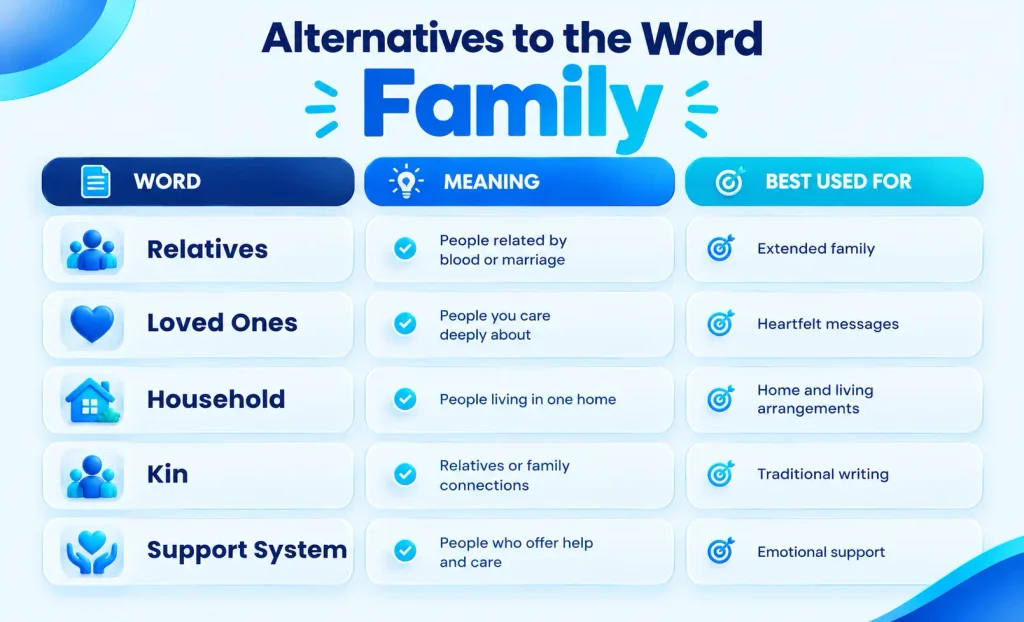
| Alternative | Best Used In | Tone |
|---|---|---|
| Relatives | Discussions about extended relations | Neutral |
| Loved Ones | Cards, personal messages | Warm |
| Household | Budgets, home arrangements | Formal |
| Kin | Literature, heritage | Traditional |
| Family Members | Reports, announcements | Neutral |
| Loved Ones at Home | Personal reflections | Warm |
| Immediate Family | Workplace policies, personal events | Formal |
| Extended Family | Reunions, family gatherings | Friendly |
| Clan | Informal storytelling, heritage | Casual |
| The People Closest to You | Emotional writing | Warm |
| Support System | Personal growth, encouragement | Supportive |
| Circle of Loved Ones | Celebrations, heartfelt writing | Warm |
| Ancestral Line | Genealogy, family history | Formal |
| The People You Call Family | Chosen family, friendships | Personal |
| Household Members | Forms, housing documents | Formal |
Common Mistakes When Choosing a Family Synonym

1. Using “Household” When You Mean Relatives
A household includes people who live together, even if they are unrelated. If you mean cousins, grandparents, or other relatives who live elsewhere, “relatives” is usually more accurate.
2. Using Casual Language in Professional Writing
Words such as “clan” may sound friendly in a personal message but unusual in a workplace report. Choose neutral expressions such as “family members” when writing professionally.
3. Treating Every Alternative as an Exact Synonym
“Support system” describes people who provide help, while “ancestral line” describes generations of ancestors. Neither means exactly the same thing as family in every context.
4. Choosing Overly Formal Language
Using terms such as “kin” or “ancestral line” in a simple greeting can make your writing sound unnatural. Match your vocabulary to the situation and your audience.
5. Forgetting Emotional Context
A message about grief, gratitude, or love needs language that feels sincere. “Loved ones” may communicate warmth more effectively than a neutral term such as “household members.”
Frequently Asked Questions
1. What is another word for family?
Common alternatives include relatives, loved ones, kin, household, and family members. Each has a slightly different meaning. “Relatives” emphasizes family connections, “loved ones” expresses affection, and “household” describes people who live together. Choose the word that best matches your intended meaning.
2. What is a more professional way to say family?
“Family members,” “immediate family,” and “household members” are useful professional alternatives. For example, a workplace policy might refer to immediate family, while a housing application might ask for household members. The best choice depends on whether you mean relationships, a specific family group, or shared residence.
3. What is a fancy word for family?
“Kin” is a traditional alternative, while “clan” can describe a larger group connected through ancestry. “Lineage” and “ancestry” relate to family history rather than a family as a whole. For polished writing, choose a term that fits the meaning instead of selecting a sophisticated word simply because it sounds impressive.
4. What is another way to say family and friends?
You can say “loved ones,” “the people closest to you,” or “your support system.” These expressions can include relatives and friends who play important roles in your life. “Loved ones” is particularly useful for invitations, personal messages, and announcements when you want a warm, inclusive tone.
5. What is a synonym for family that includes close friends?
“The people you call family” is a natural expression for relatives and close friends who share a strong bond. “Chosen family” is another option, especially when people intentionally build family-like relationships outside their biological or legal family. Both expressions emphasize belonging, trust, and emotional connection.
6. What is a short word for family?
“Kin” is a short alternative that refers to relatives. “Fam” is an informal slang term used in casual conversation and online messages. For example, someone might write, “Spending the weekend with my fam.” Use “fam” with friends or on social media rather than in formal communication.
7. How can I say family in a heartfelt way?
Expressions such as “loved ones,” “the people closest to my heart,” and “the people I call family” can make your message more personal. For example, “I’m grateful for the people I call family” communicates appreciation without sounding overly formal. Choose wording that reflects your genuine relationship with the people involved.
8. What is the difference between family, relatives, and household?
“Family” is the broadest term and can describe biological, legal, or chosen relationships. “Relatives” usually means people connected through blood or marriage, while “household” refers to people living together. These groups can overlap, but they are not identical. Someone’s relatives may live elsewhere, and roommates may share a household without being family.
Conclusion

Choosing another way to say family helps you communicate with greater clarity, warmth, and variety. The best alternative depends on the relationship you want to describe and the message you want to convey.
Use “relatives” when discussing people connected through blood or marriage, “loved ones” for heartfelt messages, and “household” when referring to people living under the same roof. For professional communication, “family members” and “immediate family” often provide a clear, appropriate choice.
If you are writing about close friends who feel like family, expressions such as “the people you call family” can communicate that bond naturally. Meanwhile, “kin” and “clan” may suit heritage-focused writing or storytelling.
Ultimately, there is no single synonym that works in every situation. Think about your audience, tone, and intended meaning before choosing a phrase. The right words will make your writing sound more natural and help your message feel more personal and meaningful.

The Majestic Studio Editorial Team creates practical resources about synonyms, alternative phrases, vocabulary, and English usage. Our content is designed to help readers choose clearer, more natural words and communicate effectively in everyday, professional, and academic contexts.
Each article is researched, edited, and reviewed for clarity, context, usefulness, and language accuracy. We regularly update our content to keep examples and recommendations relevant.